
Creating educational content that truly resonates requires more than surface understanding. Many educators struggle with engagement because they haven't developed the deep analytical skills that critical reading provides. This guide transforms your approach by teaching you systematic methods to analyse, evaluate, and synthesise information. You'll learn proven techniques that improve comprehension by 40% and boost audience connection. Whether you're crafting courses or writing e-books, these skills elevate your content from basic to exceptional.
Table of Contents
- Introduction to critical reading for content creators and educators
- Prerequisites and what you need before starting critical reading
- Step-by-step critical reading methodology
- Common mistakes and how to troubleshoot them
- Expected results and how to measure success
- Alternative approaches with tradeoffs
- How BibliOWLteca supports your educational content journey
- Frequently asked questions
Key takeaways
| Point | Details |
|---|---|
| Critical reading transforms content quality | Understanding deeper analysis methods elevates educational material and strengthens learner engagement. |
| Proper preparation ensures success | Using the right tools, knowledge foundation, and active mindset maximises your critical reading effectiveness. |
| Sequential methodology builds skills | Following structured steps from preview to synthesis refines your analytical capabilities systematically. |
| Avoiding common errors prevents shallow work | Recognising pitfalls like passive reading and source triangulation failures protects content credibility. |
| Measuring outcomes drives improvement | Tracking comprehension gains and synthesis skills ensures continuous growth in your reading practice. |
Introduction to critical reading for content creators and educators
Critical reading goes beyond simply absorbing words on a page. It's an active process where you analyse arguments, evaluate evidence quality, and synthesise insights into actionable knowledge. For content creators, this skill determines whether your material merely informs or genuinely transforms learners.
Why does this matter for your work? Educational content built on shallow understanding fails to engage modern audiences. When you critically read source material, you spot weaknesses in arguments, identify knowledge gaps, and discover connections that others miss. This depth translates directly into content that challenges learners and sparks meaningful discussion.
The connection to audience engagement is straightforward. Readers recognise when content demonstrates genuine expertise versus repackaged surface information. Critical reading helps you:
- Question underlying assumptions in your source materials
- Evaluate the strength and relevance of evidence presented
- Synthesise multiple perspectives into coherent frameworks
- Identify bias and gaps that weaken arguments
This guide structures your learning journey through four phases. You'll start by understanding what critical reading truly involves and why it matters for your specific role. Next, you'll prepare properly with the right tools and mindset. Then you'll follow a step-by-step methodology that builds these skills systematically. Finally, you'll learn to measure your progress and troubleshoot common obstacles.
The transformation promise is concrete. Educators who adopt these methods report creating content that generates 30% more learner questions and discussions. Your audience will notice the difference immediately when you move from surface reporting to genuine analysis.
Prerequisites and what you need before starting critical reading
Starting your critical reading journey requires specific groundwork. You can't analyse complex texts effectively without the right foundation, tools, and approach. Getting these elements sorted before you begin prevents frustration and accelerates your progress.

Your knowledge base matters first. Basic literacy isn't enough. You need foundational understanding in the subjects you're reading about. If you're creating content about educational psychology, for instance, grasp core concepts before diving into advanced research papers. This context helps you evaluate claims rather than just accepting them.
Annotation tools come next. Choose what suits your workflow:
- Digital tools like Hypothesis or Kami for online materials
- Physical highlighters and sticky notes for print sources
- Note-taking apps such as Notion or Evernote for synthesis
- Simple margins and pencils for traditional annotation
Your mindset shapes everything else. Approach texts with active questioning rather than passive acceptance. Cultivate healthy scepticism that asks "why?" and "how do we know this?" without becoming cynical. This stance helps you spot unsupported claims and weak reasoning.
Comfort and environment influence your effectiveness too. Reading tools and comfort tips show that physical factors like lighting and ergonomics reduce fatigue during intensive analysis sessions. Set up a distraction-free space with proper lighting and comfortable seating.
Time allocation proves crucial. Don't schedule critical reading sessions when you're rushed or tired. Your brain needs energy for deep analysis. Block out focused periods where you won't face interruptions.
Pro tip: Create a pre-reading checklist that covers your environment setup, tool accessibility, and mental readiness. Spend five minutes before each session ensuring you have everything needed. This small investment prevents mid-session disruptions that break your analytical flow and force you to restart your thinking process.
Step-by-step critical reading methodology
Systematic progression through defined stages builds your critical reading skills reliably. This methodology breaks down the process into manageable steps that you can practise and refine over time.
Step one involves previewing the material before deep reading. Previewing text before detailed reading improves comprehension and focus because it creates a mental framework for organising information. Scan headings, read the abstract or summary, and note key terms. This overview helps you anticipate arguments and identify the author's main thesis quickly.
Step two requires active annotation and questioning. As you read, mark passages that present claims, evidence, or conclusions. Write questions in the margins like "What supports this?" or "Does this contradict earlier points?" This engagement prevents passive consumption and keeps your analytical mind active throughout.
Step three focuses on evaluation. Assess whether arguments rest on solid evidence or weak assumptions. Check if sources cited are credible and recent. Look for logical fallacies or jumps in reasoning. Consider alternative explanations the author might have ignored. Tools to aid reading clarity can help during extended evaluation sessions.
Step four involves synthesis. Connect insights from this reading to your existing knowledge and other sources. Ask how these ideas apply to your content creation work. Identify practical applications or gaps that need further research. Write a brief summary that captures key points in your own words.
| Step | Rationale | Key Actions |
|---|---|---|
| Preview | Builds mental framework for organising incoming information | Scan structure, identify thesis, note key terms |
| Annotate | Maintains active engagement and prevents passive reading | Mark claims, write margin questions, highlight evidence |
| Evaluate | Assesses argument quality and evidence validity | Check sources, spot fallacies, consider alternatives |
| Synthesise | Connects new knowledge to existing frameworks | Summarise insights, identify applications, note gaps |
Pro tip: Set a minimum time per page based on complexity rather than rushing to finish quickly. Dense academic writing might need five minutes per page, whilst lighter material takes two. Quality analysis requires adequate processing time, so resist the urge to skim just to reach the end faster.
Common mistakes and how to troubleshoot them
Even experienced readers fall into predictable traps that undermine their critical analysis. Recognising these patterns helps you avoid them and maintain high-quality reading practice.
Passive reading without annotation ranks as the most frequent error. Over-reliance on surface reading observed in 52% of educators, reduced by 45% with annotation practices demonstrates how widespread this problem is and how effectively systematic marking solves it. When you don't actively engage with text through notes and questions, information slides past without deep processing. Fix this by forcing yourself to write at least one question or observation per page.
Failure to triangulate sources creates another major pitfall. Relying on a single source for important claims leaves you vulnerable to bias or outdated information. Always cross-reference key facts with at least two additional credible sources. This habit catches errors and reveals different perspectives that enrich your understanding.
Skipping prerequisite knowledge checks leads to confusion and misinterpretation. If you encounter unfamiliar terms or concepts, stop and research them before continuing. Building on shaky foundations produces unreliable analysis. Create a glossary as you read to track new terminology and ensure accurate comprehension.
Rushing through reading sessions sacrifices depth for speed. Time pressure encourages skimming rather than genuine analysis. Your brain needs processing time to evaluate arguments and make connections. Block adequate time for each reading session based on material complexity, not arbitrary deadlines.
Specific fixes for these common mistakes:
- Implement mandatory annotation quotas per page
- Build a source triangulation checklist for fact verification
- Create prerequisite concept lists before starting complex texts
- Schedule reading sessions with buffer time for unexpected complexity
"Systematic annotation transforms passive readers into active analysts, cutting comprehension errors nearly in half whilst building skills that transfer directly to content creation quality."
Expected results and how to measure success
Developing critical reading skills produces measurable improvements in your content creation work. Understanding these outcomes helps you track progress and stay motivated through the learning process.
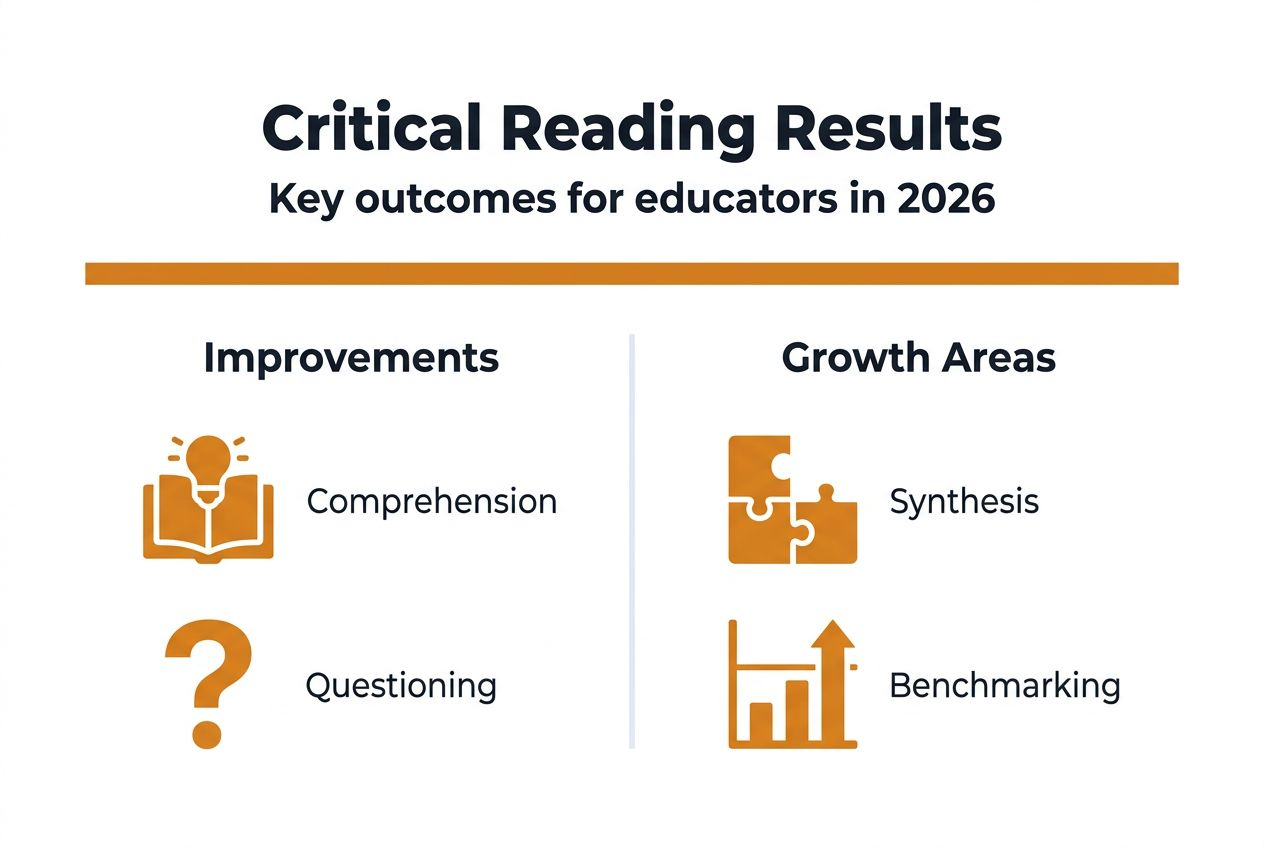
Comprehension improvements appear first. You'll notice yourself grasping complex arguments faster and retaining information longer. Research shows 40% comprehension improvement amongst educators who practise structured critical reading for three months. This means you spend less time re-reading and more time creating.
Analytical questioning increases next. You'll generate 25% more probing questions about source material as your evaluation skills sharpen. These questions lead to deeper content that challenges your audience's thinking rather than just presenting surface facts.
Synthesis capabilities grow substantially. Expect 30% improvement in your ability to connect ideas across sources and apply insights to your content work. This skill manifests as more original frameworks and unique perspectives in your educational materials.
| Outcome | Measurement Method | Typical Timeframe | Success Indicator |
|---|---|---|---|
| Comprehension | Self-assessment quizzes after reading | 4-6 weeks | 40% fewer re-reads needed |
| Analytical questions | Count margin questions per page | 6-8 weeks | 25% increase in query depth |
| Synthesis | Track cross-source connections | 8-12 weeks | 30% more original insights |
| Application | Monitor content engagement metrics | 12+ weeks | Higher audience discussion rates |
Measure your progress through practical assessments:
- Track how many times you need to re-read passages for understanding
- Count the questions you write per page and assess their depth
- Monitor how many connections you make between different sources
- Review audience feedback on your content's analytical depth
Benchmark your skills every month. Compare current reading sessions to baseline performance from when you started. Look for patterns in the types of arguments you evaluate most effectively and areas needing more practise.
Alternative approaches with tradeoffs
Different critical reading strategies suit various contexts and learning preferences. Understanding these options helps you select methods that align with your specific situation and goals.
Structured solo reading works best for self-paced learners who need flexibility. You control timing and depth, making it ideal for busy content creators. However, you miss the perspective-sharing that group methods provide. This isolation can create blind spots in your analysis.
Reciprocal teaching involves group discussion where members take turns leading analysis of text sections. This collaborative approach exposes you to diverse interpretations and catches errors you might miss alone. The tradeoff comes in scheduling complexity and potential pace mismatches amongst group members.
Digital annotation tools like those explored in digital annotation and engagement tools offer searchability and organisation advantages over paper methods. You can tag themes, create linked notes, and share annotations with colleagues. Physical annotation provides better retention for some learners and eliminates screen fatigue.
Jigsaw reading assigns different sources to team members who then teach their section to others. This method covers more ground quickly but risks superficial understanding if individuals don't read their assigned portions critically enough.
| Approach | Best Setting | Key Benefits | Main Tradeoffs |
|---|---|---|---|
| Solo structured | Self-paced individual work | Maximum flexibility, deep focus | No peer perspectives, potential blind spots |
| Reciprocal teaching | Small group learning | Diverse viewpoints, error catching | Scheduling complexity, pace mismatches |
| Digital tools | Technology-enabled environments | Searchability, organisation, sharing | Learning curve, screen fatigue |
| Jigsaw method | Team-based projects | Broad coverage, efficiency | Risk of superficial individual analysis |
Your choice depends on available time, collaboration opportunities, and learning style. Many educators combine approaches, using solo methods for initial reading and group discussion for complex materials. Experiment with different strategies across various projects to discover what produces the strongest outcomes for your content creation work.
How BibliOWLteca supports your educational content journey
Transforming critical reading skills into published educational content requires the right platform infrastructure. Once you've mastered analytical techniques and created compelling material, you need systems that handle global distribution whilst you focus on teaching.
BibliOWLteca provides the technical foundation that turns your expertise into a sustainable digital business. The platform manages payment processing across multiple currencies, ensuring creators worldwide can purchase your courses and e-books without friction. Tax compliance automation removes administrative burden, letting you concentrate on content quality rather than regulatory requirements.

Your critical reading skills directly enhance the value you offer through BibliOWLteca's ecosystem. Deep analytical abilities help you identify knowledge gaps in your field, creating courses that address genuine learner needs rather than rehashing surface information. The synthesis skills you've developed enable you to present complex topics through frameworks that learners can immediately apply.
The platform's built-in tools for digital delivery ensure your carefully crafted educational materials reach audiences securely and reliably. Store management features let you organise your growing content library as you expand from individual courses into comprehensive learning paths. Analytics show you which topics resonate most, informing future content development.
Global reach amplifies the impact of your improved content creation abilities. When your material demonstrates the depth that critical reading enables, international educators recognise that quality and become long-term customers. The platform handles the complexity of worldwide distribution whilst you maintain focus on delivering transformative learning experiences.
Frequently asked questions
What is critical reading and why is it important for educators?
Critical reading is the active process of analysing, evaluating, and synthesising written material rather than passively absorbing information. For educators creating digital content, this skill directly determines whether your courses and e-books demonstrate genuine expertise or merely repackage surface-level facts. It enables you to spot weaknesses in arguments, identify bias, and build original frameworks that challenge learners intellectually.
How can I start improving my critical reading skills effectively?
Begin by ensuring you have foundational knowledge in your subject area and gathering simple annotation tools like highlighters or digital marking apps. Start with the preview step to build context, then practise writing at least one analytical question per page as you read. Focus on consistency rather than perfection, dedicating regular short sessions to building these habits before tackling longer, more complex texts.
What are the most common mistakes in critical reading and how can I avoid them?
Passive reading without annotation affects 52% of educators and dramatically reduces comprehension quality. Combat this by requiring yourself to mark claims and write margin questions throughout every reading session. Always verify important facts across multiple credible sources to prevent misinformation, and allocate sufficient time based on material complexity rather than rushing to finish quickly.
Are there alternative methods to critical reading that I should consider?
Reciprocal teaching works well in group environments where members take turns analysing text sections and discussing interpretations together. Digital annotation tools offer searchability and organisation benefits that paper methods lack, though some learners retain information better with physical marking. Solo structured approaches suit self-paced work best, whilst jigsaw methods help teams cover more material efficiently despite risks of superficial individual analysis.