

Students and researchers lose countless hours searching through chaotic book collections. Your academic efficiency suffers when finding the right reference takes longer than reading it. This guide reveals systematic methods that improve retrieval time by up to 40%, covering categorization, digital tools, ergonomic storage, maintenance, and troubleshooting for your 2026 academic success.
Table of Contents
- Prerequisites and Preparation
- Categorization and Cataloging Systems
- Digital Tools for Inventory Management
- Physical Storage and Ergonomics
- Maintenance and Audits
- Common Mistakes and Troubleshooting
- Expected Outcomes and Benefits
- Explore Bibliowlteca's Solutions for Academic Inventory Management
- Frequently Asked Questions
Key Takeaways
| Point | Details |
|---|---|
| Systematic categorization | Organizing by genre, author, or topic boosts retrieval efficiency by 40%. |
| Digital tools reduce errors | Integrated library systems cut manual errors by 30%. |
| Ergonomic shelving | Proper positioning decreases musculoskeletal complaints by 25%. |
| Regular audits | Six month inventory checks maintain 95% accuracy. |
| Avoid common mistakes | Inconsistent labeling can halve your retrieval speed. |
Prerequisites and Preparation
Before diving into organization, establish your foundation. You need clarity on how you actually search for books in daily research. Do you remember authors, topics, or genres first?
Here's what to prepare:
- Define your categorization strategy based on your natural search habits (genre, author, or subject matter)
- Choose between Dewey Decimal Classification (DDC) or Library of Congress Classification (LCC) as your cataloging framework
- Assess your physical space and acquire sturdy shelving with adequate load capacity
- Set up digital inventory tools such as spreadsheet software or specialized catalog platforms
- Block dedicated time for initial organization (typically 8-12 hours for 200-300 books) and schedule recurring audit sessions
Pro Tip: Start with a small test section of 20-30 books to refine your system before committing to organizing your entire collection.
Your preparation quality directly impacts long term maintenance ease. Rushing this phase creates confusion that compounds over time. Take two hours to plan properly rather than spending twenty hours fixing mistakes later.
Categorization and Cataloging Systems
Proper classification transforms random book piles into searchable knowledge bases. Systematic categorization by genre, author, and topic improves book retrieval efficiency by up to 40% compared to unorganized collections.
Two major library classification systems dominate academic spaces. The Dewey Decimal Classification system is widely used in libraries globally to categorize books into ten main classes and sub-classes for easier finding and shelving. Library of Congress Classification (LCC) offers more granular subject divisions suited for specialized academic collections.
| Feature | Dewey Decimal (DDC) | Library of Congress (LCC) |
|---|---|---|
| Structure | 10 main classes, numerical | 21 main classes, alphanumeric |
| Best For | General collections under 5,000 books | Specialized academic collections |
| Complexity | Simpler to learn and apply | More detailed subject specificity |
| Flexibility | Good for diverse topics | Excellent for deep subject areas |
Implement your chosen system with these steps:
- Review each book and assign the appropriate classification number or code
- Create call number labels for book spines using consistent formatting
- Group books by their classification codes on your shelves
- Arrange books within each group alphabetically by author surname
- Document your classification choices in your digital inventory
Pro Tip: For collections under 500 books, DDC provides sufficient organization without overwhelming complexity. Switch to LCC only when your collection exceeds 500 volumes or focuses heavily on specialized academic fields.
Digital Tools for Inventory Management
Manual record keeping breeds errors that multiply as your collection grows. Digital integrated library systems (ILS) like Koha and Evergreen automate cataloging and inventory tracking, reducing manual errors by 30%.
Modern integrated library systems offer comprehensive solutions. Koha provides open source flexibility perfect for budget conscious students. Evergreen scales well for growing research collections. Both handle cataloging, circulation tracking, and search functionality.
Speed matters when managing hundreds of titles. Using barcode scanning apps for book inventory speeds up data entry by up to 50%, improving accuracy and ease of updates. Apps like Book Collector or Libib let you scan ISBN barcodes and automatically populate bibliographic data.
Complement your inventory system with reference managers:
- Zotero captures citation data while you research online
- Mendeley organizes PDFs alongside physical book records
- EndNote integrates with word processors for seamless citation insertion
- RefWorks offers cloud based collaboration for research teams
Implementing clear file naming conventions like including date and descriptive titles can reduce search time for electronic inventory records by 35%. Structure your digital files as: YYYY-MM-DD_AuthorSurname_ShortTitle.xlsx for instant chronological and alphabetical sorting.
Pro Tip: Update your digital records within 24 hours of any physical change (new acquisition, loan, relocation) to maintain synchronization between your database and actual shelf arrangement.
Physical Storage and Ergonomics
Your shelving arrangement affects both retrieval speed and physical health. Ergonomically arranged shelving positioned between waist and eye level reduces physical strain and retrieval errors, decreasing musculoskeletal complaints by 25%.
Optimal ergonomic shelving follows these principles:
- Position frequently accessed books between hip and shoulder height (75-145 cm from floor)
- Reserve top and bottom shelves for rarely used references or archival materials
- Ensure shelves are no deeper than 30 cm to avoid double stacking
- Maintain at least 3-5 cm clearance above tallest books per shelf
- Install adequate lighting above and in front of shelving units
Select shelving with weight capacity exceeding your needs by 30%. Academic texts average 1-2 kg each, so a shelf holding 30 books needs 45-60 kg capacity minimum. Metal shelving offers superior strength over particleboard alternatives.
Arrange books by access frequency within your classification system. Place your most referenced 20% of books at prime ergonomic height. This Pareto principle application dramatically reduces daily physical strain.

25% fewer musculoskeletal complaints reported by researchers using waist to eye level shelving versus traditional floor to ceiling arrangements.
Maintenance and Audits
Organization degrades without active maintenance. Conducting inventory counts every six months verifies physical holdings match digital records and catches discrepancies before they compound.
Execute comprehensive audits using this process:
- Generate a complete inventory report from your digital system sorted by shelf location
- Physically verify each book appears in its designated position on the shelf
- Mark missing items for investigation and note any books shelved in wrong locations
- Update digital records immediately for any discrepancies found
- Investigate missing items by checking loan records, study areas, and recent returns
- Document audit completion date and findings for trend analysis
Daily maintenance prevents major issues. Update your database the same day you acquire, loan, or move books. Waiting even a week introduces uncertainty that multiplies across hundreds of titles.
Backup your digital inventory weekly to cloud storage and monthly to external drives. Losing inventory data means restarting organization from scratch. Three copies (working, cloud, external) protect against hardware failure and accidental deletion.
Correct misplaced books immediately upon discovery. A book in the wrong location might as well be lost. Train anyone with shelf access on proper reshelving procedures using call numbers.
Common Mistakes and Troubleshooting
Common mistakes in book inventory include inconsistent labeling, poor shelving order, and ignoring digital record updates; these cause up to 50% decrease in retrieval efficiency. Understanding these pitfalls helps you avoid them.
Top organizational errors:
- Inconsistent call number formatting across books (mixing handwritten and printed labels)
- Shelving books without updating digital records first
- Ignoring ergonomic mistakes like placing heavy reference volumes on top shelves
- Skipping scheduled audits when collections seem stable
- Failing to train roommates or colleagues on reshelving procedures
Failure to ergonomically arrange bookshelves leads to increased physical discomfort and longer retrieval times, reported by 40% of academic staff and students. This compounds into chronic issues affecting your research productivity.
Inconsistent labeling and ignoring digital updates can halve retrieval efficiency within six months of initial organization.
Solutions for common inventory mistakes:
- Create standardized label templates and print all call numbers uniformly
- Establish a workflow: digital entry first, physical shelving second
- Reorganize shelving to place heavy volumes at waist height
- Set calendar reminders for biannual audits regardless of perceived stability
- Post simple reshelving instructions near your collection with visual examples
When retrieval times increase despite organization efforts, audit your classification consistency. Mixed systems (partial DDC, partial alphabetical) create confusion. Commit fully to one approach.
Expected Outcomes and Benefits
Proper organization delivers measurable improvements across multiple dimensions. You'll spend less time hunting for books and more time actually reading them.
Up to 40% faster book retrieval times translate to 15-20 hours saved per semester for active researchers. That's an entire workweek reclaimed for actual study and analysis.
Reduction of musculoskeletal complaints by 25% due to ergonomic arrangements means fewer headaches, reduced neck strain, and better long term spinal health. Your body thanks you.
Inventory accuracy rises to 95% with regular audits, decreasing lost or duplicated books. You'll stop buying replacements for books you already own but can't locate.
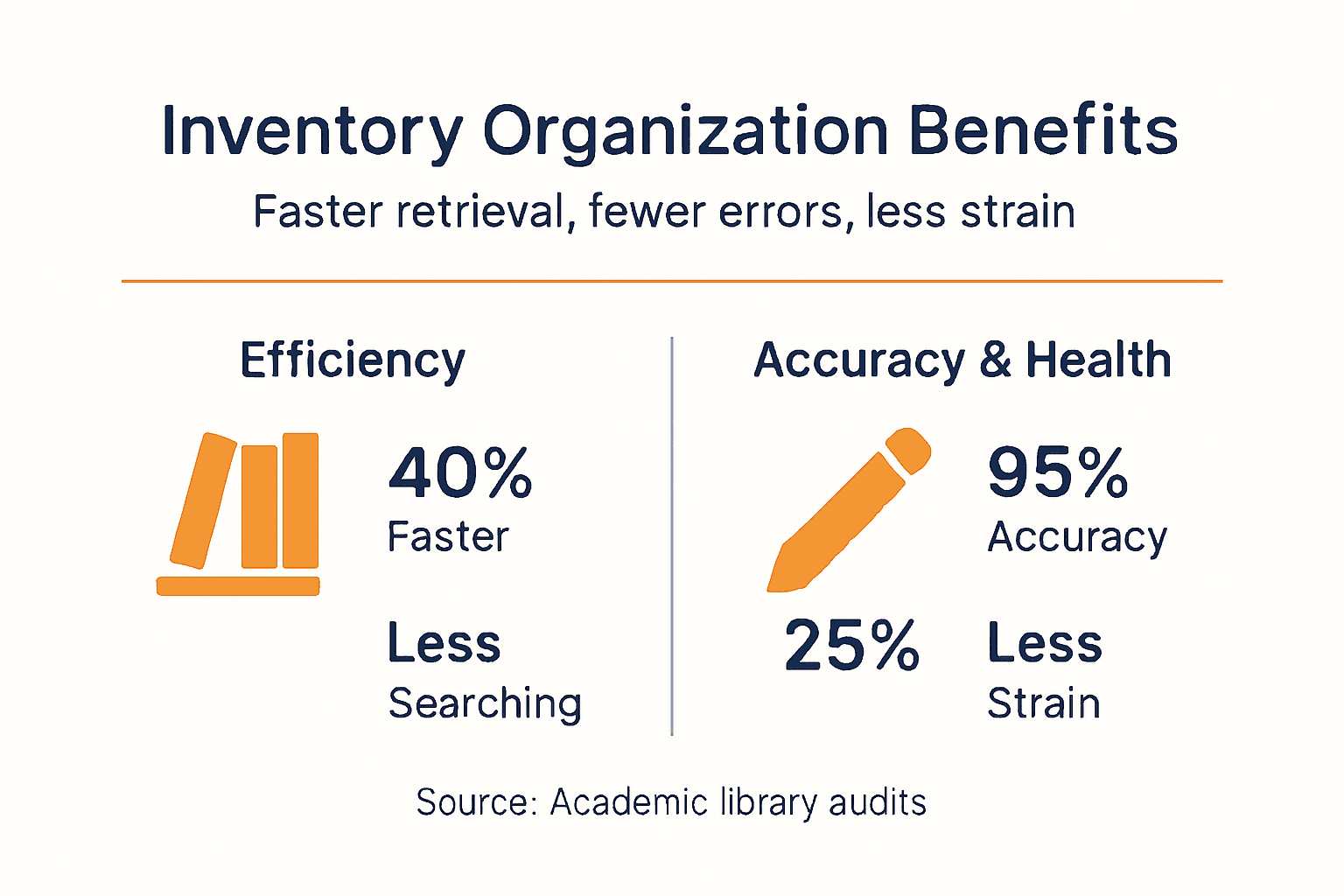
| Metric | Before Organization | After Implementation | Improvement |
|---|---|---|---|
| Average Retrieval Time | 5-8 minutes | 2-3 minutes | 40-50% faster |
| Inventory Accuracy | 60-70% | 95%+ | 25-35% increase |
| Musculoskeletal Complaints | 40% report discomfort | 15% report discomfort | 25% reduction |
| Lost/Misplaced Books | 10-15% annually | Under 2% annually | 80%+ reduction |
Track these metrics yourself using simple before and after measurements. Time ten random book retrievals before organization, then repeat monthly after implementation. Document any physical discomfort weekly. Count missing books during each audit.
Sustained benefits require sustained effort. Your initial organization investment of 10-15 hours pays dividends through reduced daily friction. Weekly maintenance of 15-20 minutes preserves your system indefinitely.
Explore Bibliowlteca's Solutions for Academic Inventory Management
Now that you understand best practices, accelerate your implementation with expert resources. Bibliowlteca offers digital platforms specifically designed for academic book inventory challenges you face daily.

Our curated collection includes specialized cataloging software, ergonomic shelving recommendations, and inventory management tools tailored for student budgets. Finding the right solutions matters as much as the organizational method itself.
Visit Bibliowlteca's Marketplace to discover resources that streamline your organization efforts and enhance study effectiveness. From barcode scanners to classification guides, we've assembled everything needed to transform your chaotic collection into an efficient research tool.
Frequently Asked Questions
How often should I update my digital book inventory?
Update your digital records within 24 hours of any physical change to your collection. This includes new acquisitions, loans to colleagues, relocations between shelves, or removals. Immediate updates prevent the discrepancies that compound into major synchronization problems requiring full re-audits.
What classification system is best for small academic collections?
Dewey Decimal Classification (DDC) works best for collections under 500 books due to its simpler structure and faster implementation. The ten main classes cover most academic needs without overwhelming complexity. Switch to Library of Congress Classification (LCC) only when specializing deeply in specific academic fields or exceeding 500 volumes.
How can I ergonomically arrange my bookshelf to reduce strain?
Position your most frequently accessed books between waist and eye level (75-145 cm from floor) to minimize bending and reaching. Reserve top shelves for rarely used references and bottom shelves for archival materials. Keep shelves no deeper than 30 cm to avoid double stacking that forces awkward reaching.
What are the top mistakes to avoid in book management?
Avoid inconsistent call number labeling, shelving books before updating digital records, ignoring ergonomic principles, skipping scheduled audits, and failing to train others on reshelving procedures. These mistakes cause up to 50% decreases in retrieval efficiency and 40% increases in physical discomfort complaints among academic users.
How do regular audits improve inventory accuracy?
Biannual audits catch discrepancies before they multiply, maintaining 95% inventory accuracy compared to 60-70% without audits. Regular verification identifies missing books early for recovery, corrects misplaced items before they're forgotten, and reveals patterns in organizational breakdown that guide system improvements. Schedule audits every six months regardless of perceived stability.