
If you want a starting shortlist right now, here it is: Pride and Prejudice, To Kill a Mockingbird, The Great Gatsby, Frankenstein, Crime and Punishment, Don Quixote, War and Peace, Moby-Dick, Great Expectations and Anna Karenina. These ten turn up again and again on editorial and reader-voted lists because they combine strong storytelling with ideas that still land generations later, from Austen's social comedy to Dostoevsky's descent into guilt.
- Pride and Prejudice (Jane Austen) — a sharp social comedy about marriage and money. Why read it: wit that still bites.
- To Kill a Mockingbird (Harper Lee) — a child's view of racial injustice in the American South. Why read it: moral clarity without preaching.
- The Great Gatsby (F. Scott Fitzgerald) — obsession and excess in Jazz Age New York. Why read it: prose you can quote from memory.
- Frankenstein (Mary Shelley) — a scientist's creation turns monstrous. Why read it: the original science-fiction warning.
- Crime and Punishment (Fyodor Dostoevsky) — a murderer's conscience unravels. Why read it: psychological tension few novels match.
- Don Quixote (Miguel de Cervantes) — a knight tilts at windmills, literally. Why read it: widely cited as the most influential novel ever written.
- War and Peace (Leo Tolstoy) — Russian society through war and peacetime. Why read it: the definitive epic.
- Moby-Dick (Herman Melville) — obsession at sea, told with strange brilliance. Why read it: nothing else reads quite like it.
- Great Expectations (Charles Dickens) — an orphan's rise and reckoning with class. Why read it: Dickens at his most human.
- Anna Karenina (Leo Tolstoy) — love, betrayal and Russian aristocracy. Why read it: one of fiction's great tragic heroines.
If you want something short first, start with Frankenstein. If you're ready to commit, War and Peace rewards the effort.
Key Takeaways
Choosing a classic novel to read comes down to matching length and theme to your available time, then letting genre sampling reveal your actual taste.
| Point | Details |
|---|---|
| Start with the top 10 | Pride and Prejudice, Frankenstein and To Kill a Mockingbird are reliable, widely-recommended entry points. |
| Use short classics as warm-ups | Novels under 200 pages, like Animal Farm or The Old Man and the Sea, build confidence before longer epics. |
| Sample across genres | Try gothic, satire and adventure early to discover personal preference rather than following one list rigidly. |
| Judge a classic by endurance | A true classic keeps revealing new meaning, per Calvino's definition, not just old age or fame. |
| Read curated digital editions | BibliOWLteca's ebook collection offers formatted classic editions and companion guides from independent creators. |
Table of Contents
- Popular classic literature: 20 titles worth your time
- Short classic novels for readers short on time
- How to pick which classic to read next
- What actually makes a novel a classic
- A reader's note on where to actually start
- Read these classics without hunting for a physical copy
- Frequently asked questions
- Sources
Popular classic literature: 20 titles worth your time
Once you've picked from the top ten, this wider list gives you room to browse by mood, theme and how much time you actually have. Each entry carries a rough length tag, so you can judge the commitment before you start.
- Wuthering Heights — Emily Brontë. A brutal, obsessive love story on the Yorkshire moors. Gothic romance at its rawest. Medium.
- Jane Eyre — Charlotte Brontë. An orphan governess finds independence and love on her own terms. Early feminist realism. Medium.
- Middlemarch — George Eliot. A study of provincial life and thwarted ambition. Often called the finest English social novel. Long.
- Madame Bovary — Gustave Flaubert. A bored wife's affairs end in ruin. The blueprint for literary realism. Short.
- The Picture of Dorian Gray — Oscar Wilde. Vanity and moral decay behind a portrait. Gothic horror with wit attached. Short.
- Dracula — Bram Stoker. An ancient vampire menaces Victorian London. The genre-defining gothic horror novel. Medium.
- A Tale of Two Cities — Charles Dickens. Love and sacrifice during the French Revolution, available as a free public-domain text. Historical epic with a devastating ending. Medium.
- The Count of Monte Cristo — Alexandre Dumas. Betrayal, imprisonment and elaborate revenge. Adventure on a grand scale. Long.
- Les Misérables — Victor Hugo. Redemption and revolution in 19th-century France. Social critique wrapped in adventure. Long.
- The Adventures of Huckleberry Finn — Mark Twain. A boy and an escaped slave raft down the Mississippi. American coming-of-age with sharp satire. Medium.
- The Life and Adventures of Robinson Crusoe — Daniel Defoe. A shipwrecked man builds a life alone, freely readable in its original form. Often called the first English novel. Medium.
- Vanity Fair — William Makepeace Thackeray. A social climber schemes her way through English society. Satire with no clean heroes. Long.
- The Scarlet Letter — Nathaniel Hawthorne. A woman branded for adultery in Puritan New England. Psychological realism before the term existed. Short.
- Emma — Jane Austen. A well-meaning matchmaker causes chaos. Social satire with a warmer heart than Pride and Prejudice. Medium.
- The Brothers Karamazov — Fyodor Dostoevsky. Faith, doubt and patricide among three brothers. Dostoevsky's philosophical peak. Long.
- Oliver Twist — Charles Dickens. An orphan navigates London's criminal underworld. Social critique aimed at the Poor Laws. Medium.
- In Search of Lost Time — Marcel Proust. Memory, time and a childhood biscuit change everything. One of the most frequently cited foundational works in reader surveys. Long.
- Ulysses — James Joyce. A single day in Dublin, told through radical style shifts. The novel that rewired modernist fiction. Long.
- Heart of Darkness — Joseph Conrad. A journey up the Congo confronts colonial brutality. Dense, unsettling, unforgettable. Short.
- The Adventures of Tom Sawyer — Mark Twain. Mischief and moral growth on the Mississippi. A gentler entry point than its sequel. Short.
Publishers tend to group these by narrative focus rather than by date, sorting titles into gothic horror, social satire, coming-of-age and epic narrative. That's a genuinely useful way to browse once the length of a book stops being the deciding factor.
Short classic novels for readers short on time
Long doesn't mean better. Some of the most quoted, most taught novels in this list barely crack 150 pages, and that brevity is often the point. LitHub's roundup of classics under 200 pages makes exactly this case: short classics deliver the same weight of theme without the multi-week commitment.
- The Old Man and the Sea (Hemingway, ~127 pages) — weekend read. One man, one fish, one relentless sea.
- Animal Farm (Orwell, ~112 pages) — starter. A farmyard allegory for political betrayal.
- The Metamorphosis (Kafka, ~55 pages) — intense. A man wakes up as an insect; nothing is explained, and that's unsettling in the best way.
- The Stranger (Camus, ~123 pages) — intense. Flat, detached prose that captures existential indifference perfectly.
- Of Mice and Men (Steinbeck, ~107 pages) — starter. Friendship and tragedy during the Great Depression.
- Heart of Darkness (Conrad, ~100 pages) — intense. Dense sentences, heavy themes, best read slowly.
- The Picture of Dorian Gray (Wilde, ~184 pages) — weekend read. Gothic and quotable in equal measure.
Short novels work as an entry point because they let you get used to older sentence rhythms and vocabulary without committing to 800 pages before deciding whether you even like the style. If War and Peace feels like scaling a mountain, a 120-page Kafka novella is a walk round the block, and it still counts.
Pro Tip: Read the first twenty pages of a short classic before buying the doorstop epic by the same author or era. If the sentence rhythm clicks, the longer book will feel far less intimidating.
How to pick which classic to read next
Match the book to your mood and your calendar, not to a syllabus. Ask yourself three quick questions: how much time do you actually have this month, do you want comfort or challenge, and have you read anything from this period before?
- Starter path: pick a short classic (Animal Farm, The Old Man and the Sea), then move to a social novel (Pride and Prejudice, Emma), then attempt one epic (Great Expectations before War and Peace).
- Genre sampler: choose one from each category, gothic horror, social satire, adventure, so you find out what you actually enjoy rather than what a list says you should. Grouping by genre makes this far easier than working chronologically.
- Ambitious epic plan: commit to one long classic per season rather than one per month. Middlemarch, Les Misérables and War and Peace all reward patience but punish rushing.
Pro Tip: Keep a second, lighter book going alongside a dense classic. Alternating chapters stops one slow section from stalling your whole reading habit.
Pro Tip: Read introductions after the novel, not before. Many spoil plot twists in the name of context.
What actually makes a novel a classic
A classic endures. It keeps saying something new to readers decades or centuries after publication, rather than sitting frozen as a historical curiosity. Italo Calvino put it bluntly: a classic is a book that "has never exhausted all it has to say to its readers," and Harriet Sanders of Macmillan Collectors' Library makes a similar point, arguing that the defining trait is a book that "endured and stood the test of time" while still speaking to modern concerns.
Four things tend to separate a genuine classic from a merely old book:
- Endurance — it's still read, taught and argued about generations after publication.
- Thematic relevance — its central concerns (class, guilt, ambition, injustice) haven't dated even if the setting has.
- Innovation — it changed what novels could do, structurally or stylistically.
- Ongoing readership — real people still choose to read it voluntarily, not just under instruction.
Don Quixote earns its place through pure invention: it more or less created the modern novel form. Pride and Prejudice earns its through relevance: its social satire about marriage and money still describes recognisable behaviour two centuries on.
A reader's note on where to actually start
Start short, then build up. My own route into this list ran from a slim gothic novella straight to Austen's social comedy, and only then to a genuine epic; that order made the density of War and Peace feel earned rather than punishing. Sampling different sub-genres early, gothic, satire, epic, adventure, is the fastest way to work out what actually holds your attention rather than guessing from a list. Pick the shortest book on this page tonight. See where it takes you.
Read these classics without hunting for a physical copy
Public-domain texts are free, but they're often unformatted scans with tiny type and no context for the period they were written in. If you'd rather read Frankenstein or A Tale of Two Cities in a properly formatted digital edition, with a working table of contents and no squinting required, BibliOWLteca's ebook collection carries curated digital editions of classic titles alongside guided reading material built by independent creators.

Because BibliOWLteca is a marketplace rather than a single publisher, the editions and companion guides come from creators who specialise in specific eras and authors, so a Dostoevsky companion guide and a Dickens annotated edition aren't stuck with the same generic introduction. Browse the ebook collection now and pick up tonight's short classic in a format that actually reads well on a phone or tablet.
Frequently asked questions
What are some examples of classic novels? Pride and Prejudice, To Kill a Mockingbird, The Great Gatsby, Frankenstein, Crime and Punishment, Don Quixote, War and Peace, Moby-Dick, Great Expectations and Anna Karenina are among the most frequently recommended classic novels across editorial and reader-voted lists.
What are the top 10 classic novels to read? The shortlist above covers the ten most consistently recommended titles, spanning social satire (Austen), gothic horror (Shelley), Russian epics (Tolstoy, Dostoevsky) and American fiction (Fitzgerald, Melville, Lee).
What are the top 20 classic novels? The expanded list in this article adds titles such as Wuthering Heights, Middlemarch, Dracula, Les Misérables and Ulysses, giving you options across nearly every major genre and period.
What are classic novels, exactly? A classic novel is one that has endured well beyond its own era, still speaks to readers on themes that matter now, and typically changed something about how novels were written or read, whether through style, structure or subject matter.
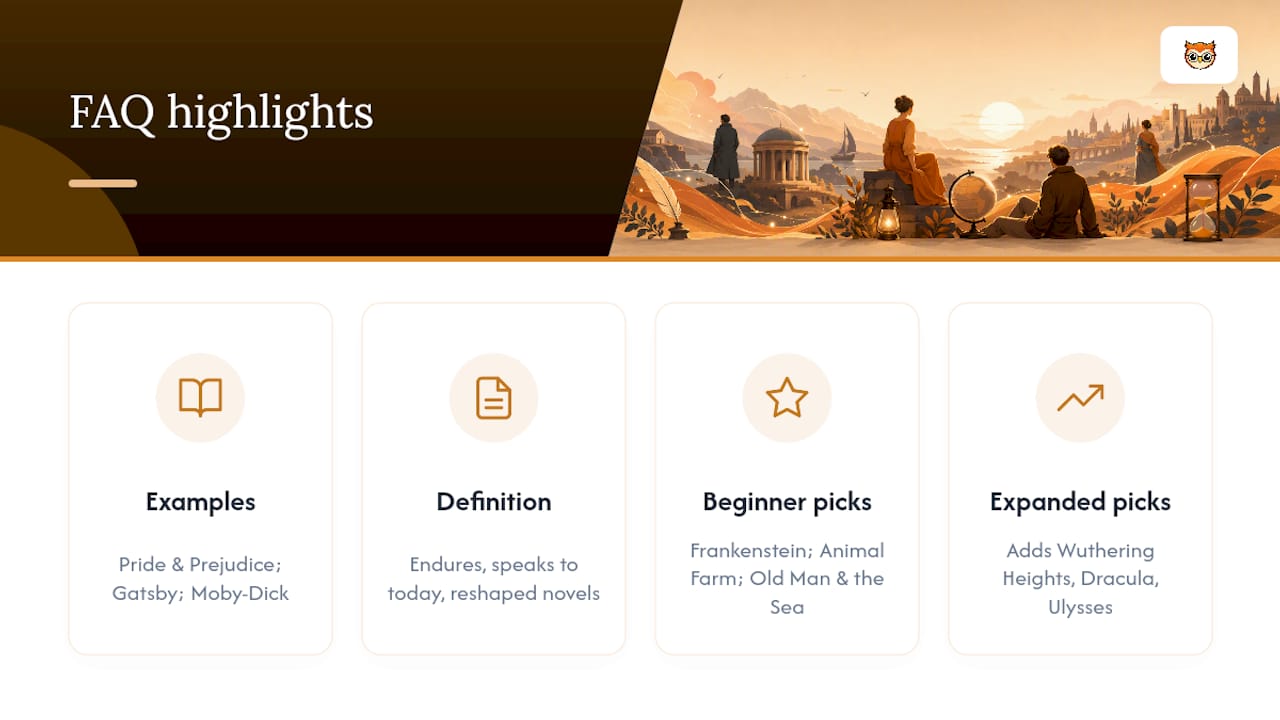
Which classic novel should a beginner start with? Start short. Frankenstein, Animal Farm or The Old Man and the Sea all deliver genuine classic weight in under 200 pages, making them far less intimidating than War and Peace or Middlemarch.
Sources
- 100 must-read classics, as chosen by our readers
- Classic books to read before you die
- A Tale of Two Cities | Project Gutenberg
Use a public-domain text when you just want the words on the page. Choose a modern annotated edition when you want historical footnotes and context explained as you go, particularly for anything written before 1900.