Finding the right platform for managing and trading books can make all the difference in your reading experience. Whether you are searching for fresh features or seeking a more user friendly approach, there is a growing range of alternatives to discover. The best options offer different styles and benefits that cater to unique preferences. Curious about which tools might suit your needs better? Explore new ways to organise your library and connect with fellow book lovers in creative and satisfying ways.
Table of Contents

At a Glance
BibliOWLteca is the leading choice for creators who want a single platform to sell and distribute educational products worldwide. It combines a secure architecture with built-in commerce and compliance tools so you can focus on content not infrastructure.
Core Features
BibliOWLteca offers a secure and scalable infrastructure that supports publishing e-books, courses and other digital products. The platform lets creators manage their own stores and audiences while handling payment processing and tax compliance.
The system supports multiple currencies and international payments, and includes tools for digital delivery and fulfilment. These features reduce operational overhead when you expand into new markets.
Pros
-
Global payment support: The platform handles multiple currencies and international payments so you can sell worldwide without complex payment workarounds.
-
Integrated tax compliance: Built-in tax handling removes routine administrative burden so you avoid manual tax calculations across jurisdictions.
-
Store and audience management: Creators control their own storefronts and customer lists which improves branding and long term customer relationships.
-
Digital delivery tools: Automated delivery for e-books and courses reduces support tickets and improves buyer experience.
-
Secure infrastructure: A focus on security and scalability protects your assets as your audience grows.
Who It's For
This platform fits content creators, educators and entrepreneurs who sell knowledge products and want to scale internationally without hiring extra technical staff. If you value owning your storefront and automating payments and compliance, this is for you.
If you teach courses, publish workbooks, or bundle curricula for schools or corporate clients, BibliOWLteca matches that workflow.
Unique Value Proposition
BibliOWLteca combines the necessary commerce, delivery and compliance functions into a single product tailored to educational creators. Unlike piecemeal solutions, it removes the need to integrate separate payment gateways, tax tools and delivery systems.
The result is a reduced time to market and fewer technical dependencies which lets you iterate on content and promotions faster. Sophisticated buyers choose BibliOWLteca because it centralises revenue operations while preserving creator control and brand presence.
Real World Use Case
Imagine a curriculum designer launching a paid course and an accompanying e-book to schools across Europe and North America. BibliOWLteca lets the designer publish course material, accept payments in local currency, deliver digital files automatically and report taxes accurately.
This reduces administrative overhead, frees time for curriculum development and improves cashflow predictability when launching to multiple markets.
Pricing
Pricing details are not available in the provided data. Contact BibliOWLteca for current plans and enterprise options tailored to audience size and international requirements.
Website: https://bibliowlteca.com
Bibliollect

At a Glance
Bibliollect presents a straightforward way for readers to trade books with one another using a Sign in with Google flow and a community focus that lowers friction for new users. The platform is clearly aimed at building peer exchanges rather than offering advanced commerce features.
Core Features
Bibliollect centres on three clear capabilities: Sign in with Google, a community-based book trading model, and a user-friendly interface to list and browse books. The available content implies collection management and peer-to-peer exchanges without detailed logistics or payment tools.
Pros
- Easy sign-in process: The platform supports Google sign in which reduces onboarding friction for users and speeds up first-time access.
- Community focus: Bibliollect emphasises peer exchanges which helps create social connections and sustained engagement among book lovers.
- Collection management potential: The interface appears designed to help users catalogue and manage items they want to trade which aids organisation and discovery.
- Accessible onboarding: New users encounter a low barrier to entry which encourages participation from casual readers and collectors.
Cons
- Limited feature detail: The provided content lacks specifics on search filters, messaging, shipping, or tracking which makes it hard to judge operational capability.
- Unclear pricing: There is no information on fees or subscription options which leaves creators and organisers unsure about costs.
- Trade logistics unknown: The platform does not specify how trades are coordinated, shipped, or verified which could create friction for remote exchanges.
Who It's For
Bibliollect suits book enthusiasts, collectors, and readers who prefer swapping physical books with peers rather than buying new copies. It also fits community organisers and book clubs that want a simple place to coordinate exchanges without complex storefronts.
Unique Value Proposition
Bibliollect’s main appeal is a simple, community-centred trading experience combined with seamless access via Google sign in. That mix reduces onboarding overhead and nudges users towards social discovery instead of transactional retail.
Real World Use Case
A user signs in with Google, posts a book they wish to trade, searches for a desired title, and messages a community member to arrange the swap. The workflow supports local exchanges and group book-club rotations.
Pricing
Pricing is not specified in the available content so it is unclear whether Bibliollect is free, ad supported, or paid. Budget planning for creators or organisers requires direct confirmation from the vendor.
Website: https://booktrader.app
BookMooch

At a Glance
BookMooch is a community book exchange that lets readers swap titles without spending money. It is best for creators and educators who value reuse and community interaction as part of a sustainable content distribution strategy.
Core Features
BookMooch centres on a community book exchange model that matches members who want to trade physical books. It supports user profiles and ratings so trust develops over time. It also offers book wishlists and offers, a point system to balance trades, and a member messaging system for direct coordination between users.
Pros
-
Free to join and use: There is no monetary barrier to start swapping books which suits creators testing distribution ideas without upfront cost.
-
Promotes recycling and sustainability: The platform encourages reuse of printed materials which aligns with environmentally conscious publishing and education practices.
-
Builds a community of book lovers: Regular interaction and trades help creators reach engaged readers who are likely to recommend content to peers.
-
Wide selection of genres and titles: A diverse catalogue emerges from active membership which can surface niche educational texts and out of print resources.
-
User rating system to build trust: Ratings and feedback reduce friction when arranging exchanges and guard against repeated poor behaviour.
Cons
-
Requires active community participation for effective trading: Trade speed and selection depend entirely on member activity which can be uneven across regions.
-
Limited to book exchange with no selling or buying options: Creators who want to monetise directly cannot sell through this platform which restricts commercial use.
-
Potentially slow process for finding specific books: Locating a particular title can take time and patience which may frustrate readers on tight schedules.
-
Dependent on user activity to maintain a vibrant marketplace: Declines in participation directly reduce available inventory and trading opportunities.
Who It's For
BookMooch suits book enthusiasts, environmentally conscious readers and community minded individuals who prefer swapping over purchasing. It also fits educators and creators who want to circulate physical copies without handling payments or logistics.
Unique Value Proposition
BookMooch offers an exchange network built on a point system that removes cash transactions and fosters reciprocity. That design keeps overhead low and shifts focus to community trust and active participation rather than storefront management.
Real World Use Case
A teacher clears a classroom library and lists surplus texts on BookMooch to earn points. They then request specific pedagogical titles from other members, receive parcels through coordinated messaging and refresh their collection without budgetary strain.
Pricing
BookMooch is free to use with no subscription fees, listing charges or transaction costs. That makes it attractive for community groups and individual educators working with limited budgets.
Website: https://bookmooch.com
PaperbackSwap
At a Glance
PaperbackSwap is a community based book exchange that lets members trade physical books using points earned by mailing titles to others. It is cost effective for readers and promotes sustainable reuse, but availability and delivery speed depend on active members.
Core Features
PaperbackSwap operates a point system where you earn points for sending books and spend them to receive books you want. Membership registration is required and members can search a searchable database of available titles and read user reviews and ratings.
The platform focuses on physical book swapping only and records listings submitted by members, which creates a living catalogue that reflects community activity rather than a static inventory.
Pros
-
Free membership means anyone can join without subscription costs while only paying for postage, which keeps upfront barriers low.
-
Large community of book lovers increases the chance of finding niche and out of print titles that might not appear on mainstream shops.
-
Wide selection across genres supports casual readers and collectors who want to explore different subjects without buying new copies.
-
Environmentally friendly sharing concept reduces waste and extends the life of printed books through repeated circulation.
-
No shipping fees for receiving books because the point system offsets postage, which can make inbound costs negligible for recipients.
Cons
-
Dependent on member activity for availability so some titles may be hard to find if few members list them at a given time.
-
Time delay due to mailing means delivery can take days or weeks depending on sender willingness and postal services in different regions.
-
Limited to physical books only which makes it unsuitable for creators who need instant digital delivery or digital editions.
Who It's For
PaperbackSwap suits book lovers who enjoy trading physical books and are comfortable with mailing parcels and tracking postage. It also appeals to educators, content creators, and small publishers looking to refresh reference shelves economically and sustainably.
Unique Value Proposition
PaperbackSwap offers an accessible way to exchange physical books at minimal cash cost by using a community driven points model and no direct incoming shipping fees. The combination of peer listings and member reviews creates social proof around condition and selection.
This model rewards active participation and encourages a circular approach to reading materials, which appeals to readers who prefer tangible books and low cost circulation.
Real World Use Case
A user clears space by mailing several used textbooks to other members, earning points that they spend to request a set of novels or reference volumes in return. The process converts unwanted books into new reading material without purchasing new copies.
For an educator this can mean updating course reading lists affordably by rotating physical copies through the community rather than buying replacements.
Pricing
Membership is free and the only direct costs are postage and mailing supplies when you send books to earn points. There are no subscription fees or per transaction charges beyond postage costs.
Website: https://paperbackswap.com
ReadCycle
At a Glance
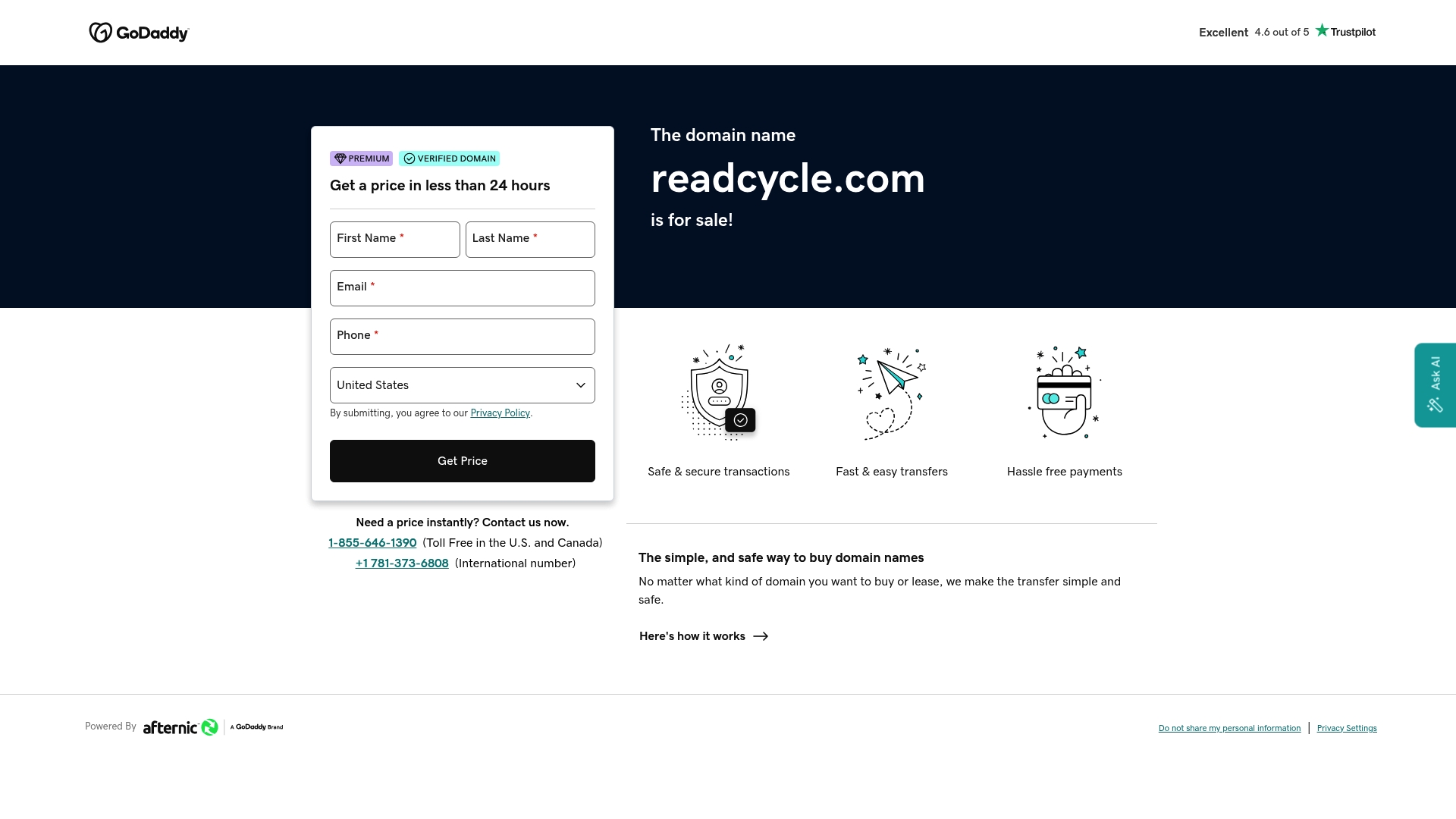
ReadCycle is a focused domain marketplace that promises secure, fast transfers and hassle free payments for buyers and sellers. Its tight integration with Afternic and a clear emphasis on verified premium domains make it a practical choice for teams seeking a simple, reliable transfer process.
Core Features
ReadCycle centres on safe & secure transactions, fast & easy transfers, and streamlined payment handling that removes friction from domain deals. The site highlights a verified premium domain for sale, emphasising trust and speed rather than a broad suite of ancillary services.
Pros
-
Secure and trusted domain transfer process: ReadCycle offers a clearly stated transfer workflow that reduces risk during ownership changes and helps protect both buyers and sellers.
-
Fast response for pricing and support: The platform promises pricing within 24 hours and direct support for instant queries, which speeds decision making for time sensitive purchases.
-
User friendly interface for buying and selling domains: The site presents information and purchase options cleanly, lowering the barrier for non technical founders and marketers.
-
Partnership with Afternic, a reputable marketplace: The relationship with Afternic adds marketplace credibility and broader exposure for listed domains.
-
Clear emphasis on security and ease of use: Repeated messaging around safety and simplicity gives confidence to risk averse buyers and small teams.
Cons
-
Limited information about additional features or tools beyond domain transfer: The offering is narrow which may disappoint users who want bundled services such as hosting or branding tools.
-
Focus appears primarily on domain sales, not on other services or digital products: If you sell courses, e books, or other educational assets this platform does not cater to those needs.
-
No detailed user reviews or testimonials provided directly on the site: The lack of on site testimonials makes it harder to gauge real customer experience and long term reliability.
Who It's For
ReadCycle suits individuals, startups, and small businesses intent on acquiring or disposing of domain names with minimal fuss. It appeals to brand builders who value verified listings and a straightforward purchase path rather than a full commerce ecosystem.
Unique Value Proposition
ReadCycle stands out by combining a narrow focus on domain transactions with the backing of Afternic and emphasising verified premium listings. That combination reduces transaction risk and accelerates acquisition for teams that prize speed and security.
Real World Use Case
A Startup seeking a distinctive brand name can use ReadCycle to locate a verified premium domain, obtain a price within 24 hours, and complete a secure transfer with support available for immediate questions. The process shortens brand launch timelines.
Pricing
Get a price in less than 24 hours or contact support for instant pricing. The site positions pricing as responsive and handled on a per domain basis rather than via standard subscription tiers.
Website: https://readcycle.com
BookFinderHub
At a Glance
BookFinderHub offers a straightforward way to discover titles with a user-friendly interface and basic account features that deliver personalised suggestions. It suits readers who prioritise simple search and browse flows rather than deep marketplace integrations.
Core Features
The platform provides core discovery tools including search across genres and categories, user account login for a personalised experience, curated collections to explore, and access to book recommendations that aim to refine suggestions as you use the service.
Pros
-
User-friendly interface: The site presents search and category results clearly which reduces friction when you look for a specific title or browse new genres.
-
Personalised recommendations: Account-based recommendations tailor suggestions to your reading history which helps build a relevant reading list without manual curation.
-
Broad book database access: A wide catalogue improves the odds of finding niche or less mainstream titles which benefits educators and creators building resource lists.
-
Multiple language options: Support for several languages expands accessibility to diverse audiences and aids international educators and content creators.
Cons
-
Limited explicit details about which book providers the platform connects to, so you may not know whether a title links to a preferred seller or academic vendor.
-
The provided content gives no evidence of advanced filters or granular search options which can slow precise discovery for academics seeking edition, format, or publisher specifics.
-
Pricing information is absent from the available material which makes it hard for budget-conscious educators and entrepreneurs to assess long term suitability.
Who It's For
BookFinderHub suits book enthusiasts, students, educators, and casual readers who want quick discovery without a steep learning curve. Content creators and course designers will find it useful for assembling reading lists when direct purchasing or integration with stores is not required.
Unique Value Proposition
BookFinderHub focuses on straightforward discovery rather than commerce. Its strength lies in accessible browsing, account-driven suggestions, and multilingual support which together make it a practical discovery tool for building reading resources and reference lists.
Real World Use Case
A university student assembles a reading list for a seminar by searching genre filters and curated collections, saving recommendations to a personal account. This speeds up finding relevant textbooks and novels without hopping between multiple catalogue sites.
Pricing
Pricing is not specified in the provided content which means you will need to contact BookFinderHub or explore the site to determine subscription models or commercial terms for extended features.
Website: https://bookfinderhub.com
Comparison of Book Trading and Distribution Platforms
The following table provides a concise comparison of various platforms discussed for book trading and distribution purposes. It highlights their core features, advantages, limitations, and ideal user group to assist users in selecting the right platform for their needs.
| Platform Name | Core Features | Pros | Cons | Ideal User Group |
|---|---|---|---|---|
| BibliOWLteca | Secure architecture for selling and distributing digital educational products; international payment support | Facilitates tax compliance, secure infrastructure, and audience management | Pricing details not readily available; caters mainly to digital products | Educators and content creators selling digital products internationally |
| Bibliollect | Google-based sign-in; peer-to-peer book trading | Emphasizes community interactions; user-friendly for cataloging and trading books | Details on logistics and pricing are vague | Book enthusiasts and clubs seeking easy swaps |
| BookMooch | Community exchange with a points-based system | Encourages recycling; builds trusted communities with user ratings | Efficiency relies on active participation; limited options for book monetization | Environmentally-conscious users opting for community-based book swapping |
| PaperbackSwap | Points-based swapping for physical books | Free membership, large inventory; no shipping fees for recipients | Depends on user activity; slower due to mail exchanges | Budget-conscious and sustainable readers |
| BookFinderHub | Simplified book discovery with personalized suggestions | User-friendly interface and multilingual support | Advanced filters are lacking; unclear on associated costs | Casual readers and those compiling reference lists or seeking book recommendations |
Each platform caters to unique needs, ranging from commerce and compliance tools tailored for educational content creators to simple, community-driven book swap models for enthusiasts.
Discover a Smarter Way to Sell Educational Content Globally
If you are exploring BookTrader.app alternatives to expand your educational content business internationally, you face challenges like managing multiple currencies, automating tax compliance, and securing digital delivery. BibliOWLteca offers a powerful solution tailored for creators who want full control over their stores and audiences without worrying about complex infrastructure. With built-in global payment support and automated compliance tools, you can focus on what matters most — creating and sharing valuable knowledge worldwide.

Ready to elevate your digital education business and reach a global audience effortlessly Visit BibliOWLteca today to build your personalised storefront and simplify payment processing while ensuring seamless tax reporting. Don’t let technical hurdles slow you down Start transforming your educational content into a thriving online business now at BibliOWLteca.
Frequently Asked Questions
What are some popular alternatives to BookTrader.app for book trading in 2026?
Many platforms offer options for trading books, such as community exchanges and direct swapping systems. Explore these alternatives to find one that suits your trading preferences and community engagement goals.
How can I determine which book trading platform is best for my needs?
To identify the most suitable platform, consider factors such as user interface, community size, and features offered. Compare at least three alternatives to weigh their pros and cons effectively.
Are there fees associated with using book trading platforms like those mentioned?
Most book trading platforms aim to be free or have minimal costs, typically involving postage for sending books. Check the individual platform's policies to confirm any potential fees before engaging in trades.
How do I ensure a secure trading experience when using these platforms?
To maintain security during book exchanges, always use verified user profiles and follow platform guidelines for arranging swaps. Communicate clearly with your trading partner before finalising any transaction.
Can I use these alternatives for both physical and digital books?
While most alternatives focus on physical book trading, some platforms may support digital exchanges as well. Review each platform’s specifications to confirm what types of books can be traded.
Is it easy to get started with these book trading alternatives?
Yes, most platforms feature user-friendly sign-up processes that enable quick participation. Create an account and follow onboarding instructions to begin trading within a few minutes.