
TL;DR:
- Metadata in libraries is essential for resource discovery, management, and preservation, serving as the backbone of library workflows. The three primary types—descriptive, administrative, and structural—each fulfill distinct roles, with quality directly impacting user experience and searchability. Implementing standards like IFLA LRM and employing automation and governance policies enhances interoperability, collection visibility, and long-term sustainability.
Metadata in libraries is defined as structured information that describes, organises, and provides context for resources, making it the backbone of every discovery, access, and preservation workflow a library operates. The four core functions of library metadata are organising, preserving, indexing for discovery, and retaining contextual information about resources. Without well-governed metadata, a catalogue entry is little more than a label on an unmarked box. Professionals working with systems such as MARC, Dublin Core, or BIBFRAME already understand this intuitively, but the full strategic significance of metadata in libraries extends far beyond cataloguing convention into quality management, interoperability, and linked data infrastructure.
What are the key types of metadata used in libraries?
The three main metadata types in libraries are descriptive, administrative, and structural, and each serves a distinct operational purpose. Understanding the difference between them is not academic pedantry. It determines how you architect a catalogue, build a digital repository, or migrate legacy records to a linked data environment.

Descriptive metadata covers the elements that enable a user or system to find and identify a resource. Title, author, subject headings, abstract, and identifiers such as ISBN or DOI all fall here. Controlled vocabularies like the Library of Congress Subject Headings (LCSH) and the Medical Subject Headings (MeSH) give descriptive metadata its precision, preventing the ambiguity that collapses search relevance.
Administrative metadata splits into three sub-types, each with a different management function:
- Technical metadata records file format, resolution, encoding, and creation software, giving systems the information needed to render or migrate a digital object correctly.
- Preservation metadata documents the object's history, including fixity checks, format migrations, and storage events, enabling accurate lifecycle reconstruction by downstream systems.
- Rights metadata captures licensing conditions, copyright status, and access restrictions, which directly governs what a user can legally do with a resource.
The NLN Digital Preservation guidance makes a point that many cataloguers overlook: preservation metadata must be placed in the correct structural layer and delivered consistently with its packaging. Misplacing it breaks the chain of custody that digital preservation depends upon.
Structural metadata describes the relationships between parts of a resource or between related resources. A digitised manuscript's structural metadata tells a viewer system how page images relate to each other and to the whole object. In a multi-volume encyclopaedia, it maps volumes to entries to cross-references.
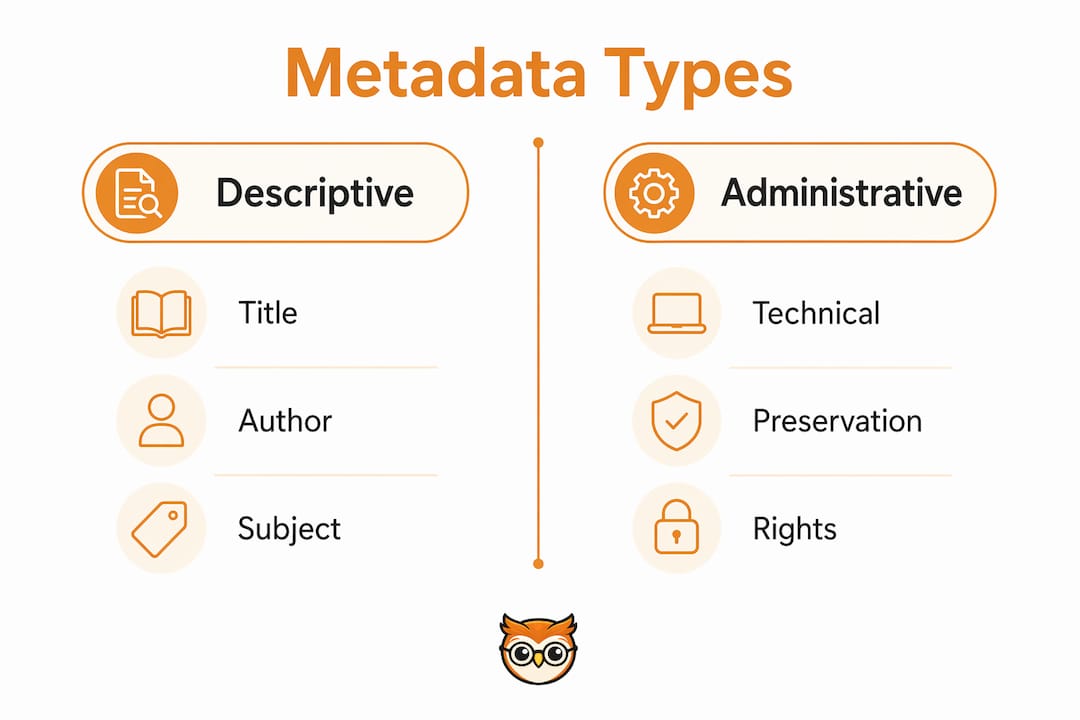
The table below summarises the three types with representative elements and encoding standards commonly used in library systems.
| Metadata type | Representative elements | Common encoding standards |
|---|---|---|
| Descriptive | Title, author, subject, abstract, identifier | Dublin Core, MARC 21, BIBFRAME, MODS |
| Administrative | Format, rights, provenance, fixity, event records | PREMIS, MIX, METS, EXIF |
| Structural | Sequence, hierarchy, inter-resource relationships | METS, IIIF Manifest, RDF/XML |
Encoding standards such as RDF and XML allow metadata to be machine-readable and transferable across systems. This is what separates a well-structured catalogue from a static database that cannot communicate with the wider web.
How does metadata quality affect discovery and user experience?
Metadata quality is a strategic asset for libraries, not a housekeeping concern. Poor metadata quality directly reduces research efficiency, increases costs associated with manual remediation, and degrades the user experience at the point of search.
The consequences of inconsistent or incomplete metadata become starkest at scale. A 2025 study on public omics repositories found that metadata heterogeneity across datasets severely limited cross-study data integration, requiring extensive retrospective curation to make records usable. The lesson for library professionals is direct: metadata problems that appear minor at the record level compound into significant retrieval failures across a collection.
Consider how this plays out in practice. A journal article catalogued without a consistent subject heading schema will surface inconsistently across different search queries. A digitised image missing technical metadata may render incorrectly or fail entirely when a user accesses it through a mobile interface. A resource with incomplete rights metadata creates legal uncertainty that forces staff to investigate manually before the item can be made available. Each failure adds friction, and friction drives users to less rigorous but more responsive alternatives.
Search engine performance is also affected. The CMU metadata guide notes that metadata influences search rankings and click-through rates, particularly for non-text content such as images, audio, and video. A library's digital collections compete for visibility in the same web environment as commercial content platforms, and well-formed metadata is the mechanism by which those collections remain discoverable.
The numbered steps below outline a practical quality assurance cycle that information professionals can apply to any collection:
- Audit existing records against a defined schema to identify missing, inconsistent, or out-of-vocabulary elements.
- Prioritise high-traffic resources for immediate remediation, using access analytics to guide effort.
- Apply controlled vocabularies consistently, selecting established schemes such as LCSH, MeSH, or the Getty Vocabularies depending on collection type.
- Automate routine checks using tools that flag schema violations or duplicate records before they enter the live catalogue.
- Schedule periodic reviews to catch vocabulary drift and update records when standards evolve.
"Metadata enrichment must be quality-governed to avoid schema bloat and inconsistency undermining retrieval." — Information Architecture Authority
Pro Tip: Resist the temptation to add every available metadata element to a schema. Unmanaged enrichment creates schema bloat, where the volume of elements outpaces the capacity to maintain them consistently. Select elements purposefully, govern vocabulary choices centrally, and review the schema annually against actual retrieval patterns.
How do metadata standards support interoperability and linked data?
Metadata standards reduce ambiguity for both humans and machines, and that reduction of ambiguity is what makes bibliographic data interoperable across institutions and systems. The IFLA Library Reference Model (LRM) consolidates three earlier IFLA conceptual models, FRBR, FRAD, and FRSAD, into a single entity-relationship framework designed specifically to support linked data environments. This matters because legacy record-based standards like MARC 21 were built for card catalogue logic, not for the web of data.
The LRM's entity-relationship approach defines bibliographic entities (Work, Expression, Manifestation, Item, Person, Agent, Place, and others) and the relationships between them using precise, machine-actionable terms. When a library exposes this data using namespaces and URIs, each entity becomes a node in a linked data graph that external systems, search engines, and knowledge bases can query directly. This is the architecture behind library trends in 2026 that are reshaping how digital collections integrate with the broader semantic web.
The practical comparison below shows the difference between legacy and linked data approaches to the same bibliographic problem.
| Approach | Data model | Interoperability | Machine-readability |
|---|---|---|---|
| MARC 21 record | Flat, field-based | Limited to MARC-aware systems | Requires transformation |
| Dublin Core | Simple element set | Broad but shallow | Moderate |
| BIBFRAME / LRM-aligned RDF | Entity-relationship, URI-based | High across web systems | Native |
The transition from MARC to BIBFRAME or LRM-aligned RDF is not primarily a front-end cataloguing change. It is a data architecture project. The real work lies in mapping existing records to new entity models, writing crosswalk logic that preserves relationships rather than just field values, and managing namespaces so that URIs resolve consistently over time.
Libraries that have completed this transition report that their collections become significantly more visible in general web search, because search engines like Google can parse structured linked data directly. The IFLA LRM's entity modelling also reduces the ambiguity that causes different catalogue systems to represent the same work differently, which is a persistent problem in federated search environments.
Pro Tip: When planning a migration to linked data, prioritise mapping and relationship preservation over cosmetic catalogue improvements. A record that correctly expresses the relationship between a Work and its Expressions in RDF delivers more long-term value than a record with a polished display label but broken entity links.
What practical strategies improve metadata management in library workflows?
A supply-chain mindset for metadata management is the most effective framework for sustaining quality over time. End-to-end automation and shared cooperative networks reduce duplicated effort and prevent the cycle of manual fixes that consumes cataloguing staff time without improving underlying data quality.
The benefits of automation in metadata workflows are concrete and measurable:
- Automated ingestion pipelines apply schema validation at the point of record creation, catching errors before they propagate through the catalogue.
- Batch normalisation tools standardise date formats, name authority entries, and subject headings across large legacy collections without requiring record-by-record human review.
- Automated metadata updates from publisher feeds or aggregator platforms keep access and licensing information current, which is particularly significant for e-resource management.
- Analytics integrations pull usage data back into the metadata record, enabling collection managers to evidence which resources are used and guide acquisition decisions with real data.
Cooperative networks are equally significant. WorldCat, maintained by OCLC, allows member libraries to share cataloguing work so that a record created by one institution is available to all. This reduces the cost of original cataloguing substantially and improves consistency across the network. The library management checklist approach, where workflows are documented and audited regularly, applies directly here: a metadata policy that specifies which elements are mandatory, which vocabularies are authorised, and how records are reviewed creates the governance structure that automation depends upon.
Integration of metadata with licensing, access control, and analytics workflows is where the benefits of library metadata become most visible to senior decision-makers. When a library can demonstrate that a particular collection of resources is heavily used, that its metadata is accurate enough to surface those resources reliably in search, and that access conditions are correctly recorded, it makes a credible case for continued investment. Metadata significance in libraries is therefore not only operational. It is political and financial.
Pro Tip: Build metadata policy documentation before deploying automation tools. Automation scales whatever rules you give it. If those rules are poorly defined, automation scales the inconsistency. A one-page element selection policy with clear vocabulary guidance prevents months of remediation later.
The library cataloguing process in 2026 increasingly involves integrating metadata creation with digital preservation workflows, rights management systems, and discovery layers simultaneously. Treating these as separate silos produces the fragmented metadata that undermines retrieval. Treating them as a single supply chain, where each stage adds governed, consistent information to a shared record, produces collections that serve users reliably over time.
Key takeaways
Metadata quality, standards compliance, and automation together determine whether a library's collections are discoverable, manageable, and sustainable at scale.
| Point | Details |
|---|---|
| Three metadata types | Descriptive, administrative, and structural metadata each serve distinct functions that must be governed separately. |
| Quality governs discovery | Inconsistent or incomplete metadata reduces retrieval accuracy and increases the cost of manual remediation across collections. |
| Standards enable interoperability | IFLA LRM and BIBFRAME provide entity-relationship models that make bibliographic data machine-actionable and web-compatible. |
| Automation requires policy first | Deploying automation without a defined metadata policy scales inconsistency rather than correcting it. |
| Cooperative networks reduce effort | Shared cataloguing through networks like WorldCat lowers the cost of original cataloguing and improves cross-institutional consistency. |
Metadata in practice: what fifteen years of working with library data has taught me
The most persistent misconception I encounter is that metadata is a cataloguing problem. It is not. It is a data governance problem that cataloguers are asked to solve with tools designed for a different era. MARC 21 is a remarkable standard for what it was built to do, but asking it to support linked data, digital preservation, and real-time analytics simultaneously is like asking a card index to run a search algorithm. The format was never designed for that load.
What I have found genuinely works is treating metadata as infrastructure rather than documentation. When a library invests in metadata the way it invests in its network or its discovery layer, the returns are proportional. Collections become more visible. Staff spend less time on remediation. Users find what they need without escalating to reference queries. The evidence from large-scale repositories confirms this: metadata heterogeneity is not a minor inconvenience. It is a barrier to the reuse of knowledge that libraries exist to provide.
The linked data transition is real and it is accelerating, but the institutions that benefit most are not those that adopted BIBFRAME earliest. They are those that did the unglamorous work of mapping their legacy data carefully, preserving relationships rather than just migrating field values, and building governance structures that keep new records consistent. That work is not visible in a product demonstration. It shows up in search results, in preservation audits, and in the confidence of a collection manager who knows her data is reliable.
My honest recommendation to any information professional reading this: start with policy, not tools. Define what your metadata must do, which elements are non-negotiable, and which vocabularies you will authorise. Then choose your tools and automation accordingly. The sequence matters more than the technology.
— BibliOWLteca
Manage your digital collections with Bibliowlteca

Bibliowlteca is built for creators and educators who understand that well-structured content metadata is what separates a discoverable digital collection from an invisible one. The platform supports e-book publishing, course distribution, and digital product sales with built-in tools for digital content management that handle delivery, payment processing, and tax compliance across multiple currencies. If you are developing educational resources and want your content to reach a global audience with the discoverability it deserves, Bibliowlteca provides the infrastructure to make that possible. Explore what the platform offers and see how structured content organisation translates directly into better outcomes for your audience.
FAQ
What is the importance of metadata in libraries?
Metadata in libraries is structured information that enables resource discovery, access management, and long-term preservation. Without consistent metadata, catalogue systems cannot reliably surface resources in response to user queries, and digital objects cannot be managed or migrated accurately over time.
What are the three main types of library metadata?
The three main types are descriptive metadata (title, author, subject), administrative metadata (technical, preservation, rights), and structural metadata (relationships between resource parts). Each type serves a distinct function in the library's information management workflow.
How does poor metadata quality affect library services?
Poor metadata quality reduces search relevance, increases staff time spent on manual remediation, and limits the reuse of resources across systems. Studies on large-scale repositories show that metadata inconsistency requires extensive retrospective curation before records become usable for cross-collection research.
What is the IFLA Library Reference Model and why does it matter?
The IFLA LRM consolidates FRBR, FRAD, and FRSAD into a single entity-relationship framework that supports linked data environments. It gives libraries a standards-compliant model for making bibliographic data machine-actionable and interoperable across web-based systems.
How does automation improve metadata management in libraries?
Automation applies schema validation at ingestion, normalises legacy records in batch, and keeps access and licensing data current through publisher feeds. The key condition is that automation requires policy to be defined first. Without governed rules, automated processes scale inconsistency rather than correcting it.