
Managing digital library resources presents unique challenges for educators and content creators navigating expanding collections. The shift towards digital formats promises efficiency but demands careful planning to preserve learning quality whilst balancing accessibility with sustainable practices. This comprehensive guide delivers practical strategies for assessment, organisation, and verification that transform complex resource management into a systematic, achievable process. You'll discover actionable frameworks for evaluating collections, implementing adaptive policies, and leveraging specialised platforms to streamline workflows and enhance educational outcomes.
Table of Contents
- Understanding your library resource management challenges
- Preparing for effective management: assessing and planning your resources
- Executing efficient organisation and digital stewardship
- Verifying quality and optimising space for future growth
- Discover how BibliOWLteca can support your library resource management
- Frequently asked questions
Key takeaways
| Point | Details |
|---|---|
| Multi-tiered assessment drives sustainability | Combine usage data, cost analysis, and stakeholder feedback to make informed resource decisions that balance budget constraints with educational needs. |
| Adaptive collection policies balance access and ownership | Develop flexible frameworks addressing vendor ethics, demand-driven acquisitions, and the ongoing access versus ownership debate in digital environments. |
| Specialised stewardship platforms reduce workload | Migrate to dedicated digital preservation systems that handle metadata, maintenance, and long-term accessibility whilst freeing staff for strategic initiatives. |
| Quality verification ensures content reliability | Apply rigorous authenticity and relevance indicators when evaluating AI-generated educational materials to maintain academic integrity. |
Understanding your library resource management challenges
Educators and content creators face mounting pressure as digital resource volumes expand exponentially. Your collection likely doubles every few years, creating overwhelming decisions about what to keep, discard, or migrate to new formats. This growth strains budgets, storage capacity, and staff expertise simultaneously.
The balancing physical and digital books debate highlights a critical tension. Whilst digital formats offer searchability and remote access, they risk eliminating tactile learning experiences that support comprehension and retention. Many educators find students engage differently with physical texts, making pure digital transitions problematic for certain subjects and age groups.
Staffing challenges compound these difficulties:
- Limited personnel with specialised digital curation skills
- Competing demands between traditional cataloguing and emerging platform management
- Insufficient time for thorough resource evaluation and quality assurance
- Budget constraints preventing adequate training or technology investments
You need sustainable management policies that adapt to changing educational demands whilst respecting resource limitations. Without systematic approaches, collections become disorganised, redundant materials consume storage, and users struggle to locate relevant content. The consequences include wasted spending on underutilised subscriptions, frustrated learners unable to access materials, and missed opportunities to enhance educational outcomes through strategic resource deployment.
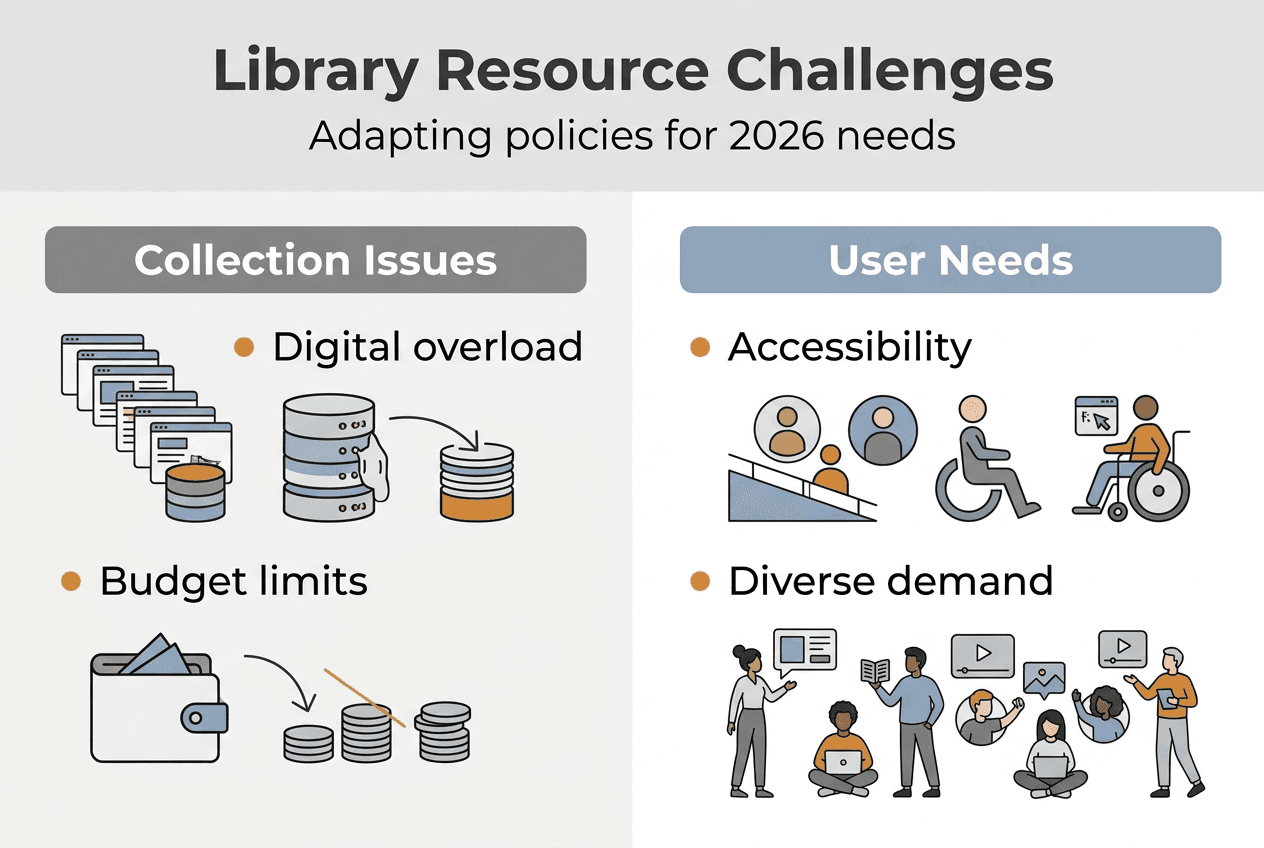
Effective management requires balancing learning outcomes with accessibility. Your policies must consider diverse user needs, technological capabilities, and long-term preservation requirements whilst maintaining flexibility to incorporate emerging formats and pedagogical approaches.
Preparing for effective management: assessing and planning your resources
Successful resource management begins with comprehensive assessment. Implement multi-tiered resource assessment processes that evaluate collections through multiple lenses simultaneously. This systematic approach prevents reactive decision-making and establishes clear priorities for resource allocation.
Follow these assessment steps:
- Gather quantitative usage data across all platforms and formats, tracking downloads, checkouts, and access patterns over multiple academic cycles.
- Conduct cost-per-use analysis comparing subscription expenses against actual utilisation to identify underperforming resources.
- Collect qualitative stakeholder feedback through surveys, focus groups, and direct consultations with educators and learners.
- Evaluate content relevance against current curriculum requirements and emerging educational priorities.
- Assess technical compatibility with existing systems and future infrastructure plans.
This data-driven framework reveals which resources deliver genuine value versus those consuming budget without proportional benefit. You'll discover surprising patterns, such as expensive databases with minimal usage or free resources generating significant engagement.
| Assessment Criterion | Data Source | Decision Outcome | | --- | --- | | Usage frequency | Platform analytics | Renewal priority ranking | | Cost efficiency | Financial records | Budget reallocation targets | | Curriculum alignment | Faculty consultation | Content gap identification | | Technical performance | User feedback | Platform migration needs | | Preservation requirements | Format analysis | Stewardship resource allocation |
Develop adaptive collection policies addressing contemporary challenges. Your policies should explicitly tackle the access versus ownership dilemma, recognising that perpetual ownership isn't always optimal for rapidly evolving content. Consider demand-driven acquisition models where resources are purchased only after demonstrated user interest, reducing speculative spending on materials that may never be used.
Address vendor ethics in your policy framework. Evaluate publishers and platforms based on fair pricing, transparent licensing terms, and commitment to accessibility standards. This ethical dimension ensures your resource investments support sustainable publishing ecosystems rather than exploitative business models.
Integrate your assessment findings with the library cataloguing process to ensure newly acquired materials are properly described and discoverable. Effective cataloguing transforms raw acquisitions into accessible knowledge resources.
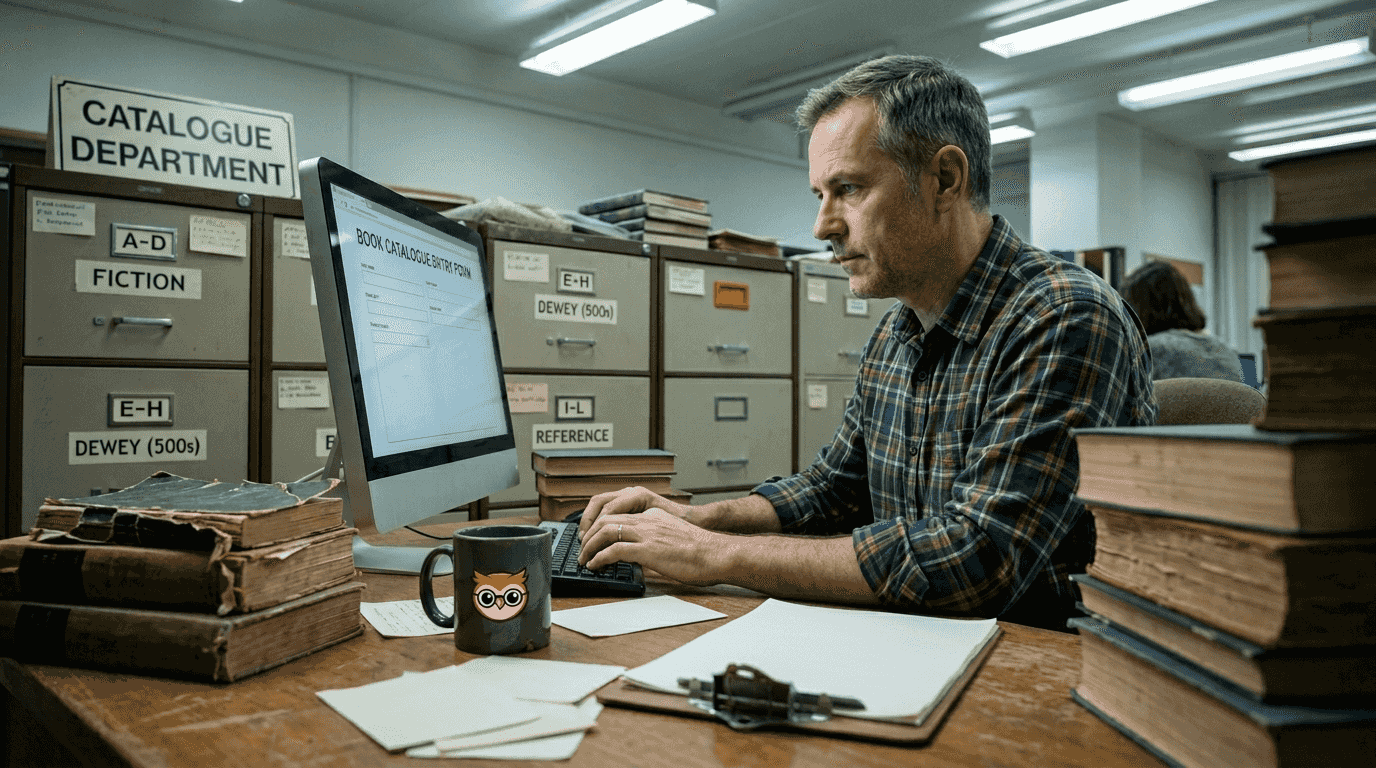
Pro Tip: Schedule quarterly policy reviews to maintain alignment with shifting educational demands and budget realities. Policies that remain static quickly become obstacles rather than enablers.
Executing efficient organisation and digital stewardship
Transition from planning to execution by leveraging specialised platforms designed for digital stewardship. JSTOR digital stewardship services demonstrate how migrating preservation responsibilities to dedicated providers reduces maintenance burden whilst improving long-term accessibility. These platforms handle complex metadata management, format migration, and technical infrastructure that would otherwise consume significant staff resources.
Specialised stewardship platforms offer distinct advantages:
- Automated preservation workflows maintaining content integrity across format changes
- Professional-grade metadata creation and enhancement improving discoverability
- Redundant storage systems protecting against data loss
- Compliance with evolving digital preservation standards
- Reduced technical debt as platforms absorb infrastructure maintenance
| Platform Feature | In-House Management | Specialised Stewardship | | --- | --- | | Metadata quality | Variable, staff-dependent | Consistent, professionally maintained | | Format migration | Manual, resource-intensive | Automated, seamless | | Storage redundancy | Limited by local infrastructure | Enterprise-grade, geographically distributed | | Standards compliance | Requires ongoing training | Built into platform operations | | Staff time required | Substantial ongoing commitment | Minimal oversight only |
Create interactive digital guides using tools like ThingLink to enhance resource organisation and accessibility. These platforms enable you to build multimedia guides integrating text, images, video, and embedded links within single interactive experiences. This approach supports asynchronous learning by providing self-guided exploration paths through complex resource collections.
Interactive guides excel for onboarding new users, explaining specialised collections, and creating subject-specific resource pathways. Students navigate at their own pace, revisiting sections as needed without requiring direct instructor intervention. This reduces repetitive reference questions whilst improving user confidence and independence.
Implement these organisational best practices:
- Establish consistent naming conventions across all digital assets for intuitive browsing
- Create hierarchical folder structures mirroring curriculum organisation
- Tag resources with multiple descriptors enabling discovery through varied search approaches
- Maintain separate collections for different user groups with appropriate access controls
- Document organisational logic in accessible guides preventing knowledge loss during staff transitions
Connect your organisation strategy with understanding the importance of bibliographies for maintaining scholarly integrity. Well-organised resources naturally support proper citation practices by making source information readily available.
Develop critical reading for education content skills amongst your user community. Organised collections facilitate comparison across sources, enabling learners to evaluate claims and identify authoritative materials.
Pro Tip: If staffing limitations prevent adequate stewardship, outsource preservation to specialised platforms rather than attempting inadequate in-house management. Poor preservation is worse than delegated professional stewardship.
Verifying quality and optimising space for future growth
As AI-generated educational content proliferates, rigorous quality verification becomes essential. Prioritise content quality evaluation focusing on authenticity, accuracy, legitimacy, and relevance as primary indicators. These dimensions ensure materials meet academic standards rather than merely appearing superficially credible.
Key quality dimensions for AI-generated content:
- Authenticity: Content reflects genuine expertise rather than algorithmic pattern matching without understanding
- Accuracy: Factual claims are verifiable and current, not outdated or fabricated information
- Legitimacy: Sources and methodologies are transparent and reproducible
- Relevance: Material addresses actual learning objectives rather than tangentially related topics
Apply this verification process systematically:
- Cross-reference factual claims against authoritative sources in the field, checking for consistency and currency.
- Evaluate source citations for legitimacy, ensuring referenced materials actually exist and support stated claims.
- Assess pedagogical appropriateness by comparing content structure and complexity against target learner characteristics.
- Test practical applications or examples provided, verifying they function as described.
- Review for bias or inappropriate content that could undermine educational objectives.
- Confirm licensing and usage rights permit intended educational applications.
This rigorous approach prevents low-quality AI content from contaminating your collection whilst identifying genuinely valuable algorithmically-generated materials. Not all AI content is problematic; some offers innovative explanations or synthesises information in helpful ways. Your verification process should distinguish quality from noise.
Optimise physical library space using library space optimisation technologies. The RLMSU methodology employing IoT sensors and reinforcement learning algorithms reduces congestion by 30% whilst increasing capacity by 25%. These systems monitor real-time space utilisation, predict peak demand periods, and dynamically adjust resource placement to match usage patterns.
Smart space optimisation delivers multiple benefits. Reduced congestion improves user experience, making libraries more inviting and functional. Increased capacity delays expensive expansion projects, stretching facility budgets further. Better space utilisation supports diverse learning activities by creating flexible zones adaptable to changing needs.
Implement IoT monitoring to track which areas experience heavy use versus underutilisation. This data reveals opportunities to repurpose space, relocate collections, or adjust furniture arrangements for improved flow. You might discover reference sections occupy prime real estate despite minimal traffic, whilst collaborative study areas are overcrowded.
Integrate physical space planning with digitising books for e-book distribution strategies. As materials transition to digital formats, reclaimed physical space can support new functions like maker spaces, multimedia production facilities, or expanded study areas.
Consider these space optimisation tactics:
- Implement compact mobile shelving for low-use physical collections, freeing floor space for active learning zones
- Create modular furniture arrangements easily reconfigured for varied activities
- Designate quiet zones separate from collaborative areas using acoustic treatments and spatial design
- Install wayfinding systems helping users navigate efficiently, reducing congestion at service points
- Establish clear circulation paths preventing bottlenecks during peak periods
Space optimisation isn't purely about cramming more materials into existing facilities. It's about creating environments that support diverse learning modes whilst maintaining comfortable, functional conditions. Your physical library should complement digital resources, offering experiences unavailable through screens alone.
Discover how BibliOWLteca can support your library resource management
Navigating the complexities of digital library management requires robust tools and strategic guidance. BibliOWLteca provides comprehensive infrastructure for educators and content creators managing educational resources at scale. Our platform streamlines assessment, organisation, and preservation workflows whilst supporting global distribution of your educational materials.
BibliOWLteca offers integrated solutions for digital delivery, payment processing across multiple currencies, and automated tax compliance, removing technical barriers to international content distribution. Whether you're publishing e-books, developing course materials, or curating specialised collections, our secure infrastructure handles the complexity whilst you focus on educational quality. Explore how BibliOWLteca empowers creators to transform knowledge into sustainable digital businesses reaching learners worldwide.
Frequently asked questions
How can I balance digital and physical resources effectively?
Maintain hybrid collections prioritising digital for frequently updated content and remote access needs, whilst preserving physical materials for subjects benefiting from tactile engagement. Conduct regular usage analysis to identify which formats best serve specific learning objectives and user preferences.
What is the best way to evaluate digital resource usage?
Implement multi-tiered assessment combining quantitative platform analytics with qualitative stakeholder feedback and cost-per-use calculations. Review data across multiple academic cycles to identify consistent patterns rather than temporary fluctuations.
Are there tools for creating interactive guides for students?
Platforms like ThingLink enable creation of multimedia interactive guides integrating text, images, video, and embedded links within single experiences. These tools support asynchronous learning by providing self-guided exploration paths through complex resource collections.
How do I ensure AI-generated content is reliable?
Verify authenticity, accuracy, legitimacy, and relevance by cross-referencing factual claims against authoritative sources, evaluating citation legitimacy, and testing practical applications. Establish systematic review processes preventing low-quality content from entering your collection.
Can I optimise physical library space with technology?
IoT sensors and smart analytics track real-time utilisation patterns, enabling data-driven decisions about resource placement and space allocation. These systems can reduce congestion by 30% and increase capacity by 25% through dynamic adjustments matching usage patterns.
Where can I find free digital resources for my collection?
Explore accessing free digital books to discover legitimate sources for high-quality educational materials. Many reputable platforms offer free resources suitable for academic collections whilst respecting copyright and licensing requirements.