
Research articles with well-documented bibliographies receive 23% more citations, yet many educators and content creators still treat them as mere formalities. Bibliographies are systematic lists of sources that establish transparency, enable verification, and protect intellectual property. This article explores their fundamental role in building credibility, dispels common misconceptions, compares citation styles, and provides practical guidance for integrating bibliographies into digital content to enhance trust and scholarly standards.
Table of Contents
- Introduction to bibliographies
- How bibliographies establish credibility and intellectual honesty
- Common misconceptions about bibliographies
- Comparative framework of bibliography styles and their roles
- Practical applications for digital content creators and educators
- Conclusion: elevating content through bibliographies
- Enhance your content credibility with BibliOWLteca
- Frequently asked questions
Key takeaways
| Point | Details |
|---|---|
| Bibliographies ensure intellectual honesty | They prevent plagiarism by acknowledging original sources and demonstrating ethical scholarship. |
| Source verification builds credibility | Readers can check claims independently, increasing trust in your content and professional reputation. |
| Citation styles serve different disciplines | APA, MLA, and Chicago each suit specific fields, affecting readability and scholarly rigour. |
| Omissions undermine trustworthiness | Even accurate content loses credibility when sources remain undocumented or inadequately cited. |
| Proper bibliographies enhance digital content | They transform educational materials into authoritative resources that audiences value and share. |
Introduction to bibliographies
A bibliography is a systematic list of sources consulted or cited in creating a piece of content. Its fundamental role centres on three pillars: source transparency, proper credit to original authors, and enabling readers to verify information independently. Without these elements, content exists in a vacuum, disconnected from the broader scholarly conversation.
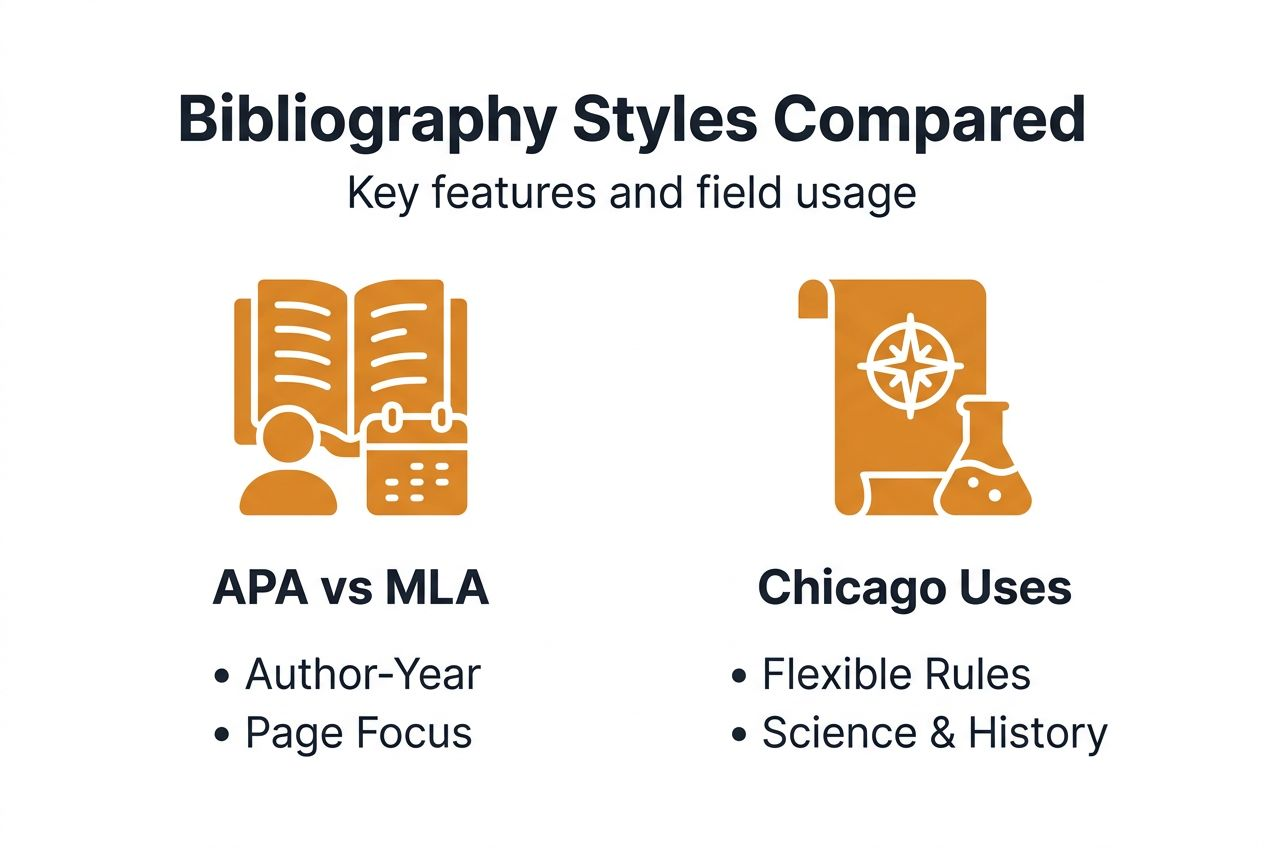
Three major citation styles dominate academic and professional writing. APA style, developed by the American Psychological Association, emphasises publication dates and suits social sciences where currency of research matters. MLA style, created by the Modern Language Association, focuses on authorship and page numbers, serving humanities disciplines like literature and philosophy. Chicago style offers two systems: notes and bibliography for historical research, and author-date for sciences.
Each style reflects disciplinary values. Social scientists need to see how recent findings are, whilst literary scholars care more about specific textual locations. Historians often work with archival materials requiring detailed provenance. These differences aren't arbitrary; they support how knowledge functions in each field.
Transparency through bibliographies establishes a foundation for intellectual honesty. When you cite sources openly, you invite scrutiny whilst demonstrating confidence in your research process. This openness separates credible scholarship from unverified claims, creating accountability that strengthens the entire knowledge ecosystem.
How bibliographies establish credibility and intellectual honesty
Transparency functions as the cornerstone of reader trust. When sources are visible and accessible, readers can follow your research trail and assess evidence quality themselves. This verification process doesn't challenge your authority; it reinforces it by proving your claims rest on solid foundations.
Bibliographies prevent plagiarism by making attribution explicit and systematic. Every idea, statistic, or framework borrowed from another thinker receives proper acknowledgement. This practice protects both creators and original authors, establishing clear intellectual property boundaries whilst enabling collaborative knowledge building.

The impact on credibility is measurable. Research papers with detailed bibliographies receive 23% more citations than those with sparse references. This isn't coincidental; thorough documentation signals rigorous methodology and increases confidence that findings are reproducible. Meanwhile, 35% of readers report scepticism towards research lacking clear bibliographic references, regardless of content quality.
Your scholarly reputation accumulates through consistent, meticulous citation practices. Each properly documented source adds to your credibility capital, demonstrating you understand academic conventions and respect intellectual traditions. This reputation becomes particularly valuable in digital spaces where audiences quickly assess trustworthiness before engaging deeply with content.
Reader trust extends beyond academic circles. Professional content creators, educators developing courses, and researchers sharing findings all benefit from transparent sourcing. When audiences see comprehensive bibliographies, they recognise someone who values accuracy over convenience, a quality that distinguishes authoritative voices from superficial commentary. Exploring why reading classic literature boosts thinking reveals how foundational texts shape intellectual development through properly documented influence.
"A bibliography transforms individual research into collective knowledge, creating bridges between past scholarship and future discoveries whilst establishing accountability in the present."
Common misconceptions about bibliographies
Many creators view bibliographies as bureaucratic requirements rather than substantive contributions to credibility. This misconception stems from educational experiences where citation formatting felt disconnected from actual learning. In reality, compiling a bibliography requires deep engagement with sources, forcing you to evaluate relevance, reliability, and relationships between ideas.
Some believe accurate content stands alone without supporting references. This ignores how knowledge functions in professional and academic contexts. Even factually correct claims need documentation because readers cannot distinguish well-researched content from plausible fabrication without source trails. Omission of bibliographies reduces credibility despite content accuracy, creating doubt where none should exist.
Disciplinary differences in bibliography importance cause confusion. Sciences demand extensive citation to position new findings within existing research landscapes. Humanities scholarship often engages deeply with fewer sources, requiring equally rigorous but differently structured bibliographies. Creative fields may use bibliographies less formally, yet even here, acknowledging influences strengthens rather than weakens original work.
The notion that bibliographies merely fulfil academic requirements misses their ethical dimension. They represent intellectual honesty, acknowledging that knowledge builds collectively rather than emerging fully formed from individual minds. This ethical foundation matters beyond formal education, shaping how professional communities maintain standards and public trust.
Some creators worry comprehensive bibliographies make content seem derivative rather than original. The opposite holds true: thorough citation demonstrates command of a field, showing you understand existing knowledge well enough to identify gaps and contribute meaningfully. Original insights gain power when positioned explicitly within broader scholarly conversations.
Comparative framework of bibliography styles and their roles
Understanding disciplinary preferences for citation styles helps you choose formats that serve your audience and enhance credibility. Each major style developed to address specific scholarly needs, creating distinct advantages for different content types.
| Style | Primary disciplines | Key characteristics | Best for |
|---|---|---|---|
| APA | Psychology, education, social sciences | Emphasises publication dates; author-year in-text citations | Research where currency matters; empirical studies |
| MLA | Literature, arts, humanities | Focuses on authorship; page numbers in citations | Textual analysis; close reading; literary criticism |
| Chicago | History, theology, business | Offers notes-bibliography or author-date systems | Archival research; detailed provenance; historical analysis |
APA style places publication year immediately after author names because social scientists need to assess whether findings remain current or have been superseded by newer research. This temporal emphasis affects how readers evaluate evidence credibility, making recency a primary consideration.
MLA style prioritises author identity and specific page references because humanities scholars engage closely with texts, often returning repeatedly to particular passages. Citations guide readers to exact locations for verification or deeper analysis, supporting interpretive rather than empirical inquiry.
Chicago style's flexibility accommodates historical research requiring extensive contextual notes whilst also serving scientific publications needing streamlined author-date formats. This versatility explains its adoption across diverse fields, though mastering both systems requires additional effort.
Style choice impacts readability significantly. In-text author-year citations interrupt prose less than numbered footnotes, improving flow for general audiences. However, footnotes allow detailed commentary without cluttering main text, valuable for complex scholarly arguments requiring substantial qualification.
Pro Tip: Select citation styles based on audience expectations rather than personal preference. If publishing in specific journals or academic fields, follow their prescribed format exactly. For broader audiences, choose the system that balances thoroughness with readability, prioritising transparency over stylistic consistency.
Practical applications for digital content creators and educators
Compiling accurate bibliographies requires systematic processes that balance efficiency with precision. Start by recording full source details immediately upon consultation, avoiding later scrambles to recover publication information. Include author names, titles, publication dates, publishers, URLs for digital sources, and access dates for web content.
Citation management tools like Zotero, Mendeley, or EndNote automate formatting and organisation, saving substantial time on large projects. However, always verify auto-generated citations manually. Software occasionally misinterprets source types or applies formatting incorrectly, errors that undermine credibility if published unchecked.
Integrating bibliographies visibly enhances transparency and user trust. Place them prominently at content end rather than hiding in appendices. For digital content, consider hyperlinking citations directly to sources when possible, enabling immediate verification. This practice particularly suits online courses, blog posts, and educational videos where audiences expect quick access to supporting materials.
Common errors include incomplete citations missing publication details, inconsistent formatting across entries, and outdated or broken links for digital sources. Creators with missing or flawed bibliographies face up to 25% decline in audience trust scores, demonstrating how technical errors carry reputational consequences.
Avoid these pitfalls through systematic checking:
- Verify each source exists and remains accessible before publication
- Ensure citation format consistency across all bibliography entries
- Double-check author names, titles, and publication details against original sources
- Test all hyperlinks functionality and update broken connections
- Review citation style guide current edition for recent formatting changes
- Consider peer review of bibliography completeness before final publication
Bibliographies serve as learning aids beyond mere documentation. When readers explore your sources, they discover additional perspectives and deepen their understanding of topics. This educational dimension transforms bibliographies from administrative requirements into valuable resources extending content utility.
Practical examples from digital educators demonstrate these principles. Online course creators embedding clickable citations within video transcripts enable learners to explore sources without disrupting viewing. Podcast hosts sharing episode bibliographies as downloadable PDFs support listener research. Blog writers linking related articles through properly cited references build interconnected knowledge networks.
Mastering critical reading skills in 2026 helps you evaluate source quality before citation, whilst understanding book selection strategies based on data improves bibliography relevance. The classic books checklist for educational content offers curated starting points for building authoritative reference lists.
External resources like best practices for digital teaching success and innovative teaching tools provide additional frameworks for integrating bibliographies into educational content effectively.
Pro Tip: Create a personal citation template matching your most frequent source types. This standardised format speeds bibliography compilation whilst ensuring consistency, letting you focus on content quality rather than formatting details.
Conclusion: elevating content through bibliographies
Bibliographies function as credibility pillars supporting every claim, argument, and insight you share. They transform isolated content into contributions within broader intellectual communities, establishing your work as part of ongoing scholarly conversations rather than disconnected commentary.
Academic integrity and lifelong learning both depend on transparent sourcing practices. When you cite thoroughly, you model intellectual honesty for audiences whilst building habits that enhance your own research skills. Each bibliography you compile strengthens your ability to evaluate sources, synthesise information, and contribute meaningfully to your field.
Adopt rigorous bibliography practices not as burdensome obligations but as professional standards distinguishing authoritative voices from casual commentators. This commitment pays dividends through enhanced reputation, increased audience trust, and greater content impact. Your bibliographies become signatures of quality, signalling to readers that your work merits serious attention and engagement.
View bibliographies as contributions to scholarly community dialogue. Every source you cite acknowledges intellectual debts whilst enabling others to build on your work, perpetuating knowledge creation cycles that benefit entire fields. This collaborative dimension elevates individual content into collective progress.
Enhance your content credibility with BibliOWLteca
Mastering bibliographic practices transforms educational content from informative to authoritative, building trust that converts casual readers into engaged audiences. BibliOWLteca provides the infrastructure and tools content creators need to publish credible, properly documented educational materials whilst reaching global audiences.

Our platform supports educators and researchers in creating professional digital products that meet scholarly standards without technical complexity. From citation management guidance to international distribution capabilities, we simplify the process of turning well-researched knowledge into successful digital offerings that audiences value and trust.
Frequently asked questions
Why is it necessary to include a bibliography even if I use few sources?
Even minimal sources require citation to ensure transparency and establish trust with readers. Omission can raise suspicion about accuracy or suggest plagiarism, undermining credibility regardless of content quality. Documentation demonstrates intellectual honesty and invites verification.
How can I ensure my bibliography is error-free?
Use reliable citation tools as a first step to automate formatting and organisation. Always cross-check source details and formatting manually against style guides, as software occasionally misinterprets source types. Systematic verification before publication prevents errors that damage professional reputation.
Which bibliography style should I choose for a multidisciplinary project?
Consider your audience composition and the primary discipline focus when selecting citation formats. When uncertain, choose a widely accepted, clear style like APA that balances thoroughness with readability. Consistency matters more than perfect style matching for interdisciplinary work reaching diverse audiences.