Producing an e-book or online course without a bibliography is a bit like publishing research without evidence. Many creators skip this step entirely, assuming it only matters in academic circles, yet the absence of proper citations quietly erodes audience trust and exposes you to copyright risk. Whether you are building your first digital course or refining a series of e-books, getting your bibliography right signals professionalism and depth. This guide walks you through every stage, from gathering source details to verifying your final list, with style-specific advice tailored for digital products.
Table of Contents
- Why bibliographies matter for digital content
- Preparation: What you need before starting your bibliography
- How to build a bibliography: Step-by-step process
- Troubleshooting: Common mistakes and tricky cases
- Verifying your bibliography and maximising impact
- A practitioner's take: What most guides miss about bibliographies for digital products
- Boost your content credibility with easy bibliography tools
- Frequently asked questions
Key Takeaways
| Point | Details |
|---|---|
| Choose the right style | Select APA, MLA or Chicago based on your audience and purpose for the most professional results. |
| Verify every entry | Manual checks catch common mistakes that citation generators can introduce. |
| Enhance value with annotations | Adding notes or summaries to your bibliography can increase engagement in online courses and e-books. |
| Always include digital access info | List DOIs or URLs for online sources to ensure readers can easily verify and access your materials. |
Why bibliographies matter for digital content
A bibliography is more than a formality. It is a signal to your readers that your content is grounded in real research, not opinion dressed up as fact. For digital creators, this matters enormously because your audience cannot see your bookshelf or assess your credentials in person. Your bibliography does that work for you.
Bibliography credibility is one of the most underestimated assets in digital publishing. When learners see a well-organised list of sources at the end of your course module or e-book chapter, they feel confident that the material has substance. This confidence translates directly into better reviews, stronger word-of-mouth, and higher completion rates.
The reference source impact extends beyond trust. Proper attribution protects you legally by demonstrating that you have credited the original authors of ideas and data you have used. Skipping citations, even unintentionally, can constitute copyright infringement, particularly when reproducing statistics, charts, or substantial passages.
For course creators, there is an additional dimension. An annotated bibliography, which lists consulted sources including books, websites, and journals while adding summaries and assessments, can become a genuine learning resource in its own right. Students who see concise evaluations of each source gain a clearer picture of where to go next.
Here is what a strong bibliography achieves for your digital product:
- Demonstrates the depth and rigour of your research
- Protects you from plagiarism and copyright claims
- Helps learners explore topics further
- Positions you as a credible authority in your subject
- Supports reading list engagement by pointing learners to high-quality further reading
"A bibliography is not just a list. It is the foundation that holds your intellectual argument upright."
For a thorough grounding in citation mechanics, the comprehensive tutorial from Purdue OWL covers formatting, in-text citations, and bibliography pages in detail. With the purpose clear, let's look at what you need before you start building your bibliography.
Preparation: What you need before starting your bibliography
Rushing into formatting before you have the right information is the single biggest cause of incomplete bibliographies. Good preparation saves hours of backtracking later.
Start by collecting the core details for every source you have used. The exact fields vary by style, but you will almost always need:
- Author name(s) including initials or full first names depending on style
- Title of the work and, if applicable, the title of the journal or book series
- Publication year and edition if relevant
- Publisher and place of publication for books
- URL or DOI for any online or digital source
- Access date for web pages that may change over time
Choosing the right citation style early is critical. The citation style comparison between APA, MLA, and Chicago shows clear differences in how each handles author names, dates, and digital sources. Use this table as a quick reference:
| Style | Best for | Date placement | Digital sources |
|---|---|---|---|
| APA | Education, psychology, sciences | After author | DOI or URL required |
| MLA | Humanities, literature | End of entry | URL in angle brackets |
| Chicago | History, publishing | Footnotes or after author | URL with access date |
For most e-books and online courses aimed at general learners, APA is the most widely recognised and accepted. If your content sits firmly in the humanities, MLA works well. Chicago suits history-focused or publisher-oriented projects.
Once you have chosen your style, set up a reference manager. Tools such as Zotero, Mendeley, or even a well-structured spreadsheet help you capture source details as you research, rather than scrambling to find them later. The educational book checklist at BibliOWLteca includes source-tracking as a key pre-production step for exactly this reason.
Purdue OWL provides tutorials covering mechanics like formatting references, in-text citations, and bibliography pages, making it an excellent free resource to bookmark. Understanding library research success principles also helps you evaluate which sources deserve a place in your bibliography.
Pro Tip: Keep a running source log in a simple document as you write. Record every source the moment you consult it. Trying to reconstruct your research trail after the fact is tedious and error-prone.
With your materials ready, move on to building your bibliography step by step.
How to build a bibliography: Step-by-step process
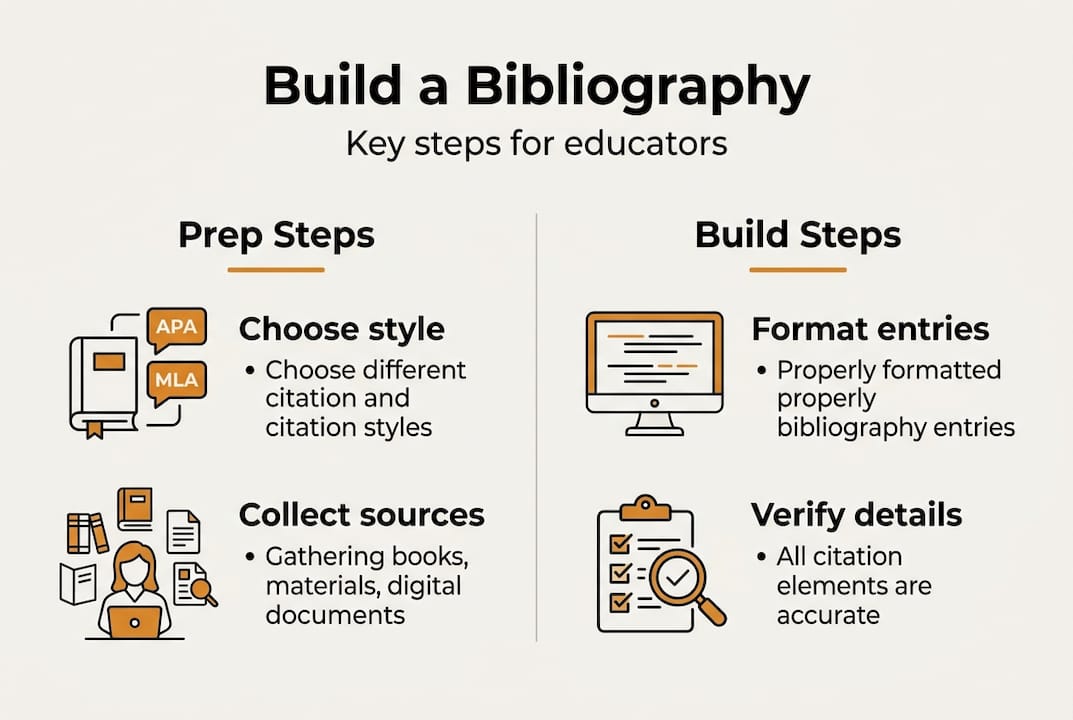
Building a credible bibliography follows a consistent logic regardless of which style you use. The process below applies to e-books, courses, and any other digital educational product.
- Compile your full source list. Pull together every source you consulted, not just those you directly quoted. A bibliography covers all works that informed your thinking.
- Identify the source type. Is it a book, journal article, website, podcast, or e-book? Each type has its own format within every style guide.
- Format each entry. Apply the rules for your chosen style. For APA, the author's surname comes first, followed by the publication year in brackets. For Chicago, bibliography entries invert author names and alphabetise the list by surname.
- Add digital access details. For e-books in APA 7th edition, include DOI or URL if freely accessible, using the same format as print books otherwise, with full publisher details.
- Arrange entries alphabetically by the author's surname. If no author is listed, alphabetise by the first significant word of the title.
- Apply hanging indents. The first line of each entry sits flush with the left margin; subsequent lines are indented. This is standard across APA, MLA, and Chicago.
- Proofread every entry. Check author names, publication years, and URLs carefully. A broken link or misspelled name undermines the professionalism of your entire product.
Here is a quick comparison of how the same book entry looks across styles:
| Style | Example format |
|---|---|
| APA | Smith, J. (2022). Learning by design. Oxford University Press. |
| MLA | Smith, Jane. Learning by Design. Oxford University Press, 2022. |
| Chicago | Smith, Jane. Learning by Design. Oxford: Oxford University Press, 2022. |
For detailed worked examples across source types, the APA examples document from the APA Style website is the most reliable reference available.
Pro Tip: Always paste URLs into your browser to confirm they still resolve before finalising your bibliography. Dead links in a published e-book look careless and frustrate readers.
Even with clear instructions, edge cases often create confusion. Let's address these next.
Troubleshooting: Common mistakes and tricky cases
Even experienced creators run into situations where the standard rules do not quite fit. Knowing how to handle these edge cases keeps your bibliography consistent and accurate.
The most common issues and their solutions:
- Multiple authors: In APA, list up to 20 authors; beyond that, use et al. after the first author with an ellipsis before the final name. In MLA, list the first author and add "et al." after the third.
- No author listed: Start the citation with the title of the work. Alphabetise it by the first significant word, ignoring articles like "the" or "a".
- No date available: Use n.d. in place of the year across APA and Chicago. In MLA, simply omit the date field.
- Missing DOI or URL: For digital content, flag the source and attempt to locate a stable link. If none exists, note the database or platform where you accessed it. The APA e-books rules clarify when URLs are required versus optional.
- Auto-generated citations: Reference management tools and citation generators are useful starting points, but they frequently introduce errors in punctuation, capitalisation, or field order. Always verify the output manually.
You can manage library resources more effectively by tagging sources with their citation status as you go, noting which entries are complete and which still need a URL or publication detail.
"Citation generators are a shortcut, not a substitute for understanding the style rules yourself."
Understanding bibliometrics for citations can also help you prioritise which sources carry the most academic weight, particularly useful when curating a reading list for a course.
Pro Tip: After generating citations automatically, run a quick spot-check against the official style guide for at least three entries. If you find errors, review the entire list manually.
Once you have verified your bibliography is accurate, consider how this process improves your digital products' value.
Verifying your bibliography and maximising impact
A bibliography that is almost right is still wrong. Verification is not optional; it is the step that separates polished digital products from rushed ones.
Work through this checklist before publishing:
- Hanging indents applied consistently across every entry
- Alphabetical order confirmed, including entries beginning with numbers or non-Latin characters
- All URLs and DOIs tested and confirmed as live
- Author names spelled correctly and formatted to the chosen style
- Publication years accurate and consistent with the in-text citations
- No duplicate entries from accidentally logging the same source twice
Consistent double-checking of formatting, hanging indents, and precise alphabetisation is the standard recommendation from APA's own instructional guidance. It sounds mechanical, but this level of care is what readers notice, even if they cannot articulate why one e-book feels more trustworthy than another.
Annotated bibliographies deserve special attention here. Adding a two to three sentence summary and evaluation beneath each entry transforms a compliance exercise into a genuine learning tool. For course creators, this can meaningfully increase the perceived value of your material and support learners who want to go deeper.
A well-verified bibliography also pays dividends when you update your content. If your book inventory retrieval system is well-organised, refreshing citations for a new edition becomes a manageable task rather than a full rebuild.
Consider presenting your bibliography with brief section headings if it is long, grouping sources by topic or chapter. This makes it far more navigable for digital readers who are scanning rather than reading linearly.
A practitioner's take: What most guides miss about bibliographies for digital products
Most bibliography guides are written for print academics. They focus on compliance: get the punctuation right, alphabetise correctly, done. For digital creators, that framing misses the point entirely.
When your reader is consuming an e-book on a tablet or working through a course module on their phone, a static list of sources at the back is nearly invisible. What actually adds value is a bibliography with clickable links, brief annotations, and a clear sense of why each source was chosen. That is a fundamentally different product from a formatted list.
The educational books checklist reflects this thinking. Bibliography building for digital products should be treated as content design, not admin. Every source you include is an implicit recommendation to your learner. Treat it that way.
Verification matters more in digital publishing than in print because errors are public and permanent until you push an update. Audience-focused tailoring, meaning choosing sources your specific readers will actually find useful, is what separates a bibliography that adds value from one that merely satisfies a checklist.
Boost your content credibility with easy bibliography tools
Building a well-structured bibliography is one of the most effective ways to strengthen the credibility of your digital products. If you are ready to take your e-books and courses to the next level, BibliOWLteca is built for exactly that.

Our platform gives creators the infrastructure to publish, sell, and distribute educational content globally, with the professional presentation your work deserves. From managing your digital store to reaching international learners, BibliOWLteca handles the technical side so you can focus on the content. Explore online bibliography tools and the full suite of creator resources available on the platform. Your knowledge is worth presenting properly.
Frequently asked questions
What styles are best for e-books and online courses?
APA is preferred for educational and scientific materials, MLA suits humanities content, and Chicago works well for history or publishing projects. APA prioritises recency with author-date format, so always consider your subject area and audience when choosing.
Do I need to include URLs for digital sources?
Yes. Include DOI or URL if freely accessible for all digital sources in APA 7th edition, and follow equivalent rules in MLA and Chicago to ensure readers can locate the original material.
How should I cite a source with no author or no date?
When no author is listed, start with the title and alphabetise accordingly. For undated sources, use n.d. in place of the publication year across APA and Chicago styles.
Why double-check auto-generated bibliographies?
Auto-generators frequently introduce punctuation errors, incorrect capitalisation, or wrong field order. Always verify auto-generated citations manually against the official style guide before publishing.
Is annotating my bibliography necessary for digital courses?
Annotated bibliographies add summaries and assessments that help learners evaluate sources independently, making them particularly valuable for courses where deeper engagement is a goal.