
Many content creators and educators dismiss bibliometrics as dry academic statistics, yet these quantitative insights reveal exactly which publication strategies amplify your research visibility and credibility. Understanding how citation patterns, collaboration networks, and field trends shape academic influence transforms how you position your work in competitive scholarly landscapes. This article unpacks practical bibliometric methods that help you identify productive journals, forge strategic partnerships, and benchmark your performance against peers, turning raw data into actionable steps for maximising research impact.
Table of Contents
- What is bibliometrics and why does it matter?
- Key bibliometric methods and tools explained
- Using bibliometrics to optimise your publication and collaboration strategy
- Challenges and responsible use of bibliometric metrics
- Enhance your research with bibliowlteca's expert tools and resources
- Frequently asked questions about bibliometrics
Key takeaways
| Point | Details |
|---|---|
| Quantitative analysis | Bibliometrics measures research performance through citation counts, collaboration patterns, and publication trends |
| Strategic applications | Identify high-impact journals, potential collaborators, and emerging topics to optimise your publication strategy |
| Multiple methods | Citation analysis, co-authorship networks, and science mapping reveal different dimensions of research influence |
| Responsible use | Context-normalised metrics and multi-indicator approaches prevent misleading comparisons across fields |
| Practical tools | Free software like VOSviewer and bibliometrix enable educators to perform sophisticated analyses without specialised training |
What is bibliometrics and why does it matter?
Bibliometrics represents the quantitative study of publications to measure research performance, impact, visibility, and trends in publication, citation, and collaboration. Rather than subjective impressions, bibliometrics delivers measurable evidence of how your work influences scholarly conversations and practical applications.
For content creators and educators, bibliometric analysis serves multiple strategic purposes. You can assess which of your publications generate the most citations, revealing which topics resonate strongest with your audience. Tracking collaboration patterns shows which partnerships produce the highest-impact work. Monitoring field-wide trends helps you anticipate emerging topics before they become saturated.
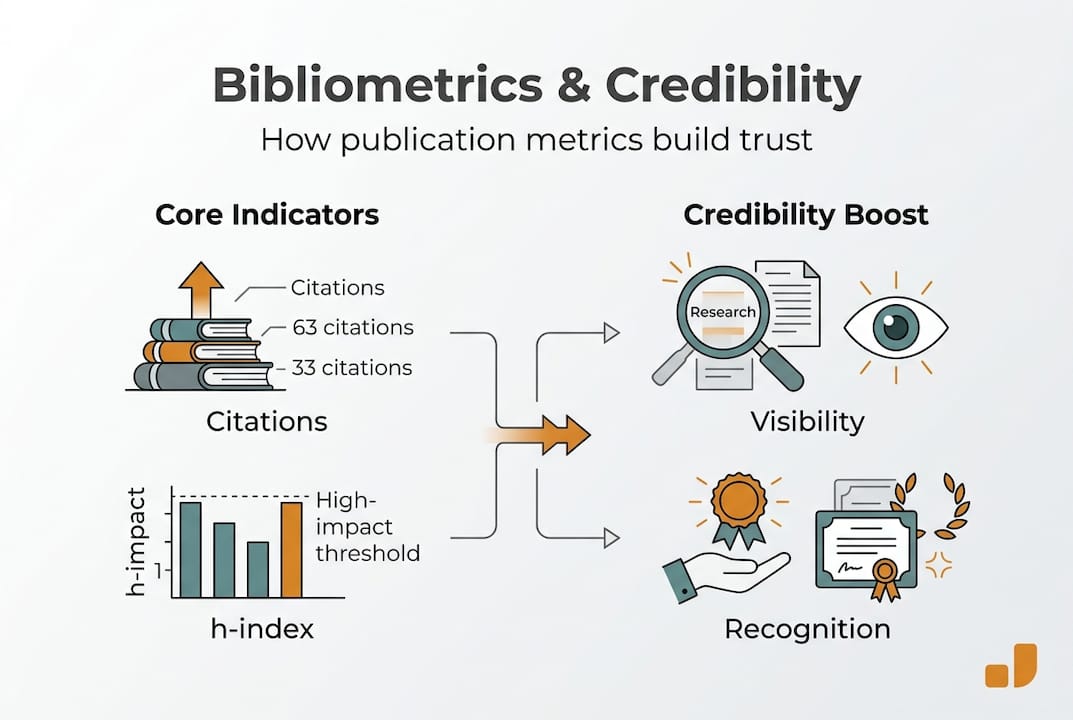
Institutions rely heavily on bibliometric indicators for research assessment, university rankings, hiring decisions, and promotion reviews. Understanding these metrics helps you position your portfolio competitively. When you grasp how citation counts, h-index values, and journal impact factors shape perceptions of scholarly contribution, you can make informed decisions about where to publish and whom to collaborate with.
Bibliometric insights transform abstract publication records into concrete strategic intelligence, revealing patterns invisible through casual observation.
The connection between bibliometrics and content credibility matters enormously for educators building authoritative educational materials. When you cite highly-cited sources or collaborate with productive researchers, you signal to readers that your content rests on solid scholarly foundations. This credibility translates directly into audience trust and professional reputation.
However, responsible use remains essential. Bibliometrics should complement, not replace, qualitative peer review. Numbers reveal patterns but cannot capture the nuance of theoretical innovation or methodological creativity. The most effective approach combines quantitative metrics with expert judgement, using bibliometrics to identify promising directions whilst relying on deep reading to assess actual quality.
Key bibliometric methods and tools explained
Several core methodologies form the foundation of bibliometric analysis, each revealing different dimensions of research influence. Citation analysis tracks how frequently other scholars reference a particular work, providing direct evidence of intellectual impact. High citation counts suggest that a publication introduced valuable concepts, methods, or findings that subsequent researchers found useful.
Co-citation analysis examines which papers researchers cite together, revealing conceptual relationships between works. When two publications frequently appear in the same reference lists, they likely address related problems or contribute to the same theoretical conversation. This method helps map the intellectual structure of research fields, showing which works form foundational clusters.
Bibliographic coupling identifies similarities between publications based on shared references. If two recent papers cite many of the same sources, they probably tackle similar questions using comparable approaches. This technique proves particularly useful for discovering relevant recent work in your field that you might have missed.
Co-authorship network analysis maps collaboration patterns, showing which researchers work together and how knowledge flows between institutions or countries. These networks reveal potential collaboration opportunities and help you understand the social structure of your research community. Identifying central figures in collaboration networks can guide strategic partnership decisions.
Keyword analysis tracks the frequency and co-occurrence of terms in titles, abstracts, and author keywords. This method identifies trending topics, emerging themes, and conceptual shifts within fields. Monitoring keyword patterns helps you anticipate which research directions will attract future attention and funding.
Science mapping synthesises multiple bibliometric techniques to create visual representations of research landscapes. These maps show relationships between topics, authors, institutions, and countries, providing intuitive overviews of complex scholarly ecosystems.
Pro Tip: Start with VOSviewer for visualising citation and co-authorship networks, then progress to bibliometrix in R for more sophisticated statistical analyses once you're comfortable with basic concepts.
Three powerful tools make these methods accessible to content creators without extensive technical training:
- VOSviewer creates intuitive network visualisations from citation and bibliographic data, perfect for exploring collaboration patterns and conceptual structures
- CiteSpace specialises in detecting emerging trends and identifying pivotal publications that bridge different research areas
- bibliometrix offers comprehensive analysis capabilities through R, supporting everything from basic descriptive statistics to advanced science mapping
These free tools democratise bibliometric analysis, enabling educators to perform sophisticated literature reviews that once required specialised expertise. Modern interfaces have simplified data import and visualisation, making it feasible to analyse thousands of publications in hours rather than weeks.
Using bibliometrics to optimise your publication and collaboration strategy
Strategic journal selection represents one of the most valuable applications of bibliometric analysis. By examining citation patterns and productivity metrics, you can identify which journals in your field attract the most citations per article and publish the most influential work. This intelligence helps you target venues where your research will gain maximum visibility.
- Analyse citation distributions across journals in your field, noting which publications consistently produce highly-cited articles rather than relying solely on average impact factors
- Examine author profiles of researchers whose work aligns with yours, identifying where they publish their most-cited papers
- Track which journals publish emerging topics you're interested in, positioning yourself at the forefront of developing conversations
- Consider publication speed and acceptance rates alongside impact metrics, balancing visibility with practical publishing timelines
Co-authorship network analysis reveals collaboration opportunities you might otherwise overlook. By mapping who works with whom, you can identify researchers whose expertise complements yours and who maintain productive partnerships. Look for scholars who bridge different research communities, as collaborating with them can expose your work to new audiences.

Pro Tip: Focus on researchers with moderate collaboration networks rather than only targeting the most prolific authors, as smaller partnerships often produce more substantive engagement and faster publication timelines.
Tracking emerging topics through keyword analysis helps you stay ahead of field developments. When you notice certain terms appearing with increasing frequency in recent publications, you've identified themes gaining traction. Publishing on emerging topics before they become saturated positions you as an early contributor, potentially earning more citations as the field develops.
Benchmarking your performance against peers provides realistic context for assessing your research impact. Compare your citation counts, h-index, and publication rates with researchers at similar career stages in your field. This comparison reveals whether you're meeting, exceeding, or falling short of typical productivity levels, informing decisions about publication pace and collaboration intensity.
| Journal Feature | High Impact Option | Emerging Option | Rapid Publication | | --- | --- | --- | | Average citations per article | 25+ | 8-15 | 5-10 | | Publication frequency | Quarterly | Bi-monthly | Monthly | | Acceptance rate | 15-20% | 30-40% | 45-55% | | Time to publication | 12-18 months | 6-9 months | 3-6 months | | Field coverage | Broad, established | Focused, developing | Varied, opportunistic |
This strategic approach transforms bibliometrics from abstract statistics into practical decision-making tools. Rather than publishing wherever you happen to submit first, you can deliberately target venues and collaborations that maximise your research visibility and influence.
Challenges and responsible use of bibliometric metrics
Bibliometric indicators carry inherent biases that can distort comparisons if applied carelessly. Citation practices vary dramatically across disciplines, with biomedical fields typically generating far more citations than humanities or social sciences. Comparing raw citation counts between a molecular biologist and an education researcher produces meaningless results, as the underlying publication and citation cultures differ fundamentally.
Self-citation practices introduce another complication. Whilst citing your own previous work appropriately builds on established foundations, excessive self-citation artificially inflates citation counts without reflecting genuine external impact. Some researchers systematically cite their earlier publications in every new paper, gaming bibliometric systems.
Field-normalised metrics address disciplinary differences by comparing researchers only within their specific domains. The Normalised Citation Score divides a publication's citation count by the average for similar papers in the same field and year. This contextualisation enables fairer comparisons, though it requires more sophisticated analysis than raw counts.
All metrics carry biases and limitations, demanding normalisation, contextual interpretation, and integration with qualitative peer review rather than blind reliance on numerical rankings.
Over-reliance on Journal Impact Factor represents a particularly problematic practice. JIF measures average citations to a journal's recent articles, not the impact of any individual publication. Publishing in a high-JIF journal doesn't guarantee your specific article will be highly cited. Many low-cited papers appear in prestigious journals, whilst groundbreaking work sometimes emerges from modest venues.
Responsible bibliometric practice demands multi-metric approaches that triangulate evidence from multiple indicators:
- Combine citation counts with qualitative assessments of theoretical contribution and methodological innovation
- Use h-index alongside total citations to balance productivity with sustained impact
- Consider field-normalised metrics when making cross-disciplinary comparisons
- Examine collaboration patterns and institutional affiliations to understand research context
- Track altmetrics like social media mentions and policy citations for broader impact evidence
The San Francisco Declaration on Research Assessment provides essential principles for fair evaluation. DORA emphasises eliminating journal-based metrics from individual assessment, recognising diverse research outputs beyond traditional articles, and providing transparent evaluation criteria. Following these guidelines ensures that bibliometric analysis supports rather than distorts research assessment.
For content creators and educators, responsible use means presenting bibliometric evidence alongside qualitative context. When citing highly-cited sources, explain why those works matter beyond their citation counts. When discussing collaboration networks, acknowledge that productive partnerships depend on interpersonal dynamics that numbers cannot capture. Use metrics to identify patterns worth investigating further, not as definitive judgements of quality.
Enhance your research with bibliowlteca's expert tools and resources
Navigating bibliometric analysis becomes significantly easier when you access comprehensive guidance and practical tools designed specifically for content creators and educators. Bibliowlteca offers curated resources that demystify citation analysis, collaboration mapping, and strategic publication planning, translating complex methodologies into actionable steps.

Our platform connects you with tutorials covering everything from basic VOSviewer visualisations to advanced bibliometrix analyses, ensuring you can leverage bibliometric insights regardless of your technical background. Whether you're identifying productive journals, mapping collaboration opportunities, or benchmarking your research performance, Bibliowlteca provides the frameworks and support to transform raw data into strategic intelligence. Explore our critical reading and analysis resources to enhance both your bibliometric capabilities and your broader research literacy.
Frequently asked questions about bibliometrics
What are the main bibliometric indicators used today?
The most widely used indicators include citation counts measuring how often others reference your work, the h-index balancing productivity with impact, and Journal Impact Factor reflecting average citations to a journal's recent articles. Field-normalised metrics like Normalised Citation Score enable fairer cross-disciplinary comparisons by accounting for different citation cultures.
How can bibliometrics help identify research collaboration opportunities?
Co-authorship network analysis maps existing collaboration patterns, revealing researchers who work on similar topics and maintain productive partnerships. By identifying scholars who bridge different research communities or institutions, you can discover potential collaborators whose expertise complements yours. Examining collaboration networks also shows which partnerships produce the most highly-cited work.
Are bibliometric metrics equally reliable across all fields?
No, citation practices vary dramatically between disciplines, making raw comparisons misleading. Biomedical fields generate far more citations than humanities or theoretical mathematics due to larger research communities and different publication cultures. Always use field-normalised metrics when comparing researchers across disciplines, and combine quantitative indicators with qualitative peer review for fair assessment.
How do I ensure responsible use of bibliometric data?
Follow DORA principles by avoiding journal-based metrics for individual assessment, recognising diverse research outputs, and providing transparent evaluation criteria. Use multiple indicators rather than relying on single metrics, contextualise numbers with qualitative judgement, and apply field-normalised measures for cross-disciplinary comparisons. Never let bibliometrics replace peer review, only complement it.
Which free tools are best for beginners to perform bibliometric analysis?
VOSviewer offers the most intuitive starting point, creating clear network visualisations from citation and collaboration data without requiring programming skills. Once comfortable with basic concepts, explore bibliometrix in R for more sophisticated statistical analyses. Both tools provide extensive documentation and active user communities, making it feasible to perform professional-quality bibliometric studies without specialised training or expensive software licences.