
Many creators believe citations are optional, reserved for academic papers or formal research. This misconception costs them dearly. Readers today demand trustworthy content backed by reliable evidence, and search engines reward creators who demonstrate expertise through proper referencing. Without citations, even well-researched content appears unsubstantiated and risks losing audience trust. This guide explains why referencing sources builds credibility, enriches learning experiences, protects your professional reputation, and amplifies your content's reach in an increasingly sceptical digital landscape.
Table of Contents
- The role of citations in establishing credibility
- Protecting reputation and avoiding plagiarism with citations
- How citations improve discoverability and content impact
- Best practices for managing and integrating reference sources
- Explore BibliOWLteca for citation and research support
Key takeaways
| Point | Details |
|---|---|
| Credibility foundation | Citations demonstrate your content is research-based, not guesswork, building immediate audience trust. |
| Legal protection | Proper referencing prevents plagiarism accusations and honours original authors' intellectual property rights. |
| Search visibility | Well-cited content signals expertise to algorithms, improving rankings and attracting valuable backlinks. |
| Reader engagement | References allow audiences to verify claims and explore topics deeper, increasing dwell time. |
| Professional integrity | Accurate citation management maintains your reputation and prevents costly mistakes. |
The role of citations in establishing credibility
When you publish educational content without citations, readers subconsciously question every claim you make. Citing sources enhances credibility by informing audiences where information originates, transforming your assertions into verifiable facts. This transparency builds immediate trust, particularly crucial for educators and content creators competing in saturated markets.
Search engines interpret citations as authority signals. When you reference peer-reviewed studies or reputable industry sources, algorithms recognise your content as expert-level material worthy of higher rankings. Readers who master critical reading skills actively seek referenced content because citations enable them to evaluate source quality independently.
Consider how work grounded in research carries more weight than intuition-based content. Audiences recognise the difference instantly. A claim about learning retention rates means nothing without supporting evidence. Reference a Stanford study, and suddenly your content becomes authoritative.
The psychological impact cannot be overstated. Readers follow citations to verify claims, which paradoxically increases their trust even before checking sources. This behaviour demonstrates that citations function as trust signals beyond their informational value. Your audience interprets referenced content as professionally vetted, regardless of whether they click through.
Pro Tip: Place citations immediately after specific claims rather than clustering them at paragraph ends. This precision shows readers exactly which facts you've verified, strengthening credibility for each individual assertion.
Credible sources serve as trust signals to audiences, editors, and search algorithms simultaneously. When multiple authoritative references support your content, you position yourself as a curator of reliable information rather than merely another voice adding noise. This distinction separates successful creators from those struggling to build engaged audiences.
Modern learners approach content sceptically, trained by misinformation to question unsupported claims. Citations answer their doubts before they form, creating smoother reading experiences that keep audiences engaged longer. Higher engagement metrics signal quality to platforms, creating a virtuous cycle where well-referenced content receives preferential algorithmic treatment.
Protecting reputation and avoiding plagiarism with citations
Your professional reputation hinges on precise citations that eliminate plagiarism risks and misquoting dangers. Many creators accidentally commit intellectual property violations through careless referencing practices, unaware that paraphrasing without attribution constitutes plagiarism just as much as copying text verbatim.

Source-based plagiarism remains prevalent because creators misunderstand citation requirements. Simply changing a few words whilst maintaining the original structure still requires attribution. Readers and algorithms alike detect these violations, damaging your credibility permanently once discovered. The solution lies in systematic citation management from your research phase onwards.
Ethical referencing honours original authors' contributions whilst protecting your professional standing. When you cite properly, you demonstrate respect for intellectual property and scholarly tradition. This practice builds trust with both audiences and fellow creators, opening collaboration opportunities that strengthen your professional network.
Consider these common citation failures:
- Paraphrasing without attribution, assuming word changes eliminate citation needs
- Citing secondary sources without verifying original research, spreading inaccuracies
- Omitting page numbers or specific locations, making verification impossible
- Mixing citation styles inconsistently, confusing readers and appearing unprofessional
Pro Tip: Create a citation spreadsheet during research, logging every source with full details immediately. This prevents the frustrating scramble to relocate references when finalising content, saving hours whilst ensuring accuracy.
Proper citation in academic writing gives credit and avoids plagiarism, but these principles extend far beyond academia. Content creators publishing online courses, e-books, or educational materials face identical ethical obligations. Your audience expects transparency about information sources, and platforms increasingly enforce intellectual property standards.
Managing citation lists carefully prevents confusion that leads to accidental misattribution. When juggling multiple sources, disorganisation causes errors like attributing findings to wrong authors or citing outdated versions of evolving research. These mistakes undermine your authority just as severely as intentional plagiarism, yet remain entirely preventable through systematic practices.
Educators accessing free books for research must track which ideas originate from which sources meticulously. The abundance of available information makes proper attribution more challenging but simultaneously more critical. Your reputation depends on demonstrating you've done this intellectual work responsibly.
How citations improve discoverability and content impact
Linking to authoritative sources signals confidence to algorithms, telling search engines your content is well-researched and trustworthy. This directly impacts your visibility through Google's E-E-A-T framework, which evaluates expertise, experience, authoritativeness, and trustworthiness when ranking content.
Well-cited content achieves higher dwell time because engaged readers follow references to explore topics deeper. Search engines interpret extended session durations as quality signals, boosting your rankings further. This creates a reinforcing cycle where better citations lead to better engagement, which leads to better visibility.
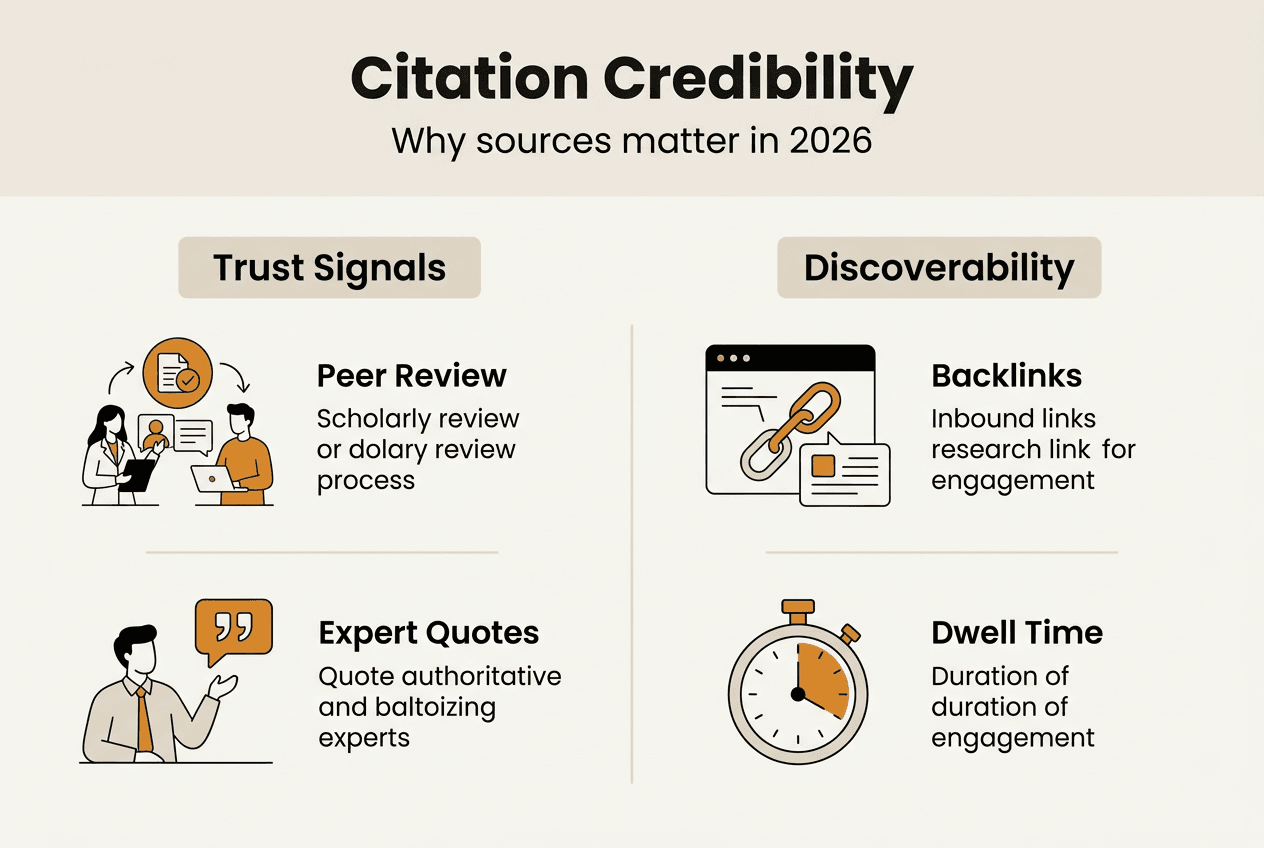
Content backed by reliable references attracts backlinks from other credible sites, exponentially increasing your domain authority. When respected publications cite your work, they validate your expertise to both human readers and algorithmic evaluators. Each quality backlink functions as a vote of confidence in your content's value.
| Content approach | Search visibility | Reader trust | Backlink potential | | --- | --- | --- | | No citations | Low rankings, appears unsubstantiated | Minimal, claims seem unverified | Rarely earns quality links | | Basic citations | Moderate improvement | Adequate for casual readers | Occasional links from similar sites | | Comprehensive referencing | Top rankings, signals expertise | High, demonstrates thorough research | Attracts authoritative backlinks |
Follow these steps to maximise citation impact:
- Identify claims requiring evidence, prioritising statistics, research findings, and expert opinions.
- Source authoritative references from peer-reviewed journals, government databases, or recognised industry publications.
- Integrate citations naturally within sentences, linking the specific claim rather than using referential phrases.
- Verify each source's credibility by checking author credentials, publication reputation, and research methodology.
- Update citations regularly, replacing outdated references with current research to maintain relevance.
Pro Tip: Link to a mix of highly authoritative sources and relevant niche publications. This balance demonstrates both rigorous research standards and awareness of current industry conversations, appealing to diverse audience segments.
Understanding why bibliographies matter helps creators appreciate how comprehensive reference lists amplify content impact beyond individual citations. A robust bibliography positions your work within broader scholarly conversations, showing readers you've engaged deeply with existing knowledge rather than operating in isolation.
Search algorithms increasingly sophisticated at detecting thin content versus genuinely valuable resources. Citations provide concrete evidence that you've invested time researching thoroughly rather than rehashing surface-level information. This distinction determines whether your content ranks on page one or disappears into obscurity.
The cumulative effect of consistent citation practices builds your reputation over time. As you publish more well-referenced content, search engines recognise patterns of quality, granting your domain increasing authority. New content from established authorities receives preferential treatment, accelerating your visibility growth.
Best practices for managing and integrating reference sources
Maintaining organised citation lists during research prevents the chaos that leads to errors and omissions. Writers who track resources systematically from the start save countless hours whilst ensuring accuracy. This practice separates professional creators from amateurs struggling with last-minute citation scrambles.
Understand when different citation approaches serve your content best. Direct quotes preserve original phrasing when specific wording matters, particularly for definitions or striking statements. Paraphrasing demonstrates your understanding whilst maintaining flow, but still requires attribution. Summarising condenses lengthy arguments into key points, useful for providing context without overwhelming readers.
Good knowledge of citation practices ensures clarity and accuracy throughout your work. Many creators cite inconsistently, mixing formats or omitting crucial details like publication dates or page numbers. These mistakes frustrate readers attempting to verify claims and damage your professional credibility.
Common citation pitfalls include:
- Citing secondary sources without checking originals, perpetuating potential errors
- Omitting citations for paraphrased content, assuming rewording eliminates attribution needs
- Using outdated references when current research exists, making content appear stale
- Inconsistent formatting across references, suggesting careless work habits
| Citation style | Primary use case | Key features | Example format |
|---|---|---|---|
| APA | Social sciences, education | Author-date in-text, detailed references | (Smith, 2026, p. 45) |
| MLA | Humanities, literature | Author-page in-text, works cited | (Smith 45) |
| Chicago | History, business | Footnotes or author-date options | Smith, Title, 45. |
| Harvard | Sciences, general academic | Author-date, flexible adaptation | Smith (2026, p. 45) |
Pro Tip: Use reference management tools like Zotero or Mendeley to automate citation formatting and bibliography generation. These platforms eliminate manual formatting errors whilst allowing you to switch citation styles instantly when repurposing content for different publications.
Exploring literature gaps in your field requires meticulous citation tracking to identify which questions existing research hasn't addressed. This strategic approach to referencing positions you as an innovator rather than merely summarising others' work. Your citations should tell a story about the current state of knowledge and where you're advancing understanding.
Consistency matters more than perfection in citation style selection. Choose one format appropriate for your field and apply it uniformly throughout your content. Readers notice inconsistencies, which undermine the professionalism you've built through careful research. Automated tools help maintain this consistency effortlessly.
Regularly audit your citation practices by reviewing published content for accuracy and completeness. This quality control catches errors before they damage your reputation and helps you refine your referencing workflow. Continuous improvement in citation management translates directly to stronger content credibility over time.
Explore BibliOWLteca for citation and research support
Managing references effectively becomes simpler when you leverage purpose-built tools designed for content creators and educators. BibliOWLteca offers comprehensive solutions for organising, generating, and managing citations whilst you focus on creating valuable educational content. Our platform streamlines research workflows, helping you maintain accuracy without sacrificing productivity.

Access curated educational resources and practical guides tailored specifically for creators building credible content. Whether you're publishing e-books, developing online courses, or creating educational materials for global audiences, proper citation management protects your professional reputation whilst enhancing content trustworthiness. Integrate BibliOWLteca's research tools into your workflow to eliminate citation mistakes and save valuable time during content production.
FAQ
What types of sources should content creators prioritise when referencing?
Prioritise peer-reviewed studies, government reports, and established industry publications for authoritative foundations. Balance these with recent niche blogs capturing current trends and specific insights your audience values. This combination demonstrates both rigorous research standards and awareness of evolving conversations within your field.
How can proper citation improve my content's search engine rankings?
Citations signal expertise and trustworthiness to search algorithms, directly improving visibility through E-E-A-T evaluation frameworks. Well-referenced content attracts backlinks from other credible sites, further boosting your domain authority and search performance. Understanding how bibliographies enhance SEO helps you leverage citations strategically for maximum discoverability.
What are the most common citation mistakes to avoid?
Failing to cite paraphrased content, providing inaccurate source details, and using inconsistent formatting plague many creators. Managing lengthy reference lists without systematic organisation increases error risks and potential plagiarism accusations. Learning from common citation pitfalls helps you establish reliable practices from the start.
How often should I update citations in existing content?
Review citations annually or when significant new research emerges in your field. Replace outdated references with current studies to maintain content relevance and authority. This practice signals to both readers and search engines that you're actively maintaining content quality rather than letting it stagnate.
Can too many citations overwhelm readers or appear excessive?
Balance citation frequency with readability by referencing specific claims requiring evidence whilst avoiding over-documentation of common knowledge. Aim for citations supporting key arguments, statistics, and expert opinions rather than every sentence. Readers appreciate thorough referencing without feeling buried under excessive academic apparatus.