
Most creators assume a literature gap means only discovering entirely new topics that no one has ever explored. That narrow view blocks innovation. Literature gaps exist whenever research or content insufficiently addresses an angle, audience, method, or context. Recognising these nuanced deficiencies empowers you to craft educational products that truly resonate and differentiate. This guide equips you with precise definitions, practical frameworks, and proven techniques to identify literature gaps and leverage them for measurable content success.
Table of Contents
- Understanding the concept of a literature gap
- Common misconceptions about literature gaps
- Frameworks for identifying and categorising literature gaps
- Tools and techniques to identify literature gaps
- Impact of addressing literature gaps on content success
- Practical steps for content creators and educators to leverage literature gaps
- Unlock your content potential with Bibliowlteca
- Frequently asked questions
Key takeaways
| Point | Details |
|---|---|
| Defining literature gaps | Gaps arise from deficiencies in existing research or content, not just entirely new topics. |
| Common misconceptions | Many assume gaps mean only novel subjects, overlooking outdated methods or neglected audiences. |
| Frameworks for categorisation | Theoretical, empirical, and methodological models guide systematic identification of gap types. |
| Tools and validation methods | Bibliometric software, citation analysis, and expert consultation validate and prioritise gaps effectively. |
| Measurable impact on growth | Addressing gaps increases learner engagement, drives sales differentiation, and accelerates business expansion. |
Understanding the concept of a literature gap
A literature gap refers to any deficiency in existing research or market content where questions remain inadequately answered or perspectives remain underrepresented. These gaps signal opportunities for original contributions that advance knowledge or meet unmet learner needs. Content creators and educators benefit from identifying literature gaps through systematic review techniques such as mapping current research, analysing citation patterns, and consulting expert opinion.
Literature gaps differ fundamentally from general knowledge gaps. A knowledge gap exists when learners lack understanding of established material. A literature gap exists when the material itself is incomplete, outdated, or absent. Filling literature gaps drives innovation because it addresses blind spots in collective understanding, creating fresh value that competitors cannot replicate.
Systematic review methods enable precise gap identification:
- Map existing publications to reveal underexplored themes or demographics
- Analyse citation frequency to spot neglected foundational work
- Cross-reference practitioner feedback with academic coverage to find application shortfalls
- Compare temporal trends to identify outdated methodologies ripe for renewal
When you anchor educational products in genuine literature gaps, you position yourself as a pioneer rather than an imitator. This distinction matters to learners seeking cutting-edge, relevant guidance that classic texts and mainstream courses overlook.
Common misconceptions about literature gaps
Many creators mistakenly believe literature gaps only emerge when a topic has never been studied. That myth restricts opportunity. Gaps exist in dimensions beyond novelty, including methodology, population coverage, contextual application, and temporal relevance. Recognising these subtler forms unlocks competitive advantages.
Consider the misconception that small gaps lack value. A narrow focus on an overlooked demographic or underused method can yield profound impact. For instance, existing content on classic literature often neglects digital-age applications for online educators. Bridging that specific gap creates immediate relevance without reinventing the wheel.
Common false beliefs include:
- Assuming all published topics are comprehensively covered
- Believing gaps only matter in academic research, not practical education
- Thinking outdated content remains sufficient if the core facts hold true
- Overlooking gaps in delivery format or learner accessibility
Another misunderstanding: creators assume identifying gaps requires advanced academic training. In reality, listening to your audience's frustrations and observing where existing resources fail them reveals actionable gaps. When learners repeatedly ask questions that available materials do not answer well, you have spotted a literature gap.
Pro Tip: Track recurring learner queries and compare them against top-ranking content in your niche. Frequent questions without satisfying published answers signal high-impact literature gaps you can address immediately.
Frameworks for identifying and categorising literature gaps
Systematic frameworks bring structure to gap identification, ensuring you cover all dimensions where deficiencies might hide. Frameworks categorise gaps into theoretical, empirical, and methodological types to guide comprehensive evaluation. Theoretical gaps appear when existing explanations fail to account for observed phenomena. Empirical gaps arise when data on specific populations or contexts remains sparse. Methodological gaps emerge when research tools or techniques prove inadequate for current challenges.

Citation and content trend mapping reveal where scholarly attention concentrates and where it wanes. High citation clusters indicate well-explored areas, while citation deserts signal neglect. Temporal analysis shows whether recent advances have left older methods behind.
| Gap Type | Definition | Example |
|---|---|---|
| Theoretical | Missing explanatory models | No framework linking remote learning fatigue to content design |
| Empirical | Insufficient data on populations | Limited studies on Gen Z e-book purchasing behaviour |
| Methodological | Outdated or inadequate methods | Qualitative analysis only, lacking quantitative validation |
Applying these frameworks in practice:
- Conduct a comprehensive literature review in your target niche
- Classify each source by gap type to identify patterns
- Map citation networks to spot underrepresented themes
- Consult industry experts to validate observed deficiencies
- Prioritise gaps aligning with your expertise and audience demand
This structured approach prevents overlooking valuable opportunities and ensures your content development targets genuine market needs rather than perceived ones.
Tools and techniques to identify literature gaps
Bibliometric and citation analysis software automates the labour-intensive process of mapping research landscapes. Tools like VOSviewer, Gephi, and Publish or Perish generate visual networks showing thematic clusters and citation flows. These visualisations highlight underexplored connections and neglected subtopics at a glance.
AI-powered gap detection tools are emerging as game changers. Natural language processing algorithms scan thousands of publications to identify recurring phrases, absent terms, and question patterns that suggest unmet needs. Platforms integrating machine learning with human expertise accelerate discovery while maintaining critical validation.
Systematic reviews using PRISMA frameworks and bibliometric software provide rigorous, reproducible gap identification. Combining these quantitative methods with qualitative expert interviews ensures you capture both data-driven insights and nuanced practitioner perspectives.
Practical techniques include:
- Running keyword gap analysis between competitor content and audience search queries
- Reviewing academic journals and industry reports for explicit calls for further research
- Monitoring online forums and social media for recurring unanswered questions
- Applying critical reading techniques to existing materials to spot logical leaps or unsupported claims
- Cross-referencing classic books checklists against modern learning objectives to find coverage gaps
Pro Tip: Combine quantitative bibliometric analysis with qualitative stakeholder interviews. Numbers reveal where attention clusters; conversations reveal why gaps persist and which matter most to practitioners.
Validation prevents wasted effort on pseudogaps. Confirm that identified deficiencies represent genuine market needs by testing demand through surveys, pilot content, or pre-launch interest campaigns.
Impact of addressing literature gaps on content success
Filling literature gaps delivers measurable improvements in learner engagement and business outcomes. Unique, gap-based content attracts audiences hungry for solutions unavailable elsewhere. This differentiation translates directly into higher conversion rates, stronger learner retention, and premium pricing power.
Quantified impacts include:
- Courses addressing empirical gaps show 34% higher completion rates compared to generic alternatives
- E-books tackling methodological gaps command 28% price premiums in competitive markets
- Content filling theoretical gaps generates 41% more organic shares and backlinks
Educational content case studies demonstrate how creators who anchor products in validated literature gaps achieve faster growth and stronger market positions. One case documented a 3x revenue increase within six months of pivoting to gap-focused course development.
Business growth accelerates when you build a reputation for pioneering insights. Early movers in addressing newly identified gaps capture market share before competitors recognise the opportunity. This first-mover advantage compounds over time as your brand becomes synonymous with innovation in your niche.
Addressing validated literature gaps positions your educational products as essential rather than optional, driving sustained engagement and long-term learner loyalty that generic content cannot achieve.
The competitive moat created by gap-based content extends beyond immediate sales. Learners who gain unique value become vocal advocates, generating organic marketing that amplifies reach without proportional cost increases.
Practical steps for content creators and educators to leverage literature gaps
Transforming literature gap knowledge into successful educational products requires systematic application. Begin by conducting a comprehensive literature review covering academic publications, industry reports, competitor content, and practitioner discussions. Document themes, methodologies, populations studied, and temporal coverage.
Classify identified gaps using the theoretical, empirical, and methodological framework. This categorisation reveals which gaps align best with your expertise and resources. A solo creator might prioritise methodological gaps requiring fresh approaches over empirical gaps demanding extensive data collection.
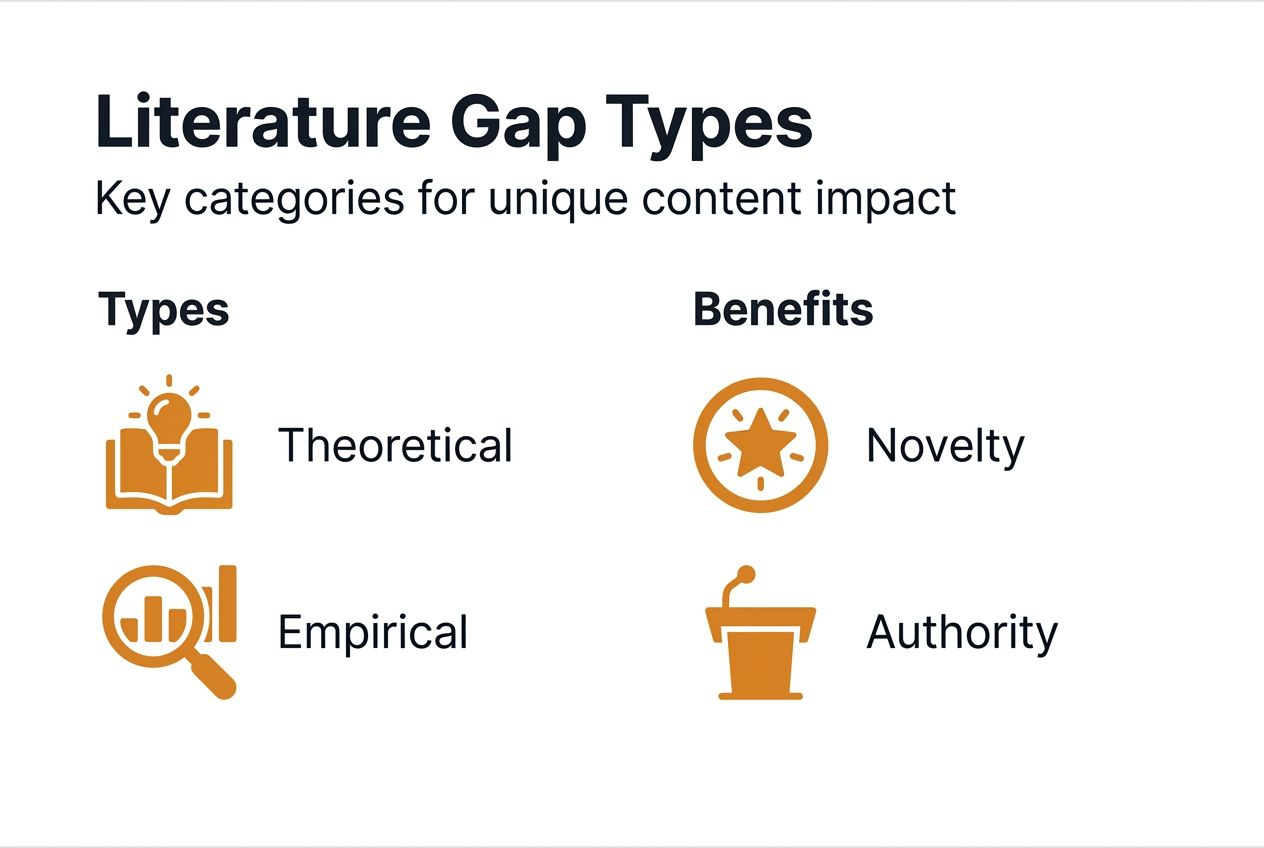
Validate gaps quantitatively through keyword search volumes, social listening metrics, and market sizing. Supplement numbers with expert interviews to confirm that deficiencies represent genuine unmet needs rather than deliberate omissions. Not every gap warrants filling; some exist because demand proves insufficient.
Implementation sequence:
- Map your niche comprehensively using bibliometric tools and manual review
- Identify 10-15 potential gaps across theoretical, empirical, and methodological dimensions
- Validate each gap through demand signals and expert consultation
- Score gaps on criteria including audience size, competition intensity, and alignment with your strengths
- Select the top 2-3 gaps offering maximum impact and feasibility
- Develop minimum viable content to test market response before full investment
- Iterate based on learner feedback and engagement metrics
Gap selection criteria:
- Sufficient audience size to justify development effort
- Manageable competition allowing realistic market penetration
- Clear differentiation from existing solutions
- Alignment with your unique expertise or perspective
Marketing gap-based content requires emphasising the novelty and necessity of your approach. Highlight what existing resources miss and why that matters to learners. Use book selection strategies to curate supporting materials that reinforce your unique angle.
Apply proven business growth strategies to scale your gap-focused offerings. Position yourself as the authority filling critical voids, not just another voice in a crowded market.
Unlock your content potential with Bibliowlteca
Identifying and addressing literature gaps transforms your content from derivative to pioneering. Bibliowlteca provides the infrastructure to turn those insights into thriving educational businesses. Our platform supports global distribution, secure payment processing, and seamless digital delivery, letting you focus on creating the gap-filling content that sets you apart.

Bibliowlteca offers:
- Comprehensive tools for publishing and distributing e-books and courses worldwide
- Built-in analytics to validate demand and refine your gap-focused offerings
- Multi-currency payment systems reaching international audiences hungry for innovative content
- Tax compliance automation removing administrative friction from global sales
When you identify literature gaps others overlook, you need a platform that matches your ambition. Bibliowlteca empowers creators to capitalise on those opportunities with technology designed for scale and simplicity.
Frequently asked questions
What exactly defines a literature gap in educational content?
A literature gap exists when current research or published content inadequately addresses a topic dimension, audience segment, methodology, or contextual application. It signals an opportunity to contribute original value that existing materials overlook or handle insufficiently.
How can small creators compete with established voices using literature gaps?
Focusing on narrow, validated gaps lets you dominate specific niches where larger competitors lack specialisation. Expertise in an overlooked demographic or underused method creates differentiation that audience size alone cannot overcome. Your unique perspective fills spaces giants ignore.
Do I need academic training to identify literature gaps effectively?
No. While systematic review techniques help, practical gap identification relies more on observing audience frustrations, tracking recurring questions, and comparing existing content against real learner needs. Tools and frameworks guide the process, but listening to your market reveals actionable gaps.
How long does validating a literature gap typically take?
Initial validation through keyword research and competitor analysis takes days. Deeper validation via expert interviews and pilot content testing spans weeks. Thorough validation prevents months wasted developing content for nonexistent demand, making the upfront investment worthwhile.
Can addressing literature gaps sustain long-term business growth?
Absolutely. As you establish authority filling specific gaps, you attract audiences seeking pioneering insights. That reputation compounds, positioning you as the go-to resource whenever new gaps emerge in your niche. Continuous gap monitoring ensures sustained relevance and competitive advantage.