
Most people still picture libraries as quiet spaces filled with dusty books and stern librarians. By 2026, that image has shattered completely. Modern libraries now function as high-tech innovation centres where artificial intelligence meets educational content creation, virtual reality transforms learning experiences, and knowledge graphs revolutionise information discovery. These institutions have become essential partners for content creators, educators, and digital entrepreneurs seeking to understand how technology reshapes educational delivery. This article explores the most significant library trends in 2026, revealing practical insights you can apply to enhance your own digital content strategies and educational offerings.
Table of Contents
- The rise of generative AI in libraries
- Ensuring digital accessibility and compliance
- AI-powered content curation and personalised learning
- Emerging knowledge graphs and retrieval innovations
- Explore BibliOWLteca's marketplace for educational resources
- Frequently asked questions
Key takeaways
| Point | Details |
|---|---|
| AI policy frameworks | Libraries require clear governance structures for generative AI implementation, balancing innovation with ethical concerns |
| Accessibility mandates | WCAG 2.1 level AA compliance becomes legally required by April 2026 for digital resources serving large populations |
| Personalised learning systems | AI-powered content curation increases student engagement by 30% through tailored resource recommendations |
| Advanced retrieval methods | Semantic frameworks achieve 81% precision rates, dramatically improving information discovery over traditional keyword searches |
| Hybrid service models | Libraries integrate physical and digital offerings, creating seamless online-to-offline experiences for modern learners |
The rise of generative AI in libraries
Generative AI technologies like GPT-4 have fundamentally transformed how libraries operate in 2026. Rather than simply searching for existing information, patrons now interact with systems that actively create summaries, generate research questions, and synthesise knowledge from multiple sources. This shift from passive retrieval to active creation represents the most disruptive technological change libraries have faced in decades.
The challenge lies not in the technology itself but in governance. Libraries will need to establish clear policies regarding the use of generative AI, covering everything from staff assistance protocols to content inclusion criteria. These frameworks must address critical questions: When should librarians recommend AI tools versus traditional resources? How do libraries verify AI-generated content accuracy? What ethical guidelines govern patron data usage in AI systems?
Communicating these policies effectively presents enormous operational challenges. Staff require training to explain AI capabilities and limitations to diverse patron groups, from tech-savvy students to elderly community members unfamiliar with machine learning concepts. Libraries must balance transparency about AI involvement with maintaining user trust in information quality.
Pro Tip: When developing AI policies for your educational content platform, study how leading libraries communicate complex technology decisions to non-technical audiences. Their frameworks offer valuable templates for explaining algorithmic systems clearly.
Policy considerations extend across multiple operational areas:
- Collection development strategies must account for AI-generated content quality and provenance
- Cataloguing systems need updated metadata standards to identify and classify AI-created works
- Reference services require protocols for when to deploy AI assistance versus human expertise
- Privacy protections must safeguard patron interaction data from unauthorised AI training use
These policies balance openness to innovation with legitimate concerns about misinformation, copyright infringement, and privacy violations. Libraries implementing robust generative AI synthesis frameworks report higher patron satisfaction whilst maintaining ethical standards. The institutions succeeding in 2026 treat AI policy development as an ongoing dialogue rather than a one-time decision, regularly updating guidelines as technology evolves.
For content creators, understanding library AI policies reveals emerging standards for educational technology governance. These frameworks influence how digital learning platforms structure their own AI implementations, particularly regarding transparency and user control. Observing library approaches to book selection strategies 2026 provides insights into quality curation in an AI-augmented environment.
Ensuring digital accessibility and compliance
Accessibility has moved from optional enhancement to legal requirement in 2026. Libraries serving large populations must achieve WCAG 2.1 level AA compliance by April 2026, ensuring digital resources work seamlessly for people with disabilities. This mandate affects every aspect of digital library services, from website navigation to e-book formats and online catalogue interfaces.
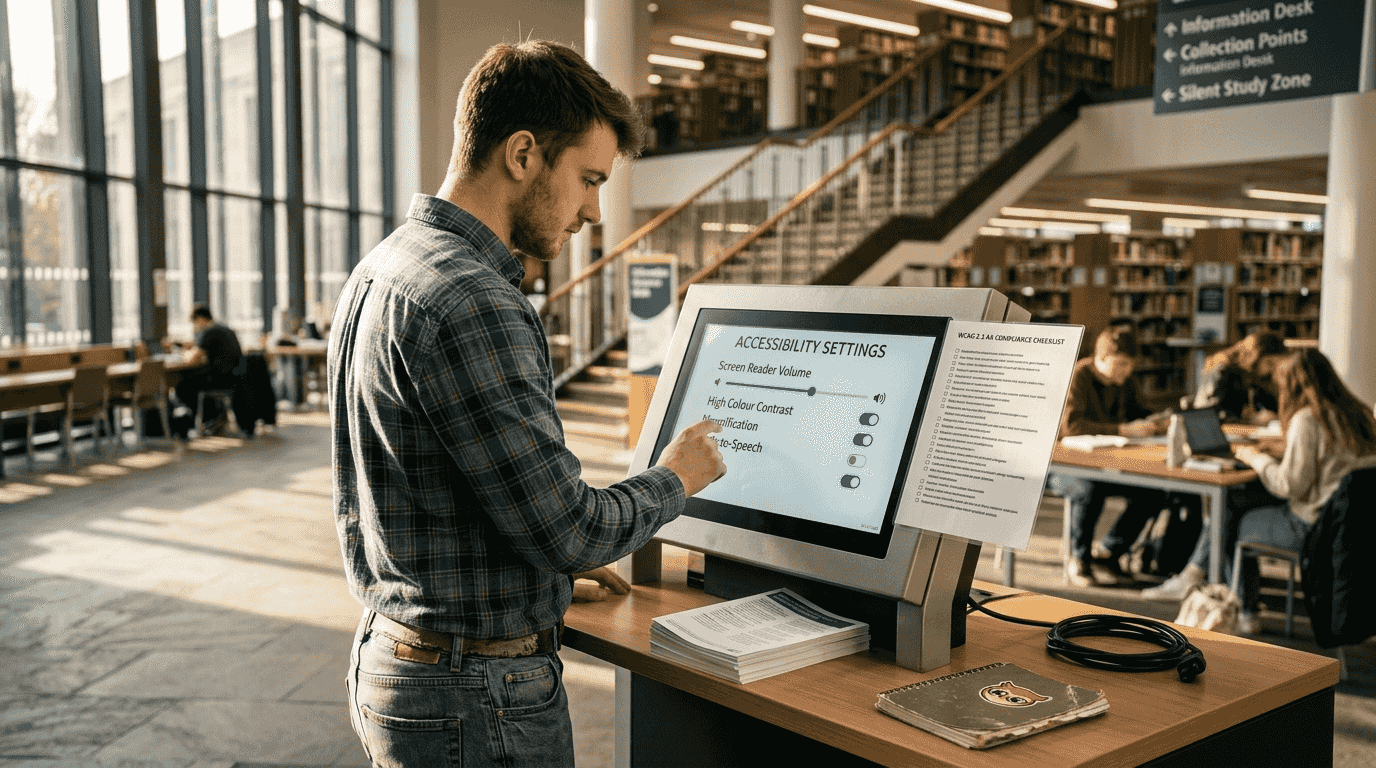
The compliance requirements are comprehensive and technically demanding. Screen reader compatibility ensures visually impaired users can navigate digital collections independently. Video content requires accurate captions and transcripts for deaf and hard-of-hearing patrons. Keyboard navigation must function completely without mouse input, supporting users with motor disabilities. Colour contrast ratios, text resizing options, and clear visual hierarchies make interfaces usable for people with various visual impairments.
Beyond legal mandates, accessibility improvements enhance experiences for all users. Clear navigation benefits everyone, not just those using assistive technologies. Captions help people watching videos in noisy environments or non-native language speakers. Keyboard shortcuts speed navigation for power users. These universal design principles create better digital products whilst meeting compliance requirements.
Implementing accessibility requires significant investment in both technology and training:
- Software platforms need audits and updates to meet technical standards
- Content creators require training in accessible document formatting and alt text writing
- Procurement policies must specify accessibility requirements for new digital resources
- Regular testing with actual users ensures standards translate to real-world usability
Libraries leading accessibility efforts report improved user satisfaction scores and reduced support requests. When digital resources work properly for everyone, fewer patrons need individual assistance. This efficiency gain offsets implementation costs whilst expanding service reach to previously underserved populations.
For educators and content creators, library accessibility standards preview requirements likely to affect all digital education platforms soon. Understanding these technical specifications helps you design accessible content from the start rather than retrofitting later. The library cataloguing process 2026 incorporates accessibility metadata, demonstrating how classification systems evolve to support inclusive discovery.
Proactive accessibility improvements also provide competitive advantages. As awareness grows, learners increasingly choose platforms prioritising inclusive design. Content creators who master accessible formats position themselves favourably in expanding markets for inclusive educational materials.
AI-powered content curation and personalised learning
Artificial intelligence has revolutionised how libraries match learners with appropriate resources. In 2026, school libraries increasingly adopt AI-powered content curation systems to personalise learning experiences, analysing individual student data to recommend resources matching their reading levels, interests, and learning objectives. This targeted approach transforms generic library collections into customised learning environments.
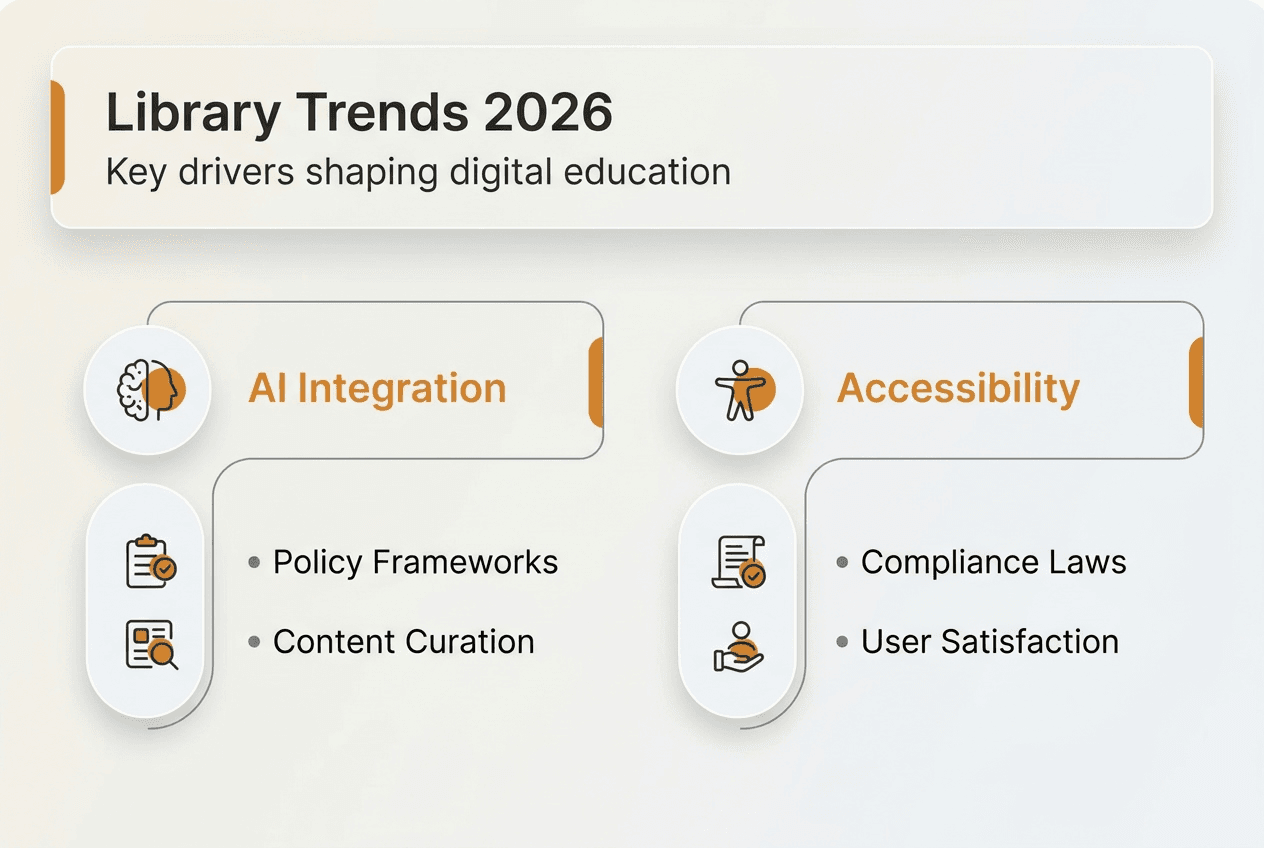
The results prove compelling. Pilot programmes implementing personalised content delivery report 30% increases in student engagement compared to traditional browsing methods. Students spend more time with recommended materials, complete more assignments, and demonstrate improved comprehension when AI systems guide their resource selection.
This personalisation trend reflects broader shifts in educational technology markets. Virtual reality in e-learning has exploded to a $365 billion market by 2026, whilst AI tutoring systems command $8.11 billion globally. These technologies dominate innovative learning environments because they adapt to individual needs rather than forcing one-size-fits-all approaches.
Adaptive learning ecosystems combining AI curation with intelligent tutoring produce remarkable academic outcomes:
- Initial assessment algorithms identify knowledge gaps and learning style preferences
- Content recommendation engines suggest resources matching identified needs
- Progress monitoring systems track comprehension and adjust difficulty dynamically
- Feedback loops refine recommendations based on actual learning outcomes
- Predictive analytics identify students needing additional support before they fall behind
Pro Tip: When designing educational content, structure materials to support adaptive learning systems. Include clear difficulty indicators, prerequisite knowledge tags, and learning objective mappings that AI curation engines can process effectively.
The pedagogical impact extends beyond student engagement. Schools implementing comprehensive adaptive learning systems report test score improvements up to 62%, transforming education efficacy across diverse student populations. These gains stem from precisely matching content difficulty to current ability levels, maintaining optimal challenge without overwhelming learners.
| Technology | Market Size 2026 | Primary Application | Engagement Impact |
|---|---|---|---|
| VR E-Learning | $365 billion | Immersive simulations | 45% increase |
| AI Tutoring | $8.11 billion | Personalised instruction | 62% score improvement |
| Content Curation | Growing rapidly | Resource recommendation | 30% engagement boost |
Educators benefit substantially from AI-powered systems reducing manual workload. Automated grading handles routine assessments, freeing instructors to focus on complex feedback and individual student interactions. Content curation systems eliminate hours spent searching for appropriate supplementary materials, as algorithms instantly identify relevant resources matching lesson objectives.
For content creators, understanding these curation systems reveals how libraries and schools discover and recommend educational materials. Optimising your content with proper metadata, clear difficulty indicators, and aligned learning standards increases visibility in AI-powered discovery systems. The access free books online guide 2026 demonstrates how proper categorisation enhances discoverability.
Developing master critical reading 2026 skills helps educators evaluate AI recommendations critically, ensuring algorithmic suggestions align with pedagogical goals rather than blindly following automated systems.
Emerging knowledge graphs and retrieval innovations
Knowledge graphs represent a fundamental reimagining of how libraries organise and retrieve information. Rather than simple keyword matching, these systems structure relationships between works, authors, subjects, and concepts, creating rich contextual networks that dramatically improve discovery precision. A search for materials on climate change might automatically surface related works on environmental policy, renewable energy, and ecological systems based on semantic relationships rather than exact keyword matches.
The performance improvements prove substantial. An adaptive semantic retrieval framework achieves 81% precision and 85% recall in digital library collections, dramatically outperforming traditional keyword search systems typically achieving 60-65% precision rates. This 20-point improvement means users find relevant materials faster whilst missing fewer important resources.
Knowledge graphs enhance information retrieval and personalisation in digital libraries by encoding domain expertise directly into search algorithms. Subject matter experts map conceptual relationships that automated systems then leverage for smarter recommendations. A student researching Victorian literature automatically receives suggestions for relevant historical context, biographical materials, and contemporary critical analyses without manually exploring each category.
| Retrieval Method | Precision Rate | Recall Rate | User Satisfaction |
|---|---|---|---|
| Traditional Keyword | 62% | 68% | Moderate |
| Semantic Framework | 81% | 85% | High |
| Knowledge Graph Enhanced | 79% | 83% | Very High |
Local inference models represent another significant innovation in 2026 library technology. Rather than sending every query to cloud servers, these systems run AI models directly on library servers, improving response speed whilst enhancing data privacy. Patrons receive instant search results without concerns about their research interests being tracked by external technology companies.
These technical advances support broader service model evolution. Libraries increasingly integrate online and offline experiences, allowing patrons to start research online, receive personalised recommendations, then visit physical locations to access recommended materials or consult specialist staff. This hybrid approach combines digital convenience with human expertise and physical resource access.
Implementation considerations for knowledge graph systems include:
- Initial domain modelling requires subject matter expertise to map conceptual relationships accurately
- Ongoing maintenance updates graphs as new works and concepts emerge
- Integration with existing catalogue systems needs careful technical planning
- Staff training ensures librarians understand and can explain enhanced search capabilities to patrons
For content creators and educators, understanding knowledge graph principles reveals how modern discovery systems surface educational materials. Properly structured metadata incorporating semantic relationships increases content visibility in these advanced systems. When you organize book inventory faster retrieval, incorporating knowledge graph principles enhances discoverability across multiple access points.
The shift towards semantic retrieval also influences content creation strategies. Materials explicitly connecting to related concepts and clearly defining their place within broader knowledge domains perform better in graph-based discovery systems than isolated works lacking contextual relationships.
Explore BibliOWLteca's marketplace for educational resources
The library innovations explored throughout this article point towards a future where educational content distribution becomes increasingly sophisticated, personalised, and accessible. As libraries adopt AI-powered curation, semantic retrieval systems, and hybrid service models, content creators and educators need platforms supporting these emerging standards.
BibliOWLteca's marketplace provides exactly this foundation, offering curated educational materials reflecting 2026's library innovations whilst supporting creators seeking adaptable digital content licensing. The platform's integrated tools align with trends towards AI-powered discovery and accessible resource design, helping you reach global audiences through infrastructure supporting multiple currencies and international payments. Whether you're an educator seeking materials enriching personalised learning environments or a creator distributing knowledge products worldwide, BibliOWLteca marketplace offers the technology needed to build successful digital education businesses. Explore how the platform's secure delivery systems, payment processing, and tax compliance tools simplify turning educational expertise into scalable digital offerings.
Frequently asked questions
What policies are libraries implementing for generative AI use?
Libraries establish comprehensive frameworks governing how staff and patrons use AI tools, including clear guidelines on content inclusion criteria and ethical usage standards. These policies address when to recommend AI-generated summaries versus traditional sources, how to verify AI content accuracy, and protocols protecting patron data privacy. Most institutions treat policy development as ongoing dialogue rather than fixed rules, regularly updating guidelines as technology evolves and new use cases emerge.
How do 2026 accessibility standards affect digital library services?
Libraries must achieve WCAG 2.1 level AA compliance by April 2026, ensuring all digital resources work seamlessly for users with disabilities through screen reader compatibility, video captions, keyboard navigation, and proper colour contrast. This requires significant investment in platform updates, staff training, and content remediation. Beyond legal compliance, accessibility improvements enhance experiences for all users through clearer navigation, better-structured content, and more flexible interface options.
What benefits does AI-driven content curation bring to educational libraries?
AI curation systems personalise learning by analysing individual student data to recommend resources matching their reading levels, interests, and learning objectives, producing 30% engagement increases in pilot programmes. These systems reduce educator workload by automating resource selection and routine grading, freeing instructors to focus on complex feedback and individual student support. Adaptive learning ecosystems combining AI curation with intelligent tutoring report test score improvements up to 62% across diverse student populations.
How do knowledge graphs improve library search capabilities?
Knowledge graphs structure relationships between works, authors, subjects, and concepts, enabling semantic search that understands contextual connections rather than just matching keywords. This approach achieves 81% precision rates compared to 62% for traditional keyword systems, helping users find relevant materials faster whilst missing fewer important resources. The technology encodes domain expertise directly into search algorithms, automatically surfacing related materials across multiple subject areas without requiring users to manually explore each category separately.