
Libraries have transformed from quiet book repositories into dynamic research hubs that directly influence academic success. Today's libraries offer comprehensive data management services, advanced research support, and AI literacy training that researchers and students increasingly depend on. Far from being outdated, libraries provide critical infrastructure for navigating complex research landscapes, managing digital scholarship, and ensuring long-term preservation of academic outputs. This article explores how libraries support every stage of research, enhance academic performance, and adapt to meet the challenges of the digital era.
Table of Contents
- Key Takeaways
- How libraries support the research lifecycle
- Impact of library use on academic success and research skills
- Libraries as centres for student engagement, wellbeing, and advanced research support
- Adapting to the digital and AI era: evolving library roles and challenges
- Discover BibliOWLteca's resources for academic research support
- Frequently asked questions
Key Takeaways
| Point | Details |
|---|---|
| Data management support | Librarians offer data management planning consultations covering storage, metadata standards and long term preservation to help researchers meet funder requirements. |
| Metadata and discovery | Professional cataloguers apply controlled vocabularies, subject headings and descriptive standards to make research discoverable across databases and search engines. |
| Training for researchers | Training programmes develop researchers' competencies in metadata creation and standardisation, data deposition, licensing considerations and version control. |
| Institutional repositories | Institutional repositories provide permanent homes for outputs with persistent identifiers and preservation workflows to ensure long term accessibility. |
| Academic benefits | Regular library use is associated with higher GPA and stronger information literacy across disciplines. |
How libraries support the research lifecycle
Academic libraries have evolved into essential partners throughout every research phase, offering specialised services that extend far beyond traditional resource provision. Understanding these services helps researchers maximise the support available to them.
Research data management represents one of the most critical services libraries now provide. Expert librarians offer consultations on data management planning, ensuring researchers comply with funder requirements whilst maintaining data integrity throughout projects. These consultations address storage solutions, metadata standards, and long-term preservation strategies that many researchers struggle to navigate independently.
Training programmes delivered by library staff significantly improve researchers' competencies in essential areas:
- Metadata creation and standardisation for research outputs
- Data deposit procedures for institutional and disciplinary repositories
- Copyright and licensing considerations for data sharing
- Version control and documentation best practices
Institutional repositories maintained by libraries serve as permanent homes for research outputs, ensuring accessibility long after projects conclude. These repositories provide persistent identifiers, handle preservation workflows, and integrate with discovery systems that amplify research visibility. The library cataloguing process ensures materials remain discoverable through sophisticated metadata frameworks.
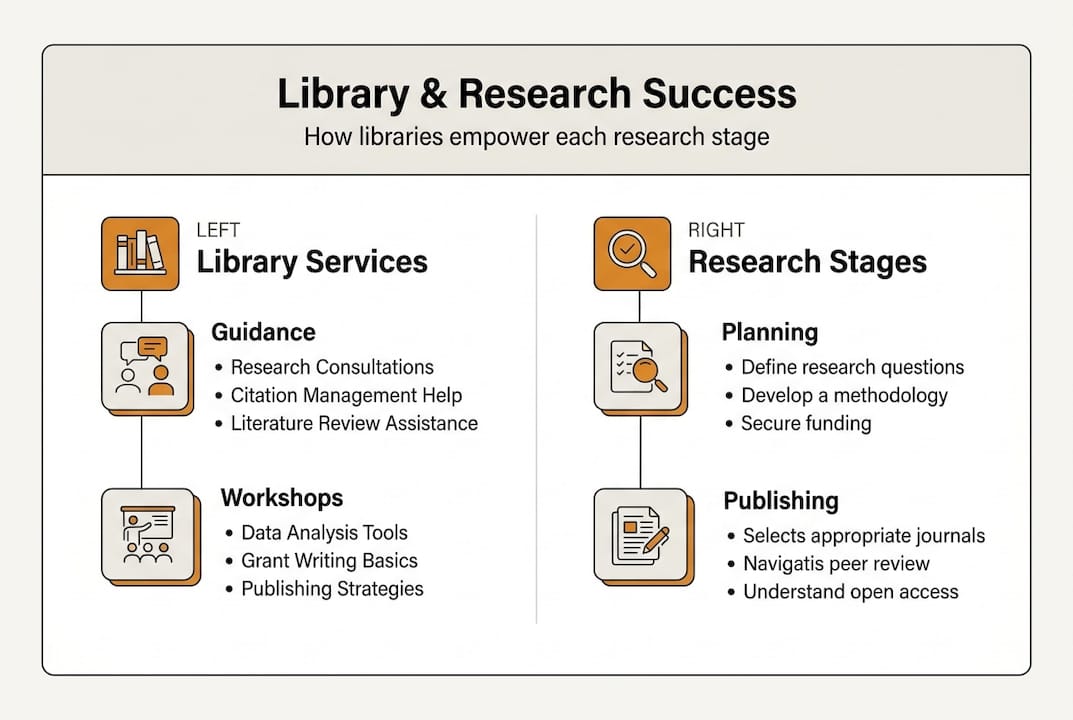
Libraries integrate comprehensive metadata services that bridge the gap between data creation and discoverability. Professional cataloguers apply controlled vocabularies, subject headings, and descriptive standards that make research findable across databases and search engines. This metadata work proves invaluable for researchers who lack expertise in information organisation.
| Research phase | Library service | Researcher benefit |
|---|---|---|
| Planning | Data management consultations | Ensures funder compliance and efficient workflows |
| Data collection | Training on metadata standards | Improves data quality and future usability |
| Analysis | Access to specialised software and datasets | Expands analytical capabilities |
| Dissemination | Repository deposit and preservation | Guarantees long-term accessibility and citation |
| Impact | Altmetrics tracking and reporting | Demonstrates research reach beyond citations |
Pro Tip: Schedule a data management consultation before submitting grant applications. Librarians can review your data management plan and identify potential compliance issues that might otherwise result in rejection.
The infrastructure libraries provide for research data management services has become indispensable as funding bodies increasingly mandate data sharing and preservation. Without library expertise, many researchers would struggle to meet these evolving requirements whilst maintaining focus on their core research activities.
Impact of library use on academic success and research skills
The relationship between library engagement and academic achievement is not merely correlational but demonstrates clear causal pathways through skill development and resource access. Evidence consistently shows that students who actively utilise library services outperform their peers across multiple metrics.

Frequent library users show higher GPA and stronger information literacy competencies compared to occasional users. This correlation holds across disciplines and institution types, suggesting universal benefits from library engagement. The 62% of students reporting strong academic benefits from library textbook and reference collections represents a substantial majority whose success directly depends on these resources.
Information literacy programmes delivered by libraries produce measurable improvements in essential research competencies:
- Database searching strategies that locate relevant sources efficiently
- Source evaluation frameworks for assessing credibility and bias
- Citation management skills that prevent plagiarism and support proper attribution
- Critical reading techniques for extracting key arguments from complex texts
Effectiveness of information literacy instruction demonstrates significant improvements in critical thinking and research abilities following structured library programmes. These skills transfer across courses and persist throughout academic careers, making information literacy instruction one of the highest-value interventions libraries provide.
Students who develop strong critical reading skills through library instruction programmes demonstrate enhanced ability to synthesise information from multiple sources and construct sophisticated arguments. This capacity for critical engagement with scholarly literature distinguishes successful researchers from those who struggle with complex academic tasks.
"Information literacy is not simply about finding information but about evaluating, synthesising, and ethically using that information to create new knowledge. Libraries cultivate these competencies through systematic instruction that transforms how students approach research challenges."
The academic performance gap between frequent and infrequent library users widens over time, suggesting cumulative advantages from sustained engagement. Students who establish library habits early in their academic careers build research competencies that compound across subsequent courses and projects.
Pro Tip: Attend at least one information literacy workshop per semester, even if you consider yourself research-savvy. Libraries continuously update instruction to address emerging challenges like AI-generated content evaluation and preprint assessment that were not concerns in previous years.
Beyond quantitative performance metrics, library use correlates with increased confidence in research abilities and reduced anxiety around complex academic tasks. This psychological dimension of library support proves particularly valuable for students from backgrounds with limited prior exposure to academic research conventions.
Libraries as centres for student engagement, wellbeing, and advanced research support
Modern academic libraries recognise that supporting research requires addressing the holistic needs of students and researchers, extending well beyond information provision into spaces, services, and specialised assistance that foster both wellbeing and sophisticated research capabilities.
Physical library spaces serve multiple functions that support diverse working styles and collaboration needs. Quiet study areas provide distraction-free environments for concentrated work, whilst collaborative zones facilitate group projects and peer learning. This spatial diversity acknowledges that effective research requires both individual focus and collective knowledge construction.
Libraries offer wellbeing initiatives that directly support student mental health and academic persistence. These 11 identified initiatives include stress reduction programmes, peer support networks, and accessible study spaces designed to reduce barriers to engagement. Such programmes recognise that academic success depends not only on intellectual resources but also on emotional and social support structures.
Advanced research support services distinguish contemporary libraries from their predecessors:
- Systematic review assistance, including search strategy development and screening protocol design
- Evidence synthesis support for meta-analyses and scoping reviews
- Publication preparation guidance, from journal selection to manuscript formatting
- Research impact assessment, including citation analysis and altmetrics interpretation
- Grant application support, particularly for data management and dissemination plans
- Research visibility enhancement through repository optimisation and author profiles
These specialised services require significant librarian expertise and represent substantial investments that many researchers could not otherwise afford. By providing these services without charge, libraries democratise access to sophisticated research support that might otherwise remain available only to well-funded projects.
| Support type | Service example | Researcher outcome |
|---|---|---|
| Wellbeing | Stress management workshops | Improved academic persistence and reduced burnout |
| Engagement | Collaborative study spaces | Enhanced peer learning and project completion |
| Advanced research | Systematic review consultations | Higher-quality evidence synthesis and publication success |
| Publication | Journal selection guidance | Increased acceptance rates and citation impact |
The management of library resources enables these comprehensive services by ensuring efficient allocation across competing priorities. Libraries must balance traditional collection development with emerging support services, requiring strategic decisions about resource deployment.
Libraries bridge the gap between research ambitions and practical execution by offering structured support at precisely the moments when researchers encounter obstacles. Whether navigating unfamiliar methodologies, preparing manuscripts for submission, or managing complex datasets, researchers find expert assistance that accelerates progress and improves outcomes.
Pro Tip: Many libraries offer research consultations where you can discuss your specific project challenges with subject librarians who understand your discipline's conventions and can recommend tailored strategies. These consultations often reveal resources and approaches you would not discover through independent searching.
Adapting to the digital and AI era: evolving library roles and challenges
The rapid advancement of artificial intelligence and digital technologies fundamentally reshapes library functions, requiring adaptation whilst preserving core missions of access, preservation, and literacy development. Libraries face the challenge of remaining relevant intermediaries in an environment where information appears universally accessible.
AI technologies demand new literacies that extend beyond traditional information evaluation frameworks. Libraries now teach researchers to:
- Assess AI-generated content for accuracy and bias
- Understand algorithmic curation and its impact on information discovery
- Navigate ethical considerations in AI-assisted research and writing
- Distinguish between legitimate AI applications and academic misconduct
Open access policies challenge traditional library collection models by shifting emphasis from acquisition to facilitation. Rather than purchasing subscriptions, libraries are shifting roles to support researchers in publishing open access whilst managing article processing charges and ensuring compliance with funder mandates.
The tension between physical and digital collections creates strategic dilemmas. Whilst digital resources offer accessibility advantages, physical materials retain importance for certain disciplines and research approaches. Libraries must allocate limited budgets across both formats whilst anticipating future needs in an uncertain landscape.
| Traditional role | Evolved role | Future direction |
|---|---|---|
| Collection curator | Access facilitator | Open scholarship coordinator |
| Reference librarian | Information literacy instructor | AI literacy trainer |
| Cataloguer | Metadata specialist | Data curator and preservation expert |
| Space provider | Learning environment designer | Flexible collaboration hub |
Digital scholarship centres emerging within libraries provide infrastructure for computational research, digital humanities projects, and data visualisation that many institutions could not otherwise support. These centres represent significant investments in expertise and technology that position libraries as essential partners in cutting-edge research.
Library trends 2026 highlight the acceleration of these transformations, with libraries increasingly serving as innovation hubs rather than passive repositories. This evolution requires continuous professional development for library staff and substantial technological investments.
Pro Tip: Explore your library's digital scholarship services even if your research seems traditionally oriented. Tools like text mining, network analysis, and digital mapping can reveal patterns in your sources that manual analysis would miss, potentially opening new research directions.
Despite technological disruptions, libraries remain indispensable intermediaries in scholarly communication. Their expertise in information organisation, preservation standards, and access equity ensures that the shift to digital scholarship does not create new barriers or result in knowledge loss. As AI and automation reshape research workflows, libraries provide the human guidance necessary to navigate these changes ethically and effectively.
Discover BibliOWLteca's resources for academic research support
Whilst libraries provide essential infrastructure for academic research, accessing the right digital resources and educational content remains crucial for research success.
BibliOWLteca offers a comprehensive platform where researchers and educators can discover specialised educational content tailored to their academic needs. Whether you are seeking advanced research methodologies, discipline-specific resources, or professional development materials, the platform connects you with creators who understand the challenges of contemporary academic work.

The platform's global reach means you can access expertise from educators worldwide, finding perspectives and approaches that might not be available through traditional channels. With support for multiple currencies and seamless digital delivery, BibliOWLteca removes barriers between researchers and the knowledge resources they need to advance their work. Explore how BibliOWLteca can complement your library resources and support your research journey with curated educational content designed for academic excellence.
Frequently asked questions
How do libraries support the entire research process?
Libraries provide comprehensive support from research planning through dissemination, including data management consultations, metadata services, repository hosting, and publication assistance. These services ensure researchers meet funder requirements whilst maintaining focus on their core work. Professional librarians offer expertise in areas where most researchers lack training, bridging critical gaps in research infrastructure.
What specific resources do academic libraries provide beyond books?
Modern libraries offer database subscriptions, specialised software, digital scholarship tools, collaborative spaces, and expert consultation services. Many provide access to datasets, research equipment, and computational infrastructure that individual researchers could not afford independently. These resources democratise access to sophisticated research capabilities across disciplines and career stages.
How are libraries adapting to artificial intelligence and digital research?
Libraries now teach AI literacy, helping researchers evaluate AI-generated content and understand algorithmic biases. They provide data curation services, support open access publishing, and maintain digital scholarship centres with computational research tools. This evolution positions libraries as essential guides through technological disruption rather than obsolete institutions.
Why does library use correlate with higher academic performance?
Frequent library users develop stronger information literacy skills, access higher-quality resources, and receive expert guidance that improves research efficiency. The 62% of students reporting academic benefits from library collections demonstrates substantial impact. Beyond resources, libraries provide structured learning environments and wellbeing support that foster academic persistence and success.