
The fastest route to a measurable result is a tiered, hybrid mentorship package purchased through a reputable marketplace, where you can compare mentor credentials, review a clear curriculum, and start onboarding within days. For Estonian-speaking professionals and leaders operating in the UK, the term mentorluse müük translates directly to the commercial act of buying or selling mentorship, and the UK market now offers structured programmes across every format and budget.
Two things to do right now:
- Check the mentor's credentials and request a sample session before committing to any package.
- Confirm the programme includes a 90-day measurement plan covering at least one KPI, such as ramp time, conversion rate, or retention, before you pay.
Frameworks like MEDDIC give you a useful lens for evaluating whether a programme is structured around measurable outcomes or just good intentions. Bibliowlteca lists mentorship programmes with curriculum fields, mentor profiles, and tiered pricing, so you can compare offers in one place.
Key takeaways
Structured mentorship with a 90-day charter, clear KPIs, and a credentialled mentor consistently outperforms informal coaching arrangements for professionals and leaders in the UK market.
| Point | Details |
|---|---|
| Choose format by goal | 1:1 suits leaders and founders; cohort programmes suit peer learning and team-wide ramp acceleration. |
| Demand a measurement plan | Ask for 30, 60, and 90-day KPIs before paying; no plan is a red flag. |
| Budget for extras | Materials, platform fees, and VAT can add 10–20% beyond the headline price. |
| Revenue impact is quantifiable | Structured programmes showed approximately 18.6% higher revenue growth versus informal training in a study of 214 professionals. |
| Buy via Bibliowlteca | Compare tiered mentorship listings, review mentor credentials, and complete purchase with VAT-compliant checkout in one session. |
Table of Contents
- What types of mentorship programmes can you buy?
- What does a mentorship programme actually include?
- Who buys mentorship, and what are the common use cases?
- How do you choose and buy the right programme?
- What does research say about the ROI of mentorship?
- How long do mentorship programmes typically run?
- How do you check a provider's reputation and accreditation in the UK?
- What outcomes benchmarks should you use to evaluate effectiveness?
- What does a mentorship programme cost, and what extra fees should you expect?
- What buyers consistently get wrong about mentorship
- Bibliowlteca makes buying mentorship programmes straightforward
- Sources
What types of mentorship programmes can you buy?
The UK market broadly offers five programme types, and choosing the wrong one is the most common and most expensive mistake buyers make.
- 1:1 private mentorship. One mentor, one mentee, bespoke agenda. The highest-touch and typically the most expensive format. Best for senior leaders and founders who need confidential, context-specific guidance.
- Group or cohort mentorship. A single mentor works with a small group, usually 6–12 people, over a fixed period. Peer learning is a genuine side benefit; cost per head drops significantly.
- Blended or hybrid programmes. Recorded lessons handle the foundational content; live coaching sessions address application and accountability. Tiered offers structured as starter, signature, and premium tiers convert different buyer segments and reduce onboarding friction when paired with a clear welcome lesson.
- Self-paced plus coaching. The learner works through content independently and books coaching calls as needed. Lower cost, but requires high self-discipline.
- Corporate-embedded schemes. Structured programmes built into an organisation's L&D calendar, often combining internal mentors with external facilitators.
Delivery formats cut across all five types: live video calls, phone coaching, recorded video lessons, asynchronous written feedback, platform-hosted resource libraries, and community spaces for peer exchange.
The core trade-off is personalisation versus scale. A 1:1 programme gives you the most tailored experience; a cohort model gives you peer accountability at a fraction of the cost. Monthly subscriptions suit ongoing development; cohort fees suit fixed-duration sprints.
Pro Tip: Cap each mentor to two active mentees at any one time. Beyond that, session quality drops and response times suffer. Use a short application filter, four questions covering goals, commitment level, current role, and timeline, to screen for coachable, high-intent buyers before onboarding begins. Price-up-front transparency cuts time wasted on unqualified prospects on both sides.
What does a mentorship programme actually include?
Standard inclusions across reputable programmes:
- Scheduled coaching sessions (weekly, fortnightly, or monthly depending on tier)
- Recorded lessons or pre-work modules covering core skills
- Workbooks or structured frameworks for between-session practice
- Call reviews or recorded session playbacks with annotated feedback
- Accountability check-ins, often asynchronous via a platform or messaging tool
- Peer sessions or community access in cohort formats
- Success metrics agreed at onboarding: ramp time, quota attainment, or retention targets
A typical module structure runs: onboarding and goal-setting, core skill-building sessions, applied practice with live feedback, and a final review against the agreed KPIs. That four-phase arc usually spans 8–16 weeks.
Watch for additional costs beyond the headline price. Pricing models vary: per-session rates suit buyers who want flexibility; monthly subscriptions suit ongoing development; cohort fees are usually the best value for a defined sprint.
Who buys mentorship, and what are the common use cases?
- Sales representatives and teams. Accelerating ramp time for new account executives is the most cited use case. A structured programme can compress a 9-month ramp to something closer to 6 months, which has a direct revenue impact.
- Newly promoted managers. The transition from individual contributor to people manager is where most leadership derailment happens. A 1:1 programme focused on coaching skills and difficult conversations is the standard intervention.
- Senior leaders and directors. Preparing for a board-level role or a cross-functional remit. Typically 1:1, highly confidential, and longer in duration.
- Founders and executives. Strategic clarity, fundraising preparation, or scaling through a growth inflection point. Often the highest-ticket category.
- High-potential employees. Cohort programmes work well here: peer learning reinforces the content, and the group dynamic builds internal networks.
Practitioner research consistently shows that mentorship improves confidence, retention, and team knowledge-sharing beyond the individual skill gains. Reported coaching importance among sales reps runs high in practitioner surveys, with notable ramp-time and performance gains cited across multiple studies.
Expected impact timelines: behavioural changes in communication and pipeline discipline tend to appear within 30–60 days; quota attainment and revenue metrics take a full quarter to move meaningfully.
How do you choose and buy the right programme?
Start with the outcome, not the format. Decide which KPI you want to shift, then work backwards to the programme type that addresses it.
Evaluation checklist:
- Mentor credentials: years of relevant experience, sector background, and verifiable track record
- Curriculum clarity: a written syllabus with session-by-session objectives, not a vague topic list
- Sample session: any credible provider will offer a taster or a recorded example
- Measurement framework: how will progress be tracked? What does the provider report, and how often?
- Refund and cancellation terms: clear, written, and not buried in a discovery call
- Price model: stated upfront, not revealed only after a 45-minute sales call
- Accreditation or professional body membership (see the section below on UK accreditation)
- References and case studies: ask for two contacts from previous cohorts
Questions to ask on a sales call or marketplace listing:
- Show me a one-week sample session, including the pre-work and the coaching agenda.
- What does your measurement plan look like at 30, 60, and 90 days?
- How many active mentees does each mentor currently carry?
- What happens if my goals change mid-programme?
- What is your refund policy if the programme does not meet the agreed KPIs?
Red flags:
- No written syllabus or a syllabus that is entirely generic
- Price revealed only after a discovery call
- No KPI or measurement plan mentioned anywhere in the listing
- Mentors carrying more than four or five active clients simultaneously
- Testimonials that are vague and unattributed
Completing a purchase on a marketplace:
- Compare tiers side by side: starter, signature, and premium listings typically differ by session frequency, mentor seniority, and included materials.
- Confirm onboarding steps: a good programme sends a welcome pack and a 90-day charter template within 48 hours of purchase.
- Review contract terms and cancellation policy before entering payment details.
- Schedule your first session at checkout if the platform allows it.
- In the first 30 days: complete the skills-gap assessment, agree your charter, and attend at least two sessions before evaluating fit.
What does research say about the ROI of mentorship?
The evidence is specific enough to build a business case. A mixed-methods study of 214 sales professionals across North America and Europe found that firms with institutionalised mentorship programmes showed significantly reduced onboarding time (β = −0.42, p < 0.01), improved sales conversion rates (β = 0.37, p < 0.05), and higher revenue growth, with a mean difference of approximately 18.6% compared with firms using informal training.
For a UK organisation with ten sales reps each generating £200,000 in annual revenue, a notable uplift represents a significant increase in additional revenue. Set against a cohort mentorship programme costing £15,000–£30,000, the ROI case is straightforward to present to finance or HR.
Pro Tip: Structure your measurement in three layers: baseline metrics captured before the programme starts (current ramp time, conversion rate, retention); leading indicators at 30 and 60 days (session attendance, skill assessment scores, pipeline activity); and lagging business metrics at 90 days and six months (quota attainment, revenue per rep, headcount retention). That three-layer approach gives you something meaningful to report at every stage, not just at the end.
How long do mentorship programmes typically run?
Programme length varies by format and objective, but the UK market has settled around a few common durations.
Short-sprint programmes run 6–8 weeks and suit skill-specific goals: a new manager learning to run one-to-ones, or a sales rep working on discovery call technique. These are often self-paced with two or three live coaching sessions included.
The most common format is the 90-day cohort or 1:1 programme. Three months is long enough to show measurable behavioural change and short enough to maintain momentum. Most providers structure this as 12 weekly sessions or 6 fortnightly sessions, with asynchronous support between calls.

Longer engagements, 6–12 months, are standard for executive coaching and leadership development. These typically involve monthly 1:1 sessions supplemented by peer group calls and a mid-point review.
Corporate-embedded schemes often run on an annual cycle aligned to performance review calendars, with cohorts rotating every quarter. Total commitment for a participant in a 90-day programme is usually 2–4 hours per week, including session time, pre-work, and between-session practice.
How do you check a provider's reputation and accreditation in the UK?
The UK has no single statutory regulator for mentorship or coaching, which means accreditation is voluntary but still a meaningful signal. The main professional bodies to look for are the International Coaching Federation (ICF), the European Mentoring and Coaching Council (EMCC), and the Association for Coaching (AC). Membership of any of these requires adherence to a code of ethics and, at senior levels, demonstrated hours of practice and supervision.

For sales-specific mentorship, look for providers whose mentors hold verifiable sector experience rather than generic coaching qualifications alone. A mentor with 10 years of enterprise sales experience and an ICF credential is a stronger signal than a credential without the commercial track record.
Check the provider's public profile: published case studies with named clients and specific outcomes, Google or Trustpilot reviews with enough volume to be statistically meaningful, and any published partnerships with UK universities or professional bodies. Providers who build mentorship into institutional culture and publish their methodology openly tend to be more accountable than those who keep their approach opaque.
What outcomes benchmarks should you use to evaluate effectiveness?
Ramp time is the most commonly cited metric in sales mentorship: the time from hire to full productivity. Structured programmes consistently reduce this compared with informal onboarding, with the academic evidence pointing to a statistically significant effect.
Conversion rate improvement is the second benchmark. Ask providers what conversion rate improvement their previous cohorts achieved, and request the baseline data they used.
Retention is the third. Mentored employees leave at lower rates than unmentored peers in most practitioner studies, and the cost of replacing a sales rep, typically estimated at 1.5–2x annual salary, makes retention a compelling financial argument.
When evaluating a programme's claimed success rate, ask three questions: what was the baseline, what was the measurement period, and was the comparison group similar in seniority and sector? Vague claims like "90% of participants reported improved confidence" are nearly impossible to act on.
What does a mentorship programme cost, and what extra fees should you expect?
In the UK market, per-session rates for individual mentorship typically run from £150 to £500 per hour depending on the mentor's seniority and sector specialism. Monthly subscription models for ongoing 1:1 mentorship commonly sit between £500 and £2,000 per month. Cohort programmes for groups of 8–12 participants are usually priced as a total programme fee, ranging from £3,000 to £15,000 for a 90-day sprint, which works out considerably cheaper per head than individual sessions.
Beyond the base price, budget for:
- Materials and workbooks: £50–£200 per participant, sometimes bundled, sometimes charged separately.
- Platform or access fees: some providers charge a monthly fee for access to their learning management system or community space.
- Certification fees: if the programme leads to a professional certificate, the assessment and issuance fee is often separate.
- Corporate invoicing or procurement fees: larger providers sometimes charge an administrative fee for purchase orders or multi-seat licences.
- VAT: UK providers charge VAT at the standard rate on most coaching and mentorship services. Confirm whether the listed price is inclusive or exclusive of VAT before comparing offers.
The total cost of a 90-day cohort programme for a team of ten, including materials and platform access, realistically sits between £8,000 and £20,000 in the UK market.
What buyers consistently get wrong about mentorship
Most buyers focus on the mentor's biography and miss the programme's structure. A brilliant mentor with no defined curriculum, no measurement plan, and no accountability mechanism will produce inconsistent results. The structure is what converts individual sessions into lasting skill transfer.
The second mistake is buying too long. A 12-month commitment sounds thorough, but most programmes lose momentum after the first 90 days if there is no mid-point review and no mechanism to reset goals. Short sprints with clear charters and defined exit criteria outperform open-ended arrangements in practice.
One thing that genuinely works: split your programme into two tracks from the start, one focused on skill transfer and one on sponsorship and network access, as the 90-day charter approach recommends. Buyers who treat mentorship as pure skills training miss the sponsorship value entirely, and that is often where the career-level impact actually comes from.
Do not buy a programme that hides its measurement approach. If a provider cannot tell you, before you pay, how they will measure progress and what they will report at 90 days, that is a structural problem, not a gap you can fix after onboarding.
Bibliowlteca makes buying mentorship programmes straightforward
Buying mentorship through a marketplace removes the friction of chasing providers individually. Bibliowlteca's platform features cover the full purchase and delivery cycle: secure checkout, multi-currency payments, course and mentorship hosting, mentor profiles with credential fields, tiered listing structures, and analytics so you can track engagement from day one.
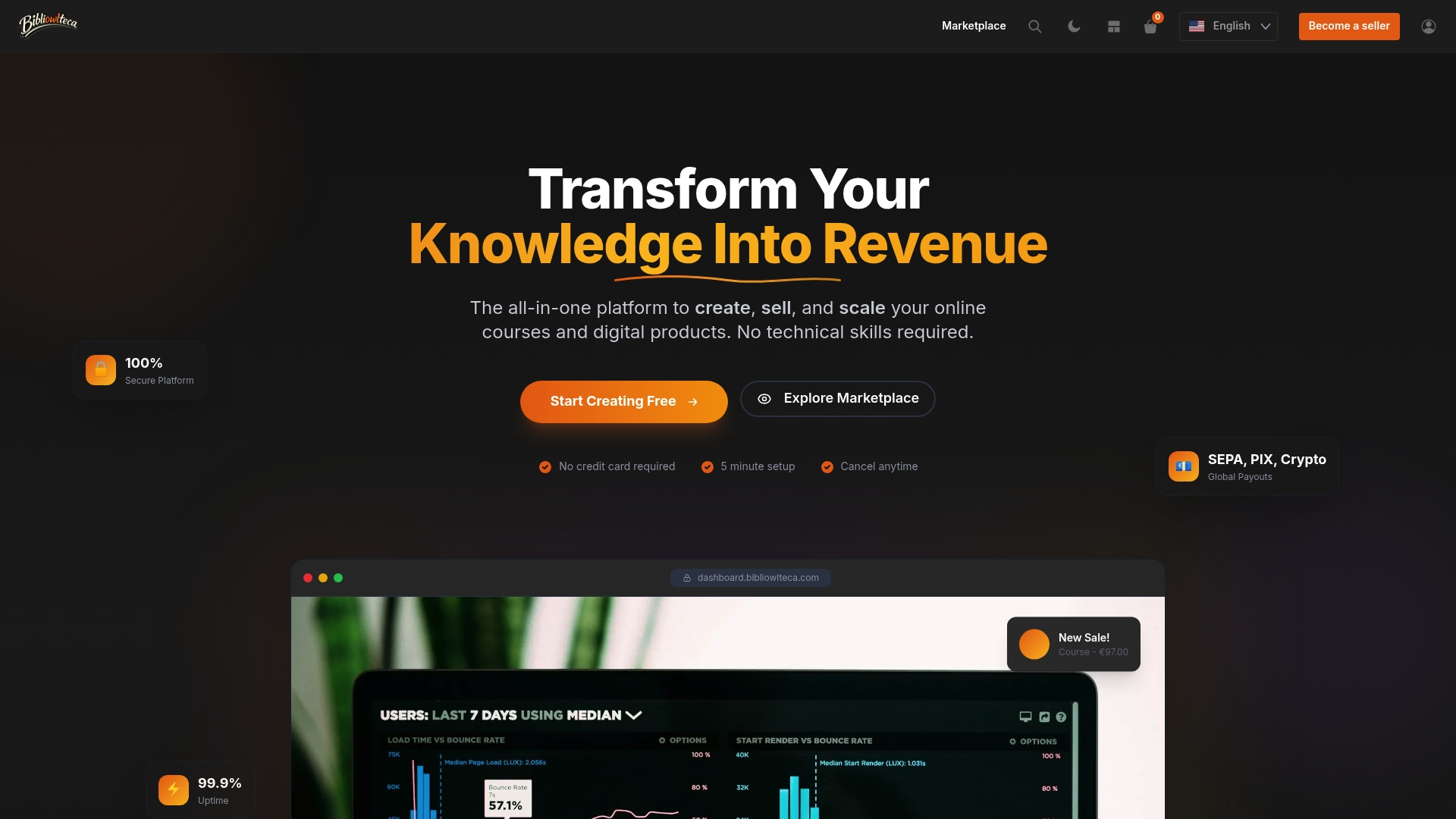
Mentor listings on Bibliowlteca include curriculum fields, session cadence, and pricing tiers side by side, so you can compare starter, signature, and premium offers without a sales call. Onboarding tools reduce the gap between purchase and first session. For UK buyers, the platform handles VAT compliance and payment processing, so procurement teams get a clean invoice without administrative back-and-forth.
Browse the mentorship and digital education catalogue to compare tiers, review mentor profiles, and book your onboarding session today.
Sources
- Mentorship systems as drivers of profit growth: Establishing internal learning institutions in sales departments
- The Role of a Sales Mentor in Team Success | SalesHood
- How to Sell High-Ticket Mentorship (Without Being #1)
- Building a sales mentorship programme: template for a department-wide kickoff