
TL;DR:
- Effective mentorship programs significantly increase lifetime earnings and serve as vital economic tools for creators.
- The success of such programs depends on relationship quality, clear structure, and ongoing feedback, not just logistics.
- Flexible, relationship-centered designs that adapt to community needs outperform rigid, process-focused approaches, fostering genuine growth.
Mentorship is one of the most undervalued assets a digital creator or entrepreneur can offer their audience, yet most people assume that simply pairing a mentor with a mentee is enough to guarantee results. It is not. Research projects a $56,000 increase in lifetime earnings for mentored individuals compared to those who receive no mentoring at all. That figure should stop you in your tracks. It means a well-designed mentorship programme is not just a nice community feature; it is a genuine economic instrument. This article gives you the evidence-based frameworks, structural best practices, and honest guidance needed to build a programme that produces real, measurable outcomes.
Table of Contents
- What makes a mentorship programme effective?
- Core structures and best practices for digital mentorship
- Measuring impact: from relationship quality to business outcomes
- Pitfalls, edge cases and programme differentiation
- The uncomfortable truth: why successful mentorship is more than process
- Take your mentorship efforts further with BibliOWLteca
- Frequently asked questions
Key Takeaways
| Point | Details |
|---|---|
| Clear goals drive success | Successful mentorship programmes set explicit goals and align participant expectations from the start. |
| Relationship quality is essential | Trust, authenticity, and identity are decisive factors—more so than technical programme structure. |
| Measure both process and impact | Track operational health as well as business outcomes to gauge a programme’s real value. |
| Iterate and adapt | Continuous feedback and programme iteration help avoid rigidity and sustain mentoring value. |
| Economic gains are real | Mentored individuals can experience significant financial and educational benefits, including a projected $56,000 boost in lifetime earnings. |
What makes a mentorship programme effective?
Most creators who launch mentorship programmes focus almost exclusively on the logistics: who matches with whom, how many sessions to schedule, and which tools to use for video calls. These things matter, but they are not what separates a transformative programme from a forgettable one. The distinction lies in the quality of the relationship itself and the clarity of the structure surrounding it.
MENTOR's research shows that programme alignment with standards around elements of effective practice is directly linked to stronger mentor commitment and more positive mentee experiences. Those elements include clearly defined goals from the very start, explicit structures that both parties understand, consistent feedback mechanisms, and a framework for resolving conflict or disengagement. When a programme is designed with these standards in mind, participants arrive prepared rather than confused, and mentors feel confident rather than overwhelmed.
That said, standards alone do not carry a programme. Relationship quality, including trust, authenticity, and careful attention to identity dynamics, is consistently one of the most decisive factors in whether mentorship succeeds or stalls. Two participants who are technically well-matched on paper can still have a dysfunctional relationship if there is no psychological safety, no honest dialogue, and no shared sense of purpose.
Consider the practical difference between a programme where mentors receive thorough training on active listening and one where mentors are simply assigned a mentee and told to "check in weekly." The first produces deeper conversations, earlier identification of obstacles, and longer-lasting relationships. The second produces surface-level exchanges that rarely move the needle.
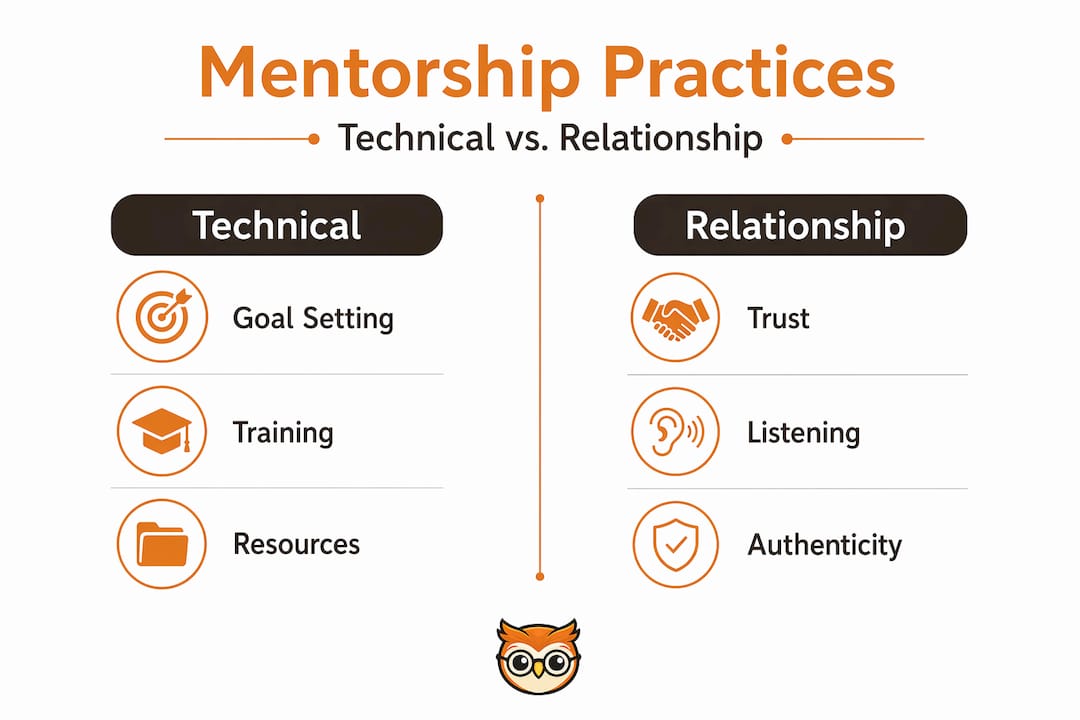
| Element | Technical design | Relationship infrastructure |
|---|---|---|
| Goal setting | Written objectives at programme start | Co-created goals with mentee input |
| Meeting structure | Fixed agenda and frequency | Flexible rhythm that honours both parties |
| Feedback | End-of-programme survey | Ongoing, two-way, and normalised |
| Trust building | Matching criteria and onboarding | Intentional community rituals and check-ins |
| Identity awareness | Demographic data collected | Active conversations about positionality |
For creators thinking about mentoring frameworks for educators, this table is a useful prompt. Ask yourself whether your programme currently operates primarily in the left-hand column. If so, you have significant room to grow by investing in the relationship side.
A few markers of a genuinely effective mentorship programme:
- Mentors are trained, not just recruited
- Goals are reviewed and updated during the programme, not only at the start
- Both mentor and mentee complete brief reflective exercises between sessions
- Programme coordinators monitor engagement, not just attendance
- Mentees have a voice in how the programme evolves
"Effective mentoring is not what happens in a meeting. It is what both parties carry with them between meetings."
This principle should inform every design decision you make, from the questions you include in your matching intake form to the resources you provide for building educational reading lists that mentees can work through independently. Strong digital learning frameworks help reinforce the learning that happens inside mentorship relationships, giving mentees materials to explore on their own time.
Core structures and best practices for digital mentorship
With clear standards established, let us look at the operational structures and practical steps for running mentorship programmes in the creator economy. There is a meaningful difference between knowing what effective mentorship looks like and actually building the scaffolding that sustains it over weeks and months.
Goal-based programmes with matched participants and established meeting cadence are measurably more effective than informal arrangements, particularly in entrepreneurial contexts. The four principles that research consistently points to are: explicit goal alignment, deliberate participant preparation, intentional matching, and accountability structures. Each of these deserves a dedicated process in your programme design.
Here is a practical sequence for building the core structure of your mentorship programme:
- Define the programme's purpose clearly. Is this about business strategy, creative development, audience growth, or a combination? Your purpose shapes every subsequent decision about matching, content, and measurement.
- Create a participant preparation module. Before the first session ever happens, mentors and mentees should complete onboarding that covers expectations, communication preferences, and how to raise concerns. This reduces first-session awkwardness by roughly two thirds in well-designed programmes.
- Establish a realistic cadence. For most digital creators, a bi-weekly or monthly one-on-one session is sustainable. Weekly sessions can produce burnout in busy entrepreneur contexts. Be honest about what your audience can genuinely commit to.
- Build in milestone check-ins. At the midpoint of your programme, run a structured review. This is where you assess whether the match is working, whether goals need updating, and whether either party feels unheard or stuck.
- Close intentionally. Many programmes end abruptly, which wastes the relationship. Design a closing session that celebrates progress, captures learnings, and maps out what continuation might look like informally.
- Run a retrospective after each cohort. Successful programmes treat feedback loops and iterative improvement as non-negotiable, not optional extras. Every cohort should teach you something that makes the next one better.
Pro Tip: Ask your mentors to submit a short "session reflection" within 24 hours of each meeting. Even three sentences about what was discussed, what the mentee is working on, and any concerns is enough to help programme coordinators spot disengagement early and intervene constructively.
Matching strategy deserves its own focus. Algorithmic matching, where you use a form to collect data on goals, experience levels, and availability, is efficient at scale. It ensures no one gets missed and reduces unconscious bias in manual selection. However, algorithmic matching alone misses the subtlety of personality compatibility, communication style, and cultural context. The best programmes use algorithmic matching as a shortlist tool and then allow a human or the participants themselves to make the final selection from two or three strong candidates.
| Matching approach | Best for | Limitation |
|---|---|---|
| Algorithmic only | Large programmes (50+ pairs) | Misses relational nuance |
| Manual coordinator selection | Small cohorts (under 20 pairs) | Time-intensive, open to bias |
| Hybrid (algorithm + choice) | Most digital creator programmes | Requires more upfront design |
| Self-selection | Peer mentoring, informal cohorts | Risk of popularity bias |
For creators who are launching your education business and adding mentorship as a premium tier, the hybrid model is usually the most practical starting point. It gives participants agency without requiring you to manually manage dozens of relationships from scratch. Many successful digital marketplace educators have found that offering two or three potential mentor matches and letting mentees make a final choice increases programme satisfaction dramatically.
Measuring impact: from relationship quality to business outcomes
Understanding structure is not enough. Evaluating programme success is crucial to ongoing value and growth, and this is where many creator-led mentorship programmes fall flat. They collect basic data, such as number of sessions completed or participant satisfaction scores, and declare the programme a success. But surface metrics can mask a failing programme just as easily as they can confirm a thriving one.

Empirical frameworks recommend tracking leading and lagging indicators as distinct categories of programme evaluation. Leading indicators give you early signals about programme health before outcomes crystallise. Lagging indicators tell you what actually changed as a result of the programme, but often only after weeks or months have passed.
Leading indicators to monitor regularly:
- Session attendance and punctuality
- Quality of goals set (specific versus vague)
- Mentor engagement scores from brief mid-point surveys
- Number of mentees who report feeling heard and supported
- Frequency of meaningful conversations versus transactional check-ins
- Early dropout rate and reason given
Lagging indicators to capture at programme close and beyond:
- Revenue growth for entrepreneur mentees
- New digital products launched or published
- Audience size or engagement changes over the programme period
- Skill ratings before and after (self-reported or assessed)
- Mentee advancement to the next stage of their business
- Long-term relationship continuity between mentor and mentee
The economic case for tracking these outcomes is compelling. Mentored individuals experience measurable gains in both educational attainment and lifetime earnings, which means the data you collect from your programme has genuine marketing weight. When you can demonstrate that mentees in your programme went from struggling to launch their first course to generating consistent monthly revenue, that is a story worth telling.
Statistic to know: Mentorship programmes that track both leading and lagging indicators are significantly more likely to identify and fix problems mid-programme rather than post-mortem. Most creator programmes only collect data at the end, which means they are always one cohort behind on learning.
Pro Tip: Build a simple one-page dashboard for each cohort. Track five leading indicators weekly and three lagging indicators at programme close. Share this summary with your mentors so they feel part of the evaluation, not subject to it.
For creators thinking about how to complement their mentorship with curated resources, libraries and academic mentorship models offer useful examples of structured learning support alongside human guidance. Pairing your mentorship programme with a curated content library distributed through an educator distribution platform creates a richer experience that mentees can return to between sessions.
Pitfalls, edge cases and programme differentiation
Once metrics are defined, it is vital to examine what can go wrong and how mentors can meaningfully differentiate their programmes from the growing number of creator-led offerings in the market.
The most common mistake is treating programme design as a one-time exercise. You build the intake form, set the matching criteria, schedule the sessions, and then step back. But mentorship is not a product you ship; it is a living system that responds to the people inside it. Rigid programmes that cannot flex to accommodate an unexpected life event, a shift in a mentee's goals, or a mismatch in communication style will frustrate participants and produce poor outcomes regardless of how thoughtful the original design was.
Mentoring is fundamentally relational infrastructure, and identity, trust, and positionality can override the best technical mechanics. This is especially relevant for creators building programmes for diverse communities. A mentee who does not see themselves reflected in the mentor pool, or who comes from a background where authority figures have been untrustworthy, will not open up simply because the matching algorithm paired them well. Trust has to be earned, and programme design needs to create the conditions for that earning.
Different mentorship formats produce different results depending on the community context:
- Formal one-on-one mentorship works well when mentees have specific, individual goals and benefit from dedicated attention. It is resource-intensive for coordinators but produces the deepest relationships.
- Group mentorship (one mentor, several mentees) is efficient and encourages peer learning, but requires a skilled facilitator who can manage group dynamics and ensure no one dominates or is left behind.
- Peer mentorship (near-peers supporting each other) reduces the power imbalance of traditional models and is particularly effective for communities where lived experience matters as much as seniority. It also scales more easily.
- Informal mentorship networks act as connective tissue between more structured touchpoints. These might be a community forum, a group messaging channel, or a quarterly gathering where alumni and current participants mix freely.
Accelerator and incubator studies consistently show that different types of mentoring produce distinct effects depending on the entrepreneurial context. A startup founder in a high-growth accelerator needs different mentorship than a solo content creator building their first digital product. Mapping your programme format to your community's actual situation, rather than copying a generic template, is one of the highest-leverage decisions you can make.
Meaningful programme differentiation often comes from the specific context you design for, not from adding more features. A mentorship programme for educators who teach online educational content about libraries and educational impact will look quite different from one designed for e-commerce entrepreneurs, even if the structural bones are similar.
Key pitfalls to avoid as you design and refine your programme:
- Treating matching as the finish line rather than the starting gun
- Failing to train mentors in active listening and boundary-setting
- Collecting feedback only at programme end rather than throughout
- Designing for your best-case participant rather than your average one
- Ignoring early dropout signals until it is too late to intervene
- Assuming that a structured programme automatically builds trust
The uncomfortable truth: why successful mentorship is more than process
Here is something that most mentorship guides will not tell you directly: the creators who invest the most in frameworks and systems often build the least human programmes. There is a paradox at work. The more you optimise your intake form, your matching algorithm, and your session agenda template, the more you risk turning what should be a deeply personal experience into something that feels managed and transactional.
We have seen this pattern repeatedly. A creator launches a premium mentorship tier with a polished onboarding process, a beautiful client portal, and carefully worded session guides. Mentees complete the first session feeling impressed. By session three, the relationship stalls. Why? Because the framework gave everyone something to do, but it did not give them permission to be honest about what they actually needed.
The mentorship programmes that genuinely transform people are almost always a little messy. Mentors go off-script. Mentees bring problems that were not in the intake form. Sessions run long because something important came up. These are not signs that your programme is failing; they are signs that real trust has formed and real work is happening.
This does not mean structure is unimportant. Structure creates the safety net that allows authenticity to emerge. But the structure should serve the relationship, not replace it. The checklist for developing educational books is a useful analogy: the checklist ensures you do not miss something critical, but it does not write the book for you.
Successful mentorship programmes are iterative, not perfected. They improve because coordinators listen carefully to what participants say did not work, and then change things. They build trust not through polished materials but through consistent follow-through and genuine care. If you are a creator or entrepreneur designing a mentorship programme, the most important question is not "what system should I use?" but rather "what kind of relationships am I genuinely able to support?"
That honest self-assessment, more than any framework, is where great programmes begin.
Take your mentorship efforts further with BibliOWLteca
Building an impactful mentorship programme is only the beginning. The next step is ensuring that the educational content surrounding your programme, whether that is guides, e-books, courses, or resource libraries, reaches your mentees reliably and at scale.
BibliOWLteca's tools give creators and educators a secure, scalable infrastructure to publish and distribute digital content globally, manage their own storefronts, and handle international payments with ease. Whether you are creating a content library to support your mentees between sessions or launching a premium course tier that sits alongside your mentorship programme, BibliOWLteca handles the delivery, payment processing, and tax compliance so you can focus on what matters: building relationships that genuinely change people's outcomes.
Frequently asked questions
What are the most important factors for successful mentorship programmes?
Evidence shows that clear goals, trust-based relationships, and recurring feedback loops make programmes most effective. Programme alignment with standards around elements of effective practice also improves overall quality and mentor commitment.
How can creators measure the results of their mentorship programmes?
Combine leading indicators like relationship quality and operational engagement with lagging outcomes such as business growth or learning progress. Mentorship programmes measured with both operational and business impact metrics produce more actionable insights.
Is algorithmic matching always best for mentorship?
Algorithmic matching is useful at scale, but relational dynamics including trust and identity often have greater impact on programme success than technical matching alone.
What is the typical economic benefit of participating in a mentorship programme?
Studies project lifetime economic gains of up to $56,000 more in lifetime present value for mentored individuals compared to non-mentored peers.
How should mentorship programmes adapt for diverse creator communities?
Successful programmes recognise and adapt to trust, identity, and community dynamics rather than applying rigid structure. Mentoring works differently depending on conditions like trust and positionality, so flexibility is essential.