
TL;DR:
- Success in online education depends on platform mechanics, ownership, and strategic decisions, not just content quality.
- Educators should start on marketplaces for discovery, then migrate to owned platforms for control and higher margins.
- Key features like drip content, certificates, and communities significantly boost student engagement and revenue.
Most creators assume that simply listing a course on a major platform guarantees a flood of students and steady income. The reality is far more nuanced. The eLearning market is projected to reach $325 billion by 2026, yet the majority of creators earn modest returns while a small group captures extraordinary income. The difference rarely comes down to content quality alone. It comes down to platform mechanics, ownership, and strategic decisions made long before the first sale. This guide cuts through the noise to show you exactly how digital marketplaces work, what features actually move the needle, and how to build a sustainable education business on your own terms.
Table of Contents
- What is a digital marketplace and why does it matter for educators?
- Choosing the right platform: owned, hosted, or marketplace?
- Unlocking features that drive sales and student engagement
- From setup to scale: how real creators succeed in digital marketplaces
- The overlooked truth about digital marketplaces for educators
- Publish, reach, and thrive: why BibliOWLteca is your trusted digital marketplace
- Frequently asked questions
Key Takeaways
| Point | Details |
|---|---|
| Choose platform wisely | The platform you select impacts your revenue, control, and student experience more than any single feature. |
| Prioritise student engagement tools | Use features like quizzes, communities, and certificates to boost both sales and learning outcomes. |
| Plan for growth and migration | Smart educators start where their audience is and shift to more control over time for better income and ownership. |
| Understand fees and billing | Avoid high transaction fees and use annual billing to significantly increase your profit margins. |
| Leverage global reach | A quality digital marketplace enables you to reach and monetise learners worldwide quickly and effectively. |
What is a digital marketplace and why does it matter for educators?
A digital marketplace, in the context of education, is an online platform that hosts multiple creators, courses, e-books, and other digital products under one roof. Think of it as a shopping centre for knowledge. Students browse, compare, and purchase from many different educators in a single environment. For creators, this means instant access to an existing audience without building one from scratch.
The appeal is obvious. Traditional teaching is constrained by geography, timetables, and physical space. A digital marketplace removes all three barriers simultaneously. Your course on graphic design or your e-book on financial literacy can reach a student in Lagos, London, or Lima at the same moment, with zero additional effort on your part.
Key benefits of selling through a digital marketplace include:
- Built-in audience discovery: Students already browsing the platform may find your content organically.
- Automated delivery: Payment processing, file hosting, and access management happen without manual intervention.
- Ready-made tools: Most platforms include analytics, review systems, and marketing integrations from day one.
- Global payment support: Multi-currency transactions and international billing are handled for you.
- Lower technical barrier: No server management, no custom code, no developer required.
Common misconceptions are worth addressing directly. Many educators believe a marketplace automatically handles all their marketing. It does not. Visibility within a marketplace is competitive, and algorithmic ranking favours sellers with strong reviews, consistent uploads, and promotional activity. Understanding digital education trends helps you position content where demand is actually growing.
The scale of the opportunity is genuinely significant. The creator economy is valued at $234 billion, and educational content sits at the premium end of that market. Students pay more for structured learning than for entertainment. That pricing power is yours to use, provided you choose the right platform and understand its mechanics. Exploring the role of e-books in engagement reveals how even supplementary digital products can meaningfully increase your revenue per student. For those building structured curricula, a solid checklist for educational books ensures your content meets the quality bar that drives strong reviews and repeat purchases.
The eLearning sector and the broader creator economy together represent over half a trillion dollars in economic activity. Educators who understand platform mechanics capture a disproportionate share of that value.
Integrating tools like assessment with AI into your courses further differentiates your offering and justifies premium pricing in any marketplace.
Choosing the right platform: owned, hosted, or marketplace?
Not all platforms are built the same, and the wrong choice can quietly erode your margins for years. There are three broad categories to understand: open marketplaces, hosted platforms, and self-hosted (owned) solutions.
Open marketplaces like Udemy prioritise discovery. Millions of students browse these platforms daily, which sounds attractive. The trade-off is significant: the platform controls pricing, runs its own promotions (often discounting your courses without your approval), and owns the student relationship. Your email list stays theirs.

Hosted platforms like Thinkific, Teachable, and Kajabi sit in the middle ground. Hosted platforms allow full pricing control, though Teachable's Starter plan charges 7.5% transaction fees on every sale, which compounds painfully at scale. Thinkific offers a 0% transaction fee model, making it more creator-friendly at growth stage. Kajabi bundles everything into a higher monthly fee but eliminates transaction costs entirely.
Self-hosted solutions give you maximum control but require technical investment. Most educators starting out find the operational overhead outweighs the benefits until they have an established audience.
| Platform type | Transaction fees | Pricing control | Audience reach | Technical effort |
|---|---|---|---|---|
| Open marketplace | High (revenue share) | Low | Very high | Very low |
| Hosted platform | Low to none | High | Medium | Low |
| Self-hosted | None | Full | None built-in | High |
Steps to assess which platform suits your goals:
- Calculate your expected volume. High transaction fees hurt most at scale. Run the maths before committing.
- Assess your existing audience. No audience means discovery matters more. An existing audience means ownership matters more.
- List your must-have features. Drip content, quizzes, certificates, and student communities are standard on mid-tier and above plans.
- Check migration terms. Can you export your student list? This is non-negotiable.
- Compare annual versus monthly billing. Annual plans typically save 20 to 25%.
Pro Tip: Avoid entry-level plans with high transaction fees if you expect consistent sales volume. The savings from upgrading to a fee-free plan often pay for themselves within the first two months. Exploring platform alternatives for educators and reviewing BookTrader.app alternatives can surface options that better fit your specific content model.
Unlocking features that drive sales and student engagement
Choosing a platform is only the first decision. What you do with its features determines whether you build a thriving education business or a stagnant catalogue of underperforming courses.
The features that genuinely move revenue and engagement are well documented. Drip content, quizzes, certificates, upsells, abandoned cart recovery, bundles, memberships, and communities are now standard on serious platforms. But knowing they exist and knowing how to use them strategically are two different things.
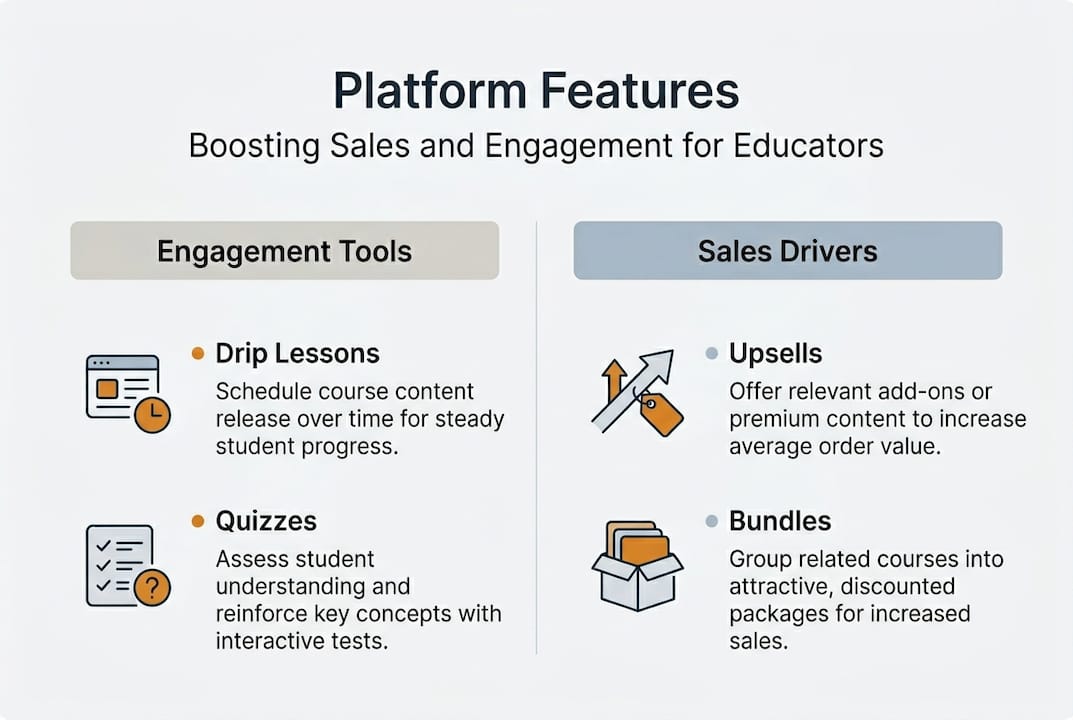
Drip content keeps students engaged over time rather than bingeing and disappearing. It also reduces refund rates, because students who are mid-course rarely abandon. Certificates serve a dual purpose: they motivate completion and give students a shareable credential, which generates organic word-of-mouth for your course.
Upsells and bundles are where significant revenue gains hide. TCommerce users sell 31% more, and top-performing course creators earn £48,500 per month on average, largely because they treat their course catalogue as an interconnected product ecosystem rather than isolated offerings.
Less obvious features that experienced creators swear by:
- Abandoned cart recovery: Automated emails to students who started checkout but did not complete it can recover 10 to 15% of lost sales.
- Student communities: Cohort-based learning with peer interaction increases completion rates dramatically, which feeds into better reviews.
- Affiliate programmes: Letting students and partners promote your course on commission scales your marketing without upfront spend.
- Multimedia support: Platforms that handle video, audio, PDFs, and interactive content in one place reduce friction for both creator and student.
Pro Tip: Bundle a core course with a supporting e-book or resource pack. The perceived value increases substantially, and you can price the bundle at a premium while the individual components anchor the comparison. For ideas on structuring supporting materials, the guide on developing education books is worth reviewing, as is the resource on e-books for engagement. Platforms that integrate AI grading tools can also reduce your administrative load while improving the student experience.
From setup to scale: how real creators succeed in digital marketplaces
Understanding features is useful. Watching how successful creators actually apply them is more useful still.
The income range across digital education is wide. Creators typically earn between $1,000 and $50,000 per month, with the spread explained almost entirely by audience size, product depth, and platform strategy rather than raw content quality. The creator economy statistics confirm this pattern consistently.
The phases most successful creators move through look like this:
- Validate on a marketplace. Use a large open marketplace to test whether your topic attracts paying students. Price modestly, collect reviews, and learn what questions students actually have.
- Build your first owned asset. Even while selling on a marketplace, start collecting email addresses through a lead magnet. This list is your most valuable long-term asset.
- Launch on a hosted platform. Once you have 200 to 500 engaged subscribers, launch your flagship course on a hosted platform where you control pricing and student relationships.
- Diversify your product catalogue. Add an e-book, a membership tier, or a live cohort. Each product serves a different buyer and price point.
- Automate and delegate. Use platform tools to automate onboarding, drip sequences, and upsell flows. Reinvest margin into content quality or paid promotion.
The migration from marketplace to owned platform is where most creators see their biggest income jump. Starting on marketplaces builds discovery, but migrating to owned platforms is where control and higher margins become accessible. Keeping pace with education market trends ensures your content stays relevant through each phase. For creators building content around established curricula, exploring classic books for education can provide a content foundation that students already trust.
The most common mistake is staying on a marketplace too long. Once your audience trusts you, every sale you make through a third-party platform is a margin and relationship you are giving away unnecessarily.
The overlooked truth about digital marketplaces for educators
Most articles about digital marketplaces focus on the setup. Very few talk honestly about what happens after the initial excitement fades.
Here is what we have observed consistently: the creators who thrive long-term are not the ones who found the best marketplace. They are the ones who used the marketplace as a launchpad rather than a destination. The marketplace gives you discovery. Ownership gives you leverage. Conflating the two is the single most expensive mistake an education entrepreneur can make.
Fee structures deserve particular scrutiny. A 7.5% transaction fee sounds small until you are processing £20,000 per month in sales. That is £1,500 leaving your business every month for the privilege of using a starter plan. Reviewing your platform costs annually is not optional; it is a core business practice.
For those serious about building a sustainable education business, critical reading for educators offers a useful framework for evaluating the claims platforms make about their own features and benefits.
Pro Tip: Use your first year to validate your content and audience rigorously. Treat it as a research phase. Once you know what your students will pay for and why, migrate to a platform that lets you keep more of what you earn and own every relationship you build.
Publish, reach, and thrive: why BibliOWLteca is your trusted digital marketplace
Everything covered in this guide points to one conclusion: the platform you choose shapes your income, your audience relationships, and your long-term growth potential.
BibliOWLteca is built precisely for educators and creators who want global reach without sacrificing control. With multi-currency support, built-in payment processing, tax compliance tools, and a scalable infrastructure, BibliOWLteca handles the operational complexity so you can focus on creating. Whether you are publishing e-books, structured courses, or a full digital product catalogue, the platform gives you the tools to build a real education business. Start publishing and reach students worldwide.
Frequently asked questions
What is the main difference between a hosted platform and a marketplace for digital courses?
A hosted platform gives you full control over pricing and student relationships, while a marketplace prioritises discovery but offers less ownership and lower margins for creators. The right choice depends on where you are in your growth journey.
How much can educators earn selling digital products online?
Earnings vary widely, but top creators earn $48,500 per month on average, with most established educators falling somewhere between £1,000 and £50,000 per month depending on audience size and product depth.
Which platform features are most important for maximising sales and engagement?
The highest-impact features are drip content, certificates, upsells, abandoned cart recovery, and built-in student communities, as these directly influence both completion rates and repeat purchases.
Is it better to start on a marketplace or with an owned platform?
Most educators benefit from starting on a large marketplace for initial exposure, then migrating to an owned platform once they have validated their content and built an engaged audience, which is when control and higher margins become most valuable.