
Surprising research reveals that ebooks significantly boost reading levels among boys by 8.4 months and transform perceptions that reading is 'cool', particularly benefiting less motivated readers. Despite concerns about screen time and digital distractions, evidence demonstrates that ebooks uniquely enhance student engagement through portability, interactivity, and accessibility features. This article explores how educators can harness ebooks to improve learning outcomes, comparing digital and print formats whilst addressing practical integration challenges. You'll discover evidence-based strategies for implementing ebooks effectively in diverse educational settings and learn how to balance digital and traditional resources for optimal student success.
Table of Contents
- Key Takeaways
- How ebooks enhance student engagement and learning
- Comparing ebooks and print: comprehension and reading experience
- Practical integration and teaching methodologies for ebooks
- Addressing challenges and accessibility in ebook education
- Unlock the full potential of ebooks with Bibliowlteca
- Frequently asked questions
Key Takeaways
| Point | Details |
|---|---|
| Boys reading uplift | Ebooks significantly raise boys' reading levels and help reframe reading as an engaging activity. |
| Portability and access | Portability lets learners carry hundreds of titles on a single device, increasing reading opportunities and frequency. |
| Interactive features boost engagement | Embedded multimedia, glossaries and hyperlinks support active reading and provide ongoing assessment opportunities. |
| Print best for comprehension | Research indicates reading comprehension is highest on paper, with digital formats trailing accordingly. |
| Balance digital and print | Strategies emphasise combining print and digital resources for optimal student outcomes. |
How ebooks enhance student engagement and learning
Digital reading materials fundamentally transform how students interact with educational content, particularly among demographics traditionally resistant to reading. Research from the National Literacy Trust demonstrates that ebooks boost boys' reading levels substantially whilst shifting cultural attitudes towards reading as an engaging activity. This impact extends beyond gender differences to include struggling readers and students from disadvantaged backgrounds who benefit from digital format flexibility.
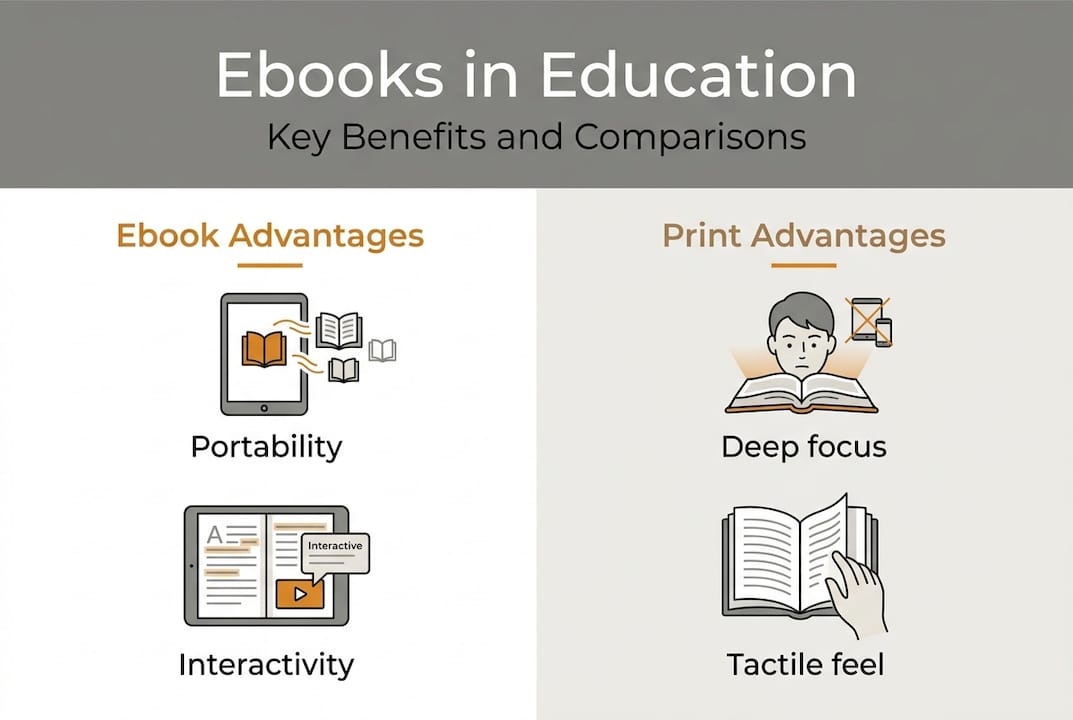
The portability advantage cannot be overstated. Students carry entire libraries on single devices, eliminating physical barriers that previously limited reading access. You can store hundreds of titles without weight constraints, enabling spontaneous reading opportunities during commutes, breaks, or unexpected free periods. This convenience factor directly correlates with increased reading frequency, as students no longer need to anticipate which specific book they'll want at any given moment.
Searchability transforms how learners navigate educational content. Digital search functions allow instant keyword location, enabling students to quickly reference previous material, find specific concepts, or revisit challenging sections without thumbing through pages. Note-taking capabilities integrate seamlessly with text, allowing highlighting, annotations, and bookmarking that persist across devices. These features support active reading strategies that research consistently links to improved comprehension and retention.
Interactive elements distinguish ebooks from static print materials. Embedded multimedia including videos, audio clips, and animations provide multi-sensory learning experiences that accommodate diverse learning styles. Hyperlinked glossaries offer immediate vocabulary support without disrupting reading flow, whilst interactive quizzes embedded within chapters provide formative assessment opportunities. Understanding literature gap impact on engagement helps educators select materials that address specific student needs through these enhanced features.
Pro Tip: Monitor which interactive features students actually use through learning management system analytics. Many ebooks include tracking capabilities that reveal which multimedia elements generate highest engagement, allowing you to refine future content selections based on demonstrated student preferences rather than assumptions.
"E-readers and tablets have fundamentally changed reading behaviours by making literature accessible in contexts where physical books prove impractical, creating reading opportunities that simply didn't exist in purely print-based environments."
Comparing ebooks and print: comprehension and reading experience
Cognitive research reveals nuanced differences between digital and print reading that educators must consider when designing learning experiences. A comprehensive meta-analysis published in Education and Information Technologies found that reading comprehension ranked best on paper, followed by tablets and dedicated e-readers, with scrolling formats producing measurably lower comprehension scores. This hierarchy reflects how physical page-turning provides spatial memory cues that aid information retention and recall.
The tactile experience of print materials contributes to cognitive processing in ways digital formats struggle to replicate. Physical books provide haptic feedback and spatial awareness, students literally feel their progress through material as page thickness shifts from right to left. This embodied cognition supports memory formation by creating multiple sensory pathways for information encoding. Print materials also eliminate digital distractions inherent in connected devices, maintaining focus on content rather than notifications, messages, or tempting app switches.
Yet ebooks offer compensating advantages that support learning in specific contexts. Adjustable font sizes accommodate visual impairments and reading difficulties without requiring specialised large-print editions. Integrated dictionaries provide instant word definitions that support vocabulary development, particularly beneficial for English language learners or students encountering technical terminology. Built-in translation features enable multilingual students to access content in their preferred language, promoting inclusive education practices.

| Format | Comprehension | Portability | Accessibility | Cost | Annotation |
|---|---|---|---|---|---|
| Print books | Highest | Limited | Fixed format | Higher per title | Permanent marks |
| Tablets | Moderate | Excellent | Highly adjustable | Variable | Reversible digital |
| E-readers | Good | Excellent | Adjustable | Moderate | Reversible digital |
| Scrolling digital | Lowest | Excellent | Adjustable | Often free | Reversible digital |
Environmental and economic factors influence format decisions beyond pedagogical considerations. Ebooks eliminate printing costs, storage requirements, and physical distribution expenses whilst reducing paper consumption. Institutional subscriptions provide access to thousands of titles at fraction of equivalent print library costs. However, device requirements create upfront investment barriers and digital divide concerns that disproportionately affect lower-income students.
Pro Tip: Reserve print materials for deep reading assignments requiring sustained focus and comprehension, whilst deploying ebooks for supplementary reading, research, and quick reference tasks. This strategic allocation maximises each format's strengths whilst minimising respective weaknesses.
Understanding critical reading comparison frameworks helps educators make informed decisions about when each format best serves specific learning objectives and student needs.
Practical integration and teaching methodologies for ebooks
Successful ebook implementation requires deliberate pedagogical strategies rather than simply substituting digital files for print materials. The National Literacy Trust research confirms that interactive ebooks with multimedia substantially enhance engagement when educators actively model effective use and receive adequate training. Without proper instructional scaffolding, students often miss valuable features or develop superficial reading habits that undermine learning potential.
Teacher modelling proves essential for demonstrating non-linear navigation strategies that leverage digital format advantages. You should explicitly show students how to use hyperlinked tables of contents, search functions, and cross-reference features during whole-class instruction. Think-aloud protocols where you verbalise decision-making whilst navigating ebook features help students develop metacognitive awareness about strategic reading approaches. This explicit instruction prevents students from defaulting to passive scrolling behaviours that research links to reduced comprehension.
Key interactive features to emphasise during instruction include:
- Embedded multimedia that provides context and elaboration beyond text
- Hyperlinked citations enabling immediate source verification
- Adjustable display settings for personalised reading comfort
- Annotation tools supporting active reading and critical analysis
- Integrated assessment features providing immediate feedback
Blended learning approaches combine digital and print materials strategically throughout units. You might assign ebook chapters for initial exposure and background knowledge building, then transition to print materials for close reading and analytical tasks requiring sustained focus. This sequencing leverages ebook accessibility for broad content coverage whilst reserving print formats for cognitively demanding work where comprehension differences matter most.
Professional development addressing ebook pedagogy remains critically underdeveloped. Many educators lack confidence with digital tools or understanding of how ebook features support specific learning objectives. Effective training programmes should include:
- Hands-on exploration of various ebook platforms and formats
- Evidence-based research on digital versus print reading comprehension
- Lesson planning integrating ebook-specific instructional strategies
- Troubleshooting common technical issues students encounter
- Assessment design appropriate for digital reading contexts
Open educational resources pedagogy offers particular promise for ebook integration. OER materials allow customisation, remixing, and adaptation that proprietary textbooks prohibit. You can curate ebook collections addressing specific student needs, cultural contexts, or curriculum requirements whilst maintaining cost accessibility. This flexibility supports differentiated instruction and culturally responsive teaching practices that commercial publishers rarely accommodate.
Exploring educator ebook methodologies provides additional strategies for effective implementation, whilst ebook selection strategies help identify materials aligned with specific learning objectives and student populations.
Addressing challenges and accessibility in ebook education
Accessibility barriers significantly limit ebook effectiveness for students with disabilities despite digital formats' theoretical advantages. The W3C Accessibility Guidelines identify that fixed-layout EPUBs create accessibility problems including incorrect reading order, missing alternative text for images, and incompatibility with screen readers. These technical limitations disproportionately affect visually impaired students and those requiring assistive technologies, potentially excluding vulnerable populations from educational content.
Cognitive load concerns extend beyond accessibility to affect all learners. Digital reading environments present competing stimuli that fragment attention and increase working memory demands. Hyperlinks, whilst offering valuable navigation options, tempt students toward tangential exploration that disrupts comprehension of primary content. Notification systems, even when silenced, create ambient awareness of potential interruptions that research links to reduced focus and information retention.
Device variability introduces inconsistent user experiences across student populations. Ebooks render differently on tablets, smartphones, e-readers, and computers, creating formatting issues that range from minor annoyances to complete content inaccessibility. Students using older devices or limited data plans face particular disadvantages, as resource-intensive multimedia features may load slowly or fail entirely. These technical inequities mirror broader digital divide patterns that education technology often inadvertently exacerbates.
Common accessibility challenges include:
- Screen reader incompatibility with complex layouts and embedded media
- Insufficient colour contrast ratios affecting visually impaired readers
- Navigation structures that confuse assistive technology users
- Multimedia content lacking captions or transcripts
- Interactive elements requiring fine motor control inaccessible to some students
Teacher confidence gaps compound technical accessibility barriers. Many educators feel unprepared to troubleshoot ebook platform issues or adapt digital materials for students with diverse needs. This uncertainty leads to underutilisation of available features or complete avoidance of ebook integration despite potential benefits. Professional development programmes rarely address accessibility considerations comprehensively, leaving educators without frameworks for evaluating or remediating problematic digital content.
| Challenge | Impact | Solution |
|---|---|---|
| Fixed-layout accessibility | Screen reader failures | Choose reflowable EPUB formats |
| Cognitive overload | Reduced comprehension | Disable non-essential features |
| Device inconsistency | Unequal access | Test across multiple platforms |
| Training deficits | Limited implementation | Provide ongoing professional development |
| Distraction potential | Decreased focus | Establish device use protocols |
Applying WCAG standards during ebook selection and creation processes substantially improves accessibility outcomes. Prioritise materials with semantic HTML structure, proper heading hierarchies, and descriptive alternative text for images. Verify that interactive elements remain keyboard-accessible and that colour coding never serves as sole information conveyor. Regular testing with actual assistive technologies reveals issues that theoretical compliance checks miss.
Pro Tip: Create accessibility checklists specific to your institution's ebook platforms and student population needs. Involve students requiring accommodations in testing processes to identify barriers that educators without disabilities might overlook.
Understanding ebook accessibility guidelines ensures materials meet technical standards, whilst effective managing digital resources practices support consistent accessibility across institutional collections.
Unlock the full potential of ebooks with Bibliowlteca
Navigating the transition to digital educational resources requires reliable platforms that support both content creation and distribution whilst maintaining accessibility standards. Bibliowlteca provides comprehensive infrastructure enabling educators to publish, distribute, and monetise educational ebooks globally whilst managing their own digital storefronts and student audiences.

The platform handles complex technical requirements including secure digital delivery, international payment processing across multiple currencies, and tax compliance automation that typically burden individual creators. You can focus on developing quality educational content whilst Bibliowlteca manages the technological infrastructure supporting worldwide distribution. This streamlined approach removes barriers that previously prevented many educators from sharing expertise through digital channels.
Comprehensive support resources help educators maximise ebook effectiveness in diverse learning contexts. Detailed guides cover everything from accessing free books online to implementing sophisticated digital learning strategies tailored to specific student populations and educational objectives. These resources translate research findings into actionable practices that improve student outcomes whilst addressing common implementation challenges.
Explore how Bibliowlteca's digital resources can transform your educational content delivery and expand your teaching reach beyond traditional classroom boundaries.
Frequently asked questions
What challenges do educators face adopting ebooks?
Training gaps and confidence deficits represent the most significant barriers to effective ebook integration. Many educators lack familiarity with digital platform features or evidence-based strategies for teaching with ebooks, leading to underutilisation or ineffective implementation. Ensuring accessibility compliance adds complexity, as educators must evaluate technical specifications against WCAG standards whilst accommodating diverse student needs. Institutional support through comprehensive professional development and dedicated accessibility review processes substantially improves adoption success rates.
How do ebooks improve student motivation and engagement?
Interactive features including embedded multimedia, hyperlinked content, and immediate feedback mechanisms appeal to diverse learning preferences and maintain student interest. Research demonstrates that ebooks particularly benefit boys and reluctant readers by incorporating game-like elements and reducing stigma associated with traditional reading materials. Portability enables reading in varied contexts beyond classroom settings, creating spontaneous engagement opportunities that increase overall reading volume. Studies document measurable improvements in reading levels and positive attitude shifts when students access ebook collections aligned with their interests.
Should educators rely solely on ebooks or use print materials too?
Print materials consistently demonstrate superior comprehension outcomes for complex texts requiring sustained focus and deep processing. A blended approach strategically deploys each format where it offers greatest advantage, using ebooks for accessibility, portability, and initial content exposure whilst reserving print for analytical reading and assessment tasks. This hybrid model accommodates diverse student preferences and learning contexts whilst maximising cognitive benefits associated with both formats. Research supports balanced implementation rather than exclusive reliance on either medium.
How can educators ensure ebook accessibility for all students?
Prioritise reflowable EPUB formats over fixed-layout designs to maintain screen reader compatibility and text reflow capabilities. Verify that selected materials include proper semantic structure, descriptive alternative text, and keyboard navigation support before adoption. Conduct testing with actual assistive technologies and involve students requiring accommodations in evaluation processes to identify barriers that theoretical compliance checks miss. Establish institutional accessibility standards and provide educators with evaluation rubrics specific to your ebook platforms and student population needs.
What role does teacher training play in ebook effectiveness?
Professional development directly correlates with successful ebook implementation and student outcome improvements. Effective training programmes combine hands-on platform exploration with evidence-based pedagogical strategies specific to digital reading contexts. Educators need explicit instruction in modelling non-linear navigation, leveraging interactive features, and designing assessments appropriate for digital formats. Ongoing support addressing technical troubleshooting and accessibility considerations builds confidence that translates into more sophisticated and effective classroom integration. Without adequate training, ebooks often function as expensive substitutes for print materials without realising their unique pedagogical potential.