

TL;DR:
- The global e-learning market is projected to reach 337 billion dollars by 2026, with creator education valued at 12.4 billion dollars. Building an engaged audience before product creation is essential for success, emphasizing community and validation. Educators should focus on transformation, community, and leveraging suitable platforms to stay competitive amidst AI disruption and low course completion rates.
The global e-learning market is projected to reach $337 billion by 2026, with the creator education segment alone forecast at $12.4 billion. If you are a teacher, coach, or subject-matter expert still trading hours for money, that number should stop you mid-scroll. The conditions for building a profitable digital education business have never been more accessible, more global, or more forgiving of a lean start. This guide walks you through every layer of the journey, from understanding what digital entrepreneurship really means for educators, to building an audience, choosing a platform, pricing your knowledge, and navigating the challenges that trip up most first-timers.
Table of Contents
- Understanding digital entrepreneurship for educators
- Building your audience: The engine of course and content sales
- Choosing your platform: Marketplace vs self-hosted models
- Monetisation models and scaling strategies
- Navigating challenges: AI, competition, and completion rates
- What most creators get wrong about digital entrepreneurship
- Ready to launch your digital education business?
- Frequently asked questions
Key Takeaways
| Point | Details |
|---|---|
| Audience is critical | Building a loyal audience is the foundation for success in digital education entrepreneurship. |
| Choose the right platform | Compare marketplaces and self-hosted models to match your goals and maximise revenue. |
| Monetise with purpose | Hybrid, cohort, and subscription models outperform pure information products, especially in retention. |
| Adapt to AI disruption | Focus on transformational outcomes and accountability to stay relevant as AI increases competition. |
| Systems beat polish | Automated systems and rapid testing matter more than perfect production or fancy design. |
Understanding digital entrepreneurship for educators
Digital entrepreneurship, in the context of education, is the practice of packaging your knowledge into scalable products that earn revenue independently of your time. Unlike traditional teaching, where income is directly tied to the hours you spend in front of students, digital products work while you sleep. A course recorded once can sell ten times or ten thousand times without any additional effort from you. That shift, from time-based to asset-based income, is the fundamental promise of digital education entrepreneurship.
The rise of online learning has been extraordinary. Learners worldwide now expect to access high-quality education on demand, at their own pace, and on their own devices. This expectation has opened up an enormous market for independent creators who possess deep knowledge in virtually any field. From language learning to financial modelling, from watercolour painting to software development, every niche has a paying audience somewhere in the world.
So what does a digital education business actually look like in practice? It starts with knowledge. You take what you already know, structure it into a learnable format, and deliver it through a digital product. The most popular formats include:
- Online courses: Pre-recorded video modules, often with downloadable worksheets, quizzes, and community access
- E-books and guides: Written content that teaches a specific skill or concept, typically sold as PDF downloads
- Templates and frameworks: Ready-made tools that save learners time, such as lesson plan templates or business planning spreadsheets
- Live cohort programmes: Time-limited, instructor-led experiences that combine recorded content with live sessions and peer accountability
- Membership sites: Ongoing subscription access to a content library, community, or coaching calls
- Workshops and webinars: Short, focused sessions on specific topics, often used as entry points into a creator's wider product ecosystem
Monetisation comes in several forms. Creators and educators monetise digital educational materials primarily through online course platforms using subscription, pay-per-course, freemium, and cohort-based models. Each model carries different revenue characteristics, different levels of ongoing effort, and different ideal use cases depending on your audience and content type.
The key to understanding which approach fits you lies in recognising where your expertise sits. Are you teaching a repeatable, step-by-step process? A structured course model works well. Are you sharing ongoing insights, tools, and updates in a fast-moving field? A membership or subscription makes more sense. Do you want to help learners achieve a specific transformation in a concentrated timeframe? A cohort model is often the most powerful option.
Market insight: The digital education space is not slowing down. Online courses consistently represent the top revenue stream for independent creators, accounting for 60 to 70 per cent of total creator education income. Structured transformation and community-led learning are the fastest-growing segments as learners increasingly demand results, not just content.
When you understand these mechanics, you can begin to sell and distribute educational materials in a way that aligns with your goals, your audience's needs, and the wider market dynamics.
Building your audience: The engine of course and content sales
Here is an uncomfortable truth that most creator guides gloss over: your product is not your biggest asset. Your audience is. Without an engaged group of people who trust you and are interested in what you teach, even the most beautifully produced course will sit unsold. Audience-building for educators must come before product creation, not after.

The reason is simple. When you build an audience first, you gather market intelligence. You learn exactly what your potential students struggle with, what language they use to describe their problems, and what outcomes they desperately want. That insight is worth more than any course production tool on the market. It shapes your curriculum, your sales copy, and your pricing in ways that dramatically increase your chances of success.
So how do you build an audience from scratch? A practical, step-by-step approach works far better than trying to be everywhere at once:
- Choose one content channel: Start with a single platform where your ideal learner already spends time. YouTube is particularly powerful for evergreen traffic because videos rank in both YouTube search and Google search, driving passive discovery for months or years after publication.
- Publish consistently with a clear topic focus: Your content should solve one specific type of problem for one specific type of person. Breadth kills early-stage audience growth. Depth builds it.
- Capture email addresses from day one: Social media audiences can disappear overnight due to algorithm changes or platform shifts. Your email list is the only audience you truly own. Even a small, highly engaged list of 200 subscribers is enough to validate a new product idea.
- Offer a free lead magnet: A short guide, template, or mini-course that delivers immediate value in exchange for an email address is your most reliable list-building tool.
- Use automated email sequences: Once someone joins your list, a series of pre-written emails builds trust, delivers value, and naturally leads towards your paid offers without requiring any manual effort on your part.
- Engage your community before launching: Ask questions, run polls, and invite direct feedback. This both strengthens relationships and gives you the product insight mentioned above.
Success requires prioritising systems such as email automation and sales funnels over polishing production quality. This is one of the most counterintuitive lessons in digital entrepreneurship. Creators routinely spend months perfecting slide decks and lighting rigs when they should be spending that time building their email list and creating free content that attracts their future students.
On conversion rates: email lists convert at 2 to 5 per cent, which means a list of 500 engaged subscribers could generate 10 to 25 sales on a course launch. Margins in digital education can reach 85 to 95 per cent after platform and marketing costs, making this one of the highest-margin business models available to independent creators.
Developing educational mini-courses as entry-point offers is a particularly smart strategy for list-building. A low-priced mini-course, priced between £27 and £97, does three things simultaneously: it attracts buyers rather than freebie-seekers, it demonstrates your teaching style and quality, and it creates a natural pathway towards a higher-priced flagship programme.
Pro Tip: Do not wait until your course is perfect to start building your list. Launch a free five-day email challenge or a short video series now. The audience you build during production will be your first paying customers at launch.
Choosing your platform: Marketplace vs self-hosted models
After you have built your audience, selecting the right platform to deliver and monetise your educational content becomes one of the most important decisions you will make. The two main routes are marketplace platforms and self-hosted solutions, and each comes with very different trade-offs.
Marketplace platforms such as Udemy, Skillshare, and Teachable host your content alongside thousands of other creators. They bring built-in audiences and discovery mechanisms, which can be enormously valuable for creators who are just starting out and do not yet have an established following. The downside is significant: marketplace platforms like Udemy offer discovery but low margins, with revenue cuts ranging from 25 to 75 per cent depending on how a sale originates. You also have limited access to customer data, which restricts your ability to build direct relationships and market future products.
Self-hosted solutions such as Kajabi, Podia, or purpose-built platforms like BibliOWLteca give you full control over your brand, your pricing, and your customer relationships. You keep a far higher proportion of revenue, you own your student data, and you can customise the entire learning experience. The trade-off is that you are responsible for driving your own traffic and sales.
| Feature | Marketplace (e.g. Udemy) | Self-hosted (e.g. BibliOWLteca) |
|---|---|---|
| Revenue share | 25 to 75% cut | Low fixed fees, higher retention |
| Discovery | Built-in audience | Creator-driven traffic |
| Brand control | Limited | Full control |
| Customer data | Platform owns it | You own it |
| Ideal for | New creators, validation | Established audiences, scaling |
| Pricing flexibility | Restricted by platform | Full flexibility |
When choosing between these models, ask yourself the following questions:
- Do I already have an engaged audience who will follow me to any platform?
- How important is owning my customer data and building long-term relationships?
- Am I comfortable driving my own traffic, or do I need built-in discovery?
- What percentage of revenue do I need to keep to make my business viable?
- Do I want to sell across multiple product types, such as e-books and courses together?
A digital marketplace empowerment approach works best when you pair a platform with global reach with your own audience-building efforts. Many successful creators use a hybrid model: they list introductory content on marketplaces for discovery, then direct buyers to their own digital storefronts to sell e-books and courses worldwide for higher-margin flagship products.
Expert view: Contrasting views on platforms make one thing clear: pure information products are increasingly vulnerable to AI commoditisation, while structured transformation experiences with community and accountability are far more resilient. Whichever platform you choose, your differentiation must go beyond content delivery.
The knowledge marketplace model is evolving fast. Cohort-based courses, which run for a fixed period with a live group, show completion rates of 50 to 60 per cent compared to just 15 per cent for self-paced evergreen courses. Higher completion rates mean more testimonials, more referrals, and a stronger reputation, all of which compound over time.
Monetisation models and scaling strategies
With your platform chosen, it is time to optimise how you earn and grow. There are four primary monetisation models available to digital educators, and the most successful creators eventually combine more than one.

Subscription models provide predictable recurring revenue in exchange for ongoing access to content, community, or coaching. Monthly memberships priced between £15 and £49 work well for creators who produce regular content and can sustain ongoing engagement.
Pay-per-course models involve a one-time purchase for lifetime or timed access to a specific course. This is the most familiar model for learners and works best for standalone transformations with a clear beginning and end.
Freemium models offer a free tier to attract learners and then upsell premium content, features, or support. This works particularly well for building large audiences quickly, though conversion rates from free to paid typically sit between 2 and 5 per cent.
Cohort-based models charge a premium for a structured, time-limited experience with live elements and peer interaction. These courses command the highest prices, often ranging from £500 to several thousand pounds, because the perceived and actual value of transformation is higher.
| Model | Typical price range | Margin potential | Completion/retention |
|---|---|---|---|
| Subscription | £15 to £49/month | High with scale | Ongoing, churn-dependent |
| Pay-per-course | £97 to £997 | 85 to 95% | 10 to 20% self-paced |
| Freemium | Free + £29 to £199 upsell | Moderate | Variable |
| Cohort-based | £500 to £3,000+ | Very high | 50 to 60% |
Hybrid pricing and multi-year contracts boost EdTech growth 2.4 times, and aligning pricing with measurable customer success metrics leads to 34 per cent higher lifetime value. This is a signal that smart creators should be building pricing structures around outcomes, not content volume.
Scaling your digital education business follows a natural progression:
- Validate with a mini-course: Launch a low-priced, focused product to test demand, gather testimonials, and learn what your audience actually needs.
- Build your flagship course: Use the feedback and data from your mini-course to create a comprehensive, premium offer priced to reflect its transformational value.
- Add upsells and complementary products: Introduce higher-priced coaching, community memberships, or advanced courses to existing students who already trust you.
- Automate your funnel: Build email sequences, evergreen webinars, and automated delivery systems so your business earns revenue without requiring your constant attention.
- Expand distribution: Use global digital sales strategies to reach learners in new markets, accepting multiple currencies and localising your marketing messaging where appropriate.
Pro Tip: Price your course based on the transformation it delivers, not on the number of hours of video it contains. A two-hour course that helps someone land a better-paying job is worth far more than a twenty-hour course with no clear outcome. Learners pay for results. The monetisation models for creators that consistently outperform are those built around a specific, measurable promise.
Navigating challenges: AI, competition, and completion rates
Before you accelerate your growth, it is worth understanding the pitfalls that derail most digital entrepreneurs. The landscape in 2026 presents three significant challenges: AI commoditisation, low course completion rates, and intensifying competition on high-fee marketplace platforms.
Artificial intelligence can now generate written guides, explanations, and even personalised learning pathways at a fraction of the cost of a traditional course. This is genuinely disrupting the market for pure information products. If your course simply compiles information that learners could find through a well-structured AI prompt, your product is vulnerable. According to library trends shaping digital education, AI is fundamentally reshaping what learners expect from educational content in 2026 and beyond.
The creators who are thriving despite this shift are those who offer something AI cannot replicate: human accountability, community, expert feedback, curated experience, and genuine transformation. A course that connects learners with peers, provides live coaching, and tracks real-world outcomes will always command a premium over a static content library.
Completion rates are the silent killer of course businesses. Marketplace platforms like Udemy see average completion rates of around 15 per cent for self-paced courses, meaning 85 per cent of buyers never finish what they purchase. This is devastating for word-of-mouth growth and repeat sales. Cohort-based and community models push completion rates to 50 to 60 per cent, making them far superior for building a reputation and generating testimonials. An alarming statistic for any aspiring creator: 60 per cent of course creators who launch without an existing audience earn zero revenue from their first product.
Understanding the impact of AI trends in education and developing smart global distribution strategies are increasingly non-negotiable for long-term success. Here is what the most resilient digital educators are doing differently:
- Focusing on transformation, not information: Every product is designed around a specific, measurable outcome rather than a topic or subject area
- Building accountability into the experience: Check-ins, progress tracking, live Q&A sessions, and peer cohorts all increase completion and satisfaction
- Creating community as a core feature: An active, well-moderated community of learners who support each other adds enormous value that no AI can replicate
- Iterating continuously based on student feedback: Rather than launching once and moving on, successful creators treat their courses as living products that improve with each cohort
- Diversifying revenue streams: Combining self-paced evergreen content with live cohorts, e-books, templates, and membership access creates stability against any single channel underperforming
Why most creators fail to monetise: Jumping straight to course creation without an audience is the single most common and costly mistake in digital entrepreneurship. Without a warm audience ready to buy, even genuinely excellent content struggles to find its first students. The sequence matters: audience first, validation second, product third.
What most creators get wrong about digital entrepreneurship
After observing how hundreds of educators attempt to build digital businesses, a pattern emerges that is difficult to ignore. The obsession with production quality, platform selection, and course design is almost always misplaced. Creators spend weeks agonising over their video backdrop, their course platform's colour scheme, and whether their slides should use a serif or sans-serif font. Meanwhile, the actual work that drives results, building an audience and nurturing a community, goes undone.
The uncomfortable truth is that a mediocre course with a warm, engaged audience will outsell a masterfully produced course with no audience every single time. Systems and relationships are the actual product. The course is almost secondary.
There is also a deeper shift happening that most creators are not fully grappling with. AI is not just changing what learners can access for free. It is raising the bar for what they expect when they pay. Learners in 2026 are more sophisticated than ever. They have access to high-quality free information on virtually every topic. What they will pay for is structured guidance, accountability, expert perspective, and community. Creators who understand this are building businesses around those elements rather than around content volume.
What actually works, based on real patterns from the field, is rapid validation, honest community-building, and relentless focus on student outcomes. Launch fast, gather feedback aggressively, improve continuously, and price for results. The creators sharing real-world sales wisdom consistently point to the same lesson: the market rewards generosity and transformation above all else.
Do not wait for perfect conditions. The best time to start building your audience was twelve months ago. The second best time is now.
Ready to launch your digital education business?
Everything covered in this guide points to one clear next step: getting your knowledge onto a platform designed to help it reach the right learners, anywhere in the world.
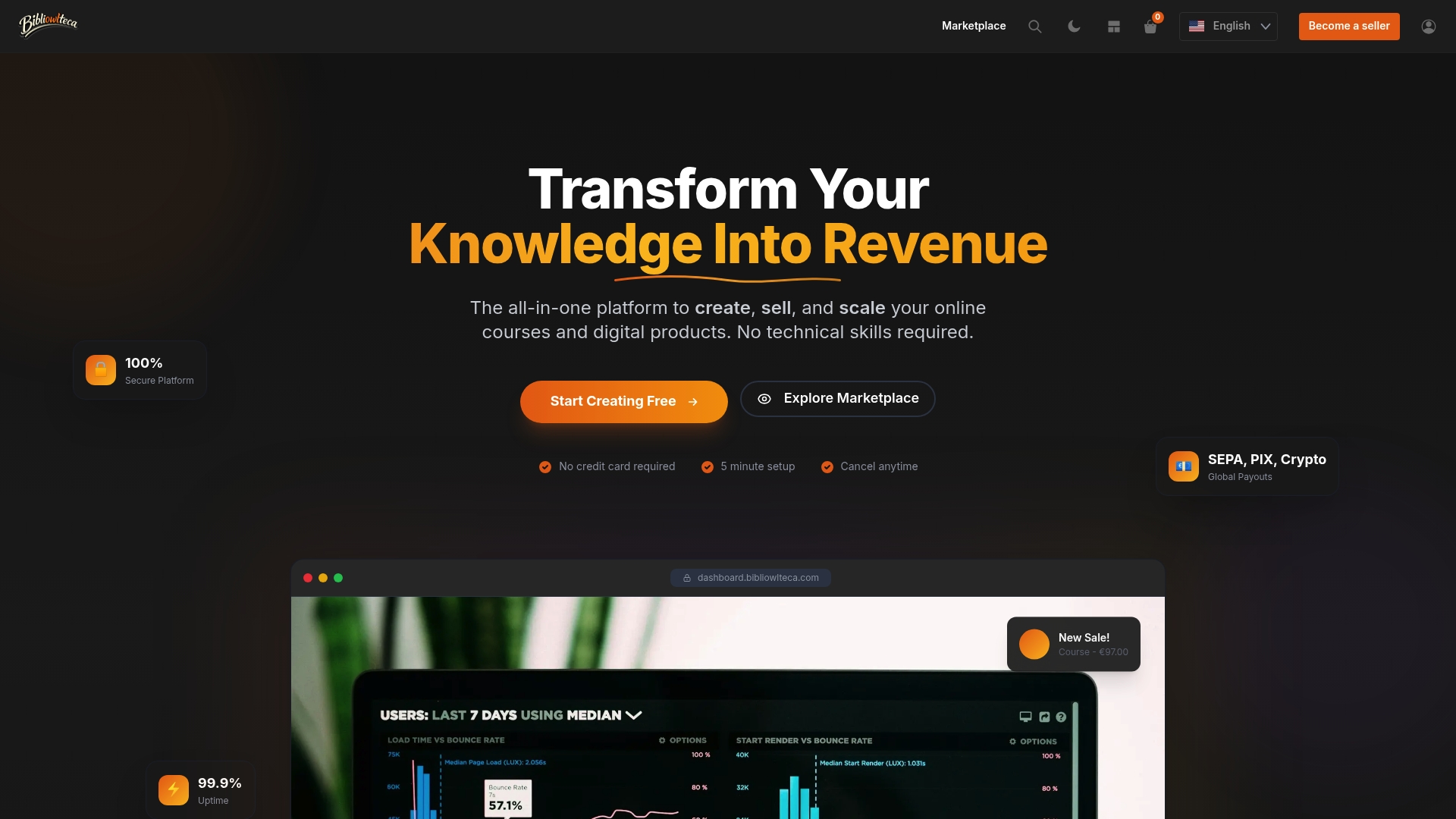
BibliOWLteca is built specifically for creators and educators who want to publish, sell, and scale digital educational products without the friction of complex technical setup or punishing revenue splits. Whether you are selling your first e-book, launching a structured online course, or building a full curriculum, the platform handles payment processing, digital delivery, tax compliance, and multi-currency support so that you can focus on what you do best: teaching.
Explore the digital education marketplace to see how other creators are reaching global learners today. Or start earning as a creator by listing your first digital product and turning your expertise into a sustainable, scalable income stream.
Frequently asked questions
What is the most lucrative way to monetise digital educational content?
Flagship or cohort-based online courses consistently generate the highest revenue per student because of their high perceived value and structured outcomes. Courses represent 60 to 70 per cent of total creator education income.
How big should my audience be before launching a course?
You do not need a large audience to validate your first course. An engaged email list of 100 to 200 subscribers is sufficient for a mini-course launch, since email lists convert at 2 to 5 per cent even for new creators.
Is there still space for new educators with so much competition?
Absolutely, but you need to differentiate through transformation and community rather than information alone. The global e-learning market is heading to $337 billion by 2026, which means demand for quality educational content continues to grow faster than supply.
Which platforms are best for new digital entrepreneurs?
It depends on your starting point. Marketplaces like Udemy suit low-barrier entry and discovery for total beginners, while self-hosted platforms are better for creators who already have an audience and want to keep more revenue and control.