
TL;DR:
- Most creators earn little because they skip foundational audience building and validation processes.
- Choosing the right platform depends on audience size, product type, and scalability goals.
- Building systems, including product ladders and pre-launch marketing, is crucial for sustained online business success.
Nearly 60% of creators earn between £0 and £100 per month, not because their knowledge lacks value, but because they skip the foundational steps that separate a profitable digital business from an expensive hobby. Publishing an e-book or course without a validated audience, a clear platform strategy, and a structured product system is the single biggest reason most creators stall. This article walks you through every critical decision: choosing the right platform, validating your niche before you build, structuring content that sells, and navigating the real challenges of market saturation and AI disruption. If you follow this roadmap, you will not just launch a product. You will build a system.
Table of Contents
- Choosing the right platform for selling digital products
- Validating your niche and structuring products for success
- Maximising engagement, retention, and average order value
- Critical challenges, edge cases, and market saturation
- What most creators miss about building an online business
- Start your online business journey with BibliOWLteca
- Frequently asked questions
Key Takeaways
| Point | Details |
|---|---|
| Platform matters | Choosing the right platform determines your control, earnings, and discoverability. |
| Validate before building | Testing demand early prevents wasted effort and improves product success. |
| Engagement drives revenue | Retention strategies and upsells significantly boost income and user satisfaction. |
| Adapt to market shifts | AI and saturation require creators to focus on value-driven, outcome-based content. |
| Audience first | Building a direct audience outweighs product perfection for long-term profitability. |
Choosing the right platform for selling digital products
Platform choice is one of the most consequential decisions you will make as a digital creator. Get it wrong and you will either haemorrhage revenue to fees, lose pricing control, or spend years building an audience on someone else's land. Get it right and your platform becomes the engine of a scalable, profitable business.
There are two broad categories to understand: hosted SaaS platforms and marketplaces. Popular global platforms for selling e-books and courses include Teachable, Thinkific, Kajabi, Podia, Gumroad, and Udemy, and each serves a fundamentally different creator profile.
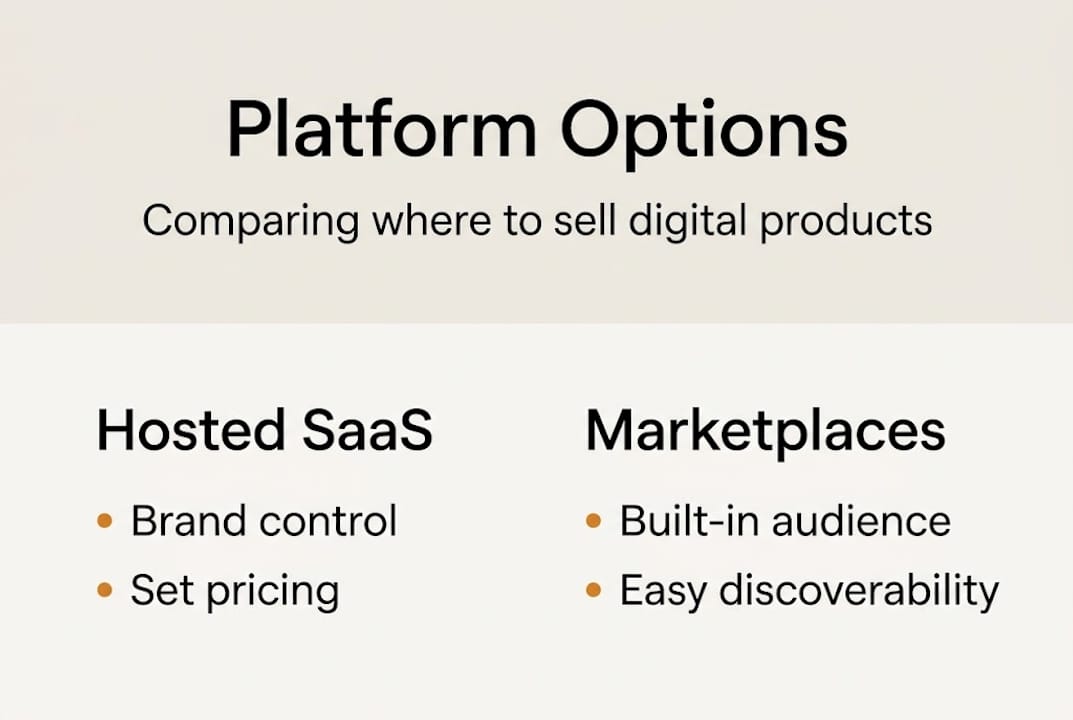
Hosted SaaS platforms give you control. You set the price, own the customer relationship, and build your brand. Kajabi is the most feature-rich option, bundling email marketing, pipelines, and community tools into one subscription. Thinkific offers a cleaner, more affordable entry point. Teachable sits in the middle. Podia is excellent for creators who want simplicity. Gumroad is ideal for lightweight digital product sales with minimal overhead.
Marketplaces like Udemy offer discoverability. If you have zero audience, Udemy's built-in traffic can get your first sales quickly. The trade-off is significant: Udemy controls pricing, regularly discounts your course to £1.99, and takes a substantial revenue share. You are renting shelf space, not building an asset.
The revenue gap between these models is stark. Kajabi creators average around £9,400 per month at the top end, Thinkific creators can reach approximately £6,000 per month, and Udemy creators earn a median of less than £1,000 over a course's lifetime. These are not small differences.
Here is a quick comparison of the main platform options available in 2026:
| Platform | Monthly fee | Transaction fee | Best for |
|---|---|---|---|
| Kajabi | From £55 | 0% | Full business suite |
| Thinkific | Free to £74 | 0% on paid plans | Course creators |
| Teachable | From £0 | 5% on free plan | Beginners |
| Podia | From £33 | 0% | Simple storefronts |
| Gumroad | Free | 10% per sale | Digital downloads |
| Udemy | Free to list | Up to 75% revenue share | Discovery only |
Key factors to weigh when choosing:
- Audience size: If you already have an email list or social following, go hosted SaaS immediately.
- Budget: Gumroad and Teachable's free tier let you test before committing.
- Product type: E-books suit Gumroad or Podia; structured courses suit Kajabi or Thinkific.
- Scalability: Marketplaces cap your ceiling; owned digital storefronts raise it.
For a deeper look at how to structure your publishing setup, the digital publishing guide covers the technical and business decisions in detail. And if you want to understand the full revenue picture, exploring strategies for maximising author income will give you the financial context you need.
The bottom line: start where your audience is, then migrate to a platform you own as you grow.
Validating your niche and structuring products for success
Most creators build first and validate second. That is the wrong order. Spending three months writing an e-book on a topic nobody is searching for is not a creative risk. It is an avoidable mistake.
Validation is the process of confirming real demand before you invest significant time. Here is a step-by-step approach that works:
- Search Google Trends for your topic over a 12-month period. Look for stable or rising interest, not spikes tied to a single news event.
- Browse Udemy's search results for your category. High enrolment numbers on existing courses confirm demand. If the top course has 50,000 students, the market exists.
- Check Reddit and Quora for recurring questions in your niche. Real pain points expressed in real language tell you exactly what your content should address.
- Run a smoke test. Create a simple landing page describing your course or e-book and drive traffic to it via social media or a small paid ad. Measure clicks and sign-ups before you build anything.
- Pre-sell your product. Offer early-bird pricing to your existing audience. If nobody buys, the market has spoken. If ten people pay upfront, you have proof of concept and cash to fund creation.
Once validated, structure matters enormously. Validate niche demand first via Google Trends and Udemy searches, then use drip content, order bumps, and upsells, and integrate email for launches. These mechanics are not optional extras. They are the architecture of a profitable product.
Outcome-focused content consistently outperforms topic-focused content. Instead of "Introduction to copywriting," sell "Write your first sales page in 7 days." Specificity signals credibility and justifies higher pricing.
The product ladder is one of the most powerful frameworks for growing lifetime customer value. Structure your offerings across three tiers:
- Free: A lead magnet (checklist, short guide, mini-course) that builds your email list.
- Low-cost: An e-book or starter course priced between £9 and £49 that converts subscribers into buyers.
- High-ticket: A flagship course, coaching programme, or cohort priced from £197 upwards.
For a broader view of how to position these products for global digital sales, understanding international pricing and distribution is essential. You can also explore frameworks for selling digital products online to see how successful creators structure their catalogues.
Pro Tip: The narrower your niche, the higher your perceived expertise and the more you can charge. "Productivity for remote software engineers" will outsell "Productivity tips" every time.
Maximising engagement, retention, and average order value
Getting a customer is hard. Losing them to a poor experience is easy. The creators who build sustainable income are the ones who obsess over what happens after the sale.

Engagement begins with how you deliver content. Drip content, where lessons are released on a schedule rather than all at once, keeps students coming back and dramatically reduces the overwhelm that causes people to abandon courses. Structured launches with countdown timers and email sequences create urgency and lift conversion rates on new products.
On the revenue side, the numbers are compelling:
Tripwire funnels boost average order value by 15 to 30 per cent. Upsells and bundles can double average order value. Cohort-based courses achieve completion rates of 50 to 60 per cent, compared to under 15 per cent for self-paced formats.
These are not marginal gains. A 20 per cent lift in average order value across 100 sales per month is a meaningful income shift.
Here is how the formats compare on key metrics:
| Format | Completion rate | Avg. revenue multiplier | Best use case |
|---|---|---|---|
| Self-paced course | Under 15% | 1x baseline | Evergreen content |
| Drip-based course | 25-35% | 1.5x | Structured learning |
| Cohort-based course | 50-60% | 2-3x | High-ticket offers |
| Bundled products | N/A | 1.5-2x | Upsell at checkout |
Branded platforms earn 3.8 times more than marketplace-dependent creators, reinforcing the case for owning your platform as you scale.
Practical steps to boost retention and lifetime value:
- Add a community element (a private group or forum) to cohort courses. Belonging increases completion.
- Offer an order bump at checkout: a low-cost add-on priced at £9 to £27 that complements the main purchase.
- Use post-purchase email sequences to guide students through the first 48 hours. Early wins reduce refund rates.
- Create a logical upsell path from your low-cost product to your flagship offer.
For a broader perspective on how these systems connect to empowering global educators at scale, the principles of community and structured delivery apply across every market. A practical digital selling roadmap can help you sequence these tactics in the right order.
Critical challenges, edge cases, and market saturation
The digital education market is growing, but it is also maturing. Naïve optimism about passive income from a single course upload is increasingly disconnected from reality. Here is what you actually need to navigate.
Market saturation is real in broad niches. "Learn Python" or "Start a business" are not viable positioning strategies for new creators in 2026. The solution is not to avoid these markets but to go deeper. Specificity, community, and outcomes are what separate profitable products from invisible ones.
AI disruption is reshaping what sells. Generic information products, the kind that simply explain concepts available freely online, are losing ground fast. AI disruption impacts generic info products, while cohort and outcome-focused content wins. If your course could be replaced by a well-prompted AI chatbot, you need to rethink your value proposition.
Pricing compression is a structural risk on marketplaces. Marketplaces like Udemy offer discovery but create pricing compression and fee losses, and transaction fees can kill margins at scale, while branded platforms deliver significantly higher revenue. A course you price at £99 on your own platform might sell for £1.99 during a Udemy promotion, training your audience to wait for discounts.
Audience dependency is the make-or-break factor most creators underestimate. Without pre-launch traffic, even the best product will launch to silence. Building an email list before you build a product is not optional. It is the work.
Key challenges to plan for:
- Fee structures that erode margins on lower-priced products
- Refund rates that spike when student expectations are misaligned with product outcomes
- Platform dependency risk if a marketplace changes its algorithm or terms
- The psychological toll of slow early growth before momentum builds
For context on how 2026 digital education trends are reshaping what buyers expect, and for a look at the e-book tools that can streamline production, both resources are worth your time. For raw data on online earning insights across creator types, the numbers will recalibrate your expectations usefully.
Pro Tip: Use a marketplace to validate demand and get your first reviews, then migrate buyers to your own platform where you control pricing, relationships, and revenue.
What most creators miss about building an online business
After reviewing the data and working with creators at every stage, one pattern stands out above all others: most people spend 90 per cent of their energy on product creation and almost none on audience building. That is the wrong ratio.
A mediocre product with a warm, engaged audience will outsell a brilliant product launched to nobody. Every time. The uncomfortable truth is that the actual work of building a digital business happens outside your course builder. It happens in your email sequences, your social content, your community conversations, and your pre-launch campaigns.
60% of creators fail because they lack an audience or marketing systems, and pre-launch validation and traffic are the essential ingredients most skip. This is not a content quality problem. It is a distribution problem.
The creators who break through are not necessarily the most knowledgeable in their field. They are the ones who build systems: a product ladder that guides buyers from free to paid to high-ticket, a launch sequence that creates genuine urgency, and a feedback loop that improves products over time.
Our advice is simple. Before you write a single lesson, spend 30 days building your audience. Publish content. Collect email addresses. Start conversations. Then validate your idea with a smoke test or pre-sale. Only then should you build. The strategies for expert global sales all point to the same foundation: traffic and trust before product.
Start your online business journey with BibliOWLteca
You now have the framework: choose the right platform, validate before you build, structure your products for lifetime value, and navigate the real challenges of a maturing market. The next step is finding a platform built to support exactly this kind of global, scalable digital business.

BibliOWLteca is designed for creators and educators who are serious about turning their knowledge into income. The BibliOWLteca marketplace connects your e-books and courses with a global audience, with built-in support for multiple currencies, international payments, and tax compliance. You handle the content. We handle the infrastructure. Whether you are launching your first digital product or scaling an existing catalogue, the BibliOWLteca platform gives you the tools to build, sell, and grow without the technical friction that slows most creators down. Start building the business your knowledge deserves.
Frequently asked questions
What is the best platform for selling e-books and online courses in 2026?
Top platforms include Kajabi, Thinkific, Teachable, Podia, Gumroad, and Udemy, each suiting different needs such as audience control, feature depth, or discoverability. Your choice should depend on your existing audience size and the type of product you are selling.
How can I validate demand for my course or e-book before spending weeks creating it?
Validate niche demand using Google Trends, Udemy search data, and pre-launch smoke tests to confirm real interest before committing to full production. A simple landing page with a sign-up form can tell you more in a week than months of guesswork.
Why do most online course creators struggle to earn significant income?
Around 60% of creators earn less than £100 per month because they lack an audience or any marketing system to drive traffic to their products. Real income requires validated offers and consistent distribution, not just good content.
What are some effective ways to boost retention and sales for digital products?
Cohort-based learning, upsells at checkout, product bundles, and structured content drip strategies all boost average order value and improve completion rates. Even small structural changes, like an order bump or a post-purchase email sequence, can meaningfully lift revenue per customer.