
TL;DR:
- Digital publishing is accessible to educators without technical expertise due to advanced tools and platforms.
- Choosing the right platform depends on control, revenue share, marketing tools, and audience ownership.
- High-quality, engaging content using best practices increases learner retention and long-term success.
The eLearning market reached $325 billion in 2025 and is projected to hit $365 to $400 billion in 2026. Yet many talented educators and content creators still believe digital publishing belongs to tech specialists or large organisations. It does not. Whether you are an independent educator producing online courses or an author writing e-books, the tools and platforms available today make it possible to publish, sell, and distribute educational materials to a global audience without a technical background. This guide walks you through platform choices, content optimisation, distribution strategies, and practical workflows to help you build a sustainable digital publishing business.
Table of Contents
- Understanding digital publishing and its evolution
- Choosing the right platform for educational publishing
- Building and optimising digital materials for learning outcomes
- Managing distribution, revenue and educational impact
- Our take on scaling success in digital publishing for education
- Ready to amplify your digital publishing impact?
- Frequently asked questions
Key Takeaways
| Point | Details |
|---|---|
| Platform choice matters | Select a publishing platform based on your need for audience control, discoverability and revenue optimisation. |
| Prioritise accessibility | Always use accessible formats, compress images, and test content across devices to reach a global audience. |
| Engagement drives success | Focus on interactive content and community building to increase course completion rates and repeat purchases. |
| Leverage AI and workflow | AI tools enable faster, multi-format content creation and enhance learning experiences. |
| Revenue and impact balance | Understand the trade-offs between platform fees, global distribution, and meaningful educational outcomes. |
Understanding digital publishing and its evolution
Digital publishing, at its core, is the process of creating, formatting, and distributing content in electronic formats. For educators and content creators, this means transforming knowledge into structured files that learners can access on any device, anywhere in the world.
The technical foundation of modern digital publishing relies on structured content using XML, HTML, and CSS to produce reflowable EPUB files. Unlike fixed-layout PDFs, EPUB content adapts to the reader's screen size, font preferences, and device type. This makes it far more suitable for educational materials, where learners may switch between a phone, tablet, and laptop throughout their study session.
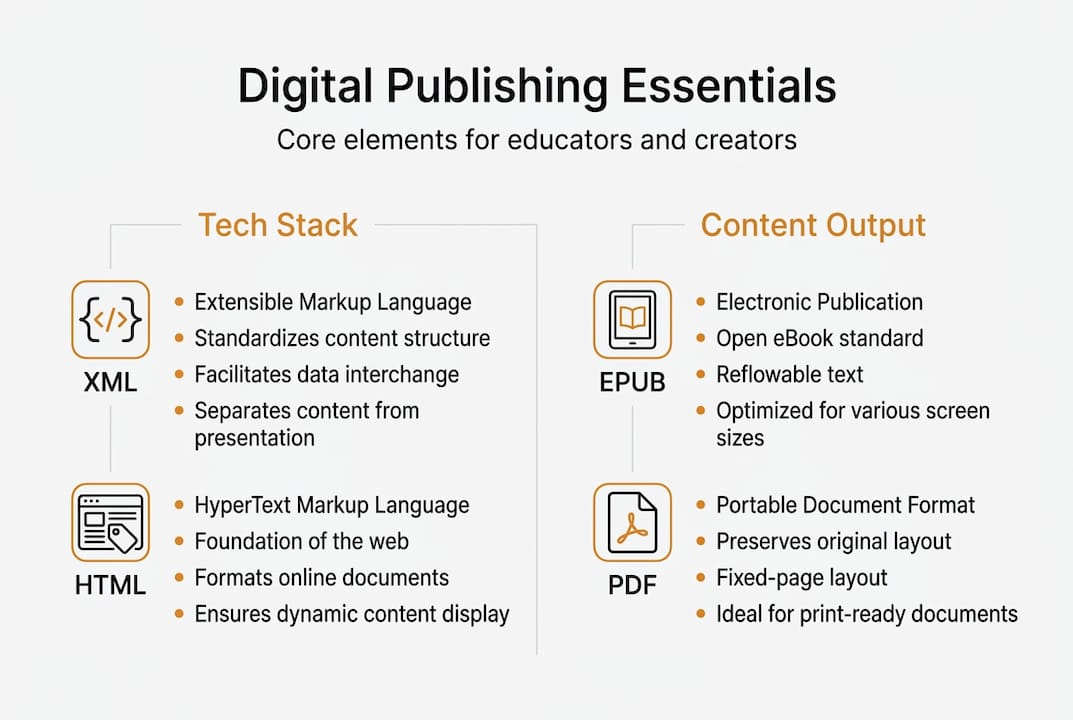
One of the most significant shifts in recent years is the adoption of single-source multi-output workflows. This approach lets you write content once and publish it across multiple formats simultaneously, such as EPUB, web pages, and print-ready PDFs. The result is less duplication, fewer errors, and faster time to market.
Metadata optimisation is another area that separates discoverable content from content that gets ignored. Properly structured metadata, including title, author, subject tags, and language codes, helps search engines and platform catalogues surface your materials to the right learners. Think of metadata as the signposting that guides your ideal audience to your content.
"A well-structured EPUB with accurate metadata is more likely to be discovered, purchased, and completed than a beautifully designed PDF that cannot be searched or reflowed."
Accessibility is no longer optional. Testing your content across devices and following WCAG (Web Content Accessibility Guidelines) standards ensures that learners with visual impairments or different learning needs can engage fully with your materials. Platforms that support e-books in education consistently report higher engagement when content is accessible and device-friendly.
Key formats and tools to understand:
- EPUB: Reflowable, interactive, preferred for educational e-books and courses
- PDF: Fixed layout, suitable for workbooks and printable resources
- HTML5: Ideal for web-based courses with embedded media
- XML: The backbone of structured, reusable content
If you are just starting out, explore the tools available for creating e-books to find the right fit for your workflow and technical comfort level.
Choosing the right platform for educational publishing
With the technical landscape clearer, the next decision is choosing where to publish and sell your educational content. The platform you choose directly affects your revenue, your relationship with learners, and your long-term independence as a creator.
Popular platforms for educators include Thinkific, Teachable, Kajabi, Podia, and Gumroad. Each serves a different type of creator depending on scale, budget, and goals.
| Platform | Transaction fee | Best for | Key strength |
|---|---|---|---|
| Thinkific | 0% | Structured courses | Learning experience design |
| Teachable | 0-5% | Simplicity | Quick setup |
| Kajabi | 0% | All-in-one marketing | Email, funnels, community |
| Podia | 0% | Digital downloads | Affordable entry point |
| Gumroad | 10% flat | Simple digital products | Ease of use |
The most important distinction to understand is marketplace versus hosted SaaS. Marketplace platforms like Udemy bring built-in audiences, which is appealing for new creators. However, you trade discoverability for control. Hosted SaaS platforms like Thinkific or Kajabi let you build your own audience and brand, but you are responsible for driving traffic.
For creators focused on selling e-books and courses to a global audience, the hosted model often wins in the long run. You own your customer relationships, control your pricing, and keep more of each sale.
Key factors to evaluate when choosing a platform:
- Revenue share: Does the platform take a percentage of every sale?
- Marketing tools: Are email campaigns, upsells, and affiliate programmes built in?
- Customisation: Can you brand your storefront and course pages?
- International payments: Does it support multiple currencies and global buyers?
For a detailed breakdown of features and pricing, the Thinkific vs Kajabi comparison is a useful starting point. And if you want to understand how to maximise your income as an author or educator, the platform choice is one of the highest-leverage decisions you will make.
Pro Tip: Match your platform to your current scale and your independence goals. If you are building an audience from scratch, start with a platform that offers marketing automation. If you already have an email list or social following, prioritise 0% transaction fees and full branding control.
Building and optimising digital materials for learning outcomes
Selecting a platform is only half the work. The quality of your digital materials determines whether learners complete your course, leave a positive review, and return for more. Here are practical steps to build content that delivers real results.
- Plan your content structure first. Map out modules, lessons, and learning objectives before writing a single word. A clear structure reduces content gaps and makes the learner journey logical.
- Use reflowable formats. Avoid fixed PDF layouts for course content. Reflowable EPUB or HTML5 ensures your materials look correct on every device.
- Embed interactive elements. Quizzes, reflection prompts, and downloadable resources increase active engagement. Passive reading rarely leads to knowledge retention.
- Optimise metadata for SEO. Add descriptive titles, subject tags, and keyword-rich descriptions to every module and product listing.
- Test across devices. Check your content on mobile, tablet, and desktop before publishing. A broken layout on mobile can significantly reduce completion rates.
- Apply WCAG accessibility standards. Add alt text to images, use sufficient colour contrast, and provide captions for video content.
The digital-first publishing workflow approach, where content is designed for screens before print, leads to faster iteration and better learner experiences.
AI tools are reshaping what is possible for solo creators. Platforms like EdTool and MagicBox automate content conversion and help generate interactive learning materials at scale. This is particularly valuable when you want to repurpose an e-book into a course, or convert a live workshop into a self-paced programme. Explore how AI is influencing digital education to stay ahead of these shifts.

One statistic that should inform every design decision: median course completion rates sit below 10% for most online courses. That is not a content quality problem alone. It is an engagement design problem. Learners drop off when content feels passive, disconnected, or overwhelming. Use the complete checklist for developing educational books to build materials that keep learners progressing. For broader reach, global digital sales strategies can help you think beyond your home market from day one.
Pro Tip: Short lessons outperform long ones. Aim for modules under 10 minutes. Learners are more likely to complete a series of short wins than a single marathon session.
Managing distribution, revenue and educational impact
Once your content is built and your platform is chosen, the focus shifts to distribution, revenue management, and sustaining learner engagement over time.
Revenue models vary significantly across platforms. Marketplace platforms like Udemy take between 25% and 75% of each sale depending on how the customer found your course. In exchange, you gain access to millions of potential learners. Hosted SaaS platforms retain far more revenue for you, but require you to build and manage your own audience.
| Platform type | Creator revenue share | Discoverability | Audience ownership |
|---|---|---|---|
| Marketplace (e.g. Udemy) | 25 to 75% | High | Low |
| Hosted SaaS (e.g. Thinkific) | 95 to 100% | Low | High |
| Hybrid (e.g. Podia) | 95 to 100% | Medium | High |
Gumroad offers an interesting data point for educators: 9,987 education products on the platform have generated $9.7 million in revenue, averaging approximately $974 per product. That figure suggests a healthy market for niche educational content, even on a simple platform.
Distribution considerations beyond the platform itself:
- VAT and tax compliance: If you sell to customers in the EU or UK, you may be required to collect and remit VAT. Many hosted platforms handle this automatically.
- Piracy management: Watermark downloadable files, use licence keys for software-based content, and monitor for unauthorised sharing.
- Global reach: Ensure your platform supports multiple currencies and international payment methods to avoid losing buyers at checkout.
Engagement drives long-term revenue more reliably than volume. A learner who completes your course and feels part of a community is far more likely to purchase your next product. Explore how digital marketplaces empower global educators to build sustainable income streams.
Pro Tip: Belonging drives repeat purchases. Build a community around your content, whether through a private group, a live Q&A, or a discussion forum. Learners who feel connected to you and each other complete more and buy more.
Our take on scaling success in digital publishing for education
Most guides focus on platform features and pricing tables. Those details matter, but they are not what separates creators who build lasting businesses from those who publish once and disappear.
The uncomfortable truth is that high-volume publishing without genuine learner satisfaction is a short-term strategy. Creators who chase quantity over quality often find themselves with declining reviews, low completion rates, and audiences that do not return. The digital education trends shaping 2026 point clearly toward personalisation, community, and outcome-focused design.
Platform independence is worth protecting early. Starting on a marketplace for discoverability makes sense. But building your own email list and branded storefront from day one means you are never entirely dependent on an algorithm or a platform's pricing policy.
Niche focus consistently outperforms broad appeal. A course on financial planning for freelance illustrators will outperform a generic personal finance course almost every time, because it speaks directly to a specific audience with a specific problem. Pair that focus with AI-powered workflows and community building, and you have a model that scales without burning out.
Ready to amplify your digital publishing impact?
If this guide has helped clarify your path forward, the next step is finding a platform that matches your ambitions as an educator or content creator.
BibliOWLteca is built specifically for creators who want to publish, sell, and distribute educational materials globally without the complexity. With built-in tools for digital delivery, international payments, and tax compliance, you can focus on creating rather than managing infrastructure. Whether you are launching your first e-book or scaling a catalogue of online courses, publishing with BibliOWLteca gives you the control, reach, and support to grow your digital education business on your own terms.
Frequently asked questions
What are the main differences between platforms like Thinkific and Udemy for educators?
Thinkific offers full control and 0% transaction fees, whereas Udemy is a marketplace that takes a significant revenue cut in exchange for access to its existing learner base. The right choice depends on whether you prioritise discoverability or audience ownership.
How do I optimise my content for accessibility and devices?
Use reflowable EPUB format, compress images, optimise metadata, and test across multiple devices following WCAG accessibility guidelines. This ensures your content works well for all learners regardless of how they access it.
What engagement strategies help increase course completion rates?
Interactive elements, community building, and short modular lessons are the most effective approaches. Low MOOC completion rates below 10% highlight that engagement design matters far more than content volume alone.
How does AI support digital publishing for educators?
AI tools like EdTool and MagicBox automate content conversion and help generate interactive learning materials, making it practical for solo creators to produce and repurpose content across multiple formats efficiently.