

TL;DR:
- Selling digital products globally involves managing platform fees, VAT, compliance, and piracy risks.
- Choosing the right platform depends on audience ownership, automation, and sales volume.
- Building a scalable sales funnel with lead magnets and upsells enhances customer lifetime value and growth.
Selling your knowledge to a global audience sounds straightforward until you hit the reality: dozens of platforms, conflicting fee structures, VAT obligations you never anticipated, and a nagging fear that your carefully crafted course will sell fewer than ten copies. The opportunity is genuinely enormous, and the barriers are real but manageable. This guide walks you through every decision you need to make, from choosing the right platform to automating compliance, so you can focus on what you do best: creating content that changes how people learn.
Table of Contents
- Key criteria for global digital sales success
- Top platforms for selling educational digital products
- How to build a repeatable, scalable sales funnel
- Global compliance: VAT, payment and piracy protection
- Why creators must rethink digital sales for 2026
- Unlock your global potential with BibliOWLteca
- Frequently asked questions
Key Takeaways
| Point | Details |
|---|---|
| Global sales opportunity | The digital education market is expanding rapidly, offering creators massive revenue potential. |
| Smart platform selection | Choosing the right platform balances cost, audience reach, and automation for best results. |
| Sales funnel mastery | Effective funnels and multiple products are key to scalable, repeatable sales income. |
| Compliance confidence | Global VAT and payment requirements are manageable with proper tools and platform support. |
| Practical pricing strategies | Value-based pricing and niche validation significantly increase conversion rates and lifetime value. |
Key criteria for global digital sales success
The digital sales platform market is projected to reach $5.8 billion by 2032, growing at an 11.3% compound annual rate. That growth reflects a genuine shift in how people learn and how educators earn. But scale alone does not guarantee your success. Before you choose a platform or set a price, you need to get clear on a handful of foundational criteria.
Audience and niche validation comes first. Selling to everyone is selling to no one. The creators who thrive globally are those who have identified a specific problem their content solves, validated that real people are searching for that solution, and priced accordingly. Understanding digital education trends helps you spot where demand is growing before the market becomes saturated.
Monetisation strategy matters more than most creators realise. Will you sell a single e-book, a course bundle, or a membership? Each model has different implications for pricing, delivery, and customer retention. Reading about selling ebooks for income reveals that creators who combine formats consistently outperform those who rely on a single product type.
Compliance and protection are non-negotiable for global sales. VAT rules, payment gateway compatibility, and piracy protection all need to be considered before your first sale, not after your first tax bill.
Here is a quick checklist of criteria to evaluate before committing to any platform or strategy:
- Niche demand validated through keyword research and community forums
- Clear monetisation model with upsell potential
- Platform fee structure aligned with your expected volume
- Multi-currency payment support
- Automated VAT collection or compliance tools
- Digital rights management and piracy protection
- Ownership of customer data and email list
Pro Tip: Price your products based on the transformation they deliver, not the hours you spent creating them. A $49 e-book that saves someone 20 hours of research is a bargain. Anchoring price to value rather than effort is one of the fastest ways to improve conversion rates. Also review developing educational books to ensure your content quality matches your pricing ambition.
Top platforms for selling educational digital products
Once you know what you are selling and to whom, the platform decision becomes much clearer. The leading platforms for creators include Gumroad, Teachable, Podia, Thinkific, Kajabi, and self-hosted stores, each with distinct trade-offs.

The core tension in platform selection is discovery versus ownership. Marketplaces offer discovery but charge higher fees and limit your access to customer data. Your own site gives you full control but requires you to generate your own traffic. Neither approach is universally better; the right answer depends on where you are in your creator journey.
Here is a comparison of the most popular options:
| Platform | Fee structure | Audience ownership | Automation | Best for |
|---|---|---|---|---|
| Gumroad | 10% per sale | Partial | Basic | Beginners, low volume |
| Teachable | 0% on paid plans from $39/mo | Full | Strong | Course creators |
| Podia | 0% on paid plans from $39/mo | Full | Strong | Courses and communities |
| Thinkific | 0% on paid plans from $49/mo | Full | Moderate | Structured courses |
| Kajabi | 0% on plans from $149/mo | Full | Advanced | High-volume creators |
| Own site | Payment gateway fees only | Full | Custom | Established creators |
For creators exploring alternatives to established platforms, the landscape has expanded significantly. Newer entrants often combine lower fees with stronger compliance tools, which matters enormously when selling across borders.
Explore Gumroad alternatives if the 10% fee feels steep at your current volume. At 100 sales of a $49 product, that fee costs you $490 monthly. Switching to a flat-rate platform at that volume almost always makes financial sense.
A digital marketplace for educators also offers built-in discoverability that a standalone site cannot match in the early stages. Consider BookTrader alternatives if you are specifically focused on educational book formats.
Pro Tip: Do not put all your sales through a single channel. Listing on a marketplace while maintaining your own storefront gives you discovery benefits and data ownership simultaneously. Many successful creators use a marketplace to attract new buyers and their own site to retain them.
How to build a repeatable, scalable sales funnel
A platform alone does not generate sales. You need a system that consistently moves strangers from awareness to purchase without requiring your personal attention every time. The good news is that digital products are designed for exactly this: create once, sell repeatedly, and automate delivery and payments.
Here is a proven funnel structure for educational content creators:
- Lead magnet: Offer a free resource (a checklist, a short guide, or a sample chapter) in exchange for an email address. This builds your list and demonstrates your expertise before asking for money.
- Core product: Your primary e-book, course, or template pack. Price it based on the value it delivers, not its production cost.
- Upsell: Immediately after purchase, offer a complementary product at a discount. This is where significant revenue is generated without additional marketing spend.
- Automated delivery: Use your platform's built-in delivery tools or integrate with Stripe and PayPal to ensure instant, frictionless access for buyers worldwide.
- Follow-up sequence: A short email series that helps buyers get results, builds trust, and introduces your next product naturally.
For educators building content libraries, the free books guide offers useful context on how learners discover and consume educational content. Understanding that behaviour shapes how you structure your funnel. Similarly, book selection strategies can inform which topics you develop next based on actual demand signals.
"The creators who scale fastest are those who treat each product as the beginning of a relationship, not the end of a transaction. Every purchase should open a door to the next logical step in the buyer's learning journey."
If you are building a bibliography or resource list as part of your content, the build bibliographies guide is worth reviewing to add credibility and depth to your materials.
Pro Tip: A $49 product with a 3% conversion rate and a well-structured upsell sequence can generate more revenue than a $199 product with no follow-up. Think in terms of customer journeys, not individual transactions.
Global compliance: VAT, payment and piracy protection
This is the section most creators skip until it becomes a problem. Do not make that mistake. EU VAT rules for digital sales apply from your very first sale, with no minimum threshold and an average rate of 21% across member states. The One Stop Shop (OSS) system simplifies registration, but you still need to collect and remit VAT correctly.
Here is what compliance looks like in practice across key regions:
| Region | VAT/tax requirement | Threshold | Recommended tool |
|---|---|---|---|
| European Union | OSS registration, avg 21% | No threshold | Quaderno, TaxJar |
| United Kingdom | UK VAT registration | £85,000/year | HMRC VAT account |
| United States | Sales tax (state-by-state) | Varies by state | TaxJar, Avalara |
| Australia | GST registration | AUD 75,000/year | ATO BAS system |
| Canada | GST/HST registration | CAD 30,000/year | CRA account |
For B2B sales within the EU, the reverse charge mechanism shifts VAT responsibility to the buyer, which simplifies your obligations significantly. Always collect VAT numbers from business buyers and validate them before applying reverse charge.
Payment compliance is equally important. Ensure your chosen gateway supports the currencies and regions you are targeting. Stripe and PayPal both handle multi-currency transactions and offer built-in tax tools, but their coverage varies by country. Review the digital product tax guide for a detailed breakdown of obligations by region.
On piracy protection, here are the most effective techniques:
- Unique, expiring download links generated per purchase
- PDF stamping with the buyer's name and email
- Watermarking for video content
- Licence key systems for software or template products
- Terms of use that clearly prohibit redistribution
"Piracy protection is not about making your product impossible to copy. It is about making legitimate purchase the path of least resistance for honest buyers."
Why creators must rethink digital sales for 2026
Here is an uncomfortable truth: 68% of creators have fewer than ten sales per product. That is not a platform problem or a pricing problem. It is almost always a validation problem. Creators invest weeks building a course on a topic they are passionate about, then discover the audience is smaller than expected or already well-served by free content.
The creators who consistently succeed treat product development like a business decision, not a creative one. They research demand before writing a single word, validate price points with small audiences, and build multiple products in the same niche to compound their authority. Staying across library trends in digital education gives you early signals about where learner demand is heading before the market catches up.
Platform fees are the other silent killer. A 10% fee sounds trivial until you calculate what it costs at scale. Combine that with payment processing fees of 2 to 3%, and you are losing 12 to 13% of every sale before you account for marketing spend. The creators who build sustainable businesses choose platforms strategically and revisit that choice as their volume grows. The goal is not to find the perfect platform. It is to build the right infrastructure for your current stage and evolve it deliberately.
Unlock your global potential with BibliOWLteca
If you have read this far, you already understand that global digital sales require more than a great product. You need the right infrastructure: automated delivery, multi-currency payments, compliance tools, and a storefront that works for buyers anywhere in the world.
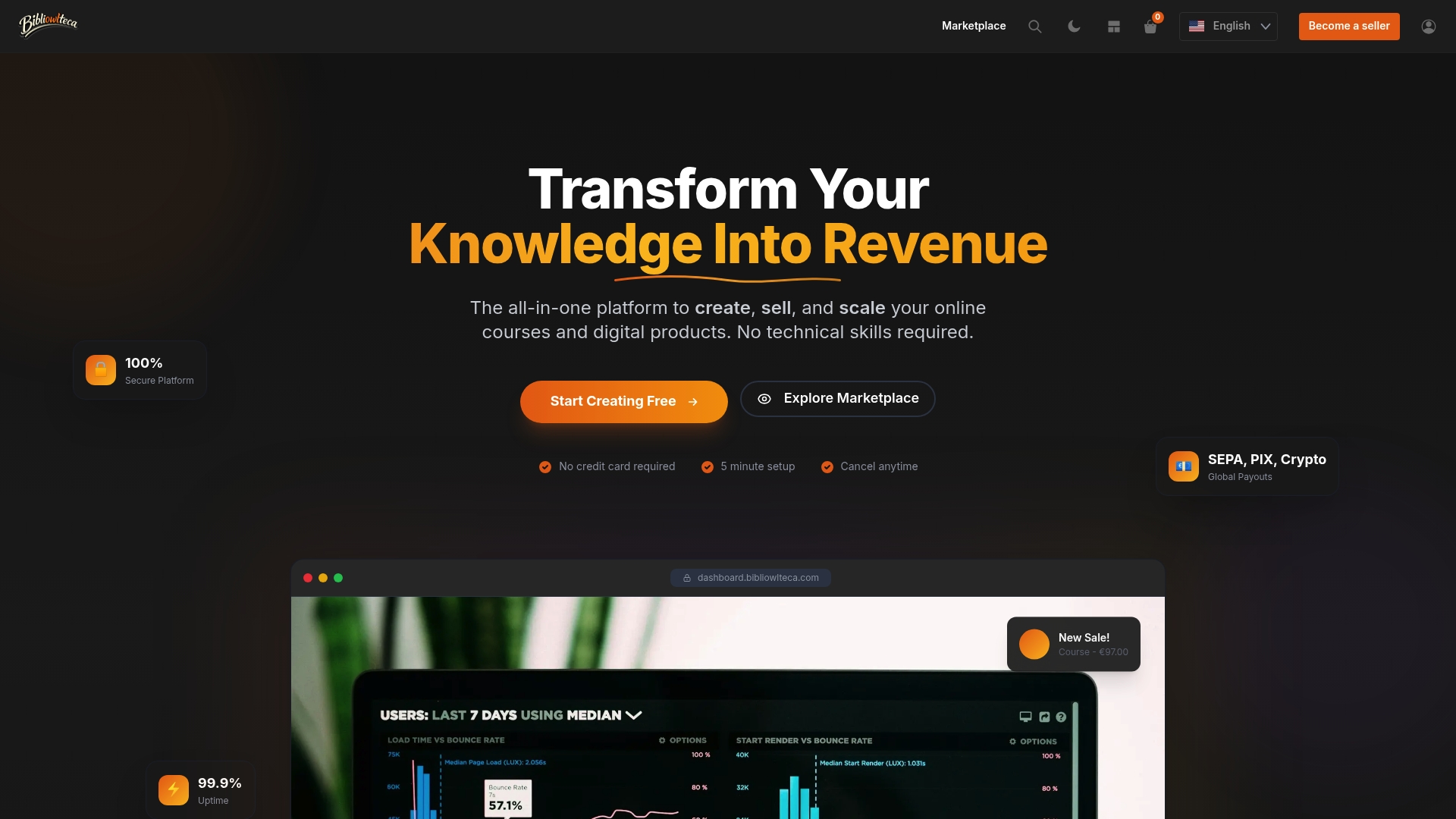
BibliOWLteca is built specifically for creators and educators who want to sell e-books, courses, and digital products globally without the technical headaches. The platform handles payment processing, tax compliance, and digital delivery in one place, so you can spend your time creating rather than troubleshooting. Whether you are launching your first product or scaling an existing catalogue, BibliOWLteca gives you the tools to reach a global audience with confidence. Explore the platform today and see how straightforward global sales can be.
Frequently asked questions
What is the best platform for selling educational e-books globally?
The best platform depends on your volume and goals. Gumroad charges 10% with no monthly fee, while Teachable, Podia, and Kajabi offer 0% transaction fees on paid plans ranging from $39 to $149 per month, making them better value at higher volumes.
How do I handle VAT for sales in Europe?
EU VAT applies from your first sale with no minimum threshold, averaging 21% across member states. Register for the OSS scheme and use tools like Quaderno or your platform's built-in tax features to automate collection and reporting.
How can I protect my digital products from piracy?
The most effective methods combine unique expiring download links with PDF stamping that embeds the buyer's details, making unauthorised sharing both traceable and less attractive.
What is the typical conversion rate for digital products?
For educational products priced around $49, a 3% conversion rate is considered a solid benchmark. Optimising your sales page, adding social proof, and refining your lead magnet are the fastest levers for improvement.
How can I increase my lifetime value per customer?
Releasing multiple products in the same niche and using structured upsells can boost lifetime value by up to 19 times compared to single-product creators, making niche depth one of the most valuable long-term strategies available.