

Most educational content creators believe author profiling means collecting basic demographic data about their audience. This misconception limits their potential for genuine engagement and targeted marketing. Author profiling actually encompasses a sophisticated analysis of writing style, linguistic patterns, thematic preferences, and how these elements shape reader perception and trust. For creators selling digital products and courses in 2026, understanding author profiling unlocks precise audience targeting, enhanced credibility, and content that resonates deeply with learners. This guide clarifies what author profiling truly involves and how you can apply it effectively to grow your educational business.
Table of Contents
- What is author profiling and why does it matter?
- Key methods and tools used in author profiling
- Applications of author profiling in educational content creation
- Common challenges and best practices in author profiling
- Discover expert resources to enhance your author profiling
- Frequently asked questions
Key takeaways
| Point | Details |
|---|---|
| Beyond demographics | Author profiling analyses writing style, tone, and linguistic patterns, not just age or gender data |
| Targeted marketing | Understanding author-audience dynamics enables precise content personalisation and campaign segmentation |
| Multiple methods | Linguistic analysis, machine learning tools, and manual review each offer distinct profiling advantages |
| Ethical application | Responsible profiling balances data insights with privacy considerations and human judgement |
What is author profiling and why does it matter?
Author profiling extends far beyond identifying whether your audience skews male or female, young or old. It involves critical reading techniques that analyse how authors construct meaning through vocabulary choices, sentence complexity, rhetorical strategies, and thematic focus. When you understand these deeper patterns, you gain insight into how your content will be received, who will find it credible, and which marketing messages will resonate.
For educational content creators, this matters because trust drives purchasing decisions. Learners assess whether an author possesses genuine expertise partly through linguistic cues like technical vocabulary usage, explanation depth, and citation practices. When you profile successful authors in your niche, you identify the stylistic markers that signal authority to your target audience. You can then calibrate your own content to meet these expectations whilst maintaining authenticity.
Author profiling also enables precise audience targeting by revealing author-consumer dynamics. Different writing styles attract different learner personalities. A conversational, story-driven approach appeals to visual learners seeking practical application, whilst dense, citation-heavy content attracts analytical minds who value academic rigour. Understanding these connections helps you segment your audience effectively and tailor marketing campaigns that speak directly to each group's preferences.
The benefits extend to content optimisation and personalised marketing strategies:
- Adjust complexity levels based on profiled audience reading abilities
- Select tone and voice that matches learner expectations for your subject matter
- Identify which content formats resonate with specific author-audience pairings
- Craft email campaigns that mirror the communication style your audience trusts
Pro Tip: Apply author profiling during your content planning phase, not after publication. Analysing successful competitors' writing patterns before you create your course or ebook ensures your output aligns with audience expectations from the start, saving costly revisions later.
Key methods and tools used in author profiling
Linguistic analysis forms the foundation of author profiling. This method examines vocabulary diversity, sentence structure patterns, punctuation habits, and stylistic markers like passive versus active voice. Advanced approaches analyse readability scores, lexical density, and even subtle patterns like function word usage that reveal cognitive styles. These linguistic fingerprints help identify author characteristics that influence how readers perceive expertise and trustworthiness.

Machine learning tools have revolutionised author profiling by automating pattern recognition across large text samples. Natural language processing algorithms can identify writing style consistency, detect tone shifts, and even predict author demographics with surprising accuracy. These tools excel at processing thousands of pages to extract meaningful patterns that manual review would miss.
The choice between manual and automated profiling depends on your specific needs:
- Manual profiling offers nuanced interpretation and contextual understanding but requires significant time investment
- Automated tools provide speed and scale, processing entire catalogues quickly, but may miss subtle cultural or contextual cues
- Hybrid approaches combining both methods deliver the most comprehensive insights for educational creators
Several author profiling software platforms serve different creator needs in 2026:
| Tool | Key features | Cost range | Best for |
|---|---|---|---|
| Linguistic Inquiry | Vocabulary analysis, readability scoring, style comparison | £50-150/month | Course creators analysing competitor content |
| AuthorDNA | Machine learning profiling, demographic prediction, tone analysis | £200-500/month | Publishers managing multiple author catalogues |
| StyleMatch | Writing style fingerprinting, plagiarism detection, consistency checking | £30-80/month | Individual educators ensuring content coherence |
| ProfilePro | Audience-author matching, engagement prediction, marketing insights | £100-300/month | Content marketers optimising campaigns |
Pro Tip: Start with a free readability analyser and manual style comparison before investing in expensive automated tools. Many creators discover they can achieve 80% of the insight with basic methods, reserving premium tools for scaling operations once their content business grows.
Applications of author profiling in educational content creation
Using profiling to customise tone and complexity transforms how effectively your educational content connects with learners. When you analyse successful authors targeting similar audiences, you identify the sweet spot between accessibility and depth. A course on advanced statistics might adopt formal academic tone with dense technical vocabulary for postgraduate students, whilst the same concepts presented to business professionals require conversational language with practical examples. Profiling reveals these distinctions clearly.
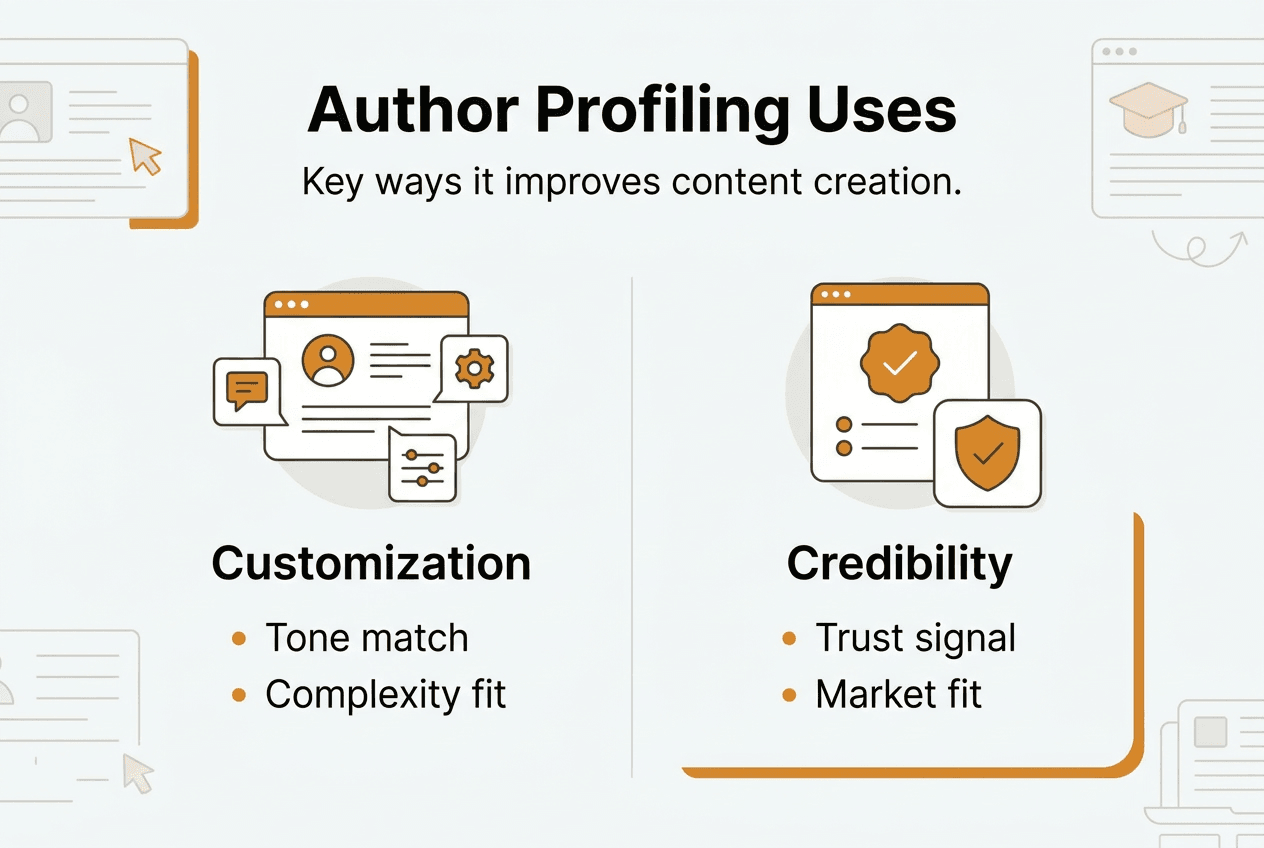
Segmenting audiences based on author profile enables surgical precision in digital marketing. You might discover that learners who engage with your conversational blog posts respond well to story-driven email campaigns, whilst those who download your technical whitepapers prefer data-heavy case studies. This insight allows you to create distinct marketing funnels matched to communication preferences, dramatically improving conversion rates.
Enhancing credibility through author profiling alignment builds trust before learners even read your content. When your writing style matches what your audience expects from an expert in your field, you benefit from immediate credibility. Legal educators gain authority through formal language and extensive citations, whilst creative writing instructors establish expertise through vivid prose and personal anecdotes. Profiling helps you identify and adopt the markers your specific audience associates with competence.
Improving engagement through personalised communication strategies keeps learners returning to your content. By understanding how different author styles affect reader behaviour, you can structure your courses and ebooks for maximum retention. Some audiences prefer short, punchy lessons with frequent interaction points, whilst others engage deeply with longer, contemplative chapters.
Follow this process to integrate author profiling into your content creation workflow:
- Identify three to five successful competitors or influences in your educational niche whose audience overlaps with your target market
- Analyse their writing samples using readability tools and manual style assessment, noting vocabulary level, sentence length, tone formality, and structural patterns
- Survey your existing audience about their content preferences and which authors they find most credible in your field
- Map the correlation between preferred author styles and your audience segments, identifying distinct preference clusters
- Create style guides for each audience segment, documenting vocabulary choices, tone parameters, and structural approaches that resonate
- Draft content following these guidelines, then test engagement metrics against your baseline performance
- Refine your approach based on data, adjusting style elements that underperform whilst amplifying successful patterns
Educational marketers gain specific benefits from author profiling:
- Craft email subject lines that match the linguistic patterns proven to engage each audience segment
- Design landing page copy that mirrors the credibility markers your target learners expect
- Develop social media content in the voice that generates maximum shares within your niche
- Create testimonial requests that prompt responses using language patterns that convince similar prospects
- Build affiliate partnerships with authors whose style complements rather than conflicts with your brand voice
These educational content strategies demonstrate how profiling moves beyond theory into measurable business results.
Common challenges and best practices in author profiling
Data privacy concerns present the first major challenge when implementing author profiling. Collecting and analysing writing samples raises questions about consent, particularly when profiling potential customers or competitors. In 2026, GDPR and similar regulations require transparent data handling. You must clearly communicate what data you collect, how you analyse it, and how it influences your marketing. Anonymising data wherever possible and focusing on publicly available content samples helps navigate these concerns ethically.
Profiling bias represents a significant pitfall that can undermine your entire strategy. Automated tools may perpetuate demographic stereotypes, assuming certain writing styles correlate with age, gender, or cultural background in ways that lack nuance. Manual profiling risks confirmation bias, where you see patterns that support your existing assumptions whilst ignoring contradictory evidence. Combat bias by validating findings across multiple methods and regularly testing your assumptions against actual audience behaviour.
Misinterpretation of results derails many well-intentioned profiling efforts. Correlation does not equal causation, a successful author's formal tone might coincide with their expertise rather than cause their success. Beginners often over-rely on surface-level metrics like word count or readability scores without considering context. A low readability score might indicate poor writing or sophisticated technical content appropriate for an advanced audience. Always interpret profiling data within the full context of your audience needs and content goals.
Best practices for responsible and effective author profiling include:
- Maintain transparency with your audience about how you use profiling insights to improve their learning experience
- Update your profiling analysis quarterly as audience preferences and market dynamics evolve
- Combine quantitative profiling data with qualitative feedback from surveys and direct conversations
- Test profiling-driven content changes with small audience segments before full rollout
- Document your profiling methodology so you can refine and improve your approach systematically
- Respect cultural and linguistic diversity by avoiding one-size-fits-all profiling conclusions
Compare these approaches to ensure ethical profiling:
| Ethical practice | Unethical practice |
|---|---|
| Analysing publicly available competitor content for style insights | Scraping private student submissions without consent for profiling data |
| Using profiling to better serve diverse learning styles | Exploiting profiling to manipulate vulnerable audiences |
| Transparently explaining how profiling improves personalisation | Hiding profiling practices in dense privacy policies |
| Validating profiling assumptions against real engagement data | Making demographic assumptions based solely on writing style |
| Regularly auditing profiling tools for bias | Accepting automated profiling results without critical review |
Regarding credibility in content, maintaining integrity whilst using profiling requires balancing data-driven insights with human judgement and ethical considerations that protect both your audience and your reputation.
"The most effective author profiling combines algorithmic precision with human empathy. Data reveals patterns, but only human insight understands the why behind those patterns and how to serve your audience authentically." This principle should guide every profiling decision you make.
Discover expert resources to enhance your author profiling
BibliOWLteca provides comprehensive resources that deepen your author profiling expertise whilst supporting your broader educational content business. Our critical reading guide sharpens the analytical skills essential for manual profiling, teaching you to recognise subtle linguistic patterns that automated tools miss. These techniques directly improve how you assess competitor content and refine your own writing style.

Explore our free books educator guide to access thousands of educational texts for profiling analysis without budget constraints. Studying diverse author styles across your subject area builds the pattern recognition skills that make profiling second nature. The Bibliowlteca homepage connects you with tools for publishing, distributing, and marketing your educational content globally, turning profiling insights into profitable digital products that serve learners worldwide.
Frequently asked questions
What is author profiling?
Author profiling analyses writing characteristics including style, tone, vocabulary, and linguistic patterns to understand author identity and how these elements influence reader perception. It extends beyond basic demographics to examine the relationship between how content is written and how audiences receive it.
How does author profiling differ from audience analysis?
Audience analysis focuses on understanding your readers' demographics, preferences, and behaviours. Author profiling examines the writer's characteristics and style to predict audience appeal and credibility. The two practices complement each other, with profiling helping you align your writing style with audience expectations identified through analysis.
Can author profiling improve my course sales?
Yes, when you align your writing style with what your target audience expects from credible educators in your field, you build trust faster and reduce purchase hesitation. Profiling also enables precise marketing message customisation that speaks directly to different audience segments, improving conversion rates across your sales funnel.
What tools do I need to start author profiling?
Begin with free readability analysers and manual comparison of successful competitors' content. As your needs grow, consider investing in linguistic analysis software that automates pattern recognition. Most educational creators achieve significant results with basic tools before requiring premium platforms.
Is author profiling ethical?
Author profiling becomes ethical when you focus on publicly available content, maintain transparency about your methods, use insights to serve your audience better rather than manipulate them, and regularly audit your practices for bias. Responsible profiling respects privacy whilst leveraging data to create more relevant, valuable educational experiences.
How often should I update my author profiling strategy?
Review your profiling approach quarterly to account for evolving audience preferences and market trends. Conduct deeper analysis annually, reassessing which author characteristics correlate with engagement and sales success. Continuous refinement ensures your content remains aligned with audience expectations as they develop.