
TL;DR:
- Digital distribution platforms enable educators to sell and deliver content globally with minimal technical effort.
- Key features include multi-currency support, local payment methods, DRM, and detailed analytics.
- Successful international sales require strategic localization of pricing, content, and buyer experience.
Selling educational materials to learners in Tokyo, Toronto, or Tunis sounds complicated. Many educators assume international payments, currency conversions, and content delivery logistics are insurmountable barriers. They are not. Digital distribution platforms enable seamless global reach for educational materials, handling the technical complexity so you can focus on creating. This guide walks you through what these platforms are, which features matter most, how they power global monetisation, and the practical steps to launch and grow your digital education business worldwide. Whether you sell e-books, courses, or lesson plans, the right platform changes everything.
Table of Contents
- What is a digital distribution platform?
- Key features to look for in a digital distribution platform
- How digital platforms drive global reach and monetisation
- Best practices for getting started and maximising sales
- Why most educators underestimate the complexity—and opportunity—of global digital distribution
- Get started with a trusted digital distribution marketplace
- Frequently asked questions
Key Takeaways
| Point | Details |
|---|---|
| Global reach made easy | Digital platforms eliminate barriers for selling educational content internationally. |
| Essential features matter | Choosing the right payment and content options boosts your sales and user experience. |
| Practical steps drive sales | Following actionable best practices helps maximise reach and profit. |
| Opportunity in localisation | Adapting your content and processes to different markets unlocks higher earnings. |
What is a digital distribution platform?
A digital distribution platform is an online service that hosts, delivers, and processes payments for digital products. For educators and content creators, it acts as your storefront, delivery system, and payment processor all in one place. You upload your content once, set your price, and the platform handles everything from checkout to file delivery.
Think of it this way: a physical bookshop requires stock, a building, and staff. A digital distribution platform requires none of that. Your course or e-book sits on a server, ready to be purchased and downloaded by anyone, anywhere, at any hour. The platform manages the transaction, delivers the file, and deposits your earnings.
Digital platforms streamline sharing and selling learning materials in ways that were simply impossible a decade ago. The infrastructure that once required a team of developers is now available to a solo educator with a laptop.
Here is what a solid digital distribution platform does for you:
- Hosts your content securely on cloud infrastructure, so files are always available
- Processes payments automatically, including tax calculation and receipts
- Delivers files instantly to buyers after purchase, with no manual effort from you
- Protects your work using digital rights management (DRM), which prevents unauthorised copying or sharing
- Tracks performance through dashboards showing sales, revenue, and buyer geography
- Supports multiple currencies, so buyers pay in their local currency without friction
For empowering global educators, the multi-currency and local payment support features are particularly critical. A learner in Brazil who sees a price in Brazilian reais is far more likely to complete a purchase than one confronted with a foreign currency they need to convert mentally.
Pro Tip: When evaluating platforms, prioritise those that support local payment methods such as mobile wallets, bank transfers, and regional card networks. PayPal and Stripe alone will not cover every global market.
The best platforms also integrate with your existing tools, whether that is an email marketing service, a learning management system, or a website builder. This connectivity means your business operates as a coherent whole rather than a patchwork of disconnected tools.
Key features to look for in a digital distribution platform
Not every platform is built the same, and the differences matter enormously once you start selling internationally. Understanding the foundation of digital distribution platforms, it is essential to know which features will empower your global educational business.
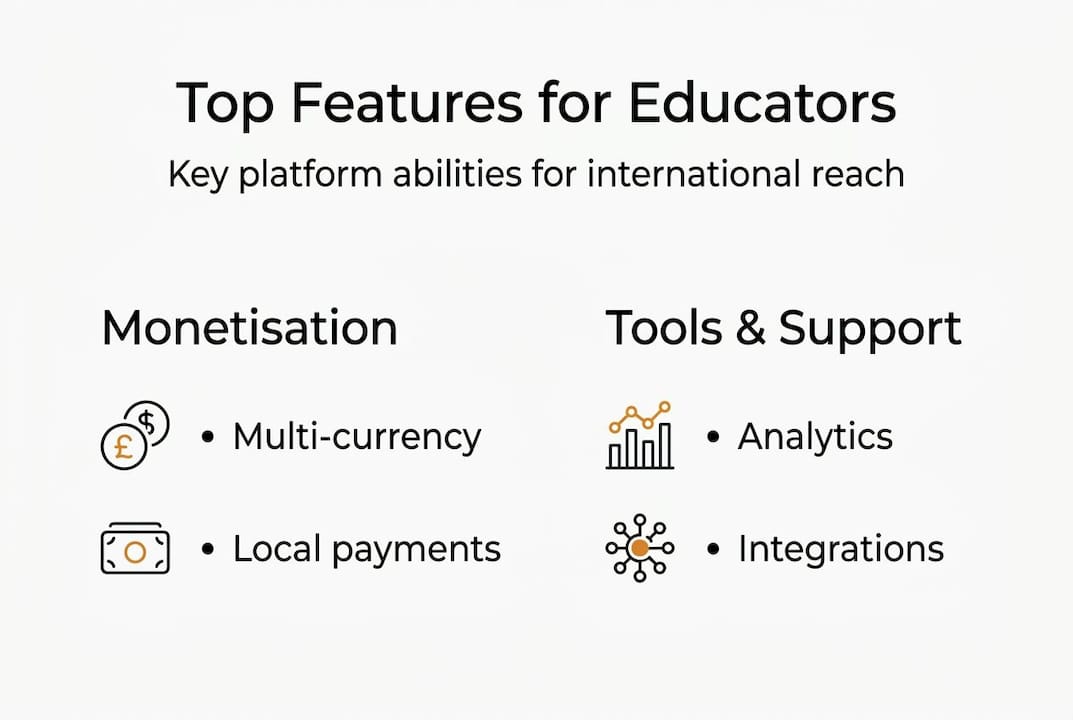
Leading platforms support a variety of formats and robust analytics, but the gap between a good platform and a great one often comes down to specifics.
Here is a comparison of key features to evaluate:
| Feature | Basic platforms | Advanced platforms |
|---|---|---|
| File formats supported | PDF only | PDF, EPUB, MP4, SCORM, ZIP |
| Payment currencies | 1 to 3 | 30 or more |
| Local payment methods | Card only | Cards, wallets, bank transfers |
| DRM and access control | Basic download limits | Full DRM, watermarking, expiry |
| Analytics | Total sales count | Revenue by region, buyer behaviour |
| Tax compliance | Manual | Automated VAT and sales tax |
| Integrations | Minimal | Email, CRM, LMS, webhooks |
The must-have features for any educator selling globally are:
- Multi-currency pricing so buyers see prices in their own currency
- Local and wallet payment support covering regions beyond North America and Europe
- Content protection tools including DRM, watermarking, and download limits
- Detailed analytics broken down by geography, product, and time period
- Mobile-optimised checkout because a significant share of buyers purchase on smartphones
- Automated tax handling for VAT, GST, and sales tax across jurisdictions
- Easy content updates so you can revise a course or e-book without re-uploading everything
When exploring selling e-books and courses at scale, analytics become your most powerful tool. Knowing that 40% of your buyers are in Southeast Asia, for example, tells you exactly where to focus your next marketing effort or localisation project.
Format support also matters more than many creators realise. A course with video components needs MP4 support. An interactive workbook may require EPUB or a specialised format. Before committing to a platform, check that it handles every file type you currently use or plan to use. Reviewing top e-book tools can help you understand which formats are most compatible across platforms.
Pro Tip: Consider scalability from day one. A platform that works for 50 sales a month may buckle under 5,000. Ask providers directly about their infrastructure limits and content update workflows before you sign up.
Finally, do not overlook customer support quality. When a buyer in a different time zone cannot access a file they purchased, a responsive support team is the difference between a refund request and a loyal customer.

How digital platforms drive global reach and monetisation
Once you know the features to compare, it is worth examining exactly how platforms enable you to monetise and reach learners worldwide. The mechanics behind global sales are more elegant than most educators expect.
Distribution platforms boost income by removing cross-border friction, which is the invisible tax on every international transaction. When a buyer encounters an unfamiliar currency, an unsupported payment method, or a checkout that does not load on mobile, they leave. Platforms that eliminate these obstacles directly increase your conversion rate.
Here is how currency and payment support typically breaks down across platform tiers:
| Region | Common local payment methods | Currencies typically supported |
|---|---|---|
| Europe | SEPA, iDEAL, Klarna | EUR, GBP, CHF, SEK, NOK |
| Latin America | Boleto, Mercado Pago, PIX | BRL, MXN, ARS, COP |
| Southeast Asia | GrabPay, GCash, OVO | SGD, MYR, PHP, IDR, THB |
| Middle East and Africa | M-Pesa, Fawry, Sadad | AED, SAR, EGP, KES |
| North America | ACH, PayPal, Apple Pay | USD, CAD |
Consider three real-world scenarios. An educator in Nigeria selling a business writing course enables local card and mobile money payments. Enrolments from West Africa triple within two months. A curriculum designer in Germany prices her lesson packs in euros and enables SEPA bank transfers. Her conversion rate among European buyers rises by a third. A language tutor in the Philippines accepts GCash alongside international cards and sees mobile purchases account for 60% of revenue.
Platforms manage far more than just payment processing. Here is what happens automatically behind the scenes:
- Dynamic currency conversion shows buyers their local price at checkout
- Tax calculation and remittance handles VAT, GST, and digital services taxes by country
- Access control grants buyers immediate, secure access after payment confirmation
- Fraud detection flags suspicious transactions before they reach your account
- Automatic receipts are sent to buyers in their language where supported
"Educators who enable local payment methods and multi-currency pricing consistently report higher conversion rates from international buyers, particularly in markets where card penetration is low."
Understanding library trends in digital education also reveals a broader shift: learners worldwide increasingly expect to access educational content on their own terms, in their own currency, through their preferred payment channel. Platforms that accommodate this expectation are not just convenient. They are essential. The educator's guide to free books further illustrates how digital access is reshaping learner expectations globally.
Best practices for getting started and maximising sales
After understanding how platforms power your business, it is time to put this into action. Here are the steps and expert recommendations to get started.
Digital platforms require deliberate product, pricing, and promotion strategies. Simply uploading a file and hoping buyers find it is not a strategy. It is wishful thinking.
Follow these steps to launch effectively:
- Choose your platform carefully. Match platform features to your content type, target regions, and growth plans. Trial periods are your friend.
- Prepare your files properly. Ensure PDFs are optimised for screen reading, videos are compressed without quality loss, and all files are clearly named.
- Configure payment settings. Enable every payment method your target audience uses. Do not limit yourself to the two or three you personally recognise.
- Set pricing with intention. Research what buyers in your target markets typically pay for similar content. A flat global price often underperforms compared to region-specific pricing.
- Write compelling product descriptions. Be specific about what the buyer will learn, how long the content is, and what format they will receive. Vague descriptions kill conversions.
- Set up your storefront branding. A professional logo, consistent colour scheme, and clear about section build trust with first-time buyers.
- Test the entire purchase flow. Use a VPN to simulate a buyer in your target market and complete a test purchase. Check the checkout, delivery, and receipt.
- Launch with a promotional push. Share on relevant communities, email lists, and social channels. Early sales and reviews build credibility.
The most common mistakes educators make when launching on digital platforms include:
- Using vague or generic product titles that do not reflect the content's specific value
- Failing to enable major regional payment methods beyond standard credit cards
- Ignoring analytics after launch and missing signals about where buyers are dropping off
- Pricing identically across all markets without considering local purchasing power
- Neglecting to update content after launch, leaving outdated materials live
Pro Tip: Always test the purchase workflow from an international user's perspective before going live. A checkout that works perfectly in your home country may display errors, unsupported currencies, or confusing tax lines for buyers elsewhere.
For further reading on building your digital product catalogue, the guide to digital publishing covers product strategy in depth, and free e-book solutions offers useful context on format choices that maximise accessibility.
Why most educators underestimate the complexity—and opportunity—of global digital distribution
Having covered practical steps, let us reflect on what most guides miss about international content success.
Most educators treat global distribution as a feature they switch on. They enable international payments, set one price, and consider the job done. What they miss is that global reach is not a setting. It is a strategy.
The educators who consistently outperform their peers are not necessarily producing better content. They are producing content that feels local to their buyers. They use examples relevant to specific regions. They price according to local purchasing power. They write product descriptions that address the specific concerns of learners in their target markets. These are not technical tasks. They are creative and commercial ones.
There is also a widely held belief that more platform features equal more sales. This is rarely true. A platform with 50 currencies is only valuable if you actively configure pricing for the markets you want to reach. The technology is a vehicle. Direction still comes from you.
We have observed that many creators lose their first wave of international buyers not to competition, but to friction they never noticed. A checkout that defaults to the wrong language. A price displayed in a currency the buyer does not recognise. A file format that does not open on an older Android device. These are solvable problems, but only if you look for them.
Following trends in digital education reveals that learner expectations are rising globally. The opportunity is enormous, but it rewards those who treat international audiences with the same care they give their home market.
Get started with a trusted digital distribution marketplace
Now that you understand what really drives global sales, here is where you can put this knowledge to work.
BibliOWLteca is built specifically for educators and content creators who want to reach learners worldwide without wrestling with payment infrastructure or delivery logistics. The platform supports multiple currencies, local payment methods, and automated tax compliance, covering exactly the features this guide recommends.
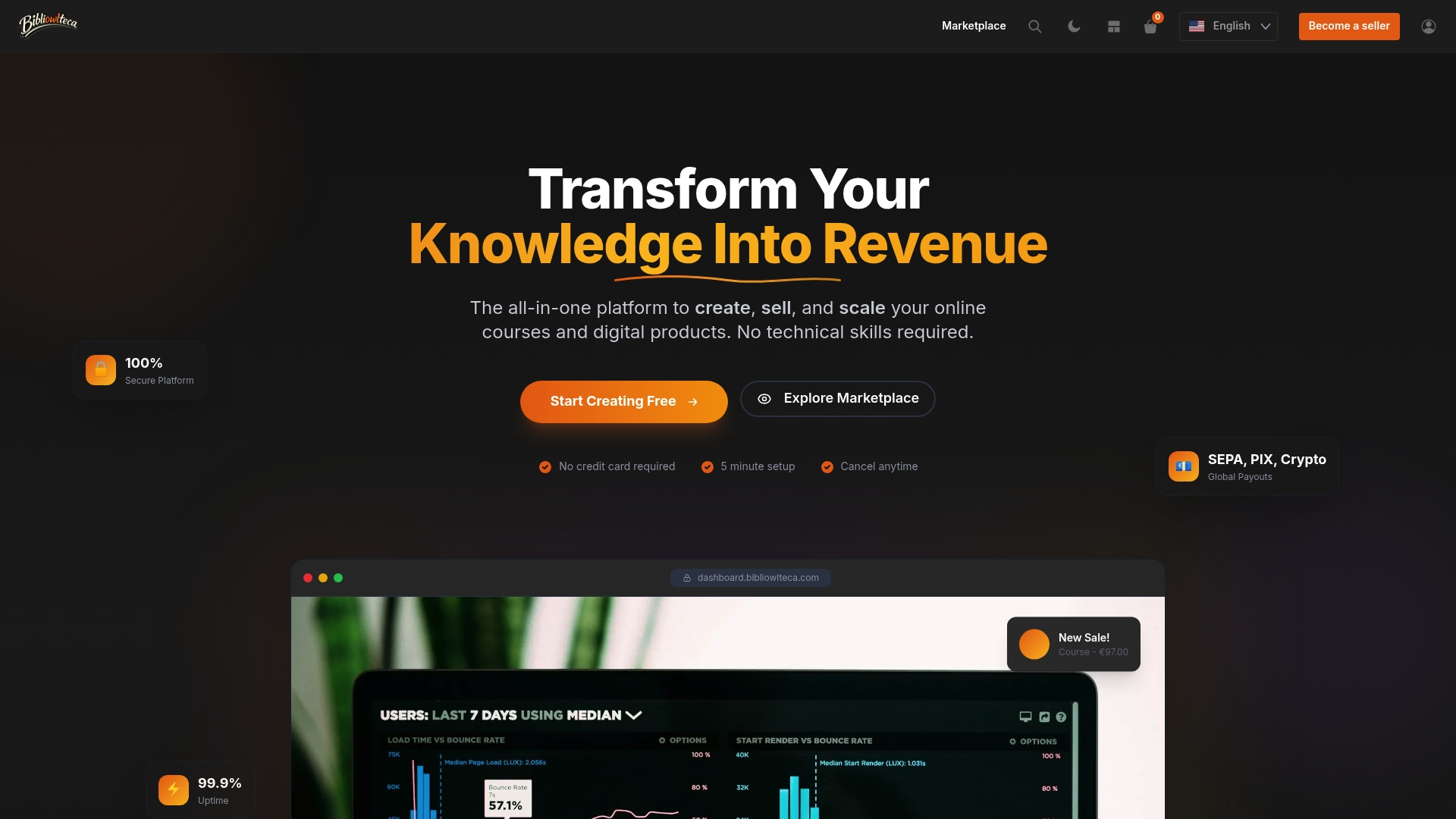
Whether you are launching your first e-book or scaling an existing course catalogue, the BibliOWLteca marketplace gives you the tools to publish, sell, and grow on your own terms. You keep control of your audience, your pricing, and your brand. The platform handles the complexity. If you are ready to turn your knowledge into a global business, visit BibliOWLteca and explore what is possible.
Frequently asked questions
What is a digital distribution platform?
A digital distribution platform is an online service that enables creators to sell and deliver educational content electronically to buyers around the world. Digital platforms allow seamless online sales and automated delivery, removing the need for manual fulfilment.
How do digital platforms handle international payments?
Platforms support various payment options for global reach, including multiple currencies and local payment methods such as mobile wallets and regional bank transfers, allowing buyers to pay in their preferred way.
What types of educational materials can I sell?
Platforms support e-books, courses and various educational content types, including lesson plans, video tutorials, interactive workbooks, and downloadable resources.
Are digital platforms secure for copyright protection?
Yes, reputable platforms offer digital rights management tools and access control to protect your materials. Protection is provided through DRM and secure access features that limit unauthorised copying or redistribution.