
TL;DR:
- Not all coaching programmes are equal; only those listed in the ICF Education Search Service qualify for official credentialing.
- Research shows coaching has a moderate positive effect on performance and emotional competence, especially over time.
Coaching programs are everywhere, and so is the confusion about what separates a life-changing qualification from an expensive certificate that collects digital dust. Not every programme that uses the word "coaching" follows the same standards, applies the same methods, or produces graduates who can genuinely help others grow. Whether you are exploring life coaching courses to support a career pivot, investigating business coaching workshops for your leadership team, or researching personal development programs for your own growth, the quality gap between the best and the rest is enormous. This guide gives you the tools to close that gap.
Table of Contents
- Key takeaways
- What coaching programs really are
- The evidence behind coaching's benefits
- How to evaluate a coaching programme's quality
- Pathways and timelines: what to expect
- Getting the most from your programme
- My honest take on coaching education
- Explore coaching resources on Bibliowlteca
- FAQ
Key takeaways
| Point | Details |
|---|---|
| Not all programmes are equal | Only programmes listed in the ICF Education Search Service qualify for official credential pathways. |
| Evidence supports coaching strongly | A 2026 meta-review found coaching has a moderate positive effect on performance and emotional competence, with Hedges' g ≈ 0.58. |
| Duration matters for depth | Most credible programmes run between 6 and 18 months, with a minimum of 60 training hours at Level 1. |
| Mentoring is non-negotiable | Live mentoring, supervised practice, and performance evaluation are the three components that build real coaching skill. |
| Align programme to your goal | Choosing between a life coaching course, business coaching workshop, or leadership accelerator depends entirely on your specific outcome. |
What coaching programs really are
Before you compare programmes, you need a clear picture of what coaching actually is. And more importantly, what it is not.
Effective coaching programmes emphasise client-centred facilitation over advice-giving or instruction. A coach evokes awareness and supports the client in finding their own path forward. This is the fundamental distinction that separates coaching from consulting, mentoring, and therapy. A consultant tells you what to do. A mentor shares their own experience and guides from it. A therapist works with psychological patterns from the past. A coach works with you in the present, using questions and presence to help you clarify thinking, build confidence, and take action.
Understanding this distinction matters because it directly affects what a quality coaching programme will teach you. You are not learning a body of knowledge to dispense. You are developing a set of relational and conversational skills that require practice, feedback, and refinement over time.
Types of programmes available
The coaching education market spans several distinct types:
- Life coaching courses focus on personal transformation, goal setting, values clarification, and supporting clients through transitions. These tend to suit people working with private clients on wellbeing, career, or life direction.
- Business coaching workshops are usually shorter, more intensive formats designed for professionals who want to apply coaching skills within organisations. They often focus on performance conversations, team dynamics, and leadership communication.
- Personal development programs blend self-coaching frameworks with interpersonal coaching skills. They are popular among HR professionals, managers, and educators who want to integrate coaching into an existing role.
- Online coaching classes cover the same territory as in-person programmes but with greater scheduling flexibility. Quality varies widely. The best online formats include live virtual sessions, peer coaching triads, and direct mentoring.
- Leadership and executive coaching programmes typically run as intensive accelerators targeting senior professionals. Executive accelerators require roughly 3 to 4 hours weekly over 90 days, while life coaching certifications are often self-paced over approximately 3 months at 3 to 5 hours per week.
Format shapes learning just as much as content does. A self-paced video course without live practice is fundamentally different from a cohort-based programme with weekly group coaching and one-to-one mentoring. Both might use the word "programme" in their marketing. Only one will develop the real-world skill you are paying for.
The evidence behind coaching's benefits
You deserve to know whether investing in a coaching programme actually works. The research is encouraging, and more specific than most providers will tell you.
A 2026 meta-review found that coaching interventions produce a moderate overall positive effect on professional performance, emotional competence, and goal attainment, with a Hedges' g of approximately 0.58. In research terms, that is a meaningful result. Effect sizes for leadership skills sit between 0.43 and 0.46. Well-being effects range from 0.37 to 0.46. These are not trivial numbers.
Where coaching is less powerful is in shifting raw performance metrics immediately. The effect on direct KPIs such as revenue or output sits between 0.16 and 0.29, considerably lower than its effect on behaviour and mindset. This is actually an important insight for setting expectations. If you enrol in a coaching programme expecting an immediate boost in quarterly sales figures, you may be disappointed. If you expect deeper self-awareness, stronger leadership presence, and more effective conversations, the research fully supports that.
What this means practically is that coaching produces its most reliable results in areas that compound over time. A leader who becomes genuinely better at listening, questioning, and creating psychological safety will see downstream improvements in team performance, retention, and engagement. The mechanism is behavioural and relational, not transactional.
Pro Tip: When evaluating a programme's claimed outcomes, ask specifically whether results are measured through self-report, 360-degree feedback, or independent assessment. Self-report figures sound impressive but are far less reliable than multi-rater or longitudinal data.
There is also a distinction worth noting between coaching as a received service and coaching as a skill you develop in a training programme. The research above largely covers coaching as a received intervention. When you train as a coach, the benefits extend both to your future clients and to your own professional capability. Leaders who complete coaching skills training consistently report improved listening, reduced reactivity, and better conflict resolution, all of which make them more effective regardless of whether they ever take on formal coaching clients.
The ICF core competencies were updated in 2025 to refine language and ensure global consistency in how coaching quality is measured. This update signals that the field is maturing, and that the bar for what counts as effective coaching continues to rise.
How to evaluate a coaching programme's quality
This is where most people go wrong. The marketing around coaching programmes is sophisticated, and phrases like "ICF-aligned", "ICF-recognised", and "accredited" are used interchangeably by providers who know most buyers will not check.
Here is the distinction that matters: only programmes listed in the ICF Education Search Service are genuinely accredited. If a programme is not in that directory, it does not qualify for an ICF credential pathway, regardless of what its website says. Checking the directory takes about two minutes and can save you thousands of pounds and months of wasted effort.
What a strong programme must include
Use this comparison when assessing any programme you are seriously considering:
| Component | Why it matters | Red flag if absent |
|---|---|---|
| Live mentor coaching | Builds practical skill through real feedback | Programme is entirely self-paced with no human contact |
| Supervised practice sessions | Develops judgement and presence in real coaching scenarios | Practice is peer-only with no qualified observation |
| Performance evaluation | Measures coaching ability against a standard | Completion is based on attendance only |
| Feedback mechanisms | Integrates learning and accelerates development | No formal feedback process between sessions |
| Community and cohort | Provides peer learning, accountability, and ongoing support | Isolated, asynchronous experience throughout |
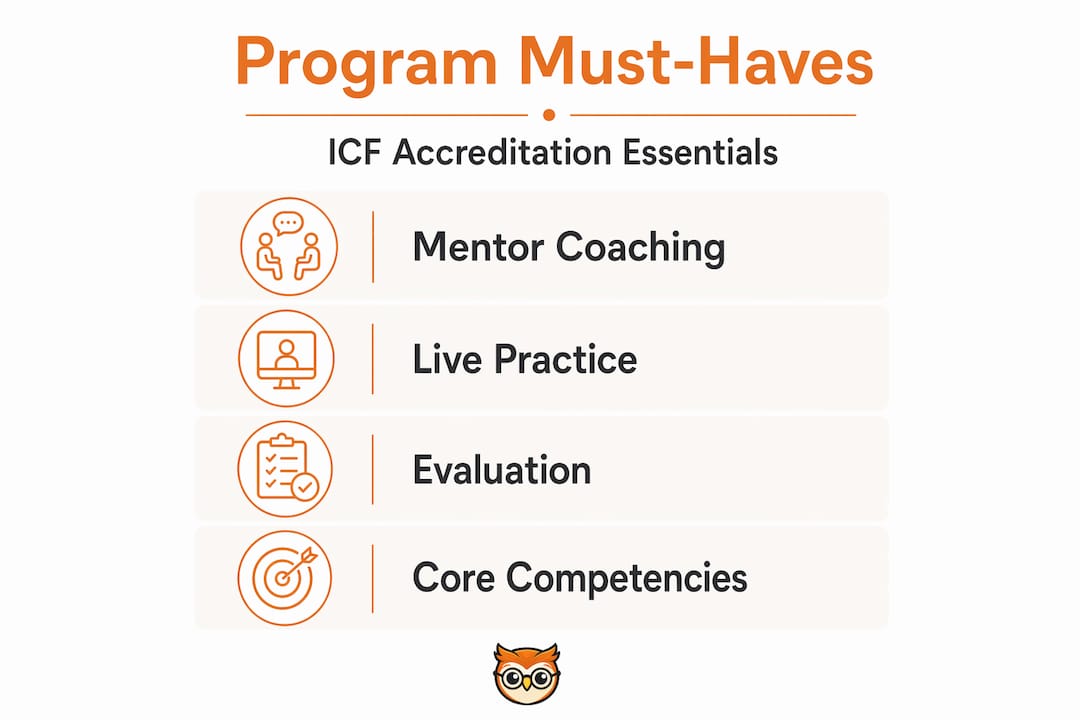
The non-negotiable elements for ICF credentialing are mentor coaching, live practice, and performance evaluation. A programme that skips any of these is not preparing you for credentialing. It may still offer value as a personal development experience, but you should know that going in.
Pro Tip: Before enrolling, ask the programme provider directly: "Is this programme listed in the ICF Education Search Service?" If they hesitate, redirect, or describe themselves as 'aligned' rather than giving a direct yes, check the registry yourself.
Beyond accreditation, look at how the programme develops the qualities that ICF-accredited programmes blend together: theoretical grounding, mentoring, live practice, and structured feedback. The best programmes treat these four elements as interdependent. Cutting one weakens all the others.
A common marketing claim to treat cautiously is the mention of famous graduates or high-profile associations. A programme that trained a well-known executive five years ago has not necessarily maintained those standards today. Ask for current cohort outcomes, current mentor coach credentials, and current pass rates on performance evaluations.
Pathways and timelines: what to expect
Knowing what a realistic progression looks like will help you plan and budget without nasty surprises.
- Start with a Level 1 programme. The minimum standard is 60 hours of coach-specific training. Programmes typically run between 6 and 18 months depending on the format, intensity, and your pace. Shorter is not always better. Programmes compressed into a few weekends rarely provide the reflective space needed for real skill development.
- Log your coaching hours. After completing your training, you need documented experience coaching real clients to apply for an ICF credential. Associate Certified Coach (ACC) requires 100 hours of coaching experience; Professional Certified Coach (PCC) requires 500 hours. These are not aspirational targets. They are gatekeeping criteria.
- Complete your mentor coaching. This is typically 10 hours of mentoring with a qualified mentor coach. Some programmes include this within the curriculum. Others treat it as an add-on with an additional cost. Clarify this before you enrol.
- Pass the Coach Knowledge Assessment (CKA). This is a written examination that tests your understanding of coaching ethics, the ICF competency model, and core concepts. Most accredited programmes prepare you for this. Non-accredited ones often do not.
- Apply for your credential. Once you meet all the criteria, you submit your application and a recording of a coaching session for independent evaluation.
The hidden costs are where people get caught out. Extra mentoring sessions, repeated performance evaluations, professional supervision, and conference attendance all add up. Build a realistic budget that includes at least 20 per cent above the headline programme fee to cover these.
Flexibility in online programmes is genuinely valuable, particularly for professionals balancing full-time work. However, flexibility without structure tends to produce disengaged learners. Look for programmes that are flexible in when you can attend sessions, not in whether live, supervised practice is required.

Getting the most from your programme
Completing a coaching programme and becoming a skilled coach are two very different things. The qualification is the beginning of the journey, not the destination.
- Practise immediately and consistently. The fastest way to develop real coaching skill is to coach real people, regularly, with feedback. Do not wait until you feel ready. You develop readiness by doing.
- Seek mentoring that challenges you. A good mentor coach will not just reassure you. They will point out patterns in your coaching that you cannot see yourself. Mentoring builds confidence and competence in ways that self-study simply cannot replicate.
- Keep a reflective journal. After each coaching session, write down what you noticed in yourself: the moments you felt uncertain, the questions that landed well, the silences you rushed to fill. Over time, this self-awareness becomes your greatest coaching asset.
- Stay connected to a community. Peer supervision, coaching circles, and continued professional development keep your skills sharp and your perspective broad. Isolation is the enemy of growth in this field.
- Align your programme to your end goal. If you want to work with corporate clients, a programme with business coaching workshop elements and organisational case studies will serve you better than a generic life coaching certification. If your goal is personal development, a digital learning framework may suit your lifestyle and budget.
Professional development strategies work best when they are connected to a clear vision of who you want to be and what impact you want to create. Coaching programmes are no different. The clearer your goal at the start, the more precisely you can choose the programme that will get you there.
My honest take on coaching education
I have spent years watching people invest in coaching education, and the pattern that separates those who flourish from those who feel let down is not talent. It is discernment at the point of choosing.
The coaching education market has a reputation problem that the best providers are working hard to fix. There are genuinely excellent programmes that will change how you listen, think, and relate to others. There are also programmes that charge significant fees for what amounts to a self-help course with a certificate at the end. The difference is almost never visible in the marketing.
What I have found is that the fastest shortcut to identifying a quality programme is a single question: who are your mentor coaches, and what qualifications and experience do they hold? Good programmes will answer this without hesitation. They are proud of their mentors. Weak programmes will redirect to their curriculum, their alumni network, or their testimonials.
I also want to be honest about something the research confirms but most providers quietly ignore. Coaching is far more powerful for developing behaviour and mindset than for driving short-term performance metrics. If someone is selling you a coaching qualification primarily on the basis of income potential, treat that claim with caution. The income follows from genuine skill. Genuine skill follows from serious, sustained practice under qualified guidance.
The credential matters. ICF accreditation gives clients and employers a reliable signal. But the credential does not make you a good coach. The mentoring, the practice, the feedback, and the honest self-reflection you bring to all of it: those things make you a good coach.
— BibliOWLteca
Explore coaching resources on Bibliowlteca
If you are serious about building your coaching skills or sharing your coaching knowledge with others, Bibliowlteca is built for exactly that.
Bibliowlteca is a digital platform where educators and coaches can publish courses, e-books, and structured learning resources. Whether you want to deepen your understanding of building impactful mentorship programmes or create and sell your own coaching content to a global audience, the platform gives you the tools to do it. You can manage your own store, handle international payments, and reach learners in multiple currencies, all without needing a technical background.
The Bibliowlteca blog covers the full range of topics that matter to coaches and educators: accreditation standards, mentoring best practices, and how to turn professional expertise into a thriving digital business. For creators ready to package their coaching knowledge and reach a wider audience, Bibliowlteca provides the infrastructure to make that possible.
FAQ
What are coaching programs?
Coaching programs are structured learning pathways that develop coaching skills through training, practice, and feedback. They range from short business coaching workshops to full certification courses lasting 6 to 18 months.
How do I know if a coaching programme is ICF-accredited?
Check the ICF Education Search Service directly at the ICF website. Only programmes listed there qualify for official ICF credential pathways. "ICF-aligned" or "ICF-recognised" are not the same as accredited.
How long does a coaching programme take to complete?
Most coaching programmes run between 6 and 18 months, starting with a minimum of 60 training hours at Level 1. Executive accelerators can compress learning into 90 days, but most pathways to full credentialing take considerably longer.
What is the difference between coaching and mentoring?
Coaching uses questioning and presence to help clients find their own answers. Mentoring shares the mentor's experience to guide the mentee. Both are valuable, but they require different skills and serve different purposes.
Do online coaching classes offer the same quality as in-person programmes?
Online coaching classes can match in-person quality if they include live sessions, supervised practice, and mentor coaching. Fully asynchronous, self-paced programmes without live human contact rarely develop the relational skills that effective coaching requires.