
TL;DR:
- Effective entrepreneurship education focuses on practical engagement, structured progression, and relevance to modern digital markets.
- Combining methodologies like Lean Startup, Design Thinking, Effectuation, and Babson’s ETA provides learners with actionable skills to navigate uncertainty confidently.
Choosing the right entrepreneurship education approach is harder than it looks. Hundreds of programmes, frameworks, and online courses compete for attention, each claiming to produce the next generation of business founders. For educators building curricula and learners investing time and money, the wrong choice means wasted effort and missed opportunity. The good news is that a growing body of research now reveals which methods genuinely work, which fall short, and why the difference almost always comes down to how learning is designed rather than what topic is covered.
Table of Contents
- Criteria for impactful entrepreneurship education
- Leading methodologies: from Lean Startup to Entrepreneurial Thought and Action
- Structuring an entrepreneurial curriculum: phases and tools
- Measuring impact: outcomes and long-term effectiveness
- Debates and neuroscience: can entrepreneurship truly be taught?
- Our perspective: what most guides miss about entrepreneurship education
- Take the next step with your entrepreneurship journey
- Frequently asked questions
Key Takeaways
| Point | Details |
|---|---|
| Prioritise hands-on learning | Experiential, action-based methods drive skill development more effectively than theory alone. |
| Structure learning in phases | Breaking programmes into mindset, ideation, validation, and pitching phases increases engagement and clarity. |
| Assess real-world outcomes | Evaluate education by its short- and long-term impact on entrepreneurial skills and confidence. |
| Adapt to your audience | Tailor methodologies and support for learner background, experience, and goals to maximise success. |
Criteria for impactful entrepreneurship education
Before comparing individual approaches, you need a clear set of criteria. Without them, selecting a programme becomes a matter of brand recognition rather than genuine quality. Strong entrepreneurship education is not defined by prestigious names or polished branding. It is defined by what learners actually do during the experience.
The most important criterion is practical engagement. Passive content consumption, watching videos or reading case studies without applying anything, produces almost no measurable change in entrepreneurial behaviour. The evidence is clear: action-oriented learning such as Lean Startup cycles, customer interviews, and MVP (minimum viable product) building consistently outperforms lecture-based instruction.
The second criterion is structured progression. A programme that throws learners into ideation without first building the right mindset is skipping a critical foundation. Equally, a course that spends all its time on mindset without moving into real market validation teaches aspiration rather than capability. The best programmes move through deliberate phases, and we will examine those phases in detail shortly.
Third, look for relevance to current market realities. Frameworks developed in the 1970s without any update are less useful than those informed by modern digital ecosystems. Programmes that integrate AI tools, digital business models, and global distribution reflect the actual environment learners will operate in. Understanding digital entrepreneurship essentials is no longer optional for new ventures.
Fourth, the best programmes build in reflection and iteration. Learners who try something, receive structured feedback, and then adjust their approach develop a genuine entrepreneurial habit. Those who simply complete exercises and move on do not.
Key criteria to evaluate any programme:
- Hands-on, experiential activities rather than passive instruction
- Structured phases from mindset through to market validation
- Integration of modern tools and current frameworks
- Built-in reflection cycles and iterative feedback loops
- Digital tool support, including AI-assisted coaching or reflection aids
- Relevance to online and global business models
"Effective entrepreneurship education must move beyond transmitting knowledge and toward cultivating the habits, mindsets, and practical skills that real founders use every day."
Pro Tip: When evaluating a course or programme, count how many hours involve actually building something, testing an idea, or talking to a potential customer. If that number is less than 40% of total learning time, treat it with caution.
Leading methodologies: from Lean Startup to Entrepreneurial Thought and Action
With clear criteria in hand, you can now assess the major methodologies that dominate entrepreneurship education today. Each has genuine strengths, and each has blind spots. Understanding the differences helps you choose what fits your context, or design a programme that borrows the best elements from several.
Lean Startup is probably the most widely adopted framework in entrepreneurship education globally. Developed by Eric Ries, it centres on the build-measure-learn loop. You form a hypothesis, build the smallest possible version of a product or service to test it, measure what real users do, and then learn whether to continue, pivot, or stop. It is elegant because it replaces expensive assumption with cheap evidence.
A typical Lean Startup cycle in an educational setting looks like this:
- Define a specific customer problem using evidence, not assumption
- Identify a single core hypothesis about how to solve that problem
- Design the simplest possible experiment to test the hypothesis
- Run the experiment with real or simulated market participants
- Measure outcomes against the original hypothesis
- Decide to persevere, pivot the approach, or abandon the idea entirely
- Document what was learnt and carry it into the next cycle
Design Thinking complements Lean Startup by placing deep empathy with users at the front of the process. Where Lean Startup is efficiency-focused, Design Thinking is imagination-focused. It moves through empathise, define, ideate, prototype, and test. For educators, it is especially powerful in early-stage ideation because it slows learners down long enough to truly understand the problem before jumping to solutions.
Effectuation theory, developed by Saras Sarasvathy through research on expert entrepreneurs, challenges the conventional assumption that founders start with a goal and find resources to reach it. Instead, expert founders start with what they already have, who they are, what they know, and who they know, and then ask what possible futures they could create from that starting point. Teaching effectuation changes how learners relate to uncertainty. Rather than seeing it as a threat, they learn to treat it as raw material.
The Babson Entrepreneurial Thought and Action methodology deserves special attention. It directly addresses a weakness common to both Lean Startup and Design Thinking: the tendency to favour one mode of working over another. Babson's approach explicitly combines creative action and experimentation with rigorous business analysis. Their flagship programme, Foundations of Management and Entrepreneurship, immerses students in real ventures from day one, requiring them to balance instinct-driven decisions with structured analytical thinking.
"The most dangerous entrepreneur is one who only knows how to think analytically or one who only knows how to act intuitively. Real founders need both."
Key features of each methodology:
- Lean Startup: Fast iteration, hypothesis testing, evidence-based decisions
- Design Thinking: Deep empathy, creative ideation, user-centred prototypes
- Effectuation: Means-first logic, partnership orientation, embracing uncertainty
- Babson ETA: Integration of action and analysis, immersive real-world engagement
Combining these approaches rather than picking one exclusively reflects how experienced educators apply creator economy strategies when building digital learning products. The goal is always the same: give learners the tools to act confidently in genuinely uncertain conditions.
Structuring an entrepreneurial curriculum: phases and tools
Knowing which methodologies to use is only half the challenge. The structure of delivery matters enormously, particularly for online educators who need to maintain engagement without the natural energy of an in-person classroom.
Research confirms that phase-based curriculum models consistently outperform unstructured content dumps. The most effective programmes move learners through five core phases: mindset development, ideation, validation, prototyping, and pitching. Each phase builds on the previous one, and each requires a different set of tools and activities.
| Phase | Core activity | Key tools |
|---|---|---|
| Mindset development | Self-assessment, resilience exercises | Journals, reflection prompts, AI coaching |
| Ideation | Problem identification, opportunity mapping | Business Model Canvas, brainstorming frameworks |
| Validation | Customer interviews, demand testing | Survey tools, landing page tests, feedback forms |
| Prototyping | Building MVPs, low-fidelity demos | Design tools, no-code platforms |
| Pitching | Storytelling, investor communication | Presentation frameworks, peer critique sessions |
The Business Model Canvas, developed by Alexander Osterwalder, is one of the most universally applicable tools across all phases. It gives learners a single-page visual map of their entire business model, covering customer segments, value propositions, channels, revenue streams, and cost structures. Its power lies in its simplicity. A learner can update it in ten minutes when new information arrives, making it ideal for fast-moving programme cycles.

AI-assisted reflection tools are a newer addition to the educator's toolkit but are proving genuinely valuable. They allow learners to review their decisions, identify cognitive biases in their thinking, and receive immediate structured feedback without waiting for a facilitator. For online course creation strategies, these tools bridge the gap between self-paced learning and mentored instruction.
Adaptations specifically for online delivery include:
- Shorter learning cycles, typically one to two weeks per phase rather than semester-length blocks
- Modular design so learners can revisit phases without restarting the whole programme
- Peer review systems that replicate the feedback dynamics of in-person cohorts
- Embedded case studies from digital-first businesses to maintain relevance
- Video-based customer interview practice with structured debrief frameworks
Building a scalable online education store around these phases means your content can serve learners at different stages without requiring you to rebuild everything for each cohort.
Pro Tip: Design each module so it ends with a concrete deliverable, a completed canvas, a recorded customer interview, a one-page MVP specification. Deliverables force application and give you a clear signal of whether learning has actually occurred.
Measuring impact: outcomes and long-term effectiveness
Understanding programme structure is powerful, but knowing what works in practice is even more important, so let us look at the evidence honestly rather than through the lens of programme marketing.
Short-term outcomes from entrepreneurship education are generally positive and well-documented. Learners consistently report higher entrepreneurial intention, stronger self-efficacy (belief in their own capability to succeed), and measurable improvements in specific skills. A meta-analysis of entrepreneurship education studies found meaningful gains in financial literacy, with one programme recording an increase of 0.98 points on a standardised scale. Attitudes toward risk, opportunity recognition, and networking behaviour all tend to improve in well-designed programmes.
Long-term outcomes are a more complicated story. The same research reveals that founding intentions sometimes decline after entrepreneurship education, particularly when learners gain a more realistic picture of what starting a business actually involves. This is not necessarily a failure. Helping someone realise that entrepreneurship is not the right path for them at this point is genuinely valuable. But it complicates how we measure programme success.
A seven-year follow-up study produced some of the most nuanced findings in the field. Key results:
- Programmes were more effective for MSc-level students than for PhD-level participants
- Novice learners benefited more than those with significant prior experience
- Men who completed entrepreneurship education tended to grow their capital base over time
- Women showed fewer long-term gains in capital accumulation, suggesting the content may not address gender-specific barriers adequately
- No significant macroeconomic effect was detected, meaning individual gains did not translate into measurable regional or national economic growth
This last point is important for educators to internalise. Entrepreneurship education genuinely helps individuals. The evidence for systemic economic transformation is weak. Setting honest expectations about this distinction makes for better programme design and more credible marketing.
Best practices for measuring impact in your own programmes:
- Track learners at 6 months, 12 months, and 24 months after completion
- Measure both hard outcomes (ventures started, revenue generated) and soft outcomes (confidence, network growth)
- Disaggregate data by learner background, prior experience level, and gender to identify who your programme serves best
- Build alumni communities that continue to generate data and support after the formal programme ends
- Use your digital product knowledge to create follow-on resources that address the gaps your data reveals
Understanding where your programme genuinely creates impact, and where it does not, is what separates serious educators from content producers chasing enrolment numbers.
Debates and neuroscience: can entrepreneurship truly be taught?
Beyond outcome data, some still raise a more fundamental question: is entrepreneurship something that can actually be taught, or is it fundamentally a matter of innate personality traits? This debate has real implications for how you design educational content.
The traditional sceptical view draws on economic theory. Writers in the tradition of Schumpeter and Kirzner argue that entrepreneurial alertness and creative destruction are not skills that can be installed through curriculum. They emerge from individual disposition, market intuition built through lived experience, and a psychological tolerance for ambiguity that no classroom exercise can genuinely replicate.
Recent neuroscience research challenges this position significantly. Studies using EEG measurement and cognitive training methods such as the WNYLE Method (What's Next in Your Learning Experience) show that entrepreneurial cognition, specifically the brain's pattern-recognition and opportunity-detection functions, can be measurably improved through targeted training. This does not mean anyone can be made into a high-growth founder through education alone. It does mean that the innate-versus-taught dichotomy is far too simple.
"The question is not whether entrepreneurship can be taught. The question is which aspects of entrepreneurship respond to which kinds of teaching."
The teachable components of entrepreneurship include:
- Hypothesis formation and testing discipline
- Customer empathy and active listening skills
- Financial modelling and break-even analysis
- Network building and stakeholder communication
- Opportunity recognition through structured frameworks
- Resilience and adaptive thinking under uncertainty
The harder-to-teach elements include raw creativity, deep domain intuition, and the sustained psychological drive that keeps founders going through genuinely difficult periods. This does not mean those elements are entirely fixed. It means they respond better to coaching, mentorship, and immersive experience than to traditional curriculum delivery.
For educators, this insight points to a clear design principle. Build your programme around the knowledge economy strategies that are most teachable, validation, experimentation, opportunity recognition, and financial literacy, while creating conditions through community, peer support, and real projects where harder traits can develop naturally over time.
Our perspective: what most guides miss about entrepreneurship education
Most articles on entrepreneurship education methodologies cover the same ground: list the frameworks, compare their features, and conclude that hands-on learning beats passive instruction. That is all true. But it misses some deeper realities that we think matter more in practice.
The first is that frameworks are starting points, not answers. Lean Startup is a magnificent thinking tool. So is the Business Model Canvas. But we have seen educators teach these frameworks as if completing them correctly is itself the goal. A perfectly filled-out canvas is not a validated business idea. It is a set of untested hypotheses presented in a visually pleasing format. The framework only creates value when it forces learners into genuine contact with reality: real customers, real constraints, real market feedback.
The second reality is that psychological capital matters more than most curricula acknowledge. Research consistently shows that self-efficacy, resilience, optimism, and hope (collectively called psychological capital or PsyCap) are stronger predictors of entrepreneurial behaviour than knowledge or even skills. Yet most programmes measure knowledge retention and skill demonstration. They pay little attention to whether learners actually believe they can do this. An educator who builds confidence as deliberately as they build competence will produce better outcomes, even if their frameworks are less sophisticated.
The third is about audience specificity. There is no universal entrepreneurship programme. A curriculum designed for recent graduates entering their first venture will not serve mid-career professionals pivoting into self-employment. Content built for technology founders will not resonate with creative entrepreneurs or social enterprise builders. The research on differential outcomes by group is not just an academic curiosity. It is a direct instruction to stop designing for a generic "entrepreneur" and start designing for the specific people you actually serve.
Finally, the relationship with learners does not end at graduation. The seven-year follow-up study we referenced earlier reveals that many of the most significant outcomes, positive and negative, appear long after the programme ends. Building ongoing alumni relationships, continued content access, peer networks, and community support is not a nice-to-have. It is a core component of effective entrepreneurship education. The business education essentials that drive sustained impact go well beyond what happens inside a single course.
Take the next step with your entrepreneurship journey
If you have spent time studying these methodologies, thinking through curriculum structure, and reflecting on what genuine impact looks like, you are already ahead of most content creators in this space. The next step is turning that knowledge into something learners can actually access and benefit from.
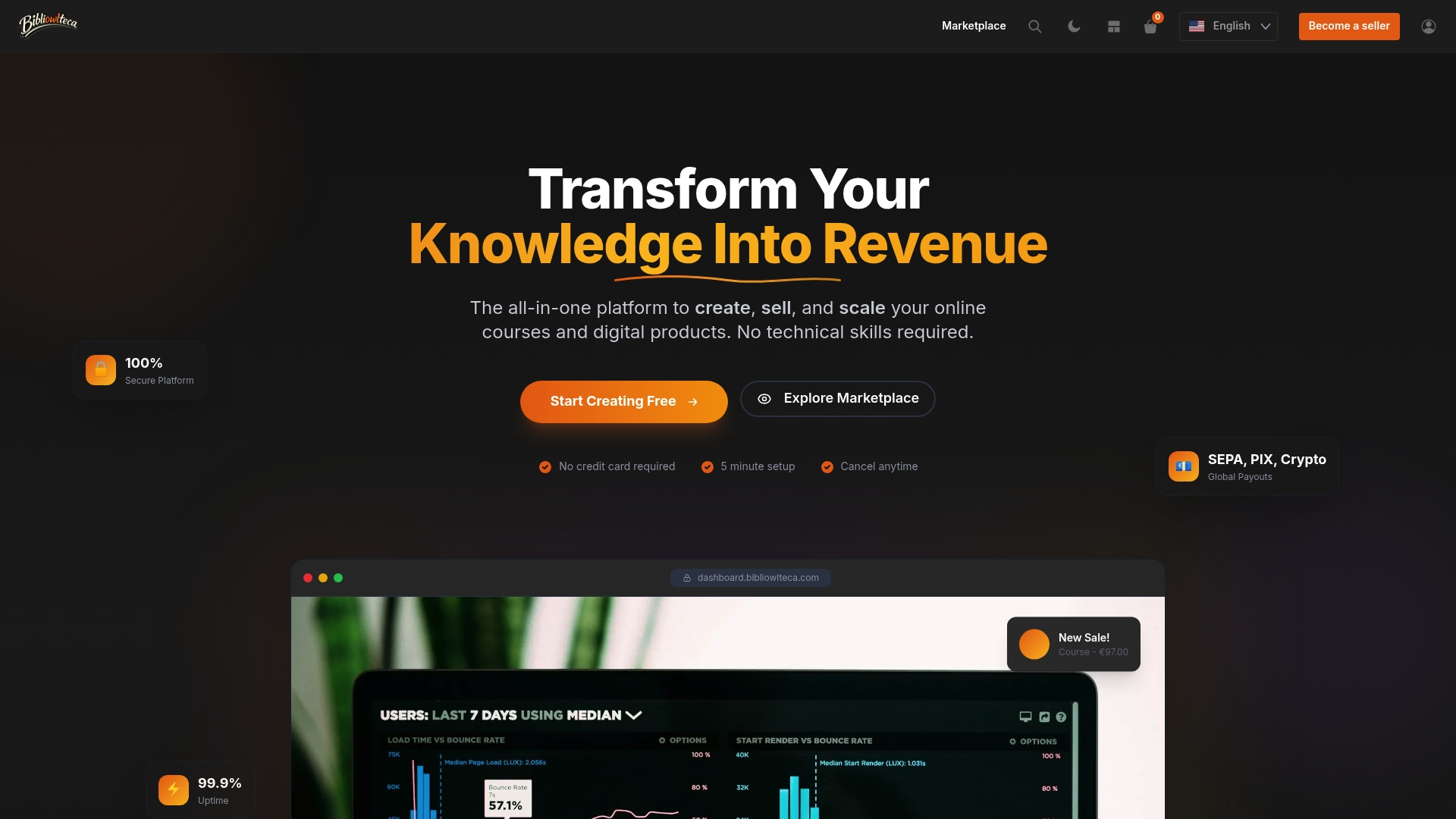
BibliOWLteca exists precisely for this moment. Whether you are an educator ready to publish your first structured entrepreneurship course, an aspiring founder looking for quality digital resources to accelerate your learning, or a creator wanting to build a scalable digital business around your expertise, BibliOWLteca provides the infrastructure to make it real. From global digital content distribution and multi-currency payments to built-in tax compliance and secure delivery, everything you need to move from knowledge to income is already in place. Explore what is possible and start building the entrepreneurship education business you have been designing in your head.
Frequently asked questions
Which entrepreneurship education methodology works best for beginners?
Action-oriented frameworks like Lean Startup and phase-based online courses are especially effective for beginners because they prioritise building practical skills through structured, stepwise experiences rather than overwhelming learners with theory upfront.
Is entrepreneurship education more effective for certain groups?
Research shows beginners and MSc-level students benefit more than highly experienced or PhD learners, and a seven-year follow-up study reveals meaningful gender differences in long-term capital outcomes, with men showing greater growth than women.
How can entrepreneurship education impact long-term business success?
It reliably boosts skills and confidence in the short term, but a meta-analysis of outcomes shows mixed long-term venture performance effects, making ongoing alumni support and continued resource access essential for sustained results.
Are entrepreneurial skills teachable or innate?
Core skills like validation, experimentation, and opportunity recognition respond well to targeted training, and neuroscience research using EEG and cognitive methods confirms that entrepreneurial cognition can be measurably improved, though some traits develop more through experience than curriculum.