
TL;DR:
- Demand validation and building a trusting audience are crucial before creating educational products.
- Beginners should start with low-cost e-books on platforms like Gumroad to test the market.
- Long-term success relies on diversifying offers, recurring memberships, and strategic platform choices.
Turning knowledge into a sustainable digital business is one of the most compelling opportunities available to creators right now, yet the gap between potential and profit is wider than most people expect. The global e-learning market is projected to exceed $400 billion by 2026, yet the majority of first-time course and e-book creators earn little in their first months. The difference between those who break through and those who stall almost always comes down to three things: strategic validation, smart platform selection, and disciplined monetisation. This article walks you through every step.
Table of Contents
- Key criteria for business education success as a digital creator
- Top platforms for business education: Which one fits your needs?
- Direct monetisation strategies: Mastering launches and recurring revenue
- Earnings benchmarks: What digital creators really make with e-books and courses
- Our unique take: What most creators get wrong about business education
- Next steps: Build, sell, and thrive as a digital educator
- Frequently asked questions
Key Takeaways
| Point | Details |
|---|---|
| Validate demand first | Pre-selling or surveying your audience is the best way to minimise risk before creating content. |
| Choose platforms wisely | Select a platform that suits your budget, stage, and content goals for business education. |
| Build and leverage your audience | Email lists and communities drive conversion and support recurring revenue. |
| Iterate and scale | Test, refine, and expand offerings to maximise both income and reach as a digital creator. |
Key criteria for business education success as a digital creator
Most creators approach their first educational product backwards. They spend weeks recording videos, designing beautiful PDF layouts, or writing exhaustive e-books, and only then ask: does anyone actually want this? That sequence is expensive, demoralising, and almost always avoidable.
The foundation of any successful digital education business is demand validation. Before you write a single lesson or format a single chapter, you need evidence that real people will pay money for the outcome you are promising. The most reliable methods include running a pre-sell campaign (selling access before the product exists), sending a survey to your existing audience, or opening a waitlist that lets you count genuine interest rather than vague enthusiasm.
Validating via pre-sell is particularly powerful because it combines market research with cash flow. If nobody buys, you have lost almost nothing except a little time. If people buy, you have both funding and proof before you have invested heavily in production.
Alongside validation, you need an audience. Not a massive one. But you need some people who trust your perspective and open your emails. An email list of 500 to 1,000 engaged subscribers is a credible launchpad for a first product, particularly when combined with a strong offer. Explore practical digital product strategies to understand how to build this foundation efficiently without burning out before you launch.
Here are the core criteria every creator should prioritise before building:
- Validate first. Use surveys, pre-sells, or waitlists to confirm real demand.
- Build your list before your product. Even 300 genuinely engaged subscribers outperform 10,000 cold followers.
- Structure for transformation. Every module, lesson, or chapter should move the learner closer to a specific outcome.
- Test and iterate. Your first version will not be your best. Ship it anyway and improve with feedback.
- Start lean with a hybrid model. Begin with a lower-priced e-book to build trust and revenue, then scale into a premium course once you understand what your audience truly needs.
"Structure content into 3 to 6 modules with lessons of 5 to 15 minutes each, always focusing on transformation and outcome rather than information volume."
Pro Tip: Before writing your course outline, write the outcome statement first. Finish this sentence: "By the end of this product, my student will be able to..." If you cannot complete it clearly, neither will your student.
The hybrid approach deserves particular attention. E-books and PDF guides are faster to produce, easier to price test, and require virtually no technical setup. They also function as an excellent proof of concept before you invest in a full course infrastructure. Many creators who successfully grow your online business start with a well-structured e-book at £15 to £30, then use the sales data and reader feedback to shape a £200 to £500 course offering. This reduces risk dramatically while keeping momentum going.
Top platforms for business education: Which one fits your needs?
With clear criteria in mind, it is time to look at your platform options for delivering educational content. The platform you choose will influence your fees, your branding, your relationship with your audience, and ultimately your income ceiling. There is no single correct answer here, but there is absolutely a wrong choice for your specific stage and goals.
Here is an honest breakdown of the most widely used platforms for selling e-books and online courses:
| Platform | Monthly cost | Transaction fees | Best for |
|---|---|---|---|
| Gumroad | Free | 10% per sale | Beginners, simple digital products |
| Teachable | From £39/month | 0% on paid plans | Growing creators, structured courses |
| Thinkific | From £39/month | 0% | Mid-market, community-focused creators |
| Kajabi | From £149/month | 0% | Scaling creators, all-in-one businesses |
| Udemy | Free | 37 to 97% instructor share | Discoverability, no existing audience |
Kajabi creators average £37,000 per year in revenue, and Teachable reports 10% growth in creators earning over £100,000 annually. Those are encouraging figures, but they reflect creators who are already established, not those in their first six months.
Gumroad is the right starting point for most new creators. It requires no monthly subscription, accepts payments immediately, and lets you sell anything from a simple PDF to a multi-module course. The 10% fee feels steep once volume grows, but at the beginning, paying no fixed costs while you test the market is the smart trade-off. Review our digital storefronts guide for a detailed look at setting up your first storefront effectively.
Teachable and Thinkific serve the mid-market well. Both offer structured course builders, quizzes, completion certificates, and student progress tracking. These features matter when your audience is paying £100 or more and expecting a professional learning experience. The monthly fee is only justified once you are generating consistent revenue, so consider these platforms your step-two home rather than your starting point.

Kajabi is genuinely all-in-one. Email marketing, landing pages, community features, course hosting, and affiliate management are all bundled together. For creators who are scaling and want to minimise the number of tools they manage, the higher monthly cost can actually save money when you factor in what you would otherwise pay separately. The platform is covered in depth in our marketplace empowers educators overview.
Udemy sits in a different category altogether. You are not building your own business there; you are contributing to theirs. The upside is free discoverability from Udemy's millions of monthly learners. The downside is that Udemy controls pricing, often discounts your course heavily, and you have no access to your students' contact details. Use Udemy to build credibility and generate some passive income, not as your primary revenue channel. Our digital publishing guide covers how to balance marketplace exposure with independent selling.
Pro Tip: Start on Gumroad or a similar low-friction platform for your first product. Once you have made at least 20 to 30 sales and gathered testimonials, migrate to Teachable or Kajabi and bring your audience with you. This keeps your early risk low while building the credibility you need to justify premium pricing later. Also consult our e-books tools overview for platform-agnostic tools that work across all these options.
A point many creators miss: where you host your product determines whether you own your customer relationship. On Udemy, you do not. On Gumroad, Teachable, or Kajabi, you do. Owning that relationship, specifically the email address, is the single most valuable asset in your digital business. Guard it accordingly.
Direct monetisation strategies: Mastering launches and recurring revenue
Once you have chosen your platform, leveraging the right monetisation strategies is key for revenue and growth. Having a good product on a good platform is only the beginning. How you introduce that product to the world, and how you structure your revenue model, will determine whether you earn a side income or build a full business.
The sequence that consistently works looks like this:
- Build your email list first. Aim for 500 to 1,000 subscribers before launching. This list is your launch engine. Every other channel, social media, YouTube, podcasts, is a feeder into it.
- Run a live launch. A structured launch with a clear open-cart and close-cart window creates urgency. People buy when there is a reason to buy now.
- Use upsells and bundles. Offer your e-book at £15, then present a bundle with a video workshop or templates at checkout for £35. Average order value rises significantly with minimal extra effort.
- Build a membership or community. Once you have sold a course, the natural next step is ongoing access. A £15 per month community where you answer questions and share new resources generates predictable recurring revenue.
- Recruit affiliates. Offer 30 to 50% commission to other creators in your niche who will promote your product to their audiences. This turns your launch into a network effect.
Webinar conversion rates average around 10%, while Gumroad stores convert at approximately 11.3%, well above the 3% industry average for digital products. These numbers highlight two things: warm audiences convert dramatically better than cold traffic, and the format of your sales mechanism matters as much as the product itself.
Here is a snapshot of what different monetisation approaches typically generate:
| Strategy | Typical conversion rate | Revenue potential (per launch) |
|---|---|---|
| Email list launch (1,000 subs) | 3 to 5% | £3,000 to £10,000 |
| Live webinar with offer | Up to 10% | £5,000 to £15,000 |
| Affiliate campaign | Varies by partner | 20 to 40% revenue uplift |
| Monthly membership | Rolling | £1,000 to £5,000 per month |
"An email list is not a nice-to-have for creators. It is the business itself. Every other platform can change its algorithm or shut down your account tomorrow. Your list cannot be taken away from you."
Explore our monetisation strategies resource for more detail on structuring your first launch campaign. For creators selling globally, our digital distribution for educators article covers how to handle currencies, tax, and delivery across different regions without the administrative headache.
Memberships deserve a special mention because they fundamentally change how you think about income. Instead of launching, earning, then waiting for the next launch, a £20 per month membership with 100 members gives you £2,000 in monthly recurring revenue as a baseline. Every new launch you run adds to that baseline rather than replacing it. Visit the knowledge marketplace article for creator case studies on how memberships have been layered onto existing course businesses with impressive results.
Earnings benchmarks: What digital creators really make with e-books and courses
Having mastered monetisation tactics, you need realistic benchmarks to evaluate your progress and set ambitious yet attainable goals. The internet is full of "I made £10,000 in my first month" stories. Most of those stories omit the pre-existing audience of 50,000 followers, the paid advertising budget, or the five previous failed launches that led to the winning formula.
Let us look at what the evidence actually says.
| Creator scenario | Product type | Revenue outcome |
|---|---|---|
| No existing audience, Gumroad, organic search | E-book at £14 | £67 profit after 9 sales in 30 days |
| Medium writer with established readership | PDF guides | £8,000 across 4 months |
| Established course creator, Kajabi | Online course | £37,000 per year (average) |
| First-time Gumroad seller, any product | Any | £0 to £100 in month one (median) |
The data is stark. Gumroad median first-month earnings sit between £0 and £100 for new sellers with no existing audience. That same source documents a real example of £102 net profit from nine sales after fees, with no social media following, purely through organic platform discovery.
These numbers are not discouraging. They are clarifying. They tell you that:
- Month one is rarely transformative. The creators who succeed treat month one as a data collection exercise, not a profit target.
- Traffic source is the main variable. Nine sales with no audience is actually a proof of concept. With a 1,000-person email list, those nine sales become 30 to 50.
- Scaling is multiplicative. The difference between £67 in month one and £8,000 in month four is almost never a better product. It is almost always more traffic and better conversion mechanics, as demonstrated by PDF guide sales via Medium traffic.
The path from zero to meaningful income typically spans six to eighteen months for creators who are consistent. Creators who use global sales insights to expand beyond their domestic market often see faster growth, simply because they are not limited to a single currency or country's audience.
Key milestones to target:
- Month 1 to 3: Validate product, generate first 10 to 20 sales, collect testimonials.
- Month 4 to 6: Run first structured email launch, aim for 50 to 100 sales total.
- Month 7 to 12: Introduce a second product, bundle existing products, explore affiliates.
- Year 2 and beyond: Membership revenue, course updates, and a growing affiliate network compound into a stable income.
Reinvestment matters enormously at this stage. Creators who take every pound of profit out of the business in year one rarely build anything lasting. Those who reinvest in better landing pages, email software, advertising tests, or additional content tend to hit inflection points much sooner.
Our unique take: What most creators get wrong about business education
Here is the honest truth that most articles about digital education will not tell you: production quality is almost irrelevant in your first year. We have seen beautifully filmed courses with 4K video, professional studio audio, and custom animated graphics fail to find an audience. We have also seen a simple screen recording with mediocre audio generate £40,000 because the creator understood their audience's exact problem and spoke directly to it.
The obsession with production quality is a displacement activity. It feels productive. It gives creators something to point to when explaining a delay. But it almost never moves the revenue needle. What moves the needle is relentless focus on the outcome you are delivering and disciplined testing of how you communicate that outcome.
The second thing most creators get wrong is treating their educational product as a one-time transaction. They build a course, launch it, celebrate or grieve the results, and then start building the next course from scratch. This is exhausting and financially inefficient. The smarter play is to treat every product as an entry point into a longer relationship. A £25 e-book buyer who gets genuine value will purchase a £300 course. That course student will join a £29 per month community. That community member will refer others. Each product should be designed with the next step in mind.
We also think the underrated traffic source for zero-budget creators is writing on platforms like Medium. A creator who publishes consistently useful articles on Medium, links to their Gumroad product, and focuses on search-friendly topics can generate steady, compounding traffic at zero cost. The case study of £8,000 in PDF sales via Medium in four months is not an outlier. It is a repeatable strategy that most creators overlook because it requires patience rather than ad spend.
Finally, the creators who scale most reliably are those who embrace hybrid monetisation early. They do not choose between e-books or courses or memberships. They build a portfolio of offers at different price points, serve different buyer readiness levels, and use each product to pull customers towards the next. This is not complicated. It just requires a plan from the start rather than a reaction to whatever feels urgent each month. Our practical monetisation strategies resource is a good starting point for mapping your own product portfolio with intention.
Next steps: Build, sell, and thrive as a digital educator
If everything covered in this article has energised you, the next practical question is where to set up your digital storefront in a way that supports global growth from day one.
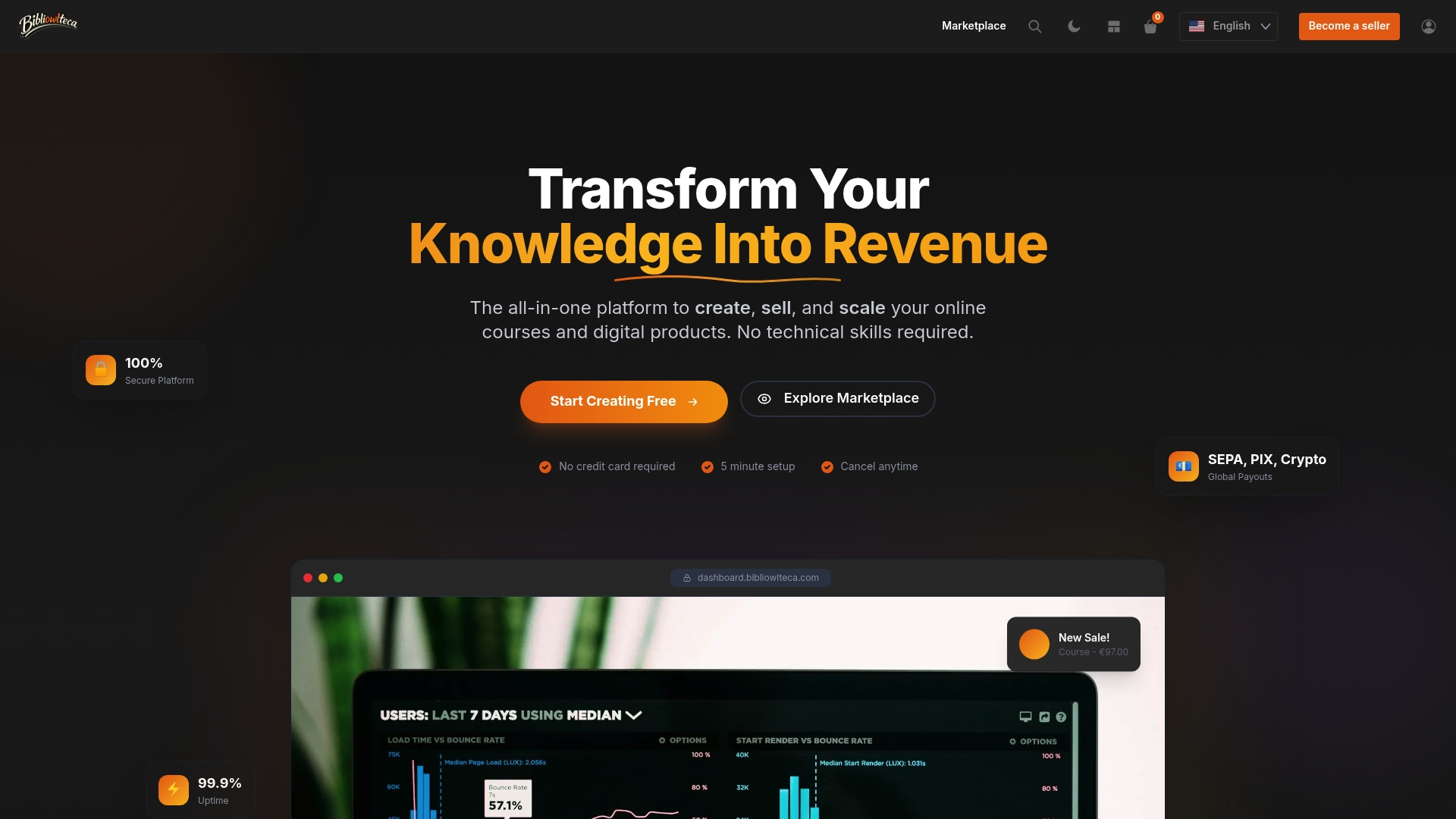
BibliOWLteca is built specifically for educational content creators who want to sell internationally without being buried in tax compliance, currency headaches, or fragmented delivery systems. Whether you are listing your first e-book or migrating an established course catalogue, the digital content marketplace gives you the infrastructure to reach buyers across multiple currencies and regions from a single, secure platform. You can manage your own store, retain your audience relationship, and focus on creating rather than administering. Visit BibliOWLteca to explore the full suite of tools available to digital educators at every stage of growth.
Frequently asked questions
How much can a new creator expect to earn from e-books in the first month?
Median first-month earnings on Gumroad range from £0 to £100 for sellers with no existing audience, although creators with targeted traffic from platforms like Medium often report significantly higher returns.
What is the best platform for beginners to sell online courses or e-books?
Gumroad is widely recommended for new creators because it requires no monthly fee, is simple to set up, and charges a flat 10% transaction fee only when you make a sale.
Can digital creators generate recurring revenue with educational content?
Yes, memberships and communities built around educational content are among the most effective recurring revenue models, providing predictable monthly income that compounds as your audience grows.
What proportion of course creators earn over £75,000 a year?
Teachable reports 10% growth in creators earning over £100,000 annually, particularly those using structured course frameworks and actively scaling their platforms with email lists and affiliate partnerships.