
TL;DR:
- Choosing a specific niche and validating demand increases sales and marketing effectiveness.
- Building focused, high-value products quickly and iterating based on feedback improves success.
- Owning your audience through platforms like email yields more sustainable, long-term income.
You have genuine expertise, hard-won experience, and a growing sense that sharing it should generate real income — yet the gap between "I know this well" and "I earn consistently from this" feels impossible to close. Many creators face exactly this frustration, pouring time into content that barely converts while watching others build profitable digital businesses from similar knowledge. The good news is that the path from expertise to income is repeatable and well-documented. This guide walks you through every stage: choosing the right niche, building your first product, selecting the best distribution channels, and keeping your audience engaged long enough to generate sustainable, scalable revenue.
Table of Contents
- Choose your niche and validate demand
- Build your first digital product: e-books, templates, and courses
- Select platforms and distribution channels
- Engage your audience and boost revenue
- What most guides miss about monetising knowledge
- Take your next step: start selling your expertise
- Frequently asked questions
Key Takeaways
| Point | Details |
|---|---|
| Niche selection matters | Focusing on a specific audience and problem increases demand and reduces competition. |
| Start simple for speed | Launching with e-books or templates lets you monetise quickly and validate ideas. |
| Owned platforms increase earnings | Selling your products on your own platform allows for better pricing and greater control. |
| Community boosts results | Active engagement with your audience improves product completion rates and revenue. |
| Diversify for resilience | Combining digital products, memberships, and coaching creates a robust income stream. |
Choose your niche and validate demand
Before you write a single word or record a single lesson, the most important thing you can do is resist the urge to create. Most creators jump straight into building, and most creators waste months producing something nobody pays for. The smarter move is to spend time upfront narrowing your focus and confirming that real people with real money are genuinely interested in what you plan to offer.
Why specificity wins
Broad topics feel safe because they seem to appeal to more people. In practice, broad topics attract no one in particular and convert very few. A course called "Introduction to Marketing" competes with hundreds of free resources, university programmes, and YouTube channels. A course called "Email marketing for independent yoga instructors" speaks directly to a specific group with a specific problem, and those people are far more likely to pay for a solution that feels made for them.
Specificity also makes your marketing much easier. When you know exactly who you are speaking to, every social media post, email, and sales page becomes more targeted and more persuasive. You are no longer writing for everyone. You are writing for someone.
How to validate demand rapidly
Validation does not need to be complicated. Here are the methods that work best for knowledge creators:
- Pre-selling: Announce your product before it exists and offer early-bird pricing. If people pay, you have confirmed demand. Pre-selling validates demand and can generate 20 to 30% of your revenue before you have built anything.
- Audience surveys: Ask your existing followers or email subscribers directly. "What is the single biggest challenge you face with X?" is more useful than any market research tool.
- Online community research: Spend time in Reddit threads, Facebook groups, LinkedIn communities, and Discord servers relevant to your topic. Look for repeated questions, common frustrations, and phrases people use when describing their problems. Those phrases become your marketing copy.
- Keyword research: Tools such as Google Keyword Planner, Ubersuggest, and even the autocomplete function in Google Search will show you what people are actively searching for. High search volume on a specific phrase means proven demand.
- Content performance: If you already publish content, look at what gets the most engagement, comments, and saves. Your audience is already telling you what they want more of.
Common pitfalls to avoid
The three most damaging mistakes at this stage are monetising too early, underpricing, and building your entire business on a single revenue stream. Monetising before you understand your audience leads to products that miss the mark. Underpricing signals low value and attracts buyers who are unlikely to complete your course or leave a positive review. Relying on one product or one platform makes your entire business fragile.
Pro Tip: Before committing to a full course or e-book, test your concept with a short, paid workshop or a mini-guide. This gives you both validation and early revenue, plus genuine feedback that will make your full product significantly stronger.
Before you begin building, review a solid educational book checklist to ensure your content plan is structured for real learner outcomes rather than just information delivery.
"A specific niche and a validated audience is not a limitation — it is your competitive advantage. The narrower your focus, the stronger your sales."
Build your first digital product: e-books, templates, and courses
Once you have confirmed demand and identified your niche, the natural impulse is to build something ambitious. Resist it. The fastest path to learning what your audience truly needs is to release a focused, impactful product quickly and then iterate based on real feedback.
Quick-start product options
The three easiest and most profitable first products for knowledge creators are e-books, templates, and short courses. Each has a different creation timeline and a different primary value:
- E-books: Written guides that teach a process, explain a framework, or solve a specific problem. Most focused e-books can be written in one to two weeks. They require minimal technical setup and carry high profit margins of 85 to 95%, meaning nearly every pound you earn goes directly to you.
- Templates: Pre-built documents, spreadsheets, Notion pages, or Canva designs that save the buyer time. Templates are often faster to create than e-books and can command surprisingly strong prices because buyers are paying for saved effort, not just information.
- Short courses: A focused video series covering a single skill or outcome. These take longer to produce but generate stronger perceived value and higher average order values. Starting with three to five short modules is far better than planning a 40-module behemoth that takes six months and never ships.
Structuring content for clarity and outcomes
Every strong digital product is built around a transformation. The buyer arrives with a problem or a goal. Your product takes them from where they are now to where they want to be. Structure your content around that journey: start with the problem, build through the solution, and close with the outcome.

Avoid the common trap of including everything you know. More content does not mean more value. Learners want clarity, not volume. A well-structured 30-page e-book that solves one problem completely is worth more than a 200-page document that covers a topic loosely.
Using AI tools to speed up creation
AI writing and content tools have genuinely changed how fast creators can build products. You can use them to generate outlines, draft initial sections, create quiz questions, and even produce supporting worksheets. However, as AI accelerates creation, depth and specificity remain the key differentiators. Free AI-generated content is everywhere. What buyers pay for is your specific experience, your frameworks, and your perspective applied to their exact problem.
Use AI to save time on structure and drafting, but always layer in your own voice, real examples, and hard-won insights.
Pricing strategy: value-based, not time-based
One of the most damaging pricing habits among new creators is charging based on how long something took to make. Your buyers do not care how long you spent creating the product. They care about the outcome it delivers. A 15-page template that saves a buyer ten hours per week is worth hundreds of pounds, regardless of how quickly you created it.
| Product type | Creation time | Typical price range | Profit margin |
|---|---|---|---|
| E-book | 1 to 2 weeks | £15 to £97 | 90 to 95% |
| Template pack | 3 to 7 days | £27 to £197 | 92 to 97% |
| Short course | 3 to 6 weeks | £97 to £497 | 85 to 92% |
| Comprehensive course | 2 to 4 months | £297 to £1,500+ | 80 to 90% |
Bundles and upsells to maximise margins
Bundling related products together increases average order value without requiring you to create entirely new content. Pair an e-book with a template, or offer a short course as an upsell to buyers of a lower-priced guide. This approach works particularly well when products are sequenced logically so that each one naturally leads the buyer to want the next.
Explore practical e-book tools that can help you produce polished, professional products without a design team, and learn how to publish and sell educational materials through established digital channels.
Pro Tip: Launch your first product at a lower "founding member" price and use buyer feedback during that period to improve it. Once refined, raise the price. This approach generates early revenue, builds social proof, and creates a natural reason to increase your pricing over time.
Select platforms and distribution channels
Your product is built. Now the question becomes: where should you sell it? This decision has a direct impact on how much you earn per sale, how much control you retain over your audience, and how sustainable your business becomes over time.
Marketplaces versus owned platforms
Marketplaces such as Udemy, Skillshare, and similar platforms offer built-in audiences. You upload your course, they drive traffic, and you earn a percentage of each sale. The problem is that this percentage is often small, and the platform controls pricing, promotions, and customer relationships. Udemy's average earnings for instructors sit around £3,000, with the platform frequently discounting courses to as little as £9.99 without the creator's meaningful input.
Owned platforms, by contrast, give you complete control. You set the price, you own the customer data, you decide when to run promotions and when to hold pricing firm. The trade-off is that you are responsible for driving your own traffic, which requires more consistent marketing effort.
Comparison: marketplace versus owned platform
| Factor | Marketplace | Owned platform |
|---|---|---|
| Initial traffic | High (built-in audience) | Low (you build it) |
| Pricing control | Limited | Full |
| Revenue per sale | Low (often 25 to 50%) | High (often 85 to 97%) |
| Customer data access | Restricted | Full ownership |
| Brand building | Minimal | Strong |
| Long-term sustainability | Platform-dependent | Creator-controlled |
Choosing the right mix
Most successful creators do not choose one or the other. They use marketplaces for initial discovery and brand awareness, then funnel buyers towards their own platforms for ongoing products, memberships, and premium content. This hybrid approach captures the reach of a marketplace while building the long-term asset of an owned audience.
The key insight is that your email list is your most valuable asset. Every buyer who comes through a marketplace and never joins your email list is a one-time transaction. Every buyer who joins your list becomes a long-term customer relationship.
Distribution tactics that actually work
Beyond platform choice, how you actively distribute your products matters enormously:
- Email marketing: A direct line to people who have already expressed interest. Even a small, engaged list converts at far higher rates than social media followers.
- Online communities: Share genuine value in communities where your audience already gathers, and let your product reputation build organically.
- Partnerships and affiliates: Other creators in adjacent niches can promote your products to their audiences in exchange for a revenue share.
- Direct sales outreach: Especially relevant for higher-priced courses and B2B-focused content, a direct conversation often converts better than any sales page.
Understanding the digital marketplace benefits for educators is important before committing to a single channel. You can also explore digital distribution strategies that balance reach with revenue control, and discover how to sell globally through well-structured storefronts.
Key insight: The creator who owns their audience owns their income. Platform algorithms change. Marketplace policies shift. Your email list is the only distribution channel you fully control.
Engage your audience and boost revenue
Getting your first buyer is an achievement. Keeping them engaged, supporting their success, and turning them into repeat customers is what builds a real business. This stage is where many creators leave the most money on the table.
Why the first week matters so much
Course completion rates across the industry average around 43%, which sounds discouraging until you realise that most drop-off happens in the first seven days. Learners who engage with content in the first week, who complete the first module, who interact with a community or receive a personal check-in, complete courses at dramatically higher rates. Community engagement lifts course completion from 43% to 65%, a significant improvement that directly affects reviews, referrals, and future sales.
Engaged subscribers outperform large audiences
One of the most important insights in the creator economy is that audience size is far less important than audience engagement. Creators with engaged subscriber lists of 1,000 to 3,000 people generate revenue of approximately £8.50 per subscriber, compared to just £1.20 per subscriber for unengaged lists of 10,000 or more. The implication is clear: a small, active, loyal audience is worth far more than a large, passive one.
Tactics to build and sustain engagement
- Welcome sequences: A short email series starting the moment someone buys creates momentum and reduces the chance of early drop-off.
- Community spaces: A private Discord, Slack group, or Facebook group attached to your course or e-book gives buyers a place to share progress, ask questions, and feel connected to each other.
- Live elements: Regular live Q&A sessions, even monthly, dramatically increase perceived value and buyer satisfaction without requiring you to produce new content constantly.
- Progress milestones: Celebrate buyer achievements publicly in your community. Recognition drives continued engagement and creates social proof at the same time.
- Feedback loops: Ask buyers regularly what they are struggling with. Their answers become the basis for your next product, your next module, or your next email sequence.
Diversifying your revenue streams
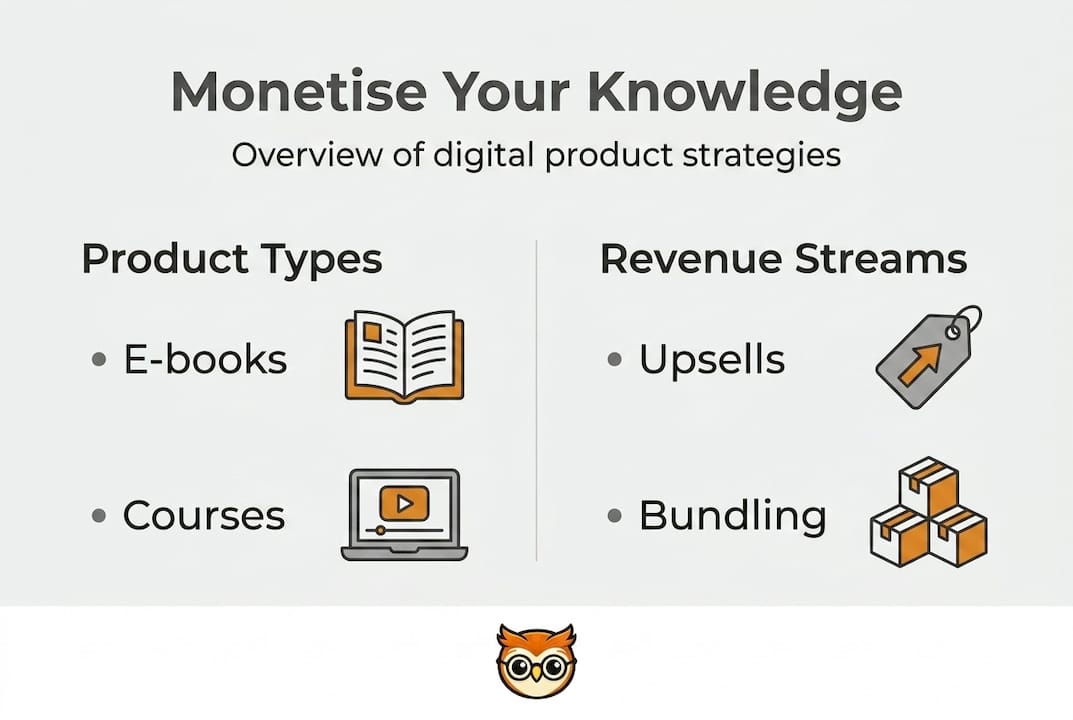
Relying entirely on product sales creates vulnerability. A diversified knowledge business might include a core course, a lower-priced e-book as an entry point, a membership for ongoing access, a small group coaching programme, and affiliate partnerships with tools you genuinely use and recommend. Retention and revenue both rise significantly when you build active audience connections rather than relying on passive content delivery alone.
This diversification also protects you from the risks that come with algorithm-dependent distribution. If a platform changes its rules, one revenue stream is affected, not your entire income.
Building genuine relationships with your buyers is the single most reliable path to a thriving knowledge business. Explore resources on earning globally as a creator, practical approaches to growing your online business, and actionable global digital sales tips that apply whether you are reaching buyers locally or across multiple continents.
What most guides miss about monetising knowledge
Most articles about digital products focus on tactics: pick a niche, build a course, sell it. That advice is not wrong, but it leaves out the part that actually determines whether a creator builds a sustainable business or burns out after two product launches.
The uncomfortable truth is that the creators who earn the most consistently are not the ones with the largest audiences, the lowest prices, or the widest content catalogues. They are the ones who go deepest into a specific problem for a specific audience and build genuine trust over time. Depth beats breadth every time, and it beats it by a wider margin than most people expect.
The trap of low pricing is particularly damaging. New creators tend to undercharge because they are nervous about rejection or uncertain about their expertise. But a low price does not just reduce your revenue. It attracts a type of buyer who is less committed, less likely to complete your course, and less likely to leave a strong review or referral. Raising your prices, when backed by strong positioning and clear outcomes, actually improves the quality of your buyers and the results they get.
The other thing most guides overlook is the value of starting small and iterating quickly. Your first product will not be your best product. Your tenth will be dramatically stronger because it is shaped by real buyer feedback, real questions, and real results. The goal of your first product is not perfection. It is learning. Every piece of feedback you receive is data that makes the next version better.
Before spending months building, validate audience demand systematically. Resilience in this business comes from multiple revenue streams, an owned audience, and a willingness to evolve your products based on what buyers actually need, not what you assumed they needed when you started.
Take your next step: start selling your expertise
You now have a practical framework for turning your knowledge into a scalable digital business. Choosing the right niche, building a focused product, selecting the best distribution mix, and engaging your audience consistently are the four pillars that separate creators who build genuine income from those who stay stuck.
BibliOWLteca is built specifically to help you put this framework into action. The BibliOWLteca marketplace gives creators and educators a secure, scalable platform to publish e-books, courses, and digital products while managing their own stores and audiences globally. With built-in tools for payment processing, tax compliance, and digital delivery in multiple currencies, you can reach buyers worldwide without the technical headaches that slow most creators down. If you are ready to turn your expertise into income, BibliOWLteca gives you the infrastructure to do it well and the reach to do it globally.
Frequently asked questions
What is the best way to validate demand for a digital product?
Pre-selling, audience surveys, and collecting feedback before fully building are proven ways to validate demand and reduce risk. In fact, pre-selling generates 20 to 30% of revenue before the product even exists, which makes it the most powerful validation method available to creators.
How long does it take to create your first e-book or digital course?
Most creators can develop a basic e-book or template in one to two weeks using streamlined tools and focused planning. As evidence confirms, e-books and templates have a low creation barrier and can be produced quickly without sacrificing quality.
Should I sell on marketplaces or build my own platform?
Owned platforms generally offer higher control and earnings, while marketplaces are easier to start but average lower revenue per product. Udemy instructors average approximately £3,000 in lifetime earnings, whereas owned platforms allow creators to set their own pricing and retain far more per sale.
How can I increase course completion rates and revenue?
Active community engagement and first-week involvement significantly raise course completion rates and income per subscriber. Research confirms that community engagement lifts completion from 43% to 65%, and engaged subscribers generate £8.50 per person compared to just £1.20 for unengaged audiences.