
TL;DR:
- The knowledge economy is driven by expertise, innovation, and intellectual assets instead of physical goods.
- AI disrupts routine tasks, emphasizing the importance of human skills like empathy and critical thinking.
- Creators should focus on packaging digital products, continuous learning, and leveraging global knowledge platforms.
Intangible goods now generate more economic value than factories, farms, or freight combined. The knowledge economy is an economic system where growth is driven by knowledge, information, expertise, innovation, and intellectual capital rather than physical goods or labour. For content creators and educators, this shift is not a distant trend to watch from the sidelines — it is an active invitation to build something meaningful and profitable. This guide moves through the landscape from the ground up, giving you a clear picture of where opportunities lie, how global forces are shaping demand, and precisely what steps to take to grow your digital knowledge business in 2026.
Table of Contents
- What exactly is the knowledge economy?
- The main pillars of the knowledge economy
- Global innovation: Who is leading and why it matters
- The impact of AI: Challenge and opportunity
- How to thrive: Actionable steps for creators and educators
- Our perspective: Why creators who embrace both tech and human skills will win
- Take your next step in the knowledge economy
- Frequently asked questions
Key Takeaways
| Point | Details |
|---|---|
| Knowledge drives growth | In today’s economy, information and expertise are more valuable than physical products. |
| Skills must evolve | Continuous upskilling in tech and human abilities is crucial for creators and educators. |
| AI is both risk and tool | AI automates basic tasks but increases demand for creativity, empathy, and complex problem-solving. |
| Global opportunities await | Innovation leaders demonstrate that global reach and adaptation are within anyone’s grasp. |
| Action leads to results | Taking practical steps—like selling digital content—turns expertise into sustainable income in the knowledge economy. |
What exactly is the knowledge economy?
To understand how to participate, it's vital to clarify what the knowledge economy truly means, and why it is different from every economic model that came before it.
For most of human history, wealth was tied to land, raw materials, and physical labour. Agricultural economies rewarded those who owned fertile soil. Industrial economies rewarded those who controlled factories and supply chains. Both depended on something you could touch, move, or consume. The knowledge economy operates by entirely different rules.
"The knowledge economy is an economic system where growth is driven by knowledge, information, expertise, innovation, and intellectual capital rather than physical goods or labor." — Knowledge economy definition
In this system, your most valuable asset is what you know, how you think, and how effectively you can communicate and package that expertise. A farmer's land depreciates. A factory's machinery ages. But a well-structured online course, a thoroughly researched eBook, or a trusted educator's audience can grow in value over time, often indefinitely.
Digital technologies accelerated this shift dramatically. Broadband internet, cloud computing, streaming platforms, and payment infrastructure made it possible for a single creator in Edinburgh, Nairobi, or Bogotá to publish knowledge and reach paying customers in dozens of countries within hours. The barriers that once protected large institutions, publishing houses, universities, and media companies, have lowered substantially.
The key intangible assets in the knowledge economy include:
- Data and analytics: Understanding audience behaviour and market demand.
- Copyrights and intellectual property: Owning the content you create.
- Human capital: The accumulated skills, experience, and credentials of individuals.
- Networks and communities: The audiences and relationships built over time.
- Reputation and trust: Perhaps the most durable asset of all.
Each of these is something you, as a creator or educator, can actively build and own. That is the fundamental opportunity this economy presents.
The main pillars of the knowledge economy
With the definition established, we can explore the foundational elements driving this new system and the specific opportunities each one creates for you.
Researchers and economists often describe the knowledge economy through four interconnected pillars. Understanding them helps you see which areas align with your current strengths and where you should invest your energy next.
| Pillar | What it means | Opportunity for creators |
|---|---|---|
| Learning economy | Continuous, modular upskilling drives relevance | Sell micro-courses, skills workshops, certification programmes |
| Creative economy | Monetising original content and digital products | Publish eBooks, templates, toolkits, and digital art |
| Open economy | Collaboration and open innovation fuel growth | Co-create, partner, and share knowledge across communities |
| Data-driven economy | Decisions shaped by analytics and digital insight | Use audience data to refine offers and improve delivery |
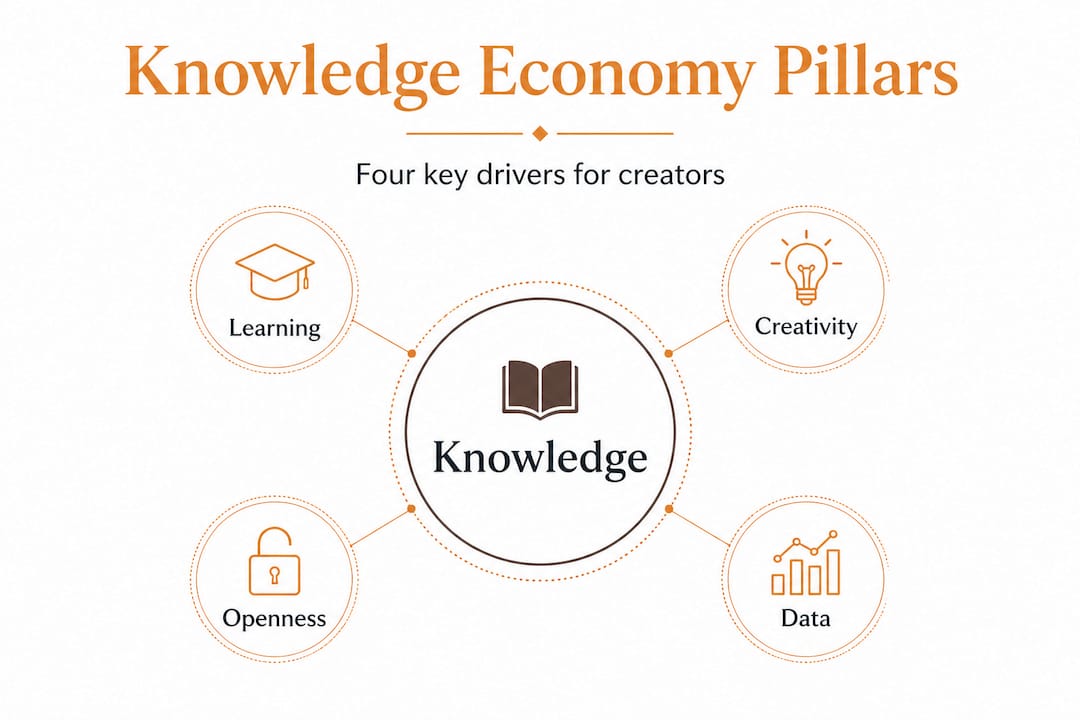
According to new knowledge economy drivers, continuous upskilling is now essential, and the four pillars — learning, creative, open, and data-driven economies — are the core engines of this transformation.
The learning economy is particularly significant for educators. Learners no longer want to commit to three-year degree programmes to gain a single skill. They want focused, modular, results-driven learning delivered on demand. Short-form courses, masterclasses, and structured learning paths are in high demand precisely because they respect a learner's time while delivering tangible outcomes. Understanding library trends in 2026 shows just how rapidly even traditional educational institutions are adapting their formats to meet this expectation.
The creative economy is where content creators find their footing. Selling your original work directly to your audience — without intermediaries taking most of the value — is now fully achievable. The role of eBooks in education illustrates how digital formats have evolved from simple text files into rich, interactive, and pedagogically sound products that learners genuinely prefer.
The open economy might surprise you. Openness does not mean giving everything away for free. It means collaborative creation and cross-pollination of ideas generate more value than working in silos. Creators who build communities, collaborate with peers, and contribute to open knowledge ecosystems often attract larger, more engaged audiences than those who guard every idea jealously.
The data-driven economy is where many creators leave value on the table. Using even basic analytics — which topics generate the most engagement, which formats convert the best, what pricing models your audience responds to — lets you refine your offer continuously. Data transforms guesswork into strategy.

Pro Tip: Start with one pillar where your current skills already shine, and add the others gradually. Trying to optimise all four simultaneously is a recipe for burnout and mediocrity.
Global innovation: Who is leading and why it matters
Having identified the main pillars, it is essential to see how different countries and regions implement these strategies, and what that means for individual creators and educators operating globally.
The scale of global knowledge-economy investment is staggering. Countries that lead in innovation tend to share common characteristics: strong public investment in research and development, open access to knowledge infrastructure, and collaborative ecosystems that bridge academia, business, and government. Understanding these patterns gives you a strategic lens for positioning your own work.
| Region | Innovation standing (2024) | Key strengths |
|---|---|---|
| USA | Global leader | R&D investment, tech ecosystems, venture capital |
| South Korea | Top global performer | Manufacturing-tech integration, AI research |
| Japan | Top global performer | Precision engineering, robotics, applied research |
| EU27 | Leads Canada, Australia, China | Diverse research clusters, regulatory innovation |
| Sweden, Ireland, Germany, Finland | Top EU performers | Education quality, digital infrastructure |
| Canada, Australia, China | Below EU27 average | Growing rapidly in targeted sectors |
The Innovation Output Indicator 2024 confirms that the EU27 as a bloc leads Canada, Australia, and China in innovation outputs, but trails the USA, South Korea, and Japan, with Sweden, Ireland, Germany, and Finland standing out as the bloc's strongest performers.
"The most innovative economies are not simply spending more money. They are building environments where knowledge flows freely, talent is nurtured across sectors, and failure is treated as data rather than disgrace." — BibliOWLteca editorial team
At the national level, sector-specific innovation tells its own story. The UK's technology sector provides a compelling example of how targeted investment in knowledge industries creates outsized economic returns. The UK semiconductor sector generated £9.6 billion in revenue in 2022 and is projected to reach £17 billion by 2030, while quantum computing alone could add £11 billion to UK GDP by 2045.
What does this mean for you as a creator or educator? Several things. First, the countries investing most heavily in knowledge infrastructure are also producing the most digitally literate populations, your most likely paying audiences. Second, the open innovation models championed by top performers suggest that being part of global knowledge communities, not just producing for them, positions you as a trusted contributor rather than a commodity seller.
Platforms that allow creators to reach international audiences are directly connected to this global shift. A digital marketplace for educators enables you to participate in the knowledge economies of multiple countries simultaneously, something that would have required a publisher, a distributor, and significant capital just fifteen years ago.
The impact of AI: Challenge and opportunity
Innovation does not just come from nations. Technology like AI is rapidly transforming day-to-day knowledge work, and it is reshaping what skills are valuable, which tasks are automatable, and where creators can carve out lasting advantage.
AI's impact on knowledge work is not theoretical. Research shows that AI disrupts roughly 30% of US workers' tasks, particularly routine knowledge-processing tasks, while simultaneously driving up demand for AI literacy, critical thinking, and non-cognitive skills like empathy and adaptability.
The disruption side is real and worth taking seriously. Tasks that were once core to many professional roles — summarising documents, generating first drafts, organising data, producing standard reports — can now be automated quickly and cheaply. If your current value proposition rests primarily on performing these kinds of tasks, your position is genuinely vulnerable.
Only 25% of surveyed workers report solid AI literacy, creating both a gap and a significant opportunity for educators who can help close it.
The opportunity side is arguably larger. Think about it this way: if AI handles the routine, human attention becomes concentrated on the irreplaceable. Creativity, judgement, emotional intelligence, contextual wisdom, and genuine teaching relationships are not just hard to automate — they become more valuable as automation increases. The creator who can combine AI tools with deep human insight will consistently outperform both pure technologists and pure traditionalists.
Here are practical steps to future-proof your work in the AI era:
- Audit your current work. List every task you perform regularly and ask honestly whether AI can replicate it adequately. This is not about fear — it is about clarity.
- Invest in AI literacy. Learn the tools relevant to your field: content generation, image creation, data analysis, and workflow automation. You do not need to become a programmer, but you must become a confident user.
- Double down on what machines cannot replicate. Developing critical reading skills and cultivating empathy and human understanding are not soft extras — they are your professional moat.
- Create content that reflects genuine experience. AI can generate plausible text but cannot replicate lived experience, personal narrative, or authentic perspective. Your story, your failures, and your hard-won insights are uniquely yours.
- Teach AI-related skills. Courses that help others navigate AI tools are among the fastest-growing categories in online education. If you understand AI well enough to use it, you understand it well enough to teach it.
Pro Tip: Use AI to accelerate the production of your foundational content — outlines, research summaries, first drafts — so you can invest your limited time in the high-value human layers: curation, personalisation, narrative, and relationship.
How to thrive: Actionable steps for creators and educators
After examining both opportunity and risk, the key question is how to carve a successful path for yourself — practically and sustainably.
The transition from expertise to income is where many creators stall. They have genuine knowledge, real skills, and valuable experience, but they are uncertain about how to structure, price, package, and distribute what they know. The good news is that the pathway is clearer than it has ever been.
Research from educational experts confirms that 40% of core job skills will need updating by 2030, driven by AI and the broader shift to lifelong, modular learning. This is not a threat — it is a sustained, multi-year demand signal for exactly what educators and creators produce.
Here is how to move from knowing to doing:
-
Package your expertise into scalable digital products. A live workshop serves ten people at a time. A recorded course can serve ten thousand simultaneously. Translate your best teaching into formats that work without your physical presence: courses, eBooks, workbooks, templates, membership communities, and guided learning paths.
-
Build a personal learning plan for yourself. The irony of teaching is that your students expect you to be ahead of them. Identify three skills gaps that are relevant to your audience — AI tools, content marketing, digital pedagogy — and schedule deliberate learning time each month.
-
Choose your distribution platform carefully. Not all platforms are equal. Look for platforms that support international payments and multiple currencies, handle digital delivery securely, and give you ownership of your customer relationships rather than locking them into someone else's ecosystem.
-
Use content marketing to attract, not just sell. Publishing valuable free content — articles, videos, podcasts, or social posts — builds the trust that converts curious strangers into paying customers. Your free content is a demonstration of what your paid products deliver.
-
Price for value, not just effort. Many creators underprice because they measure value by the hours they spent creating. Your audience measures value by the transformation your product enables. A course that helps someone get promoted, change careers, or master a skill they struggled with for years is worth far more than the hours it took to record.
-
Stay agile. The knowledge economy rewards creators who revise, adapt, and respond to new demands. Building feedback loops into every product — gathering reviews, running surveys, tracking completion rates — keeps your content relevant and your reputation strong.
Using a platform designed for earning through knowledge marketplaces removes many of the technical barriers that slow creators down, letting you focus on what you actually do best: teaching and creating.
Pro Tip: Start with one product, sell it to a small audience, collect feedback, and improve it. Launching ten mediocre products simultaneously is far less effective than refining one excellent product until it practically sells itself through word of mouth.
Our perspective: Why creators who embrace both tech and human skills will win
Bringing this guide full circle requires addressing a concern that surfaces in almost every conversation about AI and the knowledge economy: what actually differentiates sustainable success in the age of smart machines?
The popular narrative runs in one of two directions. Either AI is coming for everyone's livelihood and creators should panic, or AI is entirely harmless and creators should carry on as before. Both positions miss the point entirely.
The more honest and useful view is this: AI de-skills routine knowledge work while simultaneously elevating the value of deeply human capabilities — empathy, nuanced judgement, authentic storytelling, and the ability to build genuine trust. With only 25% of surveyed workers reporting solid AI literacy, the gap between those who understand these tools and those who do not is widening rapidly.
Here is what that means in practice. A creator who uses AI to handle research summaries and first drafts, while investing their own energy in the human layers of teaching — the personal anecdotes, the empathetic responses to student struggles, the nuanced contextual advice — will produce better products faster than someone doing everything manually. They will also produce far better products than an AI operating alone, because the machine cannot replicate genuine wisdom or authentic human connection.
The value of empathy and literature in education is not sentimental. It is strategic. Learners do not just buy information — they buy the experience of being understood, guided, and supported by someone who genuinely knows the territory. That is an experience no algorithm can fully provide.
We also think the framing of "AI versus humans" is itself the problem. The most successful creators in the next five years will not be those who rejected AI out of principle, nor those who outsourced their thinking to it entirely. They will be the ones who developed what we might call technological fluency — the ability to use powerful tools intelligently while remaining anchored in the irreplaceable human capacities that make knowledge genuinely transformative.
Strategic upskilling, then, is not a defensive move. It is the single most offensive thing you can do for your career as a creator or educator. Every hour you invest in understanding how AI works, how your audience thinks, and how to package your expertise more effectively compounds over time in ways that physical assets simply cannot.
Take your next step in the knowledge economy
The frameworks, data, and practical steps covered in this article paint a clear picture — the knowledge economy is not coming, it is already here, and the creators and educators who act now will set the standard others follow.
BibliOWLteca was built specifically for this moment. Whether you are launching your first eBook, scaling a course library, or building a global audience from a single specialisation, the platform gives you the infrastructure to buy and sell digital content securely, across multiple currencies, with full compliance and delivery handled for you. You keep ownership of your audience, your pricing, and your brand. The technology simply removes the friction so your knowledge can travel further, faster. Start publishing on BibliOWLteca today and put what you have learned into action.
Frequently asked questions
What is the knowledge economy in simple terms?
The knowledge economy is a system where economic growth depends on creating and exchanging knowledge, information, or ideas, rather than producing physical goods or performing manual labour. It rewards expertise, creativity, and innovation above all else.
How can educators monetise their expertise in the knowledge economy?
Educators can sell digital products like courses, eBooks, and templates, or join knowledge marketplaces to reach larger global audiences. The learning and creative economy pillars make this both practical and scalable.
What is the biggest challenge for creators in the knowledge economy?
Rapid technology changes, especially AI, can automate routine work, making it crucial to focus on unique human strengths. Research confirms that AI disrupts around 30% of knowledge workers' tasks, so building AI literacy and critical thinking skills is now essential.
Why is continuous upskilling important in the knowledge economy?
Skills become outdated faster than at any previous point in history, so ongoing learning is essential to stay relevant and competitive. The knowledge economy's core drivers make continuous skill-building not optional but foundational to any creator's long-term success.
Which countries are leading in knowledge economy innovation?
The USA, South Korea, and Japan currently top the global rankings, followed closely by leading EU nations. According to the Innovation Output Indicator 2024, Sweden, Ireland, Germany, and Finland are the standout performers within the EU27.