

Most students assume that studying literature is primarily about improving their writing or expanding their vocabulary. That assumption sells the subject dramatically short. Literature is one of the few disciplines that simultaneously trains your mind, stretches your emotional range, and connects you to cultures and histories far beyond your own experience. Whether you are a student navigating your degree choices or a lifelong learner seeking richer understanding, the case for literature goes well beyond grammar exercises and essay technique. This guide unpacks the full spectrum of what literature genuinely offers.
Table of Contents
- Literature beyond language skills: the surprising benefits
- How literature sharpens critical thinking skills
- Literature's role in building empathy and emotional intelligence
- Expanding cultural horizons through literature
- Practical outcomes: literature's value in education and careers
- The lasting case for studying literature
- Explore literature with us
- Frequently asked questions
Key Takeaways
| Point | Details |
|---|---|
| Boosts critical thinking | Studying literature strengthens your logic, analysis, and creative problem-solving skills. |
| Fosters empathy | Reading diverse stories encourages you to understand and relate to different perspectives. |
| Expands cultural horizons | Literature exposes you to new cultures, histories, and ideas beyond your own experience. |
| Delivers practical career value | Skills gained through literature are valued in communication, law, media, and education fields. |
| Lifelong learning benefits | Literature provides personal fulfilment, emotional growth, and lifelong curiosity. |
Literature beyond language skills: the surprising benefits
It is easy to see why the language skills argument dominates. Reading widely does sharpen vocabulary and sentence construction. But that framing misses the bigger picture entirely. Students perceive literature study primarily for practical benefits like improved language skills and vocabulary, rating social or psychological gains like empathy far lower. That gap between perception and reality is worth examining.
The actual rewards of engaging seriously with literature are considerably broader:
- Cognitive flexibility: Wrestling with ambiguous narratives trains your brain to hold multiple interpretations at once.
- Emotional awareness: Inhabiting a character's inner world builds emotional vocabulary you can apply in real life.
- Cultural literacy: Texts from different eras and regions reveal assumptions you never knew you held.
- Moral reasoning: Literature regularly places characters in ethical dilemmas, inviting you to reason through them yourself.
"Literature connects people with universal human experiences, cutting across time, geography, and social background to reveal what we share."
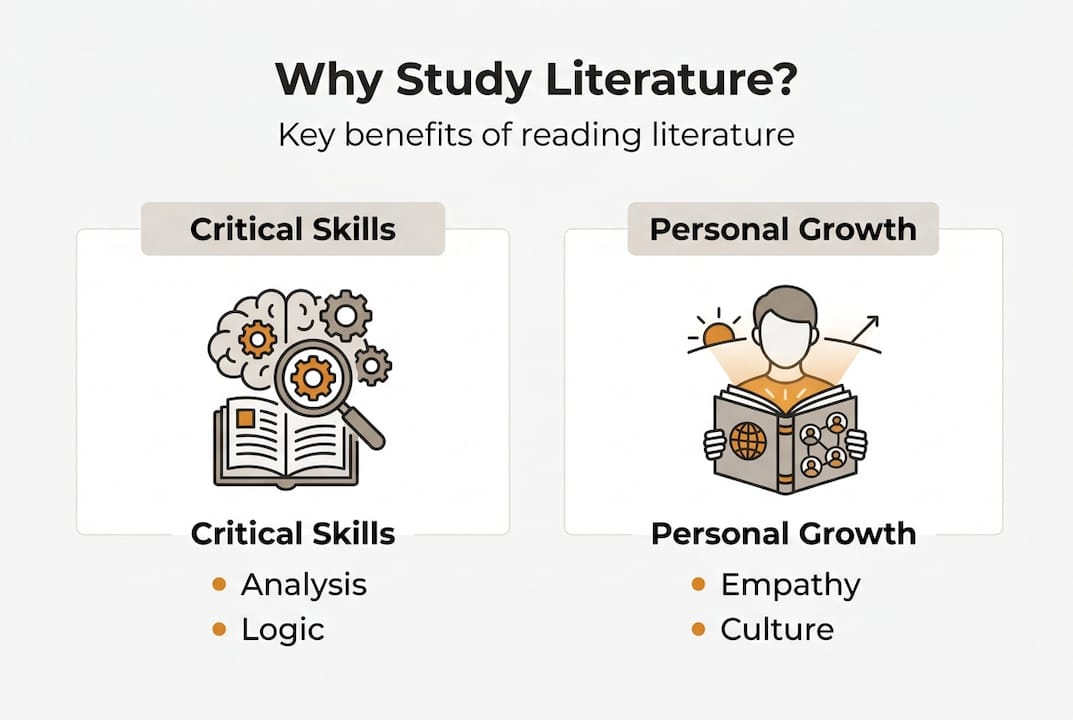
The classic literature benefit extends far beyond the classroom. Literature study evidence consistently shows that engaging with complex narratives enhances thinking, empathy, and cultural awareness in measurable ways.
How literature sharpens critical thinking skills
Critical thinking is not a single skill. It is a cluster of abilities: interpreting what you read, analysing how arguments are constructed, evaluating the reliability of claims, and synthesising ideas from multiple sources. Literature practises all of these simultaneously.
When you read a novel or a poem, you are not simply absorbing information. You are asking why a character behaves a certain way, what the author's choices reveal about their worldview, and whether the text's assumptions hold up under scrutiny. Studying literature develops critical thinking skills by requiring analysis of complex texts, themes, and narratives, directly enhancing analytical abilities and problem-solving.
Here is a practical four-step framework you can apply to any text:
- Interpret: What is the text literally saying, and what might it mean beneath the surface?
- Analyse: How does the author use structure, language, and imagery to create meaning?
- Evaluate: Are the arguments or portrayals convincing? What are their limitations?
- Synthesise: How does this text connect to others you have read, or to real-world events?
Regular literary study is linked to a 43% increase in analytical ability, a gain that transfers directly into academic performance across disciplines. Mastering critical reading is one of the most transferable skills you can develop, and building educational reading lists around diverse genres accelerates that growth considerably.
Pro Tip: Keep a reading journal where you jot down one question per chapter. Over time, you will notice your questions becoming sharper and more nuanced, which is a reliable sign that your critical thinking is developing.
Literature's role in building empathy and emotional intelligence
Empathy is frequently cited as one of literature's headline benefits, and the intuition behind that claim is sound. Spending hours inside a character's perspective, feeling their fears and motivations, does seem likely to make you more attuned to other people's inner lives.
The evidence, however, deserves a careful look. Literature fosters empathy by allowing readers to experience diverse perspectives, emotions, and human conditions through characters and stories from different backgrounds. Yet empirical studies show mixed results on literature's causal impact on empathy. Correlational evidence links fiction reading to better social cognition, but some experiments find no significant effect.
What does this mean in practice? It means the outcome depends partly on how you read, not just what you read.
| Reading approach | Likely empathy outcome |
|---|---|
| Passive reading for plot | Minimal empathy development |
| Reflective journalling after reading | Moderate to strong gains |
| Structured classroom discussion | Strong gains, especially for perspective-taking |
| Character analysis with worksheets | Consistent improvement in social cognition |
"The reader who pauses to ask 'why does this character feel this way?' is doing the cognitive work that builds genuine empathy."
Pro Tip: After finishing a chapter, write three sentences from the antagonist's point of view. This simple exercise forces perspective-taking in a concrete, practised way. Exploring literature and society through structured empathy classroom techniques makes the difference between passive reading and genuine emotional growth.
Expanding cultural horizons through literature
One of literature's most underrated powers is its ability to transport you, without a passport, into radically different worlds. Reading Chinua Achebe's Things Fall Apart places you inside Igbo society at the moment of colonial disruption. Jane Austen's novels reveal the rigid social codes of Regency England. Haruki Murakami's fiction immerses you in contemporary Japanese urban life with its particular blend of solitude and surrealism.

Literature enhances cultural understanding by exposing readers to various historical periods, societies, and global viewpoints, genuinely broadening worldview in ways that travel guides simply cannot replicate.
| Text | Author | Cultural window |
|---|---|---|
| Things Fall Apart | Chinua Achebe | Pre-colonial and colonial Nigeria |
| Pride and Prejudice | Jane Austen | Regency-era English society |
| Norwegian Wood | Haruki Murakami | 1960s Tokyo and Japanese grief culture |
| One Hundred Years of Solitude | Gabriel García Márquez | Colombian history and magical realism |
| Americanah | Chimamanda Ngozi Adichie | Nigerian and African-American identity |
Engaging with world literature examples like these builds cross-cultural empathy that is increasingly valuable in a globally connected world. The lasting impact of literature lies partly in this capacity to make the unfamiliar feel human and recognisable. Understanding the literary canon also helps you see whose voices have historically been centred and whose have been marginalised, which is itself a form of critical awareness.
- Reading across cultures reduces unconscious bias by exposing you to fully realised human beings from different backgrounds.
- Global texts challenge the assumption that your own cultural norms are universal.
- Historical literature reveals how societies have changed, and how much they have stayed the same.
Practical outcomes: literature's value in education and careers
Students sometimes worry that studying literature is a luxury they cannot afford in a competitive job market. The data suggests otherwise. Literature study equips transferable skills for careers in communication, media, law, and more, and employers actively value these capabilities for the critical intelligence they represent.
Think about what a literature degree actually trains you to do:
- Construct arguments: You learn to build a case from evidence, anticipate counterarguments, and write persuasively.
- Communicate clearly: Explaining complex ideas in accessible language is a skill honed through years of essay writing.
- Read critically: You become adept at spotting assumptions, biases, and rhetorical strategies in any document.
- Adapt quickly: Engaging with texts from wildly different periods and genres builds intellectual flexibility.
- Collaborate thoughtfully: Seminar discussions teach you to listen, respond, and build on others' ideas.
These capabilities matter in journalism, publishing, law, policy, marketing, education, and virtually any role that involves communication or persuasion. Developing strong literature review skills is also directly applicable to academic research across disciplines. Meanwhile, the rise of ebooks in education means that access to literary texts has never been easier or more affordable, removing one of the traditional barriers to wide reading.
For lifelong learners, the career argument matters less than the personal one. Literature builds emotional intelligence, expands vocabulary, and offers a structured way to engage with ideas that purely factual reading rarely provides.
The lasting case for studying literature
Pull back from the individual benefits and a larger picture emerges. Literature does not just make you a better student or a more employable graduate. It shapes the kind of person you become.
Here are the core reasons the case for literature remains as strong as ever:
- It develops character: Engaging with moral complexity in fiction builds the habit of ethical reflection.
- It sustains curiosity: Great literature always raises more questions than it answers, keeping intellectual life alive.
- It builds community: Shared texts create shared reference points, enabling richer conversation across generations.
- It preserves memory: Literature carries the lived experience of people and societies that would otherwise be lost.
- It empowers individuals: Critical literacy, the ability to read the world as well as the word, is a form of genuine power.
"For lifelong learners, literature offers emotional intelligence, vocabulary growth, and cultural bridges, with university programmes emphasising global texts and scholarly inquiry."
Global institutions from Harvard to local reading groups affirm literature's place in modern education precisely because its benefits compound over time. The more you read with genuine attention, the richer each subsequent reading becomes. Revisiting literature's enduring value through the lens of lifelong learning literature programmes shows that this is not nostalgia. It is a well-evidenced investment in human flourishing.
Explore literature with us
If this guide has sparked your curiosity, the natural next step is finding the right resources to keep that momentum going. BibliOWLteca exists precisely for readers and learners like you.

On BibliOWLteca, you will find a growing catalogue of e-books, curated reading guides, and educational content created by expert authors and educators from around the world. Whether you want to explore world literature, sharpen your analytical skills, or find structured reading programmes that fit your schedule, the platform brings everything together in one place. Creators on BibliOWLteca publish directly to a global audience, which means you get access to fresh, diverse perspectives that mainstream publishers often overlook. Start exploring today and let your reading life grow in directions you have not yet imagined.
Frequently asked questions
Does studying literature really improve my critical thinking?
Yes. Analysing literary texts builds reasoning, evaluation, and interpretation skills that transfer directly to academic and professional contexts.
Is there proof that reading fiction increases empathy?
Research shows a strong correlation between fiction reading and social cognition, but empirical studies show mixed results on whether fiction directly causes greater empathy.
How does literature help in my future career?
Literature sharpens communication, argumentation, and analytical skills. Transferable skills for careers in media, law, education, and communication are all developed through sustained literary study.
Can literature help me understand different cultures?
Absolutely. Reading global texts introduces you to diverse histories, beliefs, and societies. Literature enhances cultural understanding by exposing readers to historical periods and global viewpoints they would not otherwise encounter.
Do employers value literature degrees?
Yes. Employers across many sectors look for adaptable thinkers with strong communication and analysis skills, and literature study equips graduates with exactly those capabilities.