
Many readers assume the literary canon is a fixed list of important books, a universal syllabus carved in stone by past authorities. This misconception overlooks the canon's true nature as a dynamic, contested collection of works deemed culturally and educationally valuable. The literary canon shapes what we read, study, and preserve, yet it remains subject to ongoing debate and revision. Understanding what the canon is, how it forms, and why it sparks controversy reveals much about cultural power, representation, and the evolving nature of literary value in 2026.
Table of Contents
- What is the literary canon and how is it defined?
- How is the literary canon formed and why is it dynamic?
- Controversies and criticisms surrounding the literary canon
- What do these debates mean for readers and literature today?
- Explore literature with BibliOWLteca
Key takeaways
| Point | Details |
|---|---|
| Definition and criteria | The canon comprises works selected for literary merit, innovation, cultural significance, and lasting influence. |
| Dynamic institutional process | Scholars, educators, and anthologies shape the canon through evolving societal values and academic priorities. |
| Representation controversies | Traditional canons face criticism for Eurocentric, male-dominated bias, prompting alternative counter-canons. |
| Multiple competing canons | Feminist, postcolonial, and culturally specific canons coexist, enriching literary discourse and challenging exclusivity. |
| Ongoing relevance | The canon preserves heritage whilst adapting to contemporary values, requiring critical engagement from readers. |
What is the literary canon and how is it defined?
The literary canon is a curated set of works considered authoritative, valuable, and essential within a culture. Rather than a simple reading list, it represents a cultural consensus about which texts deserve preservation, study, and transmission across generations. The canon functions as a standard against which other works are measured, shaping educational curricula, critical discussions, and cultural memory itself.
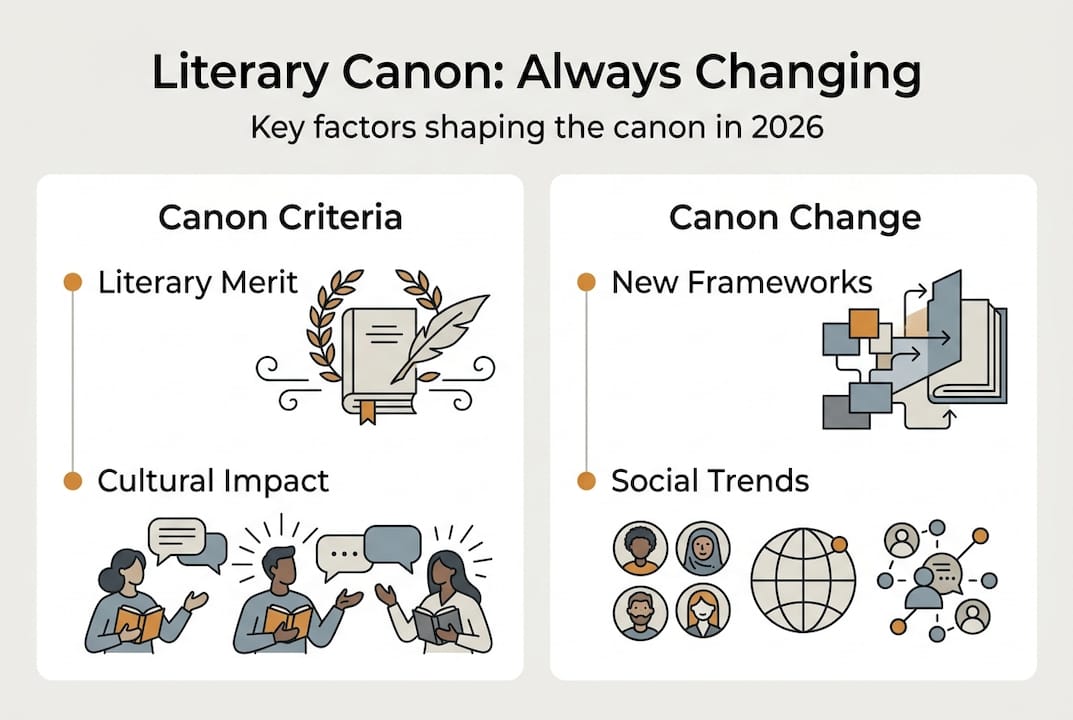
Canon formation involves criteria such as literary merit, cultural significance, influence, and longevity. These standards determine which works earn canonical status. Literary merit encompasses formal innovation, aesthetic achievement, and technical mastery. Cultural significance reflects a work's ability to capture or shape the values, conflicts, and experiences of its time. Influence measures how a text inspires subsequent writers, critics, and readers. Longevity demonstrates enduring relevance across changing historical contexts.
Consider Joyce's Ulysses, celebrated for revolutionising narrative technique through stream of consciousness and intertextual complexity. Its formal innovation secured canonical status despite initial controversy. Homer's Iliad exemplifies longevity, remaining culturally vital for nearly three millennia through its exploration of honour, mortality, and human conflict. These works anchor the Western canon because they meet multiple criteria simultaneously.
The canon serves several crucial functions:
- Establishes educational standards for literature programmes worldwide
- Provides a shared reference point for critical discourse and scholarly debate
- Preserves cultural heritage and collective memory across generations
- Shapes publishing decisions, translation priorities, and resource allocation
Understanding the canon helps readers navigate literary history and recognise which voices have shaped cultural conversations. Exploring classic books checklist 2026 reveals how canonical works continue influencing contemporary education.
"The canon represents not merely a collection of great books, but a cultural argument about what deserves remembering, studying, and preserving for future generations."
This definition highlights the canon's dual nature as both literary achievement and cultural power structure. Recognising this complexity enables more critical engagement with canonical and non-canonical works alike.
How is the literary canon formed and why is it dynamic?
The process is dynamic and institutional, shaped by scholars, educators, anthologies, and changing societal values. Canon formation occurs through multiple overlapping mechanisms rather than centralised decree. University syllabi, critical editions, literary anthologies, and prize committees all contribute to elevating certain works whilst marginalising others. This institutional process reflects broader cultural priorities at specific historical moments.
Several factors influence canonical shifts over time:
- Societal value changes prompt reassessment of works previously dismissed or overlooked
- Historical contexts shift, revealing new relevance in forgotten texts
- Academic movements like feminism and postcolonialism challenge established hierarchies
- Institutional priorities evolve as universities diversify curricula and research agendas
- Publishing industry decisions affect which works remain accessible and visible
- Digital technologies enable rediscovery and dissemination of marginalised voices
Computational analyses are now used to benchmark literariness using measurable features such as sentence length and lexical diversity. These quantitative methods complement traditional qualitative assessments, offering objective data about stylistic complexity and innovation. Whilst computational approaches cannot replace human judgement, they provide evidence for claims about literary distinctiveness.
The canon's fluidity becomes apparent when examining historical shifts. Victorian readers considered certain sensation novels vulgar, yet modern scholars recognise their cultural significance and formal innovation. Charlotte Perkins Gilman's The Yellow Wallpaper languished in obscurity until feminist critics championed its psychological depth and critique of patriarchal medicine. Such rediscoveries demonstrate how canonical status depends partly on critical attention and institutional support.

Pro Tip: Recognise that today's canonical works may shift as society evolves and new critical frameworks emerge, making literary value historically contingent rather than absolute.
Understanding library trends 2026 reveals how digital platforms democratise access to both canonical and marginalised texts, potentially accelerating canon revision.
This dynamic nature means the canon remains perpetually under construction. What appears settled and authoritative in one generation may face challenge and transformation in the next, reflecting broader cultural negotiations about value, identity, and memory.
Controversies and criticisms surrounding the literary canon
Western canon dominates with prioritisation of male, Eurocentric authors, revealing systematic bias in canonical selection. Traditional canons overwhelmingly feature white, male, European and North American writers, marginalising women, people of colour, and non-Western voices. This imbalance reflects historical power structures rather than inherent literary merit, raising fundamental questions about whose stories deserve preservation and study.
Key criticisms of the traditional canon include:
- Exclusion of women writers despite substantial literary achievement
- Marginalisation of African, Asian, Latin American, and Indigenous authors
- Privileging of elite, educated perspectives over working-class and folk traditions
- Emphasis on metropolitan centres whilst ignoring regional and rural voices
- Reinforcement of colonial hierarchies through language and subject matter preferences
Multiple competing canons exist such as feminist and postcolonial counter-canons. These alternative formations challenge exclusionary practices by centring previously marginalised voices. Feminist canons recover women's writing across centuries, revealing rich traditions obscured by patriarchal gatekeeping. Postcolonial canons prioritise authors from formerly colonised regions, offering perspectives that contest Eurocentric narratives.
| Canon Type | Primary Focus | Representative Authors | Cultural Function |
|---|---|---|---|
| Traditional Western | Male European/American classics | Shakespeare, Dickens, Hemingway | Preserves dominant cultural heritage |
| Feminist | Women's literary achievement | Woolf, Morrison, Atwood | Recovers marginalised female voices |
| Postcolonial | Non-Western perspectives | Achebe, Rushdie, Adichie | Challenges Eurocentric narratives |
| Queer | LGBTQ+ experiences | Baldwin, Lorde, Winterson | Centres sexual and gender diversity |
The "canon wars" of recent decades reflect these tensions, pitting defenders of traditional standards against advocates for greater inclusion. These debates extend beyond academic circles, influencing school curricula, publishing priorities, and cultural policy. Understanding classic literature impact requires acknowledging both canonical works' achievements and their limitations.
"The question is not whether we should have a canon, but whose canon, reflecting which values, preserving which voices, and serving which communities."
This perspective reframes canonical debates as ongoing cultural negotiations rather than battles over fixed standards. Recognising multiple canons enriches literary discourse whilst challenging assumptions about universal value and timeless greatness.
What do these debates mean for readers and literature today?
Canon preserves heritage but risks bias; ongoing revisions ensure relevance to contemporary society and education. Understanding the canon as both cultural inheritance and power structure empowers readers to engage critically with literary traditions. This dual awareness enables appreciation for canonical achievements whilst recognising their limitations and exclusions.
Readers benefit from canonical awareness in several ways:
- Recognising how literary reputations reflect institutional power rather than purely aesthetic merit
- Appreciating historical context that shaped both canonical works and their reception
- Identifying gaps and silences that reveal whose voices were excluded or suppressed
- Developing critical reading skills that question authority and challenge assumptions
Exposure to multiple canons broadens cultural awareness and enriches literary experience. Reading across traditional, feminist, postcolonial, and other canons reveals diverse perspectives on universal themes whilst highlighting culturally specific concerns. This multiplicity challenges readers to question their assumptions about literary value and cultural importance.
Practical steps for engaging with diverse canons include:
- Seeking works by authors from different cultural, geographical, and social backgrounds
- Balancing canonical classics with contemporary and rediscovered voices
- Reading critical introductions that contextualise works within their historical moments
- Joining reading groups or online communities that explore varied literary traditions
- Supporting publishers and platforms that amplify marginalised voices
Pro Tip: Deliberately explore texts from different canons to enrich your literary perspective and challenge inherited biases about what constitutes great literature.
Developing critical reading skills 2026 enhances ability to navigate canonical and non-canonical works with sophistication. Critical readers recognise that literary value emerges through complex interactions between texts, readers, institutions, and historical contexts rather than existing as inherent property.
The canon's ongoing revision reflects broader cultural evolution. As societies become more diverse and interconnected, literary canons adapt to represent wider ranges of experience and perspective. This process continues in 2026, with digital platforms enabling unprecedented access to global literary traditions whilst academic institutions reassess curricula to reflect contemporary values.
Engaging thoughtfully with canonical debates enriches reading practice and deepens cultural understanding. Rather than accepting or rejecting the canon wholesale, informed readers navigate its complexities, appreciating achievements whilst advocating for greater inclusion and representation.
Explore literature with BibliOWLteca
Navigating the complexities of literary canons becomes easier with the right resources. BibliOWLteca provides a comprehensive platform for readers and educators seeking diverse literary content in 2026. Whether you're exploring traditional classics or discovering counter-canonical voices, the platform offers curated collections that reflect multiple literary traditions.

Educators benefit from access to educational materials that support teaching across varied canons, whilst literary enthusiasts discover works beyond mainstream selections. The platform's global reach enables exploration of international literature, supporting the kind of diverse reading practice that enriches cultural understanding. Explore classic books checklist 2026 to begin building a reading practice that honours tradition whilst embracing contemporary voices and perspectives.
Frequently asked questions
What is the difference between the literary canon and popular literature?
The literary canon consists of works deemed authoritative and culturally significant by scholars, educators, and institutions, whilst popular literature achieves mass appeal through contemporary readership. Canonical works typically endure across generations, maintaining relevance through changing historical contexts, whereas popular literature often reflects current trends and tastes. Some overlap exists, as certain popular works eventually gain canonical status through sustained critical attention and cultural influence.
How has the literary canon changed in recent decades?
The canon has expanded significantly to include more women writers, authors of colour, and voices from previously marginalised communities. Cultural studies, feminist theory, and postcolonial scholarship have driven reassessment of traditional hierarchies, recovering forgotten works and challenging Eurocentric bias. Despite progress, debates continue about representation, with ongoing efforts to diversify curricula and publishing priorities reflecting the canon's dynamic nature.
Can there be multiple literary canons?
No single universal canon exists; instead, multiple canons coexist, each reflecting specific cultural values, historical contexts, and community priorities. Different educational systems, national traditions, and scholarly communities recognise varied canonical formations. This plurality enriches literary discourse by enabling diverse perspectives and challenging assumptions about universal standards, demonstrating that literary value emerges through cultural negotiation rather than absolute criteria.
Why do some works leave the canon whilst others enter?
Canonical status shifts as critical attention, institutional priorities, and societal values evolve over time. Works may lose prominence when their themes become less culturally relevant or when critical frameworks reveal limitations previously overlooked. Conversely, rediscovered texts gain canonical status through scholarly advocacy, curricular inclusion, and recognition of previously undervalued contributions. This fluidity reflects the canon's responsiveness to changing cultural needs and perspectives.
How does the literary canon affect what gets published and taught?
Canonical status significantly influences publishing decisions, translation priorities, and educational curricula worldwide. Publishers invest in editions, adaptations, and critical materials for canonical works, ensuring their continued availability and visibility. Educational institutions structure literature programmes around canonical texts, shaping what students read and how they understand literary history. This institutional power perpetuates certain voices whilst marginalising others, making canon revision crucial for equitable representation.