
Most people see literature as entertainment or academic material, yet its influence runs far deeper into the fabric of society. Literature shapes how we understand others, preserves cultural memory, and challenges our assumptions about right and wrong. This article explores literature's multifaceted impact on empathy development, educational outcomes, cultural preservation, and moral reasoning. You will discover evidence-based insights into how narrative engagement affects social cognition, why literary study remains vital despite institutional pressures, and practical ways educators can harness literature's power. We address conflicting research findings and offer actionable guidance for literature enthusiasts and educators alike.
Table of Contents
- Key Takeaways
- How literature fosters empathy and moral sensitivity
- Literature's contribution to education and language development
- Preserving culture and shaping societal values through literature
- Nuances and critiques of literature's societal impact
- Explore more about literature's impact with BibliOWLteca
- Frequently asked questions
Key Takeaways
| Point | Details |
|---|---|
| Empathy through literature | Reading fiction can enhance empathy and social understanding, though effects are modest and develop gradually. |
| Cultural preservation and values | Literature preserves cultural memory and shapes moral values despite institutional debates. |
| Education and language gains | Engagement with literature supports educational outcomes and strengthens language development, particularly in literacy and comprehension. |
| Ethics and cultural emphasis | Educators should foreground literature's ethical and cultural roles rather than focusing solely on instrumental skills. |
How literature fosters empathy and moral sensitivity
Literature functions as a moral laboratory where readers experiment with ethical dilemmas without real-world consequences. When you immerse yourself in a character's perspective, you practise understanding motivations, emotions, and social contexts different from your own. This engagement builds what psychologists call theory of mind, the ability to recognise that others hold beliefs and desires distinct from yours. Psychological research demonstrates that fiction reading correlates with enhanced empathy and social cognition, though the effects are modest and develop gradually.
The mechanisms behind empathy development involve two key processes: transportation and identification. Transportation occurs when you become absorbed in a narrative world, temporarily setting aside scepticism and analytical distance. During these moments, your emotional responses mirror those of characters, creating vicarious experiences that expand your emotional repertoire. Identification happens when you adopt a character's perspective, seeing events through their eyes and feeling aligned with their goals. Literary fiction particularly excels at triggering these processes because it often features psychologically complex characters facing ambiguous moral situations.
Foregrounding, a literary technique that disrupts conventional language patterns, enhances these effects by demanding active cognitive engagement. When authors use unconventional syntax, metaphors, or narrative structures, you must slow down and process meaning more deliberately. This effortful reading strengthens the connection between aesthetic appreciation and emotional understanding. Research on literature's lasting impact shows that challenging texts produce deeper engagement than straightforward narratives.
Pro Tip: Focus on literary fiction rather than genre fiction when seeking empathy benefits. Literary works typically feature nuanced character psychology and moral ambiguity, whilst popular fiction often relies on stereotypes and clear-cut ethical boundaries.
The empathy literature cultivates extends beyond individual interactions to societal understanding. Reading about characters from different cultures, historical periods, or social positions exposes you to worldviews you might never encounter otherwise. A Victorian novel reveals assumptions about class and gender that shaped an entire era. Contemporary fiction from marginalised communities offers insider perspectives on experiences often misrepresented in mainstream discourse. These encounters don't automatically produce empathy, they require reflection and openness, but they create opportunities for expanding your moral imagination.
Consider these key benefits of literature for moral development:
- Exposure to diverse ethical frameworks challenges cultural assumptions
- Practice resolving moral dilemmas builds ethical reasoning skills
- Emotional engagement with fictional suffering cultivates compassion
- Witnessing consequences of choices informs real-world decision making
- Ambiguous narratives develop tolerance for moral complexity
Literature's contribution to education and language development
Literature transforms language learning from mechanical skill acquisition into meaningful cultural engagement. Students who participate in literature-based programmes show significantly stronger reading comprehension growth compared to those using conventional textbooks. The impact of literature circles on second language learners proves particularly striking, with effect sizes reaching 0.8 standard deviations, a substantial improvement by educational research standards.
| Grade level | Reading growth with high literature use | Reading growth with low literature use | Difference |
|---|---|---|---|
| Grades 3-5 | 2.3 years equivalent | 1.6 years equivalent | 0.7 years |
| Grades 6-8 | 1.9 years equivalent | 1.3 years equivalent | 0.6 years |
| Grades 9-12 | 1.5 years equivalent | 0.9 years equivalent | 0.6 years |
These gains stem from literature's ability to bridge the gap between academic exercises and authentic reading experiences. When you read a novel, you encounter language in context, complete with cultural references, idiomatic expressions, and stylistic variations that textbooks sanitise away. This exposure builds vocabulary, grammatical intuition, and discourse competence simultaneously. Students report valuing literature primarily for these instrumental language benefits, though educators often emphasise socio-emotional outcomes more heavily.
Implementing literature effectively in educational settings requires structured approaches that balance freedom and guidance. Follow these steps to maximise learning outcomes:
- Select texts that match students' reading levels whilst offering slight challenge and cultural relevance
- Establish literature circles where small groups discuss assigned readings using defined roles
- Foster open-ended discussion that explores multiple interpretations rather than seeking single correct answers
- Assess growth through varied methods including written responses, presentations, and comprehension measures
- Connect literary themes to students' lived experiences and contemporary issues
Pro Tip: Encourage diverse literary selections spanning genres, time periods, and cultural origins to support broader language competence and cultural awareness.
The critical reading benefits extend beyond language mechanics to analytical thinking. Literature demands interpretation, asking you to infer character motivations, identify themes, and evaluate narrative reliability. These skills transfer to other domains, improving your ability to analyse arguments, detect bias, and synthesise information from multiple sources. Students who regularly engage with complex literature develop metacognitive awareness, recognising when they don't understand and deploying strategies to construct meaning.

Literature also increases reading motivation by offering enjoyment alongside learning. Whilst textbooks present information for retention, novels invite emotional investment in characters and plots. This engagement creates positive associations with reading that extend beyond classroom requirements. Students who discover pleasure in literature often become lifelong readers, continuing to develop language skills and cultural knowledge long after formal education ends.
Preserving culture and shaping societal values through literature
Literature serves as a cultural archive, recording stories, traditions, and values that define communities across generations. National literatures particularly function as repositories of collective identity, capturing historical moments, social conflicts, and evolving norms. When you read Shakespeare, you access Elizabethan worldviews. When you encounter postcolonial fiction, you engage with perspectives shaped by imperial histories. This archival function ensures cultural continuity even as societies transform rapidly.
Beyond preservation, literature actively shapes societal values by prompting critical reflection on accepted norms. Dystopian novels question political systems. Social realist fiction exposes injustice. Experimental works challenge aesthetic conventions. These interventions don't dictate values directly but create spaces for readers to examine assumptions and consider alternatives. Critical perspectives suggest that literature's value lies partly in this capacity for moral questioning, offering what philosophers call negative capability, the ability to dwell in uncertainty without rushing to conclusions.
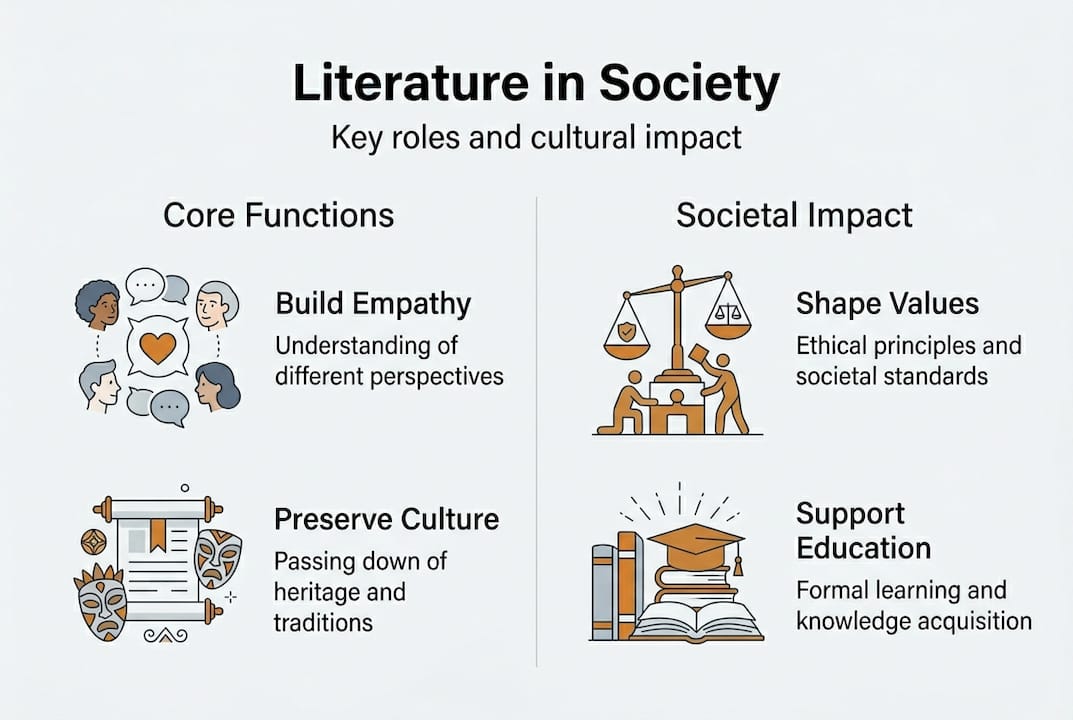
| Literature's societal roles | Institutional challenges |
|---|---|
| Archives cultural narratives and traditions | Risk of political instrumentalisation for ideological purposes |
| Builds national identity through shared stories | Declining institutional support in education systems |
| Promotes critical thinking about norms | Pressure to demonstrate measurable outcomes |
| Preserves linguistic heritage | Competition from digital media formats |
| Facilitates intergenerational dialogue | Debates over canon composition and representation |
The tension between literature's cultural value and institutional pressures reflects broader debates about humanities education. Critics argue that literature departments increasingly prioritise activism over aesthetic appreciation, reducing complex works to vehicles for contemporary political messages. Defenders counter that literature has always engaged with social issues and that excluding marginalised voices impoverishes cultural understanding. These disagreements highlight genuine challenges in balancing tradition with inclusivity, aesthetic merit with social relevance.
Several factors sustain literature's societal value despite these challenges:
- Aesthetic pleasure provides intrinsic motivation for engagement across generations
- Traditional canonical works offer shared cultural reference points
- Ethical reflection through narrative remains uniquely powerful
- Language preservation depends on continued literary production
- Educational systems still recognise literature's formative role
Literature's influence on societal values operates gradually through accumulated reading experiences rather than single transformative encounters. You internalise perspectives, question assumptions, and refine judgements over years of engagement with diverse texts. This slow accretion of cultural knowledge shapes your worldview in ways difficult to measure but nonetheless profound. The importance of literary canon debates reflects this understanding that literary traditions influence societies across generations.
Contemporary literature continues evolving to address current concerns whilst maintaining connections to tradition. Climate fiction explores environmental crises. Autofiction blurs memoir and invention. Global anglophone literature challenges Western literary dominance. These developments demonstrate literature's ongoing vitality as a cultural form, adapting to new contexts whilst preserving core functions of storytelling, meaning-making, and value transmission.
Nuances and critiques of literature's societal impact
Research on literature's effects reveals a more complex picture than enthusiastic advocates sometimes acknowledge. Whilst correlational studies link fiction reading with enhanced empathy, experimental interventions show that short-term reading assignments often produce no measurable changes in social cognition. This discrepancy suggests that empathy development requires sustained engagement rather than brief exposure, or that selection effects explain the correlation, people already inclined toward empathy choose to read more fiction.
Methodological challenges complicate efforts to establish causation. Randomised controlled trials struggle to replicate the conditions under which people naturally read, absorbed attention over extended periods. Laboratory studies using brief excerpts may fail to trigger the transportation and identification processes that drive empathy effects. Self-report measures of empathy face validity concerns, as socially desirable responding can inflate scores. These limitations don't invalidate literature's value but caution against overstating empirical support for specific claims.
Sceptics raise several important concerns about literature's societal role:
- Empathy effects may be overgeneralised from limited evidence
- Literary study risks becoming subsumed to political activism
- Institutional irrelevance threatens literature's cultural position
- Measurable outcomes fail to capture literature's true value
- Selection bias confounds research on reading and social skills
The humanities crisis, marked by declining enrolments and programme closures, reflects broader questions about literature's place in contemporary society. Some attribute this decline to internal factors, excessive politicisation, theoretical obscurity, or disconnection from public interests. Others point to external pressures, neoliberal education policies prioritising vocational training, funding cuts favouring STEM fields, or cultural shifts toward visual and interactive media. Both explanations likely hold partial truth, suggesting that revitalising literary study requires addressing pedagogical approaches and institutional contexts.
Pro Tip: Recognise literature's value as long-term cultural heritage beyond immediate empirical effects. The absence of short-term measurable outcomes doesn't negate literature's profound influence on individuals and societies over extended engagement.
Balancing optimism about literature's potential with realistic assessment of evidence produces a nuanced understanding. Literature offers unique opportunities for empathy development, cultural preservation, and moral reflection, but these benefits accrue gradually and depend on how people engage with texts. Passive reading produces minimal effects. Active interpretation, emotional investment, and reflective discussion amplify impact. Educational approaches should therefore emphasise quality of engagement over quantity of reading.
The endurance of literature despite technological and cultural changes testifies to its enduring appeal. Humans remain storytelling creatures who seek meaning through narrative. Literature satisfies this need whilst offering aesthetic pleasure, intellectual stimulation, and emotional connection. Its societal role may shift as contexts change, but the fundamental human desire for stories ensures literature's continued relevance.
Explore more about literature's impact with BibliOWLteca
Understanding literature's societal roles enriches your appreciation of why reading matters beyond entertainment or academic requirements. BibliOWLteca supports creators and educators who share this commitment to literature's cultural and educational significance. Our platform enables you to access curated content exploring literary empathy, critical reading strategies, and the enduring value of canonical works.

Whether you're an educator seeking resources for literature-based instruction or an enthusiast wanting deeper engagement with literary culture, BibliOWLteca provides the tools and content to enhance your journey. Explore our blog for insights into literature's lasting impact and practical guidance on mastering critical reading in contemporary contexts. Join a community committed to preserving and promoting literature's vital societal contributions.
Frequently asked questions
What is the role of literature in fostering empathy?
Literature immerses readers in diverse perspectives and moral dilemmas, encouraging emotional connection with characters facing complex situations. This engagement develops theory of mind and emotional understanding gradually through sustained reading rather than single encounters.
How does literature contribute to education beyond language skills?
Literature teaches cultural values, ethical reasoning, and citizenship alongside reading proficiency by presenting authentic language use in meaningful contexts. It bridges academic exercises and leisure reading, boosting motivation whilst developing analytical thinking and interpretive skills.
Can reading fiction improve social skills and empathy quickly?
Short-term reading interventions typically produce no immediate measurable changes in empathy or social cognition. Empathy development through literature requires sustained engagement over extended periods, with effects accumulating gradually rather than appearing suddenly.
Why is literature considered important for preserving culture?
Literature records stories, traditions, and values essential to collective identity, serving as a cultural archive that maintains heritage across generations. It captures historical moments and social contexts that might otherwise be lost, ensuring continuity even as societies transform rapidly.