
Many researchers and students mistakenly believe a literature review is simply a summary of what they have read. In reality, it is a sophisticated analytical tool that synthesises existing research, identifies gaps, and builds the foundation for original scholarly work. An effective literature review requires systematic methodology, critical evaluation, and thoughtful synthesis to transform scattered sources into coherent arguments. This guide will walk you through understanding what literature reviews truly are, the different approaches you can take, and practical steps to conduct reviews that strengthen your research and academic credibility.
Table of Contents
- What is a literature review and why it matters
- Types of literature reviews: systematic versus narrative
- How to conduct an effective literature review: a step-by-step framework
- Common pitfalls and best practices for successful literature reviews
- Explore expert resources to master your literature review
- Frequently asked questions
Key takeaways
| Point | Details |
|---|---|
| Literature reviews synthesise research | They critically analyse and integrate existing studies to support new investigations and reveal knowledge gaps |
| Systematic reviews reduce bias | Following structured protocols like PRISMA ensures transparency and reproducibility in the review process |
| Avoid summary-only approaches | Effective reviews synthesise findings into coherent arguments rather than listing sources sequentially |
| Organisation reveals gaps | Strategic structuring helps identify research opportunities and builds persuasive academic arguments |
| Quality demands time and reflection | Rigorous literature reviews require careful planning, critical thinking, and documented methodology |
What is a literature review and why it matters
A literature review represents the systematic identification, evaluation, and synthesis of research relevant to your specific question or topic. It forms the intellectual foundation for original research by mapping existing knowledge, identifying gaps, and demonstrating how your work will contribute to the field. Unlike a simple summary or annotated bibliography, a literature review synthesises sources to create new understanding and reveal patterns across studies.
The distinction between summary and synthesis is crucial. A summary restates what individual sources say, whilst synthesis combines insights from multiple sources to generate fresh perspectives. Think of summary as listing ingredients and synthesis as explaining how those ingredients interact to create a dish. This analytical depth separates undergraduate work from postgraduate scholarship.
Literature reviews serve multiple essential functions in academic research. They validate your research question by demonstrating its relevance to ongoing scholarly conversations. They contextualise your methodology by showing how other researchers have approached similar problems. They establish your credibility by proving you understand the field comprehensively. Most importantly, they identify gaps where your research can make meaningful contributions.
The academic benefits of well-executed literature reviews include:
- Demonstrating research quality through rigorous engagement with existing scholarship
- Building persuasive arguments by synthesising evidence from multiple authoritative sources
- Creating coherence by showing logical connections between disparate studies
- Identifying specific gaps that justify your research focus and methodology
- Preventing duplication by revealing what has already been investigated thoroughly
Many researchers struggle because they treat literature reviews as passive reading exercises rather than active analytical processes. Effective reviews require you to question assumptions, compare methodologies, evaluate evidence quality, and construct arguments about what the collective body of research reveals. This critical engagement transforms you from a consumer of research into a contributor to scholarly knowledge. Understanding why reading critically matters helps develop the analytical skills necessary for sophisticated literature reviews.
Types of literature reviews: systematic versus narrative
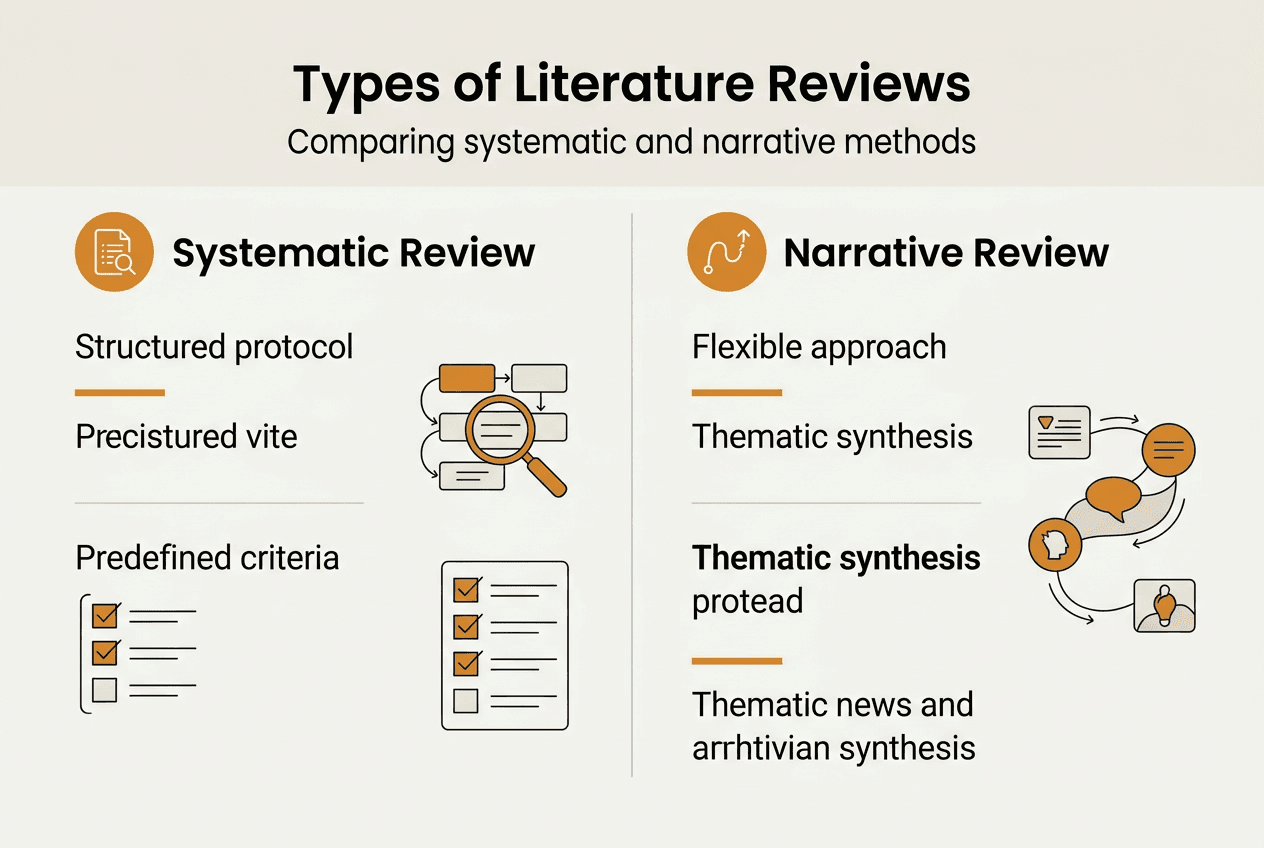
Researchers can choose between two primary approaches when conducting literature reviews, each suited to different research goals and contexts. Systematic literature reviews employ rigorous protocols to minimise bias and ensure transparency, whilst narrative reviews offer flexible synthesis with historical and conceptual depth.
Systematic literature reviews follow predetermined protocols that specify search strategies, inclusion criteria, quality assessment methods, and data extraction procedures. These reviews aim for reproducibility, meaning another researcher following your documented process should identify the same studies and reach similar conclusions. Systematic reviews often use frameworks like PRISMA (Preferred Reporting Items for Systematic Reviews and Meta-Analyses) to structure their methodology. They work particularly well for evidence-based practice questions where you need to synthesise quantitative findings across multiple studies.

Narrative literature reviews take a more interpretive approach, synthesising existing research to provide critical overviews of subjects within their historical and theoretical contexts. These reviews allow greater flexibility in source selection and analysis, making them ideal for exploring conceptual developments, theoretical debates, or emerging fields where systematic protocols might be too restrictive. Narrative reviews excel at theory development and identifying broader patterns in how fields have evolved.
| Aspect | Systematic review | Narrative review |
|---|---|---|
| Methodology | Structured protocol with predetermined criteria | Flexible approach guided by research questions |
| Purpose | Minimise bias, synthesise evidence objectively | Provide critical overview with contextual depth |
| Search strategy | Comprehensive, documented, reproducible | Selective, expert-guided, contextual |
| Quality assessment | Formal appraisal using standardised tools | Critical evaluation based on scholarly judgement |
| Best for | Evidence synthesis, meta-analysis, clinical questions | Theory development, conceptual exploration, emerging fields |
Choosing between approaches depends on your research question and disciplinary norms. Systematic reviews suit questions requiring evidence aggregation across similar studies, particularly in health sciences, education research, and social policy. Narrative reviews work better for theoretical questions, historical analyses, or fields where heterogeneous methodologies make systematic comparison difficult.
Pro Tip: Some sophisticated reviews combine elements of both approaches, using systematic search strategies to ensure comprehensive coverage whilst employing narrative analysis to explore theoretical implications and contextual nuances.
Developing critical reading skills enhances your ability to evaluate sources regardless of which review type you choose. Understanding how to identify literature gaps becomes easier when you recognise the strengths and limitations of different review methodologies.
How to conduct an effective literature review: a step-by-step framework
Conducting a rigorous literature review requires systematic methodology and careful documentation at every stage. Research frameworks provide structured approaches for search strategy, inclusion criteria, quality assessment, and data extraction, whilst simplified six-step models help narrow topics and focus searches effectively.
Follow this comprehensive framework to conduct your literature review:
-
Define your scope and research questions clearly. Articulate precisely what you want to understand, which populations or contexts interest you, and what types of evidence will answer your questions. Narrow questions produce focused reviews, whilst broad questions risk becoming unmanageable.
-
Develop a comprehensive search strategy. Identify relevant databases for your discipline, create lists of keywords and synonyms, use Boolean operators to combine search terms effectively, and document every decision. Include grey literature sources like conference proceedings, dissertations, and government reports alongside peer-reviewed journals.
-
Apply transparent inclusion and exclusion criteria. Establish clear rules for which sources qualify based on publication date, methodology, language, geographic scope, or other relevant factors. Document why you include or exclude each source to ensure reproducibility and reduce bias.
-
Assess source quality systematically. Evaluate methodology rigour, sample sizes, potential conflicts of interest, and theoretical frameworks. Not all published research deserves equal weight in your synthesis. Critical appraisal separates robust findings from questionable claims.
-
Extract data methodically. Create standardised forms to record key information from each source including research questions, methodologies, findings, limitations, and implications. Consistent data extraction enables systematic comparison and synthesis across studies.
-
Synthesise findings and write your review. Organise sources thematically rather than chronologically or alphabetically. Identify patterns, contradictions, and gaps across studies. Build arguments about what the collective evidence reveals rather than summarising individual sources sequentially.
Effective organisation proves crucial when managing dozens or hundreds of sources. Reference management software like Zotero, Mendeley, or EndNote helps track sources, generate citations, and organise materials thematically. Create detailed notes immediately after reading each source rather than relying on memory later. Develop a coding system to tag sources by themes, methodologies, or findings for easier retrieval during writing.
Pro Tip: Document every methodological decision in a research log as you work. Record which databases you searched, what terms you used, how many results appeared, and why you included or excluded specific sources. This documentation ensures reproducibility and helps you write the methodology section of your review.
Critical thinking and reflexivity must permeate every stage. Question your own assumptions about what constitutes good evidence. Recognise how your disciplinary training influences which sources you value. Consider alternative interpretations of findings. Acknowledge limitations in your own review process. This intellectual honesty strengthens rather than weakens your work.
Artificial intelligence tools can assist with literature management when used ethically. AI can help identify relevant sources, summarise lengthy articles, or spot patterns across studies. However, you must verify all AI-generated content, maintain critical judgement about source quality, and ensure your analysis remains your own intellectual work. AI assists human scholarship but cannot replace the critical thinking that defines quality literature reviews.
Applying effective book selection strategies helps you prioritise which sources deserve detailed attention. Learning to organise research materials systematically prevents the chaos that derails many literature review projects.
Common pitfalls and best practices for successful literature reviews
Even experienced researchers fall into predictable traps that undermine literature review quality. Understanding these pitfalls helps you avoid them whilst implementing best practices that elevate your work to publication standards.
The laundry list approach represents the most common error. This mistake involves listing sources sequentially with brief summaries rather than synthesising them into coherent arguments. Research shows over 60% of reviews fail to synthesise effectively, creating fragmented narratives that fail to advance understanding. Synthesis requires you to compare findings across studies, identify patterns and contradictions, and construct arguments about what the collective evidence means.
Additional common errors include:
- Unclear research objectives that produce unfocused reviews covering too much ground superficially
- Inadequate search strategies that miss relevant sources or rely too heavily on easily accessible materials
- Ignoring grey literature like dissertations, conference papers, and technical reports that contain valuable findings
- Poor organisational structures that group sources arbitrarily rather than building logical arguments
- Insufficient critical evaluation that accepts published findings at face value without questioning methodology or bias
- Lack of explicit gap identification that fails to show where research remains needed
Unclear objectives and inadequate strategies particularly reduce review quality by creating directionless compilations rather than purposeful analyses.
Best practices for producing high-quality literature reviews include:
- Formulate precise research questions before beginning your search to maintain focus throughout the process
- Develop reproducible search strategies that another researcher could follow to identify the same sources
- Document every methodological decision including database selections, search terms, and inclusion criteria
- Conduct critical analysis that evaluates source quality, identifies methodological limitations, and questions assumptions
- Structure arguments thematically to reveal patterns and build towards clear conclusions about gaps and implications
- Practice reflexivity by acknowledging your own biases and how they might influence source selection or interpretation
- Allocate sufficient time for multiple revision rounds as synthesis often requires rethinking organisational structures
Reflexivity deserves particular emphasis. Your disciplinary training, theoretical preferences, and research experiences shape how you interpret sources and construct arguments. Acknowledging these influences strengthens rather than weakens your work by demonstrating intellectual honesty and self-awareness. Consider how different theoretical lenses might interpret the same findings differently. Question whether your conclusions reflect the evidence or your preconceptions.
Literature reviews that synthesise effectively and identify clear gaps consistently produce higher-impact research. They demonstrate scholarly maturity, justify research directions convincingly, and contribute meaningfully to advancing knowledge in their fields.
Structuring your review to build coherent narratives requires strategic thinking about how themes connect. Rather than treating each theme as an isolated section, show how they relate to create a comprehensive picture. Use transitions that highlight connections between ideas. Build towards conclusions about what the evidence collectively reveals and where research remains needed.
Understanding why bibliographies matter for credibility reinforces the importance of rigorous citation practices. Learning systematic cataloguing approaches helps you organise sources effectively throughout the review process.
Explore expert resources to master your literature review
Conducting sophisticated literature reviews requires ongoing skill development and access to quality guidance. BibliOWLteca offers comprehensive resources designed specifically for researchers and students working to master literature review methodologies. Our platform connects you with expert literature review resources including detailed guides, methodological frameworks, and practical tools for managing complex research projects.

Whether you need help developing systematic search strategies, organising large numbers of sources, or synthesising findings into coherent arguments, our research project support materials provide the structured guidance that transforms good reviews into excellent ones. Explore our curated collection of resources to strengthen your research skills and produce literature reviews that meet the highest academic standards.
Frequently asked questions
What distinguishes a literature review from a summary?
A literature review synthesises multiple sources to create new understanding and identify patterns, whilst a summary simply restates what individual sources say. Reviews analyse relationships between studies, evaluate methodological quality, and build arguments about collective findings. Summaries remain descriptive without critical analysis or integration across sources.
How long does a comprehensive literature review typically take?
Systematic literature reviews often require three to six months depending on scope, whilst narrative reviews may take six weeks to three months. Time requirements vary based on research question breadth, source availability, your familiarity with the field, and whether you work independently or collaboratively. Quality reviews cannot be rushed as synthesis requires reflective thinking.
What are systematic and narrative literature reviews?
Systematic reviews follow structured protocols with predetermined search strategies, inclusion criteria, and quality assessments to minimise bias and ensure reproducibility. Narrative reviews take flexible approaches that synthesise research within historical and theoretical contexts, allowing greater interpretive depth. Choose systematic reviews for evidence synthesis and narrative reviews for conceptual exploration.
How do I avoid common pitfalls in literature reviews?
Avoid the laundry list approach by synthesising sources thematically rather than summarising them sequentially. Establish clear research questions before searching to maintain focus. Document your methodology thoroughly for reproducibility. Critically evaluate source quality rather than accepting findings uncritically. Allocate sufficient time for multiple revision rounds as synthesis often requires restructuring.
Why is documenting the search process important?
Documentation ensures reproducibility, allowing other researchers to verify your findings by following the same process. It demonstrates methodological rigour to reviewers and readers. It helps you track decisions and avoid duplicating searches. It provides material for writing the methodology section of your review. Thorough documentation distinguishes scholarly reviews from casual surveys of literature.