
Despite widespread assumptions that literature is fading in relevance amid the rise of digital media and changing reading habits, the truth is far more nuanced. Literary works continue to shape our understanding of the human condition, foster empathy, and provide frameworks for navigating complex social and personal challenges. This article explores the multifaceted reasons behind literature's endurance, examining its cultural, psychological, and educational roles. Readers interested in the enduring relevance of literature will discover why these works persist across generations and how they remain vital to students, educators, and literary enthusiasts today.
Table of Contents
- Key Takeaways
- How literature imposes order and evolves over time
- Literature's role in cultivating empathy, knowledge, and democratic values
- How literature builds resilience and supports mental health
- Debates on literature's relevance amid digital challenges and cultural shifts
- Explore more with Bibliowlteca
- FAQ
Key Takeaways
| Point | Details |
|---|---|
| Empathy through reading | Reading fiction allows us to inhabit other perspectives and develop emotional understanding across diverse contexts. |
| Playability and adaptability | Stories maintain core meaning while adapting to modern contexts, allowing readers to imagine futures and test outcomes. |
| Cognitive scaffolding | Literature provides cognitive scaffolding that helps people rehearse experiences, make sense of complexity, and build shared understanding. |
| Enduring relevance across generations | Literature continues to matter across generations, influencing education, culture and democratic engagement. |
How literature imposes order and evolves over time
At the heart of literature's persistence lies a fundamental human need: the desire to make sense of experience. Life presents us with chaos, randomness, and overwhelming complexity. Stories provide structure, creating coherent narratives that help us understand our world and our place within it. This capacity to impose order on chaos and enable playability explains why certain narratives survive across centuries whilst others fade.
Narrative coherence matters because it allows stories to evolve without losing their essential meaning. When we retell a myth or adapt a classic novel, we maintain the core structure whilst adjusting details to fit contemporary contexts. This adaptability makes stories what researchers call "playable", meaning we can use them to imagine possible futures and test different outcomes mentally. The Odyssey remains compelling not because every detail resonates with modern readers, but because its exploration of homecoming, identity, and perseverance translates across cultures and eras.
Consider how fairy tales transform across retellings. Cinderella exists in hundreds of versions worldwide, each adapted to local values and circumstances, yet the fundamental narrative about transformation and recognition persists. This evolution demonstrates literature's remarkable flexibility. Stories that survive do so because they contain enough structural integrity to remain recognisable whilst allowing sufficient variation to stay relevant. Epic poems, foundational myths, and canonical novels all share this quality of coherent adaptability.
The playability of stories extends beyond entertainment. When you engage with reading classic literature benefits, you're not merely absorbing information but actively constructing meaning by connecting narrative patterns to your own experiences. This interactive quality keeps literature vital across changing technological and cultural landscapes.
"Stories endure because they provide cognitive scaffolding, allowing us to rehearse experiences, anticipate challenges, and build shared understanding across communities and generations."
Pro Tip: Consider how your favourite stories adapt when shared in different contexts to see this process in action. Notice which elements remain constant and which shift to reflect contemporary values.
Literature's role in cultivating empathy, knowledge, and democratic values
Beyond structural coherence, literature persists because it performs essential social functions that no other medium replicates quite as effectively. When you read a novel, you temporarily inhabit another consciousness, experiencing the world through perspectives radically different from your own. This cognitive and emotional exercise builds empathy in ways that abstract instruction cannot match. Research confirms that literary study survives repeated crises precisely because it emphasises this transformative potential alongside knowledge acquisition and democratic value.
Empathy development through literature operates on multiple levels. Surface level engagement with characters creates emotional connections, but deeper reading reveals systemic patterns, historical contexts, and ethical dilemmas that challenge readers to reconsider assumptions. A novel set in a different era or culture doesn't just present facts about that setting; it invites you to feel what it might be like to navigate that world, complete with its constraints, opportunities, and moral complexities.
Knowledge gained through literature differs qualitatively from information acquired through expository texts. When you master critical reading, you learn to recognise how narratives construct meaning, how language shapes perception, and how cultural assumptions influence interpretation. These metacognitive skills transfer across domains, enhancing your ability to analyse arguments, evaluate evidence, and communicate effectively.
Literature's contribution to democratic values deserves particular attention. Democratic societies require citizens capable of understanding diverse viewpoints, engaging in reasoned debate, and recognising the humanity of those with whom they disagree. Literary engagement cultivates precisely these capacities. Here's how literature supports democratic participation:
- Empathy development enables recognition of shared humanity across difference
- Knowledge acquisition provides historical and cultural context for contemporary issues
- Ethical reflection encourages consideration of values, consequences, and moral complexity
- Critical thinking develops analytical skills essential for evaluating claims and arguments
- Cultural preservation maintains collective memory and shared reference points for dialogue
These benefits explain why library trends 2026 continue to emphasise literary collections and reading programmes despite budget pressures and competing priorities. Institutions recognise that literature serves functions beyond entertainment or cultural prestige.
"The resilience of literary study across repeated institutional and cultural crises demonstrates its unique capacity to foster the empathy, knowledge, and democratic values essential for functioning societies."
How literature builds resilience and supports mental health
Literature's psychological significance extends beyond cognitive benefits to tangible mental health outcomes. Both classic and contemporary works model human perseverance through adversity, providing readers with frameworks for understanding and navigating their own challenges. This isn't merely inspirational; research demonstrates that bibliotherapy reduces depressive symptoms and PTSD whilst enhancing empathy and self-efficacy through structured literary engagement.

The mechanism operates through multiple pathways. When you read about characters confronting hardship, you observe coping strategies, emotional regulation, and problem-solving approaches that you can adapt to your own circumstances. This vicarious experience provides psychological distance that makes difficult subjects more approachable. Trauma narratives, for instance, allow readers to process difficult emotions in a contained, manageable format rather than being overwhelmed by direct experience.
Bibliotherapy, the clinical use of literature for therapeutic purposes, has gained recognition as an evidence-based intervention. Mental health professionals use carefully selected texts to help patients explore feelings, recognise patterns, and develop new perspectives on their situations. This approach proves particularly effective for long-term depression and post-traumatic stress, conditions that often resist conventional talk therapy alone.
| Aspect | Traditional reading | Bibliotherapy |
|---|---|---|
| Primary goal | Entertainment, education, cultural enrichment | Targeted mental health improvement and symptom reduction |
| Text selection | Personal preference, curriculum requirements | Clinically matched to patient needs and therapeutic goals |
| Engagement method | Independent or group discussion | Guided by therapist with structured reflection exercises |
| Outcome measurement | Subjective enjoyment, knowledge gain | Clinical assessment of symptoms, coping skills, self-efficacy |
| Duration | Ongoing, lifelong practice | Time-limited, goal-oriented intervention |
The mental health benefits of literary engagement include:
- Reduction in depressive symptoms through emotional processing and perspective-taking
- Decreased PTSD symptoms via safe exploration of trauma narratives
- Enhanced empathy and social cognition through character identification
- Increased self-efficacy by observing diverse coping strategies and outcomes
- Improved emotional regulation through vicarious experience of complex feelings
- Strengthened resilience by recognising universal patterns of struggle and recovery
These benefits complement traditional mental health interventions, offering accessible support that doesn't require clinical settings or professional facilitation. Regular reading provides ongoing psychological maintenance, much as physical exercise supports bodily health. Understanding credible bibliographies helps readers select quality texts for both personal enrichment and therapeutic benefit.
Pro Tip: Engage with literature intentionally to enhance psychological well-being, not just for leisure. Select texts that address themes relevant to your current challenges, and take time to reflect on how characters' experiences relate to your own circumstances.
When conducting a literature review guide for academic or professional purposes, researchers frequently discover unexpected connections between literary themes and contemporary psychological research, further validating literature's mental health contributions.
Debates on literature's relevance amid digital challenges and cultural shifts
Despite compelling evidence for literature's enduring value, significant debates continue about its role in contemporary society. Digital media presents genuine competition to traditional reading habits, with streaming services, social media, and interactive entertainment claiming attention previously devoted to books. These technological shifts raise legitimate questions about how literary culture adapts and survives.
One central debate contrasts literature's instrumental value with its transformative potential. The instrumental view emphasises practical skills: literacy, vocabulary, analytical thinking, and communication abilities that literary study develops. This perspective justifies literature primarily through measurable outcomes and transferable competencies. The transformative view, conversely, argues that literature's essential value lies in ethical development, empathy cultivation, and cultural enrichment that resist quantification.
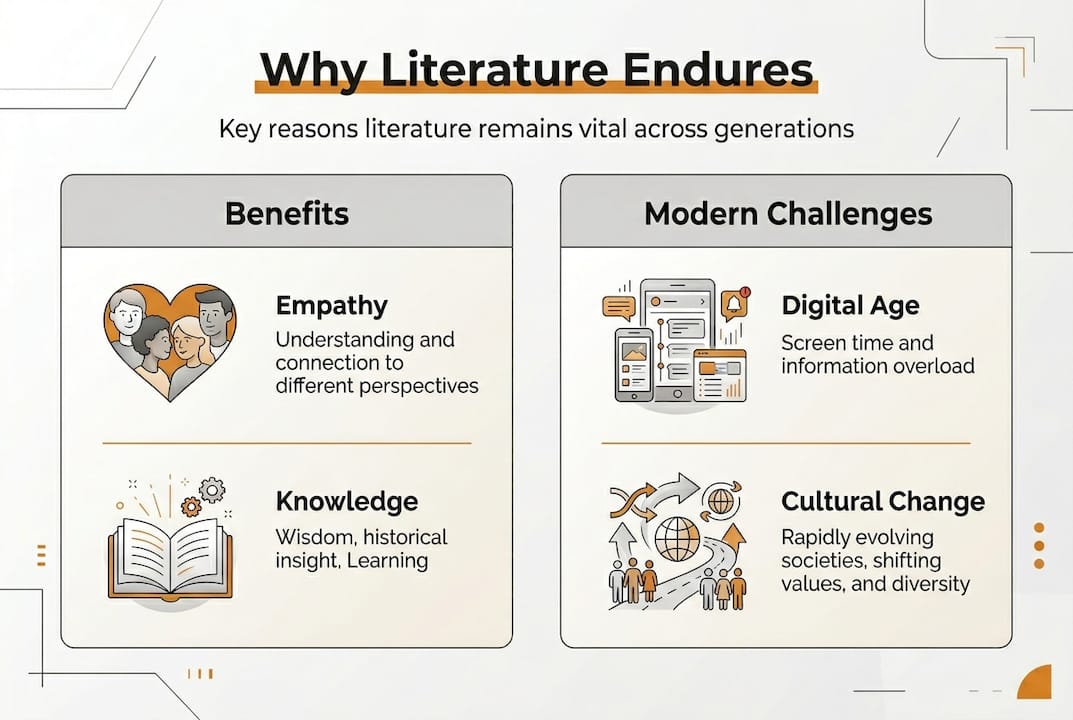
Another contentious issue involves the literary canon itself. Traditional arguments maintain that canonical texts endure for universal truths despite debates on expansion or irrelevance amid digital decline. Critics counter that "universal" often masks culturally specific assumptions, and that expanding the canon to include diverse voices better serves contemporary readers. This tension between preservation and innovation shapes curriculum decisions, publishing priorities, and cultural conversations about literary value.
Key debate points include:
- Cultural heritage preservation versus contemporary relevance and accessibility
- Competition from digital media requiring new approaches to literary engagement
- Canon inclusivity balancing traditional texts with diverse, representative voices
- Educational priorities weighing practical skills against humanistic development
- Institutional support for literary study amid funding pressures and changing student interests
These debates aren't merely academic. They influence which books schools teach, which authors publishers promote, and which literary traditions receive institutional support. Understanding classic literature relevance requires grappling with these tensions rather than dismissing them.
Approaches to sustain literature in the digital age include:
- Embrace diversity by expanding canons to reflect global perspectives and marginalised voices
- Leverage digital tools that enhance rather than replace literary engagement through audiobooks, e-readers, and online discussion communities
- Emphasise critical literacy that helps readers navigate information ecosystems and evaluate narrative construction
- Foster lifelong reading through community programmes, book clubs, and accessible library services
- Balance canon and innovation by maintaining foundational texts whilst incorporating contemporary works that speak to current concerns
These strategies recognise that literature's survival depends on adaptation without abandonment of core values. The literature gap concept helps researchers and educators identify where existing scholarship falls short, guiding efforts to make literary study more inclusive and relevant.
Digital challenges also present opportunities. E-books make literature more accessible across geographic and economic barriers. Online communities connect readers globally, creating discussion spaces that transcend local limitations. Multimedia adaptations introduce classic works to new audiences who might later engage with original texts. Rather than viewing digital culture as literature's enemy, forward-thinking educators and institutions explore how technology can support literary engagement.
Explore more with Bibliowlteca
Understanding why literature endures is just the beginning of a deeper engagement with these transformative works. Whether you're a student exploring canonical texts, an educator seeking quality resources, or an enthusiast pursuing personal enrichment, access to curated literary collections makes all the difference. Bibliowlteca offers a rich catalogue of literary works and educational resources designed to support your exploration of literature's lasting impact.

Our platform connects you with creators and educators who share your passion for literature, providing e-books, courses, and digital content that deepen understanding and enjoyment. From classic works to contemporary analyses, you'll find resources that complement your study or personal reading journey. The global reach of our platform means you can access diverse perspectives and voices that enrich your literary experience beyond local availability.
Pro Tip: Use Bibliowlteca's curated selections to complement your study or personal reading journey, exploring both foundational texts and contemporary scholarship that illuminates their continued relevance.
FAQ
Why does literature remain important today?
Literature endures because it reflects fundamental human experiences that transcend specific historical moments, fostering empathy by allowing readers to inhabit diverse perspectives. It provides cognitive frameworks for understanding complexity, builds resilience through modelling perseverance, and supports democratic values by promoting critical thinking and dialogue. These functions remain essential regardless of technological or cultural shifts, ensuring literature's continued relevance for students, educators, and enthusiasts seeking deeper understanding of the human condition.
How does literature help develop empathy?
Reading literary works requires you to temporarily inhabit another consciousness, experiencing the world through characters whose backgrounds, values, and circumstances differ from your own. This cognitive and emotional exercise builds empathy by creating genuine connection with diverse perspectives rather than abstract awareness of difference. The process increases social awareness, enhances ability to recognise others' emotional states, and develops capacity for ethical reasoning that acknowledges complexity and ambiguity in human relationships.
Can reading literature improve mental health?
Bibliotherapy, the clinical use of literature for therapeutic purposes, demonstrates that structured literary engagement reduces symptoms of depression and PTSD whilst enhancing self-efficacy and emotional regulation. Regular reading supports mental health by providing safe spaces to process difficult emotions, observe diverse coping strategies, and recognise universal patterns of struggle and recovery. These benefits complement traditional interventions, offering accessible psychological support that doesn't require clinical settings or professional facilitation for general wellness maintenance.
Is classic literature still relevant in the digital age?
Classic works maintain relevance because they address universal themes of identity, mortality, justice, and human connection that remain meaningful across eras, even as specific cultural contexts shift. Digital tools actually enhance engagement with these texts through accessible formats, global discussion communities, and multimedia adaptations that introduce classics to new audiences. The challenge isn't whether classics remain relevant, but rather how we balance traditional canons with diverse voices and contemporary works that speak to current concerns whilst preserving foundational texts that anchor cultural conversations.
What role does literature play in education?
Literature develops critical reading skills, analytical thinking, and communication abilities essential across academic disciplines and professional contexts. Beyond instrumental benefits, literary study cultivates empathy, ethical reasoning, and cultural awareness that prepare students for democratic citizenship and meaningful engagement with diverse communities. Educational institutions recognise these dual functions, using literature both as a tool for developing transferable skills and as a means of fostering humanistic values that resist simple quantification but prove essential for flourishing individuals and societies.