
TL;DR:
- Most course creators learn that platform choice, pricing, and community building are crucial for revenue growth beyond initial expectations.
- Success depends on strategic diversification, audience engagement, and adapting to AI-driven industry shifts, not just quality content.
- Building a loyal community and maintaining flexibility allow creators to thrive despite platform changes and niche saturation.
Most course creators enter the market expecting passive income and global reach, only to discover that the average Udemy creator earns just $2,950 per year while top performers on dedicated platforms clear $37,000 or more. The gap is not about talent or content quality. It comes down to strategy: which platform you choose, how you price your products, whether you build an audience before you launch, and how quickly you adapt to a rapidly changing industry. This article walks you through every layer of building a profitable course business in 2026, from platform selection and pricing models to community building and future-proofing against AI disruption.
Table of Contents
- Understanding the course creator landscape
- Choosing your platform: Comparing top options for 2026
- Monetisation models: Pricing strategies, bundles, and recurring revenue
- The role of audience and community in long-term success
- Navigating future trends: AI, niche innovation, and international scaling
- A fresh perspective: Why the best course creators win with community and adaptability
- Start scaling your course business with the right marketplace
- Frequently asked questions
Key Takeaways
| Point | Details |
|---|---|
| Market is booming | The online education market is projected to grow to $12.4 billion in 2026, with opportunities for course creators in every niche. |
| Monetisation is dynamic | Combining one-time sales, recurring subscriptions, and bundles leads to higher, more reliable income. |
| Community is essential | Building and engaging an audience boosts conversions and future-proofs against industry changes. |
| Fee structure matters | Marketplace and payment fees can significantly reduce your earnings, so platform selection is key. |
| Adapt to trends | Embracing AI, niche specialisation, and global scaling is crucial for long-term success. |
Understanding the course creator landscape
The term "course creator" covers a wide range of digital entrepreneurs. Some produce video-based online courses in niches like fitness, coding, or finance. Others sell e-books, downloadable templates, mini-courses, or bundled resource packs. Increasingly, the most successful creators diversify across all of these formats, treating their knowledge business like a product catalogue rather than a single offering.
The market backing this industry is substantial. The creator education market was valued at $8.7 billion in 2025 and is projected to reach $12.4 billion in 2026. That trajectory reflects real demand from learners who prefer self-paced, expert-led education over traditional degree programmes. For creators with the right strategy, this growth represents a genuine commercial opportunity, not just a side hustle.
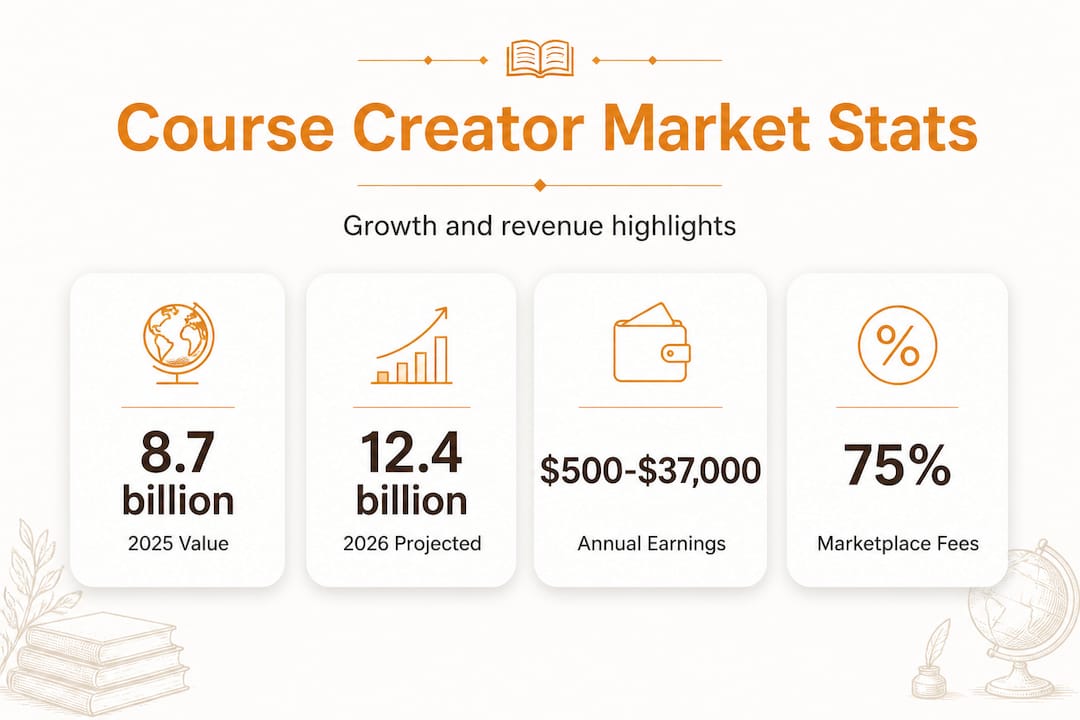
Revenue potential varies significantly depending on niche, platform, and approach. Here is a realistic snapshot:
| Creator tier | Annual revenue range | Notes |
|---|---|---|
| Beginner (marketplace) | $500 to $5,000 | Low visibility, high competition |
| Growing (standalone platform) | $10,000 to $50,000 | Requires audience building |
| Established creator | $50,000 to $250,000 | Recurring revenue, email list |
| Top 10% | $1,000,000+ | Multiple products, partnerships |
The biggest challenges facing course creators right now include market saturation in popular niches, platform fees that erode margins, and the difficulty of reaching international buyers without incurring significant payment processing costs. Understanding these pressures upfront allows you to build a business model that accounts for them from day one rather than discovering them after your first launch.
For those serious about growing long-term, the key is to think beyond a single course and begin scaling your online course business with diversified digital products from the start.
"The creators who struggle are those who treat course creation as a product launch. The ones who succeed treat it as a business they systematically build."
Choosing your platform: Comparing top options for 2026
With an understanding of the landscape and its opportunities, the next step is selecting where to build and sell your course. This decision affects your revenue, your audience ownership, and your long-term flexibility more than almost anything else.
The top platforms for course creators in 2026 include Teachable, Thinkific, Kajabi, Podia, and LearnWorlds. Each has a distinct pricing model, feature set, and audience type. Below is a comparison to help you evaluate your options:
| Platform | Starting price/month | Transaction fee | Key strength |
|---|---|---|---|
| Kajabi | $69 | 0% | All-in-one: email, funnels, community |
| Teachable | $39 | 0% (paid plans) | Easy to use, strong checkout |
| Thinkific | $36 | 0% | Flexible course builder |
| Podia | $33 | 0% | Digital downloads + courses |
| LearnWorlds | $24 | $5 per sale (starter) | Interactive video tools |
Beyond standalone platforms, there are marketplaces like Udemy, Skillshare, and Coursera. These give you built-in traffic but at a steep cost. Marketplace fees typically run between 37% and 75% of revenue, and international payments can add a further 1 to 1.5% on top of that. When you sell a $200 course on a marketplace and receive $50 to $100 back, the economics become very clear very quickly.
Standalone platforms preserve your margins and, crucially, your data. You own your customer email list. You control your pricing. You can run promotions without competing against discounted courses beside yours on the same page.
When deciding which route to take, consider these factors:
- Your existing audience size. If you have fewer than 500 email subscribers, a marketplace may give you early visibility. If you have a list, go standalone immediately.
- Your niche. Highly competitive niches like productivity or social media marketing are difficult to break through on marketplaces. Specialist niches benefit from standalone positioning.
- Your pricing strategy. Premium courses above $500 are almost impossible to sell through discount-heavy marketplaces. They belong on standalone platforms where you control the context.
- International reach. If you are targeting buyers across multiple countries, you need a platform with robust multi-currency support and transparent international fee structures.
A dedicated digital marketplace for educators can bridge the gap, offering discoverability without the punishing fee structures of the largest consumer platforms.
Pro Tip: Start with a standalone platform even if your audience is small. Building on rented land (marketplaces) from day one means you are always one algorithm change away from losing your income stream. Your platform is your business infrastructure, not just a storefront.
Monetisation models: Pricing strategies, bundles, and recurring revenue
Once you have chosen a platform, the next decision is how to structure your pricing and monetisation approach. Most creators default to a single one-time payment, but that leaves significant revenue on the table. The creators consistently earning above $100,000 per year use a layered approach.
Here are the primary monetisation models worth understanding:
- One-time purchase. The simplest model. A student pays a fixed price and receives lifetime access. Works well for focused, high-value courses where the transformation is clear.
- Tiered pricing. Offer a basic package, a mid-tier with extras like templates or workbooks, and a VIP tier with coaching or live calls. A typical structure might be $97 to $197 for basic, up to $997 or more for VIP.
- Subscription or membership. Students pay monthly or annually for ongoing access to content, community, or both. This creates predictable recurring revenue and reduces the pressure of constant launches.
- Bundles. Package multiple courses or digital products together at a discount. Bundles increase your average order value and help buyers who are already engaged with your work to go deeper.
- Upsells and order bumps. Offer a complementary product at checkout. A $297 course might have a $47 workbook as an upsell, which many buyers will take if the value is clear.
- Launch-based selling. Run a structured promotional period two to four times per year, using urgency, bonuses, and live events to drive concentrated sales.
The data on median course pricing shows considerable variation by niche. Business and finance courses typically sit at the higher end of the $110 to $531 range, while creative or lifestyle courses often fall below $200. This matters when you are setting expectations for launch targets.
For creators who want to build a sustainable income rather than chasing perpetual launches, monetising and scaling digital courses through membership models is increasingly the preferred approach. A membership with 300 subscribers paying £39 per month generates over £140,000 annually with relatively predictable cash flow.

The smartest approach to monetising expertise with digital products combines a signature course (one-time purchase) with a membership for ongoing support and a lower-priced entry product like an e-book to bring new buyers into your ecosystem.
Here are some practical monetisation strategies that work particularly well for course creators in 2026:
- Pre-sell your course before you build it. Collect payments and validate demand before investing production time.
- Use a free challenge or live workshop to warm up cold audiences before a launch.
- Set clear upgrade paths so buyers know what their next step is after they complete a course.
Pro Tip: Think of your product suite like a ladder. Your free content (social posts, podcasts, YouTube videos) sits at the bottom. Your entry product, perhaps a £19 e-book, is the first rung. Your signature course sits in the middle. A high-ticket offer or membership sits at the top. Each level should naturally lead to the next. Using monetisation tools for creators that support this full ladder is far more efficient than cobbling together separate tools for each level.
The role of audience and community in long-term success
Even with a well-priced course, your real leverage comes from building a strong audience and engaged community. This is the single biggest predictor of launch success that most new creators underestimate.
The mathematics of course launches are unambiguous. Email list conversion rates for course launches typically run between 1% and 3%. That means to generate $10,000 from a $497 course in a single launch, you need approximately 2,000 engaged subscribers at the lower end of the conversion range. If your list has 200 people, the same launch generates around $1,000 maximum. The size and quality of your audience is the ceiling on your launch revenue.
Community adds another dimension entirely. When buyers move from passive students to active community members, several things happen:
- Retention increases. Members who engage with a community complete courses at higher rates and are far more likely to renew memberships or buy follow-on products.
- Social proof compounds. An active community generates testimonials, case studies, and word-of-mouth referrals without you having to ask.
- Pre-sales become viable. A community lets you test course ideas, gather feedback, and collect pre-sale payments before a single lesson is recorded.
- Churn decreases. Members who feel connected to other learners and to you are far less likely to cancel a subscription.
The AI disruption affecting the industry is also accelerating the value of community. When a student can ask an AI chatbot for information on almost any topic, the information itself becomes a commodity. What AI cannot replicate is accountability, personalised feedback, peer connection, and the sense of belonging that a well-run community provides. This shifts the competitive advantage firmly toward creators who build transformational experiences rather than simply delivering content.
Selling courses globally also becomes far more achievable when you have a community pulling in buyers from different regions through word of mouth, rather than relying solely on paid advertising. Ad costs have risen sharply, and building a scalable store anchored by an organic community provides a more sustainable cost base.
"Your audience is your biggest asset. Your community is your moat. The creator who builds both rarely has to worry about what any single platform or algorithm does next."
Navigating future trends: AI, niche innovation, and international scaling
To future-proof your efforts, it's critical to stay ahead of industry trends and technology shifts that are reshaping what buyers expect and what they are willing to pay for.
Artificial intelligence is the most significant force currently restructuring the course industry. AI disruption is driving demand toward courses that offer transformation, accountability, and community rather than information alone. Courses that essentially serve as curated reading lists or lecture recordings are losing their value proposition rapidly. Buyers have noticed. They are choosing courses that offer coaching, live interaction, peer accountability, and measurable outcomes.
What this means practically for creators:
- Build interactivity into your course structure. Live Q&A sessions, office hours, hot seats, and cohort formats command premium prices and resist the commoditisation that AI accelerates.
- Specialise deeply rather than broadly. A course on "digital marketing" is competing against thousands of alternatives. A course on "LinkedIn lead generation for independent financial advisers" is not. 2026 digital education trends point firmly toward micro-niche specialisation as the route to sustainable margins.
- Offer transformation, not just information. Frame your course around a clear outcome your student achieves, not a curriculum they complete. The outcome is what they are paying for.
- Track your international fees carefully. If you are selling across borders, payment processing charges that include international surcharges of 1 to 1.5% on top of standard fees erode margins considerably at scale. Factor this into your pricing from day one.
International scaling deserves special attention. The course creator market is genuinely global, and some niches perform significantly better in non-English-speaking markets than creators realise. Offering content in additional languages, pricing in local currencies, and partnering with platforms that handle international tax compliance are all practical steps to expanding your addressable market without a proportional increase in your workload.
Pro Tip: Before building a second course for a new topic, explore whether you can serve an adjacent international audience with your existing course. Light localisation, currency flexibility, and local payment methods can open up entirely new revenue streams from content you have already created.
Diversifying beyond courses into related digital products is another strong hedge against platform shifts or niche saturation. E-books, template packs, swipe files, and digital toolkits are lower-cost entry points that attract new buyers into your ecosystem, who then convert to higher-ticket course buyers over time. The creators who treat their business as a diverse digital product catalogue are consistently more resilient than those who depend on a single course for the majority of their income.
A fresh perspective: Why the best course creators win with community and adaptability
Taking all of these lessons together, it is worth challenging some persistent myths about what actually drives success for course creators.
The first myth is that production quality determines revenue. Many creators over-invest in expensive recording equipment, elaborate video editing, and professional course platforms before they have validated demand. The truth is that buyers care about results, not production values. A course recorded on a decent webcam that produces clear, measurable outcomes will outsell a beautifully produced course with a weak promise every time. Spend your first budget on marketing and community building, not on a studio setup.
The second myth is that the right platform will solve your growth problem. Platforms matter, but they are infrastructure, not strategy. Switching from Teachable to Kajabi will not fix low conversion rates if the underlying issue is a weak offer or an unclear promise to buyers. The platform comparison anxiety that keeps creators in a permanent state of tool evaluation is a sophisticated form of procrastination. Choose a platform that fits your budget and audience size, then focus on the things that actually drive revenue.
The third and most damaging myth is that you can build a successful course business with a "set it and forget it" mentality. The creators earning significant income in 2026 are constantly iterating: updating their content in response to student feedback, launching new products to existing buyers, experimenting with pricing and format, and showing up consistently in their community. Digital entrepreneurship in education is not passive. It is an active business that rewards creators who treat it as one.
The most counterintuitive truth in this industry is that smaller, more engaged audiences consistently outperform large, passive ones. A creator with 800 genuinely engaged email subscribers who trust them deeply will frequently outperform a creator with 20,000 cold subscribers on launch day. The quality of your relationship with your audience is a more powerful lever than the size of your following. This is why the creators who build in public, share their processes, and engage meaningfully with their communities tend to sustain their income long after the initial launch excitement fades.
Adaptability is the competitive advantage that no competitor can copy directly. When the market shifts, when AI changes buyer expectations, or when a platform adjusts its algorithm, the creator with a loyal community and a history of rapid iteration is the one who survives and grows.
Start scaling your course business with the right marketplace
You have now got the knowledge to build and grow, but your next step is joining an ecosystem that empowers creators globally rather than working against your margins.
BibliOWLteca is built specifically for course creators and educators who want to sell digital content internationally without surrendering control of their pricing, their audience, or their data. The platform supports multiple currencies, international payments, and tax compliance out of the box, which means you can focus on creating and marketing rather than managing payment processing complexity. Whether you are launching your first e-book, building a flagship course, or assembling a full digital product catalogue, BibliOWLteca provides the infrastructure to grow your digital education business at scale. Visit the platform to explore how it supports creators at every stage, from first product to full catalogue.
Frequently asked questions
What types of content can course creators sell online?
Course creators can sell online courses, e-books, downloadable resources, and digital bundles across many educational content formats, with the most successful creators typically offering products across multiple formats and price points.
How much can you realistically earn as a course creator?
Annual earnings benchmarks range from approximately $2,950 for the average Udemy creator to $37,000 on Kajabi, with the top 10% of creators earning over $1 million per year across their digital product businesses.
What fees do course creators pay to platforms and marketplaces?
Marketplace revenue fees typically range from 37% to 75%, and international payment processing can add a further 1 to 1.5% on top, which is why standalone platforms tend to be more financially efficient for established creators.
Is building a community necessary for successful course launches?
A dedicated community significantly boosts launch conversion rates and pre-sales, particularly as AI continues to lower the perceived value of purely information-based course content without interactivity or accountability.
How is AI impacting the online course industry?
AI is shifting buyer demand toward courses that emphasise transformation, live interaction, and community rather than static knowledge delivery, making experiential and outcome-focused course design a critical competitive advantage in 2026.