
TL;DR:
- The online education market is valued at over 320 billion dollars by 2026, offering lucrative opportunities.
- Validating your course idea through surveys and pre-sales reduces failure risk and builds an eager audience.
- Successful marketing relies on email lists, content marketing, and partnerships to attract and convert students.
The global online education market is valued at over $320 billion in 2026, yet most new course creators never earn meaningful income. Not because their knowledge lacks value, but because they skip the foundational steps that separate profitable educators from frustrated ones. This guide walks you through every stage of the process: validating your idea, choosing the right platform, designing a compelling offer, and marketing it to students worldwide. Whether you are starting from scratch or relaunching an existing course, you will find practical, evidence-based steps to help you build a real online education business.
Table of Contents
- Understand the online course market and your opportunity
- Validate your course idea and build an audience before launching
- Choose your online course platform: marketplace vs self-hosted
- Design, price, and deliver a winning course offer
- Market, sell, and scale your online courses effectively
- What most guides miss about selling online courses
- Take the next step: launch and sell your course globally with BibliOWLteca
- Frequently asked questions
Key Takeaways
| Point | Details |
|---|---|
| Validate demand early | Testing your idea with real people before building is crucial to avoid wasted effort and maximise sales. |
| Choose the right platform | Marketplaces help beginners, while self-hosted options support higher profit and more control as you grow. |
| Build before you launch | Growing your email list and community before launching gives your course the best start. |
| Focus on transformation | Courses that promise and deliver real outcomes sell best, especially as information alone becomes commoditised. |
| Market consistently | Ongoing marketing—email, affiliates, content—drives sustained student enrolment and income. |
Understand the online course market and your opportunity
The scale of the opportunity here is genuinely striking. The e-learning sector is growing at a pace that outstrips most other digital industries, and it shows no signs of slowing. For creators who get the fundamentals right, the rewards can be substantial.
To put this in perspective, top platforms generate hundreds of millions annually, and individual creators are capturing meaningful slices of that revenue. The key insight is that you do not need a massive audience to earn well. You need the right audience, a focused niche, and a course that delivers a clear transformation.
Pricing is one of the most misunderstood levers in course selling. Many new creators underprice their work out of fear, but the data tells a different story. 25% of creators earn over $25k per year, with successful courses often priced around $137. That figure is not a ceiling. Premium and specialist courses regularly command $500 to $2,000 or more per enrolment.
Three factors consistently separate profitable courses from those that stall:
- Audience clarity: Knowing exactly who you serve and what they urgently need
- Niche depth: Specialising rather than trying to teach everything to everyone
- Proof of outcomes: Demonstrating real results your students have achieved
To build a sustainable course business, track these metrics from day one:
- Monthly revenue and revenue per student
- Total student enrolments
- Course completion rates
- Refund rates
- Net Promoter Score (a measure of how likely students are to recommend you)
- Email list growth rate
Here is a snapshot of how the broader market looks for context:
| Metric | Figure |
|---|---|
| Global e-learning market size (2026) | $320 billion+ |
| Average successful course price | ~$137 |
| Top creator annual earnings | $25,000+ |
| Projected annual market growth | 8-10% |
Understanding global digital sales strategies from the outset will help you position your course for international students, not just a local audience. With the opportunity defined, the next step is ensuring you lay foundations for success, starting with validation.
Validate your course idea and build an audience before launching
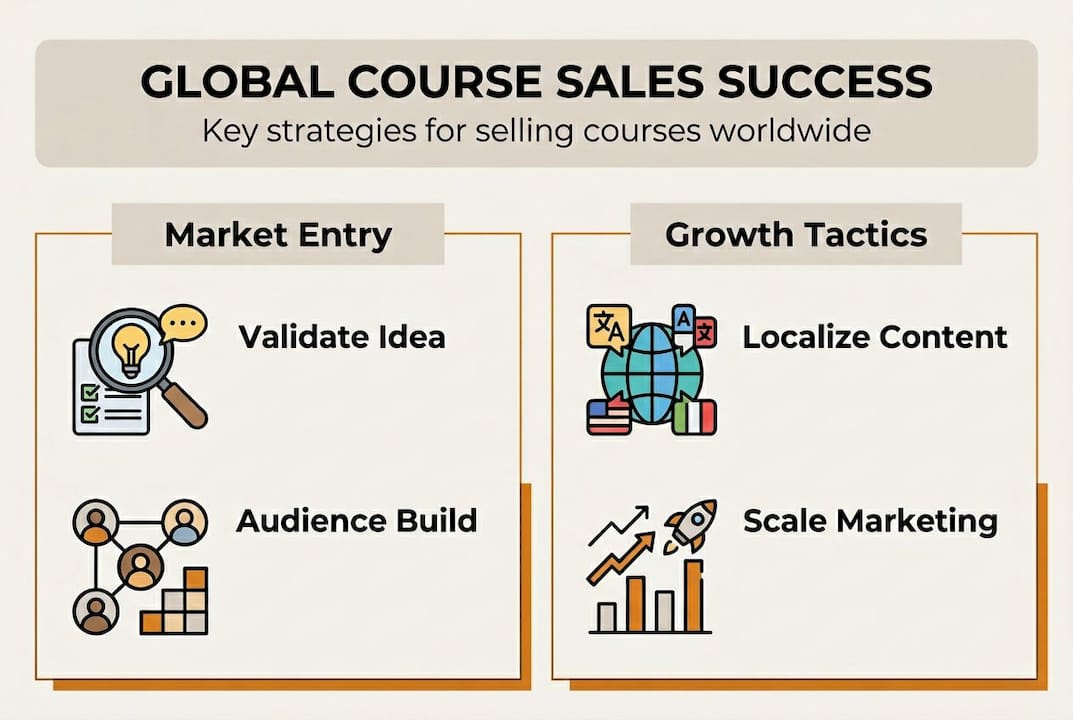
Skipping validation is the single most common reason course launches fail. It feels counterintuitive to spend weeks testing an idea before building anything, but the alternative is far more costly. 92% of creators fail due to lack of topic validation, and pre-selling has been shown to triple conversion rates.
The logic is simple. You can spend three months building a polished course that nobody buys, or you can spend two weeks confirming genuine demand and launch to a waiting list of eager students. The second path is always better.
Here is a step-by-step validation process that works:
- Identify the pain point. Talk to at least 10 people in your target audience. Ask what they are struggling with, what they have already tried, and what a solution would be worth to them.
- Test demand with a survey. Use a simple poll or Google Form to ask your existing network or social media followers which topic they would pay to learn. Specific questions outperform vague ones.
- Run a pilot session. Offer a live workshop, webinar, or short mini-course at a reduced price. This is your proof of concept.
- Collect early testimonials. Even one or two genuine success stories from pilot students dramatically improve your launch conversion rates.
- Pre-sell before you build. Offer founding member pricing to a small group before the full course exists. If people pay, you have validated demand.
Pro Tip: Use a free tool like Typeform or Google Forms to survey your email list or social followers. Ask them to rank three potential course topics by interest. The results will tell you far more than your own instincts.
"Build it and they will come" is the most expensive assumption in online education. Without an audience and validated demand, even the best course will launch to silence.
Key validation steps such as surveys and early pilot offers are consistently recommended by experienced course creators. You should also focus on collecting email addresses throughout this phase. Your email list is your most valuable asset, and building it before launch means you have a warm audience ready when you open enrolments.
If you want to monetise your expertise effectively, validation is not optional. It is the foundation everything else is built on. With a validated idea and a community waiting for your course, it is time to design your offer and choose the right delivery tools.
Choose your online course platform: marketplace vs self-hosted
Platform choice has a direct impact on your earnings, your relationship with students, and your long-term flexibility. The two main options are marketplace platforms and self-hosted platforms, and each suits a different stage of a creator's journey.

Marketplace platforms (such as Udemy or Skillshare) offer built-in audiences and simple setup. You upload your course and the platform handles discovery. The trade-off is significant: fees are high, you rarely own your student data, and pricing is often dictated by the platform. Marketplaces offer discovery but low control, which limits your ability to build a real business around your audience.
Self-hosted platforms give you full ownership of your content, pricing, and student relationships. The setup requires more effort, but the economics are far more favourable at scale.
Pro Tip: Flat-fee self-hosted platforms become the better financial choice once you pass roughly $800 per month in course sales. Below that threshold, a marketplace may help you gain initial traction and early reviews.
Here is a comparison to help you decide:
| Platform type | Fees | Control | Student data | Best for |
|---|---|---|---|---|
| Marketplace | 30-70% revenue share | Low | No | Beginners seeking exposure |
| Self-hosted (subscription) | Flat monthly fee | High | Yes | Established creators scaling revenue |
| Self-hosted (transaction fee) | 2-10% per sale | Medium-high | Yes | Mid-stage creators |
Key factors to weigh when choosing:
- How large is your existing audience?
- Do you want to control your pricing and promotions?
- How important is owning your student email list?
- Are you selling internationally and need multi-currency support?
For a thorough digital marketplace comparison, it helps to look at how different platforms handle international payments and tax compliance. These details matter enormously when you are selling to students in multiple countries.
Building digital storefronts for courses that you own outright gives you the ability to upsell, bundle, and communicate with your students without platform restrictions. If you want to explore the best marketplace platforms available to creators in 2026, it is worth comparing both the fee structures and the tools included. Having chosen the right platform, you are ready to craft and price your high-value online course.
Design, price, and deliver a winning course offer
A great course is not just a collection of videos. It is a structured journey that takes a student from a specific problem to a specific outcome. The clearer that transformation, the easier your course is to sell.
Here is a practical process for building your course:
- Map the transformation. Define the exact before and after state for your student. What do they know, feel, or achieve by the end?
- Break it into modules. Each module should represent one clear step in the journey. Aim for five to eight modules for most courses.
- Rapid prototype first. Record rough versions of your lessons before polishing anything. Get feedback from your pilot students before investing in production quality.
- Write outcome-focused lesson titles. "How to write a compelling headline" outperforms "Lesson 3: Headlines" every time.
- Add proof at every stage. Student testimonials, case studies, and before-and-after results embedded throughout the course reinforce confidence.
Pricing deserves careful thought. The most common mistake is charging too little. Consider these models:
- One-time payment: Simple and high-converting for courses priced under $500
- Payment plans: Splitting a $497 course into three payments of $167 increases accessibility
- Subscriptions: Best for ongoing content libraries or membership communities
- Bundles: Packaging two or more courses together at a discount
Bundles, subscriptions, and payment plans can boost conversions by 20 to 40%, and high-value masterclasses can command hundreds to thousands per seat. Do not leave these options off the table.
Course boosters that significantly increase perceived value and completion rates:
- Private community access (a forum, Slack group, or Discord server)
- Live coaching calls or office hours
- Bonus masterclasses with guest experts
- Downloadable templates and workbooks
- Certificates of completion
Your refund policy also signals confidence. A 30-day money-back guarantee typically increases sales more than it increases refund requests. With your offer ready, the final pillar is successful promotion and ongoing sales growth.
Market, sell, and scale your online courses effectively
Building a great course is only half the work. The other half is getting it in front of the right people, consistently. Most new creators underinvest in marketing and then wonder why sales are slow.
Here is a step-by-step approach to building a reliable sales system:
- Create a lead magnet. Offer a free resource (a checklist, template, or short video) in exchange for an email address. This builds your list and introduces your teaching style.
- Set up a simple email sequence. A five to seven email welcome series that educates, builds trust, and introduces your paid course is the foundation of any effective funnel.
- Run a launch webinar. A live or pre-recorded webinar that teaches something valuable and ends with an offer is one of the highest-converting sales formats available.
- Open and close enrolment. Scarcity and deadlines drive action. Even a simple enrolment window of five to seven days increases urgency.
- Gather and publish testimonials immediately. After your first cohort, collect written and video feedback and use it across all your marketing.
Marketing channels worth prioritising:
- Email marketing: Your list is your most reliable, algorithm-free sales channel
- SEO and content marketing: Long-form blog posts and YouTube videos drive organic discovery
- Affiliate partnerships: Offer a commission to peers who promote your course
- Paid advertising: Facebook and Google ads work well once you have a proven funnel
- Social media: Consistent short-form content builds authority and attracts leads
Email lists, affiliates, SEO, and group sales are the primary revenue drivers for top creators, with group and corporate sales accounting for up to 20% of revenue for the highest earners. B2B sales, where you sell course licences to companies for employee training, is an underused channel that can dramatically increase your average order value.
Pro Tip: Build a simple evergreen funnel where your lead magnet feeds into an automated email sequence that sells your course around the clock. Even a basic version of this system will generate sales while you focus on creating new content.
For guidance on digital publishing and selling courses at scale, it is worth understanding how AI's impact on education is reshaping what students expect from online learning. You now have the complete execution roadmap. Next, let us address what most guides miss.
What most guides miss about selling online courses
Here is the uncomfortable truth that most step-by-step guides avoid: selling online courses is not passive income. It never really was. The easy passive income myth is widespread, but the reality is that ongoing marketing and consistent value delivery are required to sustain and grow a course business.
The creators who earn the most are not the ones with the most polished videos. They are the ones who show up consistently, iterate based on student feedback, and treat their course as a living product rather than a finished artefact.
In 2026, information alone is no longer enough. Students can find answers to almost any question for free. What they are paying for is transformation, accountability, community, and proof that your approach works. If your course does not deliver on those dimensions, no amount of marketing will save it.
"Top course creators win by focusing on outcomes and community, not by chasing the latest tech or platforms."
The most counterintuitive advice from high-earning educators is to pre-sell before you build, partner with other creators to cross-promote, and invest heavily in student results rather than production quality. A course with grainy video and extraordinary student outcomes will outsell a beautifully produced course with mediocre results every time.
Iterate frequently. Survey your students after every cohort. Ask what confused them, what they wished was included, and what they achieved. Use that feedback to improve the next version. This is how creator sales strategies compound over time into a genuinely defensible business.
Take the next step: launch and sell your course globally with BibliOWLteca
You have the knowledge. You have the roadmap. The next step is choosing a platform that removes the technical barriers between your expertise and a global student base.
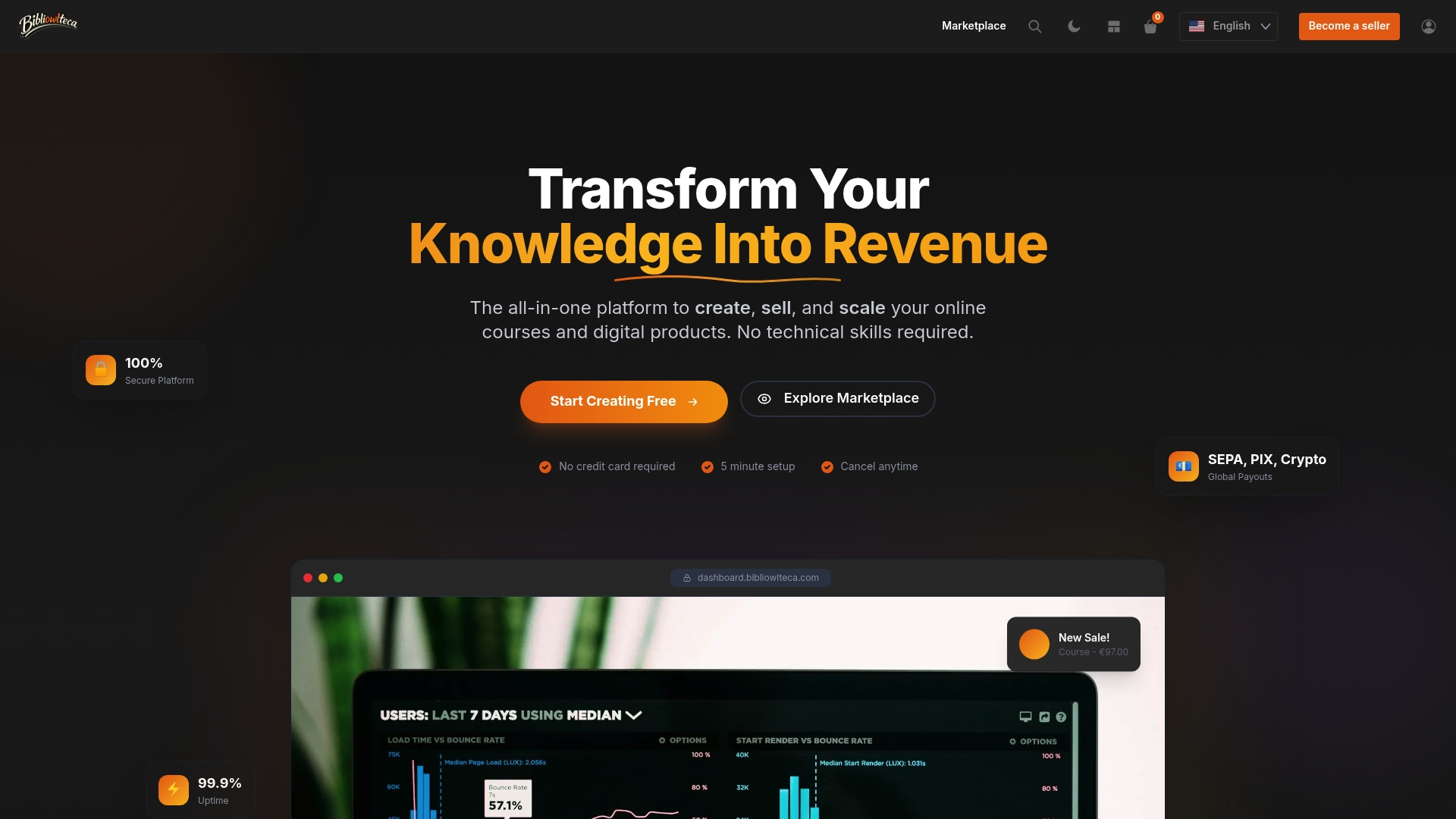
BibliOWLteca is built specifically for creators and educators who want to sell digital products worldwide without the complexity. The platform handles multi-currency payments, international tax compliance, and secure content delivery so you can focus entirely on teaching. Whether you are launching your first course or scaling an existing catalogue, the BibliOWLteca marketplace connects you with learners across the globe. With integrated tools for digital delivery, payment processing, and audience management, BibliOWLteca gives you everything you need to turn your knowledge into a thriving online business. Start building your course store today.
Frequently asked questions
What is the average income from selling online courses?
Around 25% of course creators earn more than $25,000 per year, with successful courses often priced near $137. Premium and specialist courses can command significantly more per enrolment.
How do I validate my online course idea?
Use surveys, pilot sessions, and pre-sales to confirm genuine demand before fully building your course. Validation with surveys and pre-sales is the most reliable way to avoid the 92% failure rate that affects creators who skip this step.
Should I use a marketplace platform or my own website to sell courses?
Use a marketplace for exposure if starting out, but move to a self-hosted solution for greater earnings and control as you grow. Self-hosted platforms are best for scaling once you exceed $800 per month in sales.
What are the most effective strategies for marketing my online course?
Prioritise building an email list, using lead magnets, affiliates, and content marketing to reach more students. Email lists, affiliates, and SEO are consistently the primary sales drivers for successful course creators.