
TL;DR:
- Digital products like courses and memberships offer significant earning potential for content creators.
- Validating ideas through pre-selling at least 20 units reduces risk and shapes effective products.
- Building a strong personal brand with clear positioning and consistent visuals boosts sales and trust.
How content creators monetise expertise with digital products
The online education market is projected to reach $325 to $400 billion in 2026, yet most aspiring educational content creators still believe the space is too crowded for newcomers to profit. That belief is simply wrong. Kajabi creators alone have collectively earned over $8 billion, with top performers averaging $37,000 per year from digital products. Around 25% of active creators earn more than $25,000 annually from e-books, courses, and memberships. The difference between those who thrive and those who stall is not audience size or luck. It is strategy. This guide walks you through choosing the right digital products, validating your ideas before you build, managing your brand effectively, and constructing income streams that actually last.
Table of Contents
- Understanding digital product types for content creators
- Validating ideas and building your value ladder
- Brand management essentials for educational content creators
- From launch to growth: building sustainable income streams
- The uncomfortable truth most content creators miss
- Next steps: launch and scale your creator business
- Frequently asked questions
Key Takeaways
| Point | Details |
|---|---|
| Validate before building | Pre-sell your ideas to ensure a profitable audience and avoid wasted effort. |
| Brand consistently | Clear positioning and branding significantly boost conversion rates and your perceived authority. |
| Prioritise high-value formats | Cohort-based courses and memberships offer higher lifetime value than marketplaces or low-ticket e-books. |
| Leverage the value ladder | Move audiences from free content to high-ticket offers using stepwise product tiers. |
| Choose platforms wisely | Self-hosted selling gives you more revenue control and long-term branding power. |
Understanding digital product types for content creators
With these impressive statistics in mind, it is worth clarifying exactly what digital products you can create and sell as an educator. Not all products are created equal, and choosing the wrong format for your audience can mean months of wasted effort and minimal sales.
E-books are the most accessible entry point. They are fast to produce, require no ongoing maintenance, and can be priced anywhere from £7 to £49 depending on depth and niche. For creators who are still building an audience, an e-book serves double duty: it generates revenue and positions you as an authority. The limitation is that e-books are often perceived as lower-value than courses, so your pricing ceiling is naturally lower.
Online courses are where most educational creators eventually land, and for good reason. They command significantly higher price points, typically between £97 and £997, and deliver transformation rather than just information. Courses come in two dominant formats. Self-paced courses let learners move at their own speed, which makes them easier to sell but harder to complete. Completion rates for free courses sit at just 10 to 15%, while paid cohort-based courses routinely achieve 50 to 90% completion because accountability is built in.
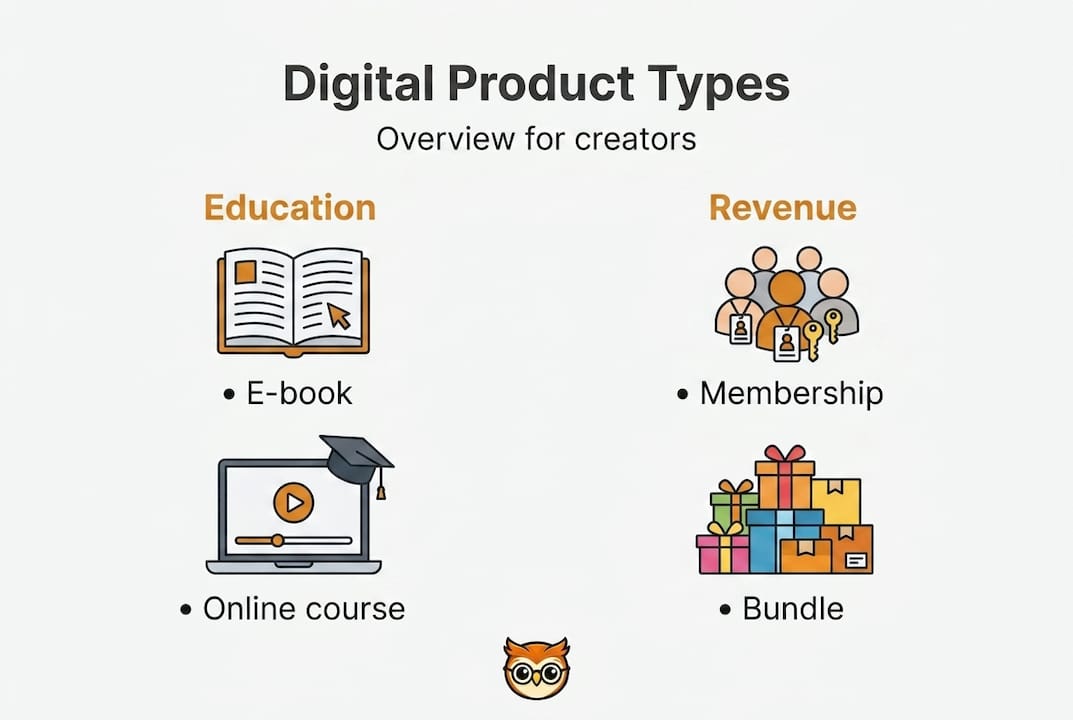
Memberships are the holy grail for recurring revenue. A membership at £47 per month with 200 active members generates £9,400 monthly without any additional launches. The trade-off is that memberships demand consistent content creation and community management. They suit creators who already have a loyal audience and a clear content roadmap.
Digital bundles combine multiple products at a discounted rate and work brilliantly as launch incentives or limited-time offers. They increase average order value without requiring you to build entirely new products.
When it comes to where you sell, the platform decision matters enormously. Marketplace platforms like Udemy expose you to millions of potential buyers, but they also dictate pricing, take a significant revenue cut, and own the customer relationship. Educational content creators on Udemy often find their courses discounted to £9.99 during promotions they cannot control. Self-hosted solutions like Kajabi, Teachable, and ThriveCart put you in charge of pricing, branding, and email lists. The margins are substantially higher, and you retain full ownership of your audience data.
For creators serious about growing an online education business, self-hosting is almost always the better long-term decision, even if the initial setup takes more effort.

| Product type | Avg price | Engagement | Pros | Cons |
|---|---|---|---|---|
| E-book | £7 to £49 | Low to medium | Fast to create, passive income | Lower perceived value |
| Self-paced course | £97 to £497 | Medium (10 to 30% completion) | Scalable, no schedule | Low completion, harder to justify premium |
| Cohort-based course | £297 to £997 | High (50 to 90% completion) | Premium pricing, testimonials | Time-intensive to deliver |
| Membership | £17 to £97/month | Very high | Recurring revenue, community | Demands ongoing content |
| Digital bundle | £47 to £197 | Medium | Higher order value | Requires existing products |
Knowing which model to choose depends on three factors: your current audience size, the level of trust you have built, and how specialised your niche is. If you have fewer than 500 email subscribers, start with an e-book or mini-course to build social proof. Once you have testimonials and a responsive list, graduate to a full course or membership. Exploring digital storefront strategies can also help you understand how to present these products to a global audience right from the start.
- Small audience (under 500): Start with an e-book or workshop to build proof
- Growing audience (500 to 2,000): Launch a self-paced course with a founding member discount
- Established audience (2,000+): Introduce cohort courses, memberships, or premium bundles
- Multi-product creators: Bundle existing content and introduce upsells for higher order values
Validating ideas and building your value ladder
Once you have selected your product model and platform, it is essential to ensure your ideas will actually sell before investing hundreds of hours into their creation. This is where most educational creators go wrong. They build in private for months, launch with excitement, and hear silence. Validation eliminates that risk entirely.
Pre-selling is the single most powerful validation tool available to you. The rule of thumb, backed by real-world product validation case studies, is to secure at least 20 paying buyers before you begin building the product in full. This is not just about covering costs. It proves genuine demand, gives you early feedback that shapes the product, and creates a group of invested learners who will generate your first testimonials.
Here is a step-by-step framework for pre-selling your first or next digital product:
- Define the transformation. What specific, measurable outcome will your buyer achieve? Vague promises do not sell. "Learn photography" is weak. "Go from smartphone snapper to confident portrait photographer in 30 days" is compelling.
- Create a sales page or simple landing page. You do not need a finished product. You need a clear description, a price, and a payment button.
- Announce to your existing audience first. Email your list, post in your community, and be transparent that this is a founding member offer. Founding members often receive a discount or bonus access in exchange for early commitment.
- Set a clear deadline. Pre-sales work best with urgency. Give yourself seven to fourteen days to hit your validation target of 20 buyers.
- Gather feedback immediately. Survey your early buyers before you record a single lesson. Their language will shape your content, and their questions will reveal the gaps you had not considered.
- Build based on real input. Now you build, knowing exactly who you are building for and what they need.
The value ladder is the structural backbone of sustainable creator income. Rather than selling isolated products, you guide buyers through a journey from free or low-cost entry points to premium high-ticket offers. A tripwire offer, priced around £27, can generate £30,000 in 41 days when launched to the right audience with a strong email sequence. That same mechanism funds advertising, which then fills your higher-ticket cohort course.
| Ladder rung | Product example | Price range | Purpose |
|---|---|---|---|
| Free | Lead magnet, mini e-book, checklist | £0 | Build trust and grow email list |
| Low-ticket | Starter guide, template pack | £7 to £47 | Cover ad spend, qualify buyers |
| Mid-ticket | Self-paced course | £97 to £297 | Core transformation, social proof |
| High-ticket | Cohort course, mastermind | £497 to £1,997 | Deep results, premium community |
| Premium service | Consulting, coaching | £150 to £500/hr | Maximum personalisation and income |
Pro Tip: Batch your content creation by recording all course videos in a single dedicated week rather than producing one lesson at a time. This maintains tonal consistency, reduces context-switching costs, and lets you repurpose clips across social media, email sequences, and bonus materials with far less effort.
When developing educational products, it also pays to think about your distribution strategy from day one. How you deliver the product shapes how buyers perceive its value, so planning distribution strategies early prevents expensive platform migrations later.
Brand management essentials for educational content creators
With your product strategy and validation in place, amplifying your success depends on how you present your value and expertise to your audience. Brand management is not about having a pretty logo. It is about making your audience feel something specific every time they encounter your work.
Positioning is your foundation. A strong positioning statement follows this structure: I help [specific audience] achieve [specific outcome] via [unique method]. For example: "I help newly qualified teachers design engaging online lessons using research-backed learning frameworks." This single sentence does three things. It filters out the wrong audience, attracts the right one, and signals your methodology. Personal branding boosts conversion rates by as much as 80%, and consistent visual and messaging branding increases revenue by 23%. These are not vanity metrics; they translate directly to sales.
Content pillars give your brand structure and keep your content strategy focused. Choose three to five core topics that sit at the intersection of your expertise and your audience's needs. If you teach sustainable business practices to freelancers, your pillars might be: pricing strategy, client communication, tools and systems, and mindset. Every piece of content you create should map back to one of these pillars. This creates the impression of depth and authority, even when you are just starting out.
"Your brand is not what you say it is. It is what your audience remembers after they leave."
Visual consistency matters more than most creators acknowledge. This does not mean hiring an expensive designer. It means choosing two to three colours, two complementary fonts, and a clear tone of voice, then sticking to them across every platform. A reader who encounters your Instagram post, then visits your sales page, then receives your email newsletter should feel the same brand energy in all three places. Inconsistency creates subconscious distrust, which kills conversions.
Social proof is the accelerant that transforms a credible brand into a trusted one. Collect testimonials actively, not passively. After every workshop, cohort, or e-book purchase, send a structured feedback request that asks for a specific result the buyer achieved. "This course changed my business" is weak. "I doubled my e-book revenue in six weeks using the pricing framework" is powerful. Display this proof prominently on your sales pages and in your email campaigns.
For creators focused on building a digital educator brand, understanding how to reach learners across different regions is equally important. Expanding your educational reach beyond your home market dramatically increases the pool of potential buyers, particularly for niche topics with global appeal.
Here are the must-have brand elements every solo educational creator needs:
- A clear positioning statement (one sentence, no jargon)
- A consistent visual identity: colour palette, fonts, and logo
- A defined brand voice: formal or conversational, authoritative or warm
- A content pillar map covering three to five core topics
- A testimonial collection system integrated into your delivery workflow
- An email welcome sequence that reflects your brand personality from the first touchpoint
Pro Tip: When choosing your brand voice, write three adjectives that describe how you want your audience to feel after reading your content. Pin those words above your desk and check every piece of content against them before publishing. This small habit eliminates inconsistency faster than any brand guideline document.
The monetisation statistics consistently show that creators who invest in brand clarity early outperform those who chase followers. A smaller, trusting audience converts at far higher rates than a large, disengaged one.
From launch to growth: building sustainable income streams
Now that you understand brand-building, let us connect the dots to practical launches, ongoing growth, and avoiding the pitfalls most educators encounter. A great product with poor launch execution rarely succeeds. And a well-executed launch without a retention plan generates one-off revenue that never compounds.
The five-to-seven-day launch framework is the proven structure for generating revenue with urgency and focus. Here is how it works:
- Day one: Open cart and announce. Email your full list, post on all active channels, and make your core offer clear. State the deadline explicitly.
- Day two: Teach something valuable for free. Share a lesson, a live session, or a video that demonstrates the quality of what buyers will receive.
- Day three: Address objections. Answer the most common questions publicly. "Is this for beginners?" "What if I'm too busy?" Objection-handling emails consistently outperform standard promotional messages.
- Day four: Showcase social proof. Highlight testimonials, case studies, and early buyer results. If this is your first launch, share behind-the-scenes footage of you building the product.
- Day five: Create genuine urgency. Launches using urgency with a hard close deadline consistently outperform evergreen funnels in short windows. This is not manipulation; it is a commitment mechanism for buyers who genuinely want to act.
- Day six: Send the "last chance" email. This single email often generates 30 to 40% of total launch revenue.
- Day seven: Close cart and deliver. Honour your deadline, deliver immediately, and begin your onboarding sequence.
Once buyers are inside your product, retention is your next priority. Paid cohort courses achieve completion rates of 50 to 90%, compared to just 10 to 15% for free or self-paced alternatives. High completion rates generate better testimonials, more referrals, and lower refund rates. All of this compounds over time.
For global digital sales strategies, upselling and cross-selling within your existing customer base is significantly more cost-effective than acquiring new buyers. Once someone has purchased and completed your mid-tier course, they are primed for your premium cohort or a monthly membership that deepens the learning.
Here are the most common monetisation pitfalls and how to sidestep them:
- Building without validation: Always pre-sell before producing. Twenty buyers confirms demand.
- Launching once and moving on: Treat every product as a recurring asset. Relaunch quarterly or move to evergreen with a tripwire funnel.
- Ignoring your email list: Social media reach is borrowed. Your email list is the only channel you fully own.
- Underpricing from insecurity: Price based on the transformation delivered, not the hours you spent creating the product.
- Neglecting post-sale experience: Onboarding quality determines completion, testimonials, and referrals. Do not neglect it.
- Relying on marketplace distribution: Platforms like Udemy offer discovery but strip margin and audience ownership. Self-hosted solutions give you lasting control.
Pro Tip: After your first cohort, request video testimonials from the three learners with the strongest results. Video social proof converts dramatically better than written testimonials on sales pages, and these clips can be repurposed across every channel in your ecosystem.
The uncomfortable truth most content creators miss
Having built a practical toolkit for sustainable growth, it is worth addressing what most guides and gurus leave unsaid. Viral content and algorithm hacks are not a business model. They are, at best, a discovery mechanism and, at worst, a distraction from the work that actually generates lasting income.
The creators who build genuinely enduring digital businesses share one common trait: they are obsessively focused on a micro-niche and a specific transformation. Educational and transformation-focused content commands a significant price premium over entertainment content, because buyers know they are investing in a measurable outcome. A course that teaches "how to get 10,000 Instagram followers" will always be commoditised. A course that teaches "how midwives can build a trauma-informed private practice" will never face meaningful competition.
Marketplaces accelerate this commoditisation problem. When your course sits on Udemy alongside 200 similar offerings, the only differentiator becomes price, and that is a race to the bottom you cannot win. Self-hosted platforms, by contrast, let you control the entire buyer journey, from the first social media impression to the post-purchase upsell. That control is not just operational. It is the difference between building a brand and feeding someone else's.
Building in public, sharing your process openly, and launching pre-sales before your product exists might feel counterintuitive. But this transparency builds a quality of trust that no advertising budget can buy. Audiences who watch you build are invested in your success and far more likely to become buyers, advocates, and long-term members.
Our perspective at BibliOWLteca, informed by working with educators and creators across multiple markets, is that sustainable creator income requires one more ingredient that rarely makes the headlines: patience in the validation phase and speed in the execution phase. Spend more time confirming product-market fit via tools for digital publishing and early feedback. Spend less time perfecting before you have paying customers. That inversion is where most creator businesses actually begin to grow.
Next steps: launch and scale your creator business
If you have identified your unique position and want to put these strategies into action, the next step is choosing a platform equipped for genuine growth.
BibliOWLteca is designed specifically for educational content creators who want to sell e-books, courses, and digital products to a global audience without sacrificing control or margin. The platform handles multi-currency payments, international tax compliance, and secure digital delivery, so you can focus on creating and marketing rather than managing technical infrastructure. With built-in storefront tools and audience management features, BibliOWLteca gives you everything needed to build a self-hosted digital business at scale. Whether you are launching your first e-book or expanding an existing course library, explore what BibliOWLteca can do for your creator business at bibliowlteca.com and take the first step towards owning your audience and your income.
Frequently asked questions
What is the most profitable digital product for educational content creators?
Cohort-based online courses and self-hosted memberships typically offer the highest earnings, with memberships priced around £47 per month and cohort courses achieving completion rates of 50 to 90%.
How can I test if my audience will buy my e-book or course before making it?
Pre-selling your offer and securing 20 buyers before you begin building is the most reliable validation method, as it confirms genuine demand without wasted production time.
Which platform is best for maximising content creator revenue?
Self-hosted solutions like Kajabi and Teachable provide higher margins and control compared to marketplaces such as Udemy, where pricing and audience ownership are largely out of your hands.
Does personal branding really impact sales for creators?
Yes. Strong personal branding increases conversions by up to 80% and consistent visual branding drives a 23% increase in revenue, making it one of the highest-return investments a creator can make.
How do I avoid commoditisation when selling educational content?
Focus on a micro-niche with self-hosting to retain full brand control, and position your offer around a specific, measurable transformation rather than a broad topic that marketplaces already saturate.