
TL;DR:
- Most creator income is concentrated among a small, skilled, and systemized minority. Building audience ownership, niche expertise, and automated systems ensures long-term resilience. Diversifying revenue streams and focusing on depth over virality lead to sustainable success.
The creator economy is worth an estimated $250 billion in 2026, yet the vast majority of that wealth flows to a small fraction of creators. If you have spent any time trying to turn your knowledge into income online, you already know the frustrating gap between what the headlines promise and what most creators actually earn. Platforms are plentiful, advice is everywhere, and yet sustainable income remains elusive for most. This guide cuts through the noise. We will map the real income streams, explain which strategies actually hold up over time, and help you make clear decisions about where to invest your energy.
Table of Contents
- What is the creator economy and who thrives?
- Revenue streams and monetisation models for creators
- Choosing the right platforms for your expertise
- Risks and resilience: what most guides miss
- Why depth, ownership, and systems win in the creator economy
- Grow your creator business with BibliOWLteca
- Frequently asked questions
Key Takeaways
| Point | Details |
|---|---|
| Top earners dominate | The creator economy is vast, but most income goes to a small percentage of creators. |
| Diversification is essential | Successful creators rely on multiple income streams and ownership of their audience. |
| Platform choice matters | Choosing the right platform and owning your audience help maximise resilience and revenue. |
| Systems beat solo grinding | Building repeatable systems and teams enables long-term sustainability for creators. |
| Trust and expertise win | Creators who focus on depth, trust, and quality outperform those chasing short-term viral trends. |
What is the creator economy and who thrives?
The creator economy refers to the ecosystem in which individuals monetise their knowledge, creativity, and expertise directly through digital platforms. It includes educators selling online courses, writers publishing e-books, podcasters building subscription communities, and independent consultants packaging their skills into productised services. The barrier to entry is low, which is exactly why so many people try and why so few build lasting businesses.
Globally, 50 to 67 million creators are active in some form. The income picture, however, is far less inspiring than the headline figure. Most creators earn below minimum wage from their content, while the top 1 to 10 per cent capture the overwhelming majority of revenue. This is not a coincidence. It reflects structural advantages that the successful minority have deliberately built.
"Income inequality in the creator economy is not just widening — it is accelerating. Niche expertise and systems are the real differentiators, not audience size alone."
Here is a rough breakdown of how creator income is typically distributed across revenue types:
| Revenue source | Typical share of income | Accessibility |
|---|---|---|
| Brand sponsorships | 55–68% | Requires large audience |
| Ad revenue (YouTube, etc.) | 15–22% | Requires high volume |
| Digital products and courses | 10–20% | Accessible at any scale |
| Memberships and subscriptions | 5–15% | Requires loyal niche audience |
| Coaching and consulting | Varies | High value, time-intensive |
So why do some creators thrive while others plateau? The answer comes down to four factors. First, niche expertise: generalists struggle to command premium prices, while specialists attract dedicated audiences willing to pay more. Second, audience ownership: creators who build email lists and communities rather than relying on a single platform retain their audience regardless of algorithm changes. Third, systems: top earners automate delivery, onboarding, and customer support so their business scales without their constant presence. Fourth, entrepreneurial mindset: they treat their content as a business, not a hobby.
Those four factors explain why a creator with 5,000 engaged email subscribers often earns more than one with 500,000 passive followers. You can learn more about how creator global earning potential shifts when you focus on the right fundamentals rather than vanity metrics.
Key traits of creators who thrive:
- They own their audience through email lists or private communities
- They specialise deeply rather than covering broad topics
- They build repeatable systems for content, sales, and delivery
- They diversify revenue across at least two or three streams
- They measure revenue per subscriber, not follower count
Revenue streams and monetisation models for creators
Once you understand who is thriving, it is essential to understand precisely how they make money. Not all income sources are created equal, and choosing the right mix early can save you years of effort in the wrong direction.
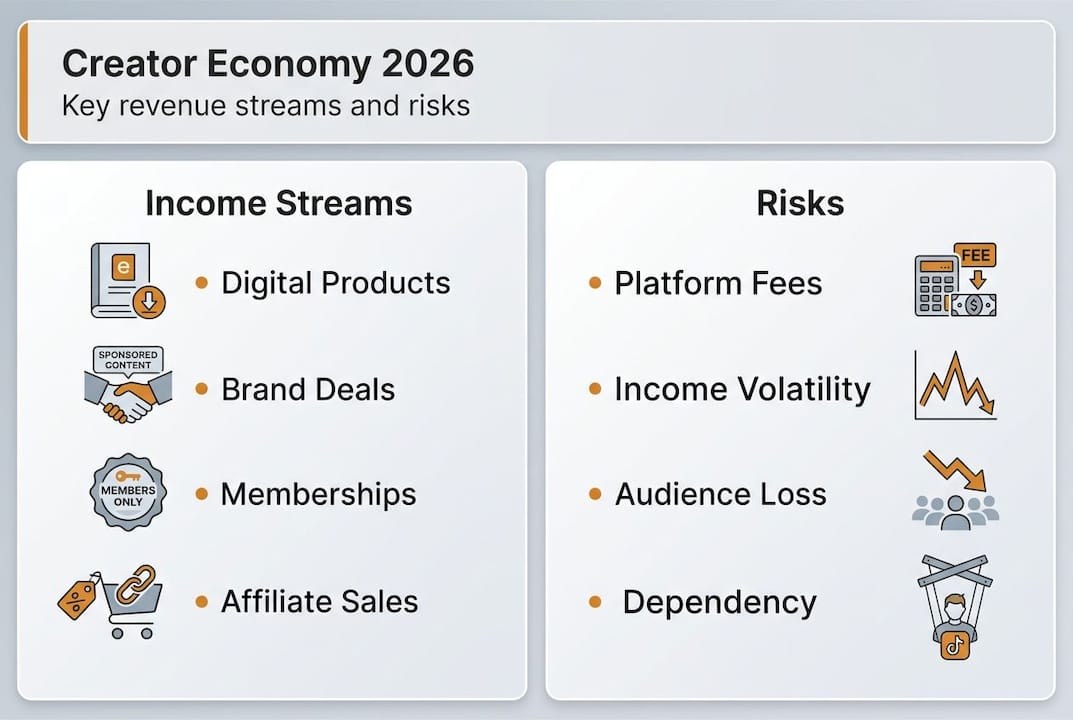
Major income sources for creators include digital products, ad revenue, brand sponsorships, memberships, affiliate marketing, and coaching or consulting. Each has a different relationship between your time, your audience size, and your income potential.
Digital products such as e-books, courses, templates, and toolkits are the most scalable option. You create once and sell repeatedly. A well-structured course on a specialist topic can generate income for years with minimal ongoing effort. The trade-off is that building a quality product takes significant upfront time.
Ad revenue and brand sponsorships together account for 55 to 68 per cent of creator income at scale, but they require large, engaged audiences and are entirely dependent on platform algorithms and brand budgets. They are volatile and not a strong foundation for new creators.
Here is a practical comparison to help you choose:
| Model | Scalability | Audience needed | Platform dependency | Revenue control |
|---|---|---|---|---|
| Digital products | Very high | Small to medium | Low | High |
| Ad revenue | Medium | Large | Very high | Low |
| Brand deals | Low to medium | Large | Medium | Low |
| Memberships | High | Medium | Medium | Medium |
| Coaching | Low | Small | Low | High |
Memberships offer recurring revenue and community depth, but they require consistent content delivery and strong community management to retain members over time. Coaching offers the highest income per hour but does not scale without systems in place.

One factor that many new creators underestimate is platform fees and ownership. Selling on a third-party marketplace often means giving up 20 to 50 per cent of revenue. Understanding how to monetise e-books and courses on platforms that prioritise creator ownership can meaningfully change your margins.
Pro Tip: Do not build your business on a single income source. The most resilient creators layer digital products (passive income) with memberships (recurring income) and occasional coaching (high-margin income). If one stream dips, the others keep the business stable. Also explore global digital sales strategies to reach buyers beyond your home market from day one.
Affiliate marketing is worth mentioning as a lower-effort supplement. By recommending tools and platforms you genuinely use, you earn commissions without creating new products. It works best as a complement to your core offer, not as a standalone strategy.
Choosing the right platforms for your expertise
With revenue models clear, selecting the right platform is your next critical decision. The wrong choice can cost you audience data, significant revenue share, and the ability to move your business if something changes.
Leading platforms for courses, e-books, and memberships include Kajabi, Teachable, Thinkific, Podia, Gumroad, and Kartra. Each has a distinct positioning and suits different creator needs.
| Platform | Best for | Revenue share | Audience ownership |
|---|---|---|---|
| Kajabi | All-in-one course and community | None (flat fee) | High |
| Teachable | Courses and coaching | 0–5% + transaction fees | Medium |
| Thinkific | Courses and membership sites | None on paid plans | High |
| Podia | Courses, downloads, memberships | None | High |
| Gumroad | Digital downloads, e-books | 10% flat | Medium |
| Kartra | Funnels, courses, automation | None (flat fee) | High |
The most important factor when choosing a platform is not the feature list. It is whether the platform allows you to own your audience. A hosted SaaS platform (software as a service) where you control your email list and customer data is strongly preferable to a marketplace where buyers never truly become your customers.
If a platform goes down, changes its algorithm, or increases fees, you need to be able to take your audience with you. That is only possible if you own the relationship. When exploring options for selling e-books and courses, prioritise platforms that export customer data freely and give you direct communication tools.
Key criteria for selecting your platform:
- Full access to customer email addresses and purchase history
- Transparent and predictable fee structure
- Support for multiple currencies and international payments
- Flexible product formats (video, PDF, audio, bundles)
- Reliable digital delivery and access control
- Integration with your email marketing tools
Also consider reviewing top e-book tools for specialist publishing use cases, and if you are currently using a popular course marketplace and wondering whether better alternatives exist, exploring Hotmart alternatives is a worthwhile exercise before committing long-term.
Do not underestimate the value of starting with a simpler, lower-cost platform. Many creators over-engineer their setup before they have validated their offer. Choose the simplest platform that lets you own your audience, validate demand, and then upgrade your tools as your revenue justifies it.
Risks and resilience: what most guides miss
Most creator economy guides focus on the opportunity. Far fewer tackle the risks honestly, and that blind spot costs creators time, money, and sometimes their entire business.
Platform dependency is the single biggest structural risk. A YouTube channel demonetised overnight, a TikTok account restricted, a newsletter platform that changes its pricing model. These are not hypotheticals. They happen constantly, and creators who have built exclusively on rented platforms lose everything when they do.
Income instability compounds the problem. Brand deal budgets shrink during economic downturns. Ad revenue per thousand views fluctuates wildly. A creator who earns well one quarter may earn half that the next without any change in their output or audience.
Then there is burnout. The pressure to publish constantly, stay visible across multiple platforms, and maintain audience engagement while also building products and managing customers is genuinely exhausting. Many creators exit quietly, not because they failed commercially, but because the model was unsustainable personally.
AI-generated content is creating a new category of risk too. When low-effort content floods every niche, the value of generic information collapses. Audience ownership and productised services become the primary differentiators because no algorithm can replicate genuine trust and demonstrated expertise.
"The creators who last are not the ones who went viral. They are the ones who built systems, owned their audience, and made their income less dependent on any single platform or trend."
Actionable resilience strategies for creators in 2026:
- Build an email list from day one, regardless of which platforms you use
- Publish your core offer on a platform you control, not just a third-party marketplace
- Create a digital publishing system that works even when you take time away
- Develop a value ladder: free content leads to low-cost products, which lead to premium offers
- Track revenue per subscriber and revenue per product, not follower counts
- Aim for at least two distinct income streams before scaling one aggressively
Pro Tip: Measure outcomes, not vanity metrics. A creator with 2,000 email subscribers and a 3 per cent conversion rate on a £200 course earns £12,000 per launch. The trust and depth advantages of a smaller, highly engaged audience almost always outperform a large, disengaged one in commercial terms.
Resilience in the creator economy is not about working harder. It is about building the right assets in the right order, so that your business continues generating income even when individual platforms or trends shift beneath you.
Why depth, ownership, and systems win in the creator economy
Here is something that most creator economy coverage gets wrong: it frames success as a distribution or discovery problem. Get your content in front of more people, grow faster, post more. But the creators who actually build durable income are not winning the distribution game. They are winning the trust game.
Research into sustainable creator businesses shows that those who build systems and teams and focus on depth rather than virality consistently outperform those chasing algorithmic wins. This makes sense when you think about it from the buyer's perspective. People do not pay premium prices for information they could find anywhere. They pay for the specific perspective, the curated path, and the accountability that comes from a creator they genuinely trust.
Mid-career creators hold a structural advantage here. Those with three to seven years of demonstrated expertise and a cultivated audience are positioned for long-term advantages that newer entrants simply cannot replicate quickly. Their content library builds compounding authority. Their audience is warmer and more likely to buy. Their systems are refined.
The uncomfortable truth is that most creators spend the majority of their time on content production and almost none on the systems that would make that content generate consistent income. Building a clear product suite, an owned email list, and an automated sales funnel is less exciting than making videos. But it is far more valuable. Tools for maximising global distribution matter far more once these foundations are in place.
If we could offer one reframe: stop thinking of yourself as a content creator and start thinking of yourself as a knowledge business owner. The content is your marketing. The product is what you sell. The system is what makes it sustainable.
Grow your creator business with BibliOWLteca
Applying these principles is much easier when your platform actively supports your goals rather than working against them. BibliOWLteca is built precisely for creators who want to sell educational content globally without sacrificing ownership, control, or revenue to unnecessary intermediaries.
Through the BibliOWLteca marketplace, you can publish and sell e-books, online courses, and other digital educational materials to buyers around the world, with support for multiple currencies and international payment processing built in. You keep your audience data, manage your own store, and benefit from tools for digital delivery, tax compliance, and secure transactions. Whether you are just launching your first product or scaling an established catalogue, BibliOWLteca gives you the infrastructure to grow your knowledge business on your own terms.
Frequently asked questions
What are the main ways to earn income as a creator?
Creators mostly earn through digital products, ads, brand deals, memberships, and coaching. Digital products are the most scalable because you create once and earn repeatedly without trading time for money.
Which platforms are best for selling courses and e-books?
Kajabi, Teachable, Thinkific, Podia, Gumroad, and Kartra are leading choices. Hosted SaaS platforms are generally preferred because they allow you to own your audience data and communicate directly with customers.
How do creators manage platform dependency and income volatility?
The most effective approach is to build owned channels such as email lists and diversify across at least two income streams. This ensures your business remains viable even if one platform changes its rules or reduces your reach.
Why is income inequality growing in the creator economy?
The top 1 to 10 per cent capture most revenue because they combine niche expertise with audience ownership and consistent systems. These advantages compound over time, making the gap between top and average earners increasingly difficult to close.
What matters most for long-term creator success?
Depth, audience ownership, and systems are the foundations that last, rather than chasing viral moments or platform trends. Creators who treat their knowledge as a business and build repeatable processes consistently outperform those who rely on content volume alone.