
TL;DR:
- Choosing the right online course platform is crucial for maximizing revenue and delivering a quality student experience. A strong platform reliably hosts content, processes payments seamlessly, and offers effective marketing and community features tailored to your goals. Ultimately, success depends more on course quality and student support than on platform features alone.
Choosing an online course platform is one of the most consequential decisions you will make as a creator or educator. The market has exploded with options, each promising to transform your knowledge into income, yet the differences between platforms can mean thousands of pounds in lost revenue or gained opportunities. The sheer variety of pricing models, feature sets, and audience tools makes a straightforward comparison almost impossible without a framework. This article walks you through exactly that: the criteria that matter, the platforms worth your attention, a direct feature and cost comparison, and practical guidance on matching a platform to your specific goals.
Table of Contents
- What makes a strong online course platform?
- Best platforms for monetising online courses
- Comparing costs and features of popular platforms
- Which platform suits your audience and goals?
- Our perspective: Beyond features—what actually drives online course success
- Start monetising your online courses and digital products today
- Frequently asked questions
Key Takeaways
| Point | Details |
|---|---|
| Platform selection matters | Choosing the right platform impacts your earnings, reach, and branding. |
| Compare costs and features | Evaluate both pricing and core features for the best strategic fit. |
| Use advanced monetisation tools | Maximise upsells and revenue with payment plans, bundles, and affiliate features. |
| Avoid restrictive marketplaces | Marketplaces can limit control—opt for platforms offering flexibility. |
| Completion rates drive revenue | High completion rates unlock backend revenue and long-term success. |
What makes a strong online course platform?
Before comparing any specific products, you need a clear set of criteria. Without this foundation, you end up choosing a platform based on a flashy homepage or a popular recommendation rather than what actually fits your business.
A genuinely strong platform does several things well at the same time. It hosts your course content reliably, processes payments without friction, provides marketing tools you can actually use, and supports your students through a structured learning experience. These are non-negotiable basics. The trouble is that many platforms do some of these well and others poorly, so you have to know which elements matter most to your situation before you sign up for anything.
Here is what to assess when evaluating any platform:
- Course hosting quality: Does the platform support video, audio, PDFs, quizzes, and drip content scheduling? Can you organise lessons into structured modules with clear progress tracking?
- Payment processing: Does it support multiple currencies, international payments, and flexible models such as one-time purchases, subscriptions, and payment plans?
- Marketing tools: Built-in email marketing, landing page builders, coupon codes, and affiliate programmes save you from stitching together a dozen third-party tools.
- Community features: Forums, cohort learning, and live session integrations keep students engaged and reduce refund rates.
- Scalability: Can the platform handle your audience growing from 50 students to 5,000 without requiring a complete system overhaul?
- Integration options: Webhooks, Zapier compatibility, and API access let you connect to tools you already use.
Popular platforms for creators include Teachable, Thinkific, Kajabi, Podia, and SamCart, each offering a distinct combination of course hosting, payment processing, marketing tools, and community building. Understanding the best learning platform criteria for your specific niche is the single most useful exercise you can do before shortlisting any tool.
Monetisation mechanics deserve special attention here. Beyond the basic one-time sale, look for platforms that support order bumps (an add-on offered at checkout), upsells after purchase, bundle pricing, and coupon-based promotions. These mechanics can meaningfully increase your average revenue per customer without requiring you to find new buyers.
Pro Tip: Look for platforms that support both courses and digital products such as e-books, templates, and worksheets. This lets you diversify income streams from a single platform and sell entry-level products that funnel students into premium courses.
Pricing transparency is also critical. Some platforms advertise a low monthly fee but charge transaction fees on every sale, which quietly erodes your margins as revenue grows. Always calculate your projected annual cost at scale, not just your starting monthly plan.
Best platforms for monetising online courses
With those criteria in mind, here is a closer look at the platforms most creators are choosing in 2026 and why each one earns its place on the shortlist.
Teachable remains one of the most widely used platforms for independent creators. Its strength lies in a clean, beginner-friendly interface and solid course delivery tools. You can create structured lessons, add quizzes, issue certificates, and sell via customisable checkout pages. The trade-off is that the basic plan charges transaction fees, which add up quickly. Teachable suits creators who are just starting out and want to validate their course idea before investing in a more expensive platform.

Thinkific sits comfortably alongside Teachable but differentiates itself with zero transaction fees across all plans, including its free tier. This is significant for creators who are generating steady revenue and want to retain more of every sale. Thinkific's course builder is intuitive, and it offers strong customisation for branded learning experiences. Its marketing features are more limited than all-in-one platforms, so many Thinkific users rely on external email tools like ConvertKit or Mailchimp.
Kajabi is the all-in-one solution that bundles course hosting, email marketing, landing pages, pipelines (automated sales funnels), a podcast tool, and a community feature into a single subscription. For creators who are scaling and want to eliminate the cost and complexity of managing multiple software subscriptions, Kajabi is genuinely compelling. The downside is cost: it starts at $149 per month, which is a meaningful commitment for early-stage creators.
Podia offers an accessible middle ground, combining course hosting with digital product sales, webinars, and an email marketing tool at a competitive price. It is particularly appealing to creators who want to sell courses and e-books from the same storefront without stitching platforms together. Podia's interface is among the most straightforward in the market, and its customer support reputation is strong.
SamCart takes a different approach entirely. Rather than a full course platform, it focuses on high-converting checkout experiences and is frequently paired with other course tools. Its one-click upsell and order bump features are industry-leading, making it a favourite among creators who are optimising for maximum revenue per transaction rather than course delivery features.
"Creators who rely on marketplace platforms like Udemy trade pricing control for traffic. That is a reasonable short-term trade, but long-term it leaves you building someone else's audience, not your own. Dedicated platforms give you the brand, the data, and the pricing flexibility that serious education businesses need." This is especially relevant if you plan to publish and sell digital products across multiple formats and territories.
Each platform has genuine strengths, and no single one is objectively best. The right choice depends on where you are in your creator journey and what you are trying to achieve in the next 12 to 24 months.
Comparing costs and features of popular platforms
To help you weigh up these platforms directly, here is a structured comparison covering the elements that matter most to creators at different stages of growth.
| Platform | Starting price | Transaction fees | Course hosting | Built-in marketing | Community |
|---|---|---|---|---|---|
| Teachable | $39/month | Yes (basic plan) | Yes | Limited | No |
| Thinkific | $49/month | None | Yes | Limited | Add-on |
| Kajabi | $149/month | None | Yes | Full suite | Yes |
| Podia | $39/month | None | Yes | Email included | Limited |
| SamCart | $79/month | None | No | Checkout only | No |
As the table shows, platforms vary significantly in their starting costs and what they include. Teachable's $39/month entry price looks attractive until you factor in the transaction fees on the basic plan. Thinkific's $49/month with zero transaction fees often works out cheaper for creators once revenue crosses a few hundred pounds per month. Kajabi's $149/month is genuinely expensive, but it replaces tools that would collectively cost more if purchased separately.
The distinction between specialist and all-in-one platforms matters enormously at different business stages. Teachable and Thinkific are specialists: they do course delivery exceptionally well and rely on integrations for everything else. Kajabi is an all-in-one: it replaces your email platform, landing page builder, and CRM at the cost of higher monthly fees and a steeper learning curve. Podia sits between these two camps, offering enough marketing functionality to reduce reliance on external tools without Kajabi's price tag.
Monetisation mechanics across platforms include one-time fees, subscriptions, payment plans, bundles, coupons, affiliate programmes, order bumps, and upsells. These mechanics are not equal across platforms. Kajabi and SamCart offer the most sophisticated upsell and order bump tools. Thinkific and Podia handle the basics well. Teachable's monetisation tools have improved significantly in recent updates but still lag behind Kajabi for complex funnels.
A useful exercise is to calculate what your platform costs you per student enrolled. If you are pricing a course at £200 and your platform charges a 5% transaction fee, you lose £10 per sale. At 500 students, that is £5,000 going to the platform rather than your business. That calculation often justifies upgrading to a higher plan with no transaction fees far sooner than creators expect.
The ability to sell online courses globally depends heavily on payment infrastructure. Check whether your chosen platform supports multi-currency checkout, international payment gateways, and VAT or GST compliance for digital goods. This is not a minor point if you are selling into Europe, Australia, or any market with specific digital goods tax requirements. A scalable online store for courses needs to handle these requirements from day one, not as an afterthought when your audience grows.
Which platform suits your audience and goals?
Once you understand what platforms cost and what they do, the next step is matching a platform to your specific audience type, content format, and growth objectives.
If your primary audience is individual learners buying personal development or skills-based courses, Teachable, Thinkific, or Podia all serve this market well. They offer clean student interfaces, certificate support, and the kind of checkout experience that individual buyers expect.
If you are selling to businesses or want to enrol teams rather than individuals, the landscape changes considerably. B2B group sales, bulk licences, and corporate enrolments require features that most consumer-facing platforms do not support well. In these cases, platforms like Academy of Mine are specifically built for group enrolments and enterprise clients, while community-focused platforms like Mighty Networks or Skool prioritise peer-to-peer engagement over traditional course delivery.
For creators building tight, engaged communities around their content, a hybrid approach often works best. Use Teachable or Thinkific for the structured course content, and layer a community platform like Skool or Circle on top for ongoing dialogue and cohort experiences. This separation keeps your course delivery clean while giving your students an active space to connect.
Here are the scenarios where each platform type tends to work best:
- Individual course creators starting out: Thinkific free plan or Teachable basic to validate demand before investing in paid tiers.
- Growing creators with an established email list: Podia or Thinkific for combined course and product sales with lower fees.
- Scaling businesses wanting automation: Kajabi for full funnel management including email sequences and sales pipelines.
- Checkout optimisation focus: SamCart paired with a course delivery tool for maximum revenue per transaction.
- B2B and corporate clients: Academy of Mine or a custom LMS solution for group enrolments and compliance tracking.
- Community-led learning: Mighty Networks or Skool for creators whose value lies in peer connection as much as curriculum.
Avoiding pricing control issues is one of the most important pieces of advice for any serious creator. Marketplace platforms like Udemy do generate traffic, but they dictate your pricing, own the customer relationship, and take a significant revenue share. Most experienced creators who have used Udemy for visibility eventually migrate their flagship courses to dedicated platforms where they control pricing, branding, and customer data.
Completion rates are one of the most underappreciated metrics in course monetisation. The industry average sits between 5% and 15%, while top creators achieve 40% to 60% completion rates. Creators in the 20% to 30% range drive significantly stronger backend revenue because students who complete courses are far more likely to buy the next course, join a mastermind, or refer paying students.
Pro Tip: When evaluating platforms, check whether they support features that actively improve completion rates: progress tracking, drip content, automated reminder emails, and community access. A platform that helps students finish your course is directly contributing to your upsell and referral revenue. That connection between student success and business growth is one that empowering global educators consistently recognise as central to their monetise and scale strategy.
Our perspective: Beyond features—what actually drives online course success
Here is an honest observation after working with creators across many education markets: the platform debate is almost always the wrong starting point.
Most creators spend weeks comparing feature lists and pricing tables before they have validated whether their course idea has a paying audience. The platform is a tool. The question that actually determines success is whether you have something people want to buy and a way to reach those people consistently.
That said, once you have validated your idea and are ready to scale, platform choice does matter. But not in the way most guides suggest.
The conventional wisdom is to choose the platform with the most features. Our view is that feature bloat is a real problem. Kajabi offers everything, but many creators on Kajabi use 30% of its capabilities and pay for the rest. A simpler platform used well almost always outperforms a complex one used poorly. Specialist platforms like Teachable and Thinkific excel in course delivery but require marketing integrations, while all-in-one solutions like Kajabi bundle everything at a higher cost, making them genuinely ideal for growth-stage businesses that have the revenue to justify the investment and the team to actually use the tools.
The factor most creators ignore entirely is student outcomes. If your students do not complete your course, they will not buy the next one, they will not refer friends, and they will not leave the kind of testimonials that convert new buyers. The most valuable investment you can make in your course business is in course design and student support, not in which platform has the prettier dashboard.
Completion rates and backend sales are where the real money in online education lives. A creator with a 40% completion rate and a well-designed follow-up offer will consistently outperform a creator with a lower completion rate and a more expensive platform, regardless of which tool they chose. Thinking about how to launch and scale digital education sustainably means prioritising your curriculum and student experience first, and then choosing the platform that best supports those priorities.
The uncomfortable truth is that platform features do not teach your students. Your content, your support, and your community do.
Start monetising your online courses and digital products today
If you have spent time comparing platforms and are now looking for a place to start selling, BibliOWLteca offers a dedicated global marketplace for creators who want to reach international audiences without the technical overhead. Whether you are selling a course, an e-book, or a set of digital resources, the platform handles payment processing, digital delivery, and tax compliance across multiple currencies so you can focus on creating.
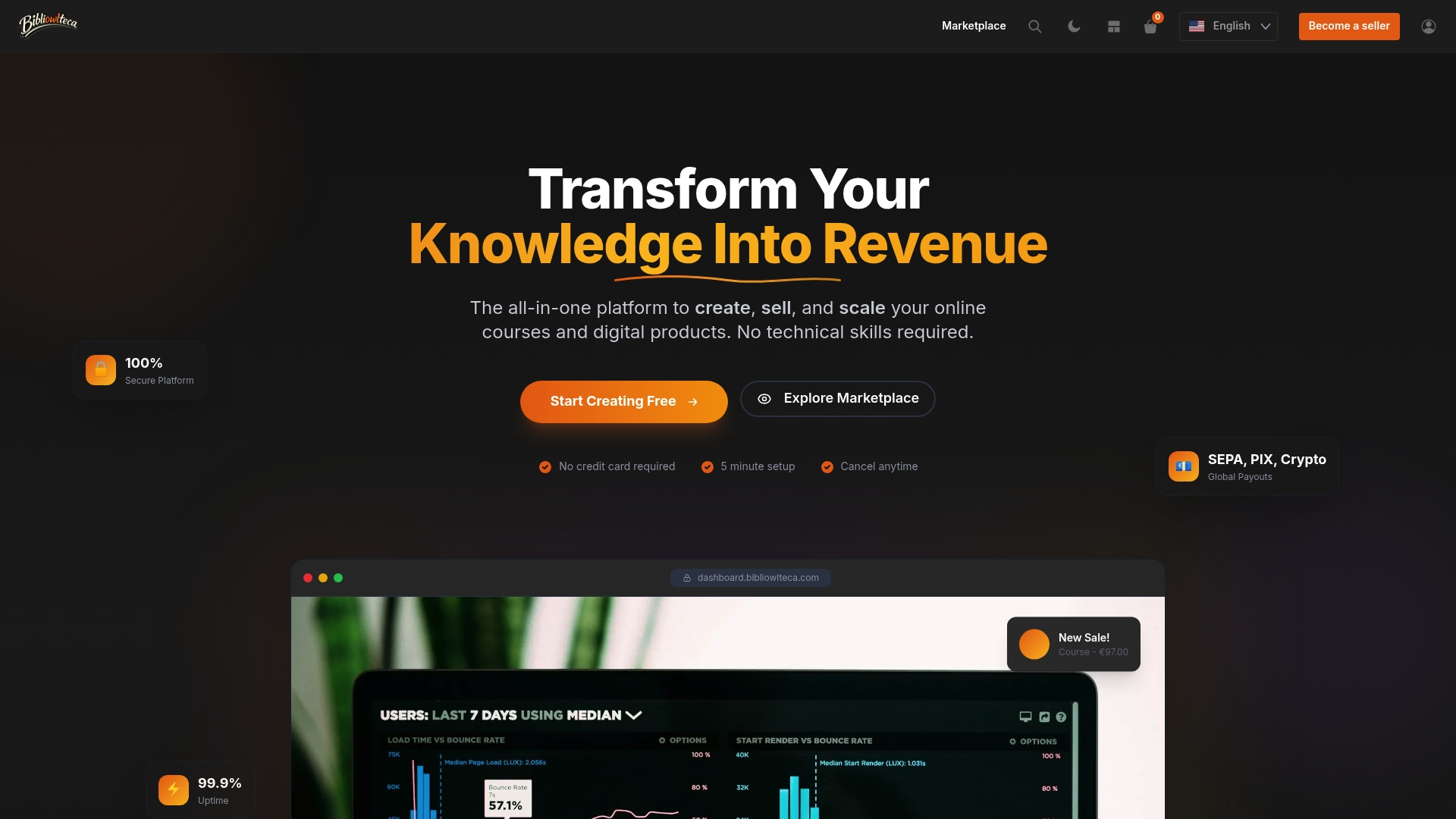
Explore the digital products marketplace to see how other creators are packaging and selling their expertise globally. If you are ready to publish your first product and reach buyers around the world, you can sell e-books and online courses directly through BibliOWLteca with a storefront that is built for international scale from day one. The platform is designed for creators who are serious about turning knowledge into a sustainable digital business.
Frequently asked questions
What are the most important features to look for in an online course platform?
Key features include course hosting, payment processing, marketing tools, and community building support, as these directly affect both the student experience and your ability to generate revenue. Leading platforms like Teachable, Thinkific, Kajabi, Podia, and SamCart each offer different combinations of these features, so matching them to your priorities is essential.
How much does it typically cost to use a course platform?
Costs vary considerably: Teachable starts at $39 per month with transaction fees on basic plans, Thinkific at $49 per month with no transaction fees, and Kajabi at $149 per month as a fully integrated all-in-one solution. Always calculate your projected cost per sale at scale rather than focusing solely on the headline monthly price.
How can I maximise my revenue from online courses?
Use a combination of upsells, payment plans, bundles, coupons, and affiliate marketing to increase the revenue you generate from each customer relationship rather than relying solely on new customer acquisition. Order bumps and post-purchase upsells in particular can increase average order value significantly.
Are marketplaces like Udemy a good choice for creators?
Marketplace platforms limit your pricing and branding control and own the customer relationship, which makes them a poor long-term choice for creators building sustainable businesses. They can be useful for initial visibility, but most serious creators migrate to dedicated platforms where they retain full control.
How important are course completion rates for my business?
Completion rates above 20% drive measurably stronger backend revenue through upsells and referrals, with top creators achieving 40% to 60% completion, compared to an industry average of just 5% to 15%. Prioritising course design and student support is one of the most financially sound decisions you can make as a creator.