
TL;DR:
- Choosing the right platform influences profit margins and global sales ability.
- Successful creators focus on building an engaged audience before platform selection.
- Revenue growth depends more on marketing and community than platform features alone.
Most creators launch their first course or e-book expecting revenue to follow automatically. It rarely does. The creator education market is projected to reach $12.4 billion in 2026, yet the majority of new creators earn far less than they expected. The reason is almost never the quality of their content. It comes down to two things: the wrong platform choice and no clear marketing plan. This guide walks you through how to evaluate learning platforms properly, compares the three biggest names in the space, and gives you a practical framework for turning your knowledge into a sustainable digital business on a global scale.
Table of Contents
- What is a learning platform and why does your choice matter?
- Comparison of top learning platforms: Kajabi, Thinkific, and Teachable
- Revenue models and what today's top earners do differently
- Must-have features for global monetisation and scale
- Critical lessons: why marketing and audience come before platforms
- Take the next step: sell digital content with BibliOWLteca
- Frequently asked questions
Key Takeaways
| Point | Details |
|---|---|
| Platform choice affects revenue | Your learning platform impacts fees, reach, and profits. |
| Community boosts earnings | Creators with active communities typically double their income. |
| Audience building is essential | Marketing and audience engagement drive most creator revenue. |
| Global sales need smart tools | Prioritise platforms with international payment, currencies, and upgradability. |
What is a learning platform and why does your choice matter?
A learning platform is any digital infrastructure that allows you to create, host, deliver, and sell educational content to students anywhere in the world. Within this broad category, you will hear the term LMS (Learning Management System), which refers specifically to software built for structured course delivery, progress tracking, and assessments. A digital product is anything you sell in digital form, from a recorded video course to a downloadable e-book or a live workshop bundle. Together, these tools form the backbone of the creator economy, the growing ecosystem in which individuals monetise their expertise directly.
Most modern learning platforms offer a recognisable set of features:
- Course creation tools with video hosting and quizzes
- Community spaces for student engagement
- Payment processing and checkout pages
- Digital delivery and student access management
- Email marketing integrations or built-in automation
- Analytics dashboards to track sales and completions
The critical point that many new creators miss is this: your platform choice directly shapes your profit margins, your ownership of student data, and your ability to sell globally. A platform that charges a 10% transaction fee on every sale quietly destroys your margin as you scale. A platform with no multi-currency support locks you out of international buyers.
"Platforms handle delivery and monetisation, but marketing drives revenue. High profit margins of 70 to 95% are possible, but only when you already have an audience ready to buy."
This is a foundational truth that most platform comparison articles skip. Being listed on a digital marketplace for educators does not mean buyers will appear. What matters is matching platform capabilities to your business stage. Early creators need low costs and simplicity. Scaling creators need automation, community, and robust global distribution platforms that remove operational friction.
The wrong platform at the wrong stage is expensive in ways that are not always visible upfront. You may pay for features you do not use, or discover too late that migration to a better platform means rebuilding your entire course library, losing student data, and interrupting recurring revenue. Choosing well from the start saves months of rework.
Comparison of top learning platforms: Kajabi, Thinkific, and Teachable
Three platforms dominate the creator education space in 2026: Kajabi, Thinkific, and Teachable. Each has a distinct profile, and choosing between them is not simply a matter of budget. It is a question of where you are in your business and where you intend to go.
| Platform | Monthly cost (2026) | Transaction fees | Best for |
|---|---|---|---|
| Teachable | $29 to $139/month | Yes, on lower plans | Beginners, simple courses |
| Thinkific | $36 to $149/month | 0% on all plans | Student experience focus |
| Kajabi | $89 to $199/month | 0% all-in-one | Scaling creators |
Pricing across these platforms ranges from Teachable at $29 to $139 per month with additional transaction fees on entry-level plans, Thinkific at $36 to $149 per month with no transaction fees, and Kajabi at $89 to $199 per month as a fully integrated all-in-one solution. Kajabi's higher cost often saves creators more than $200 per month in third-party tools they would otherwise need.
Here is how each platform compares on what matters most for monetisation:
- Teachable is the simplest entry point. The interface is beginner-friendly and course setup is fast. However, transaction fees on cheaper plans erode profits quickly once sales volume grows.
- Thinkific delivers a polished student experience and holds a G2 rating of 4.6 out of 5. It is strong for creators whose reputation depends on learning outcomes.
- Kajabi is the all-in-one choice for creators ready to scale. It includes email marketing, pipelines, community, and checkout without additional subscriptions. Kajabi users report 3.8 times higher branded revenue compared to those on fragmented tool stacks.
Pro Tip: Start on Thinkific if your budget is tight and you want 0% fees from day one. Move to Kajabi when your monthly revenue consistently exceeds $3,000 and you find yourself paying for four or more separate marketing tools.
If you are looking to sell e-books and courses alongside structured courses, also review your e-book tool options to ensure your platform integrates well with your full content catalogue. The platforms above focus primarily on video courses, so creators with strong written content libraries may benefit from a combined approach.
Revenue models and what today's top earners do differently
Knowing which platform to choose is only half of the picture. How you structure your revenue is what separates a $10,000 year from a $500,000 year.
The most common revenue models in the creator education space are:
- One-time course sales at a fixed price, typically around the $99 median price point for standalone courses
- Subscription or membership access providing recurring monthly income
- Community tiers where students pay for ongoing access, Q&A, and peer support
- Upsells and bundles that increase the average order value per student
- Cohort-based programmes with live elements and premium pricing
The data on earnings is striking. The average Kajabi creator earns $37,000 per year, while the top 5% earn between $1 million and $5 million annually. That gap is not explained by content quality. It is explained by business model and community investment.
| Revenue tier | Typical model | Key enabler |
|---|---|---|
| Under $10K/year | One-time course sales only | No email list, no community |
| $10K to $100K/year | Sales plus email nurture | Consistent content, small audience |
| $100K to $1M/year | Memberships plus upsells | Community and affiliate programme |
| $1M+/year | Multiple products, recurring | All-in-one stack, large engaged audience |
Community features can double earnings for creators at the mid-tier level. Among six-figure earners, 70% actively use community tools as a core part of their offer, not as an afterthought. A photographer on Thinkific built a $300,000 per year business. An IT academy on the same platform crossed $1 million per year. Both built their audiences before optimising their platforms.

Pro Tip: Introduce a recurring membership or community tier before you feel ready. Even at $19 per month, 200 active members generates $45,600 per year in predictable revenue that stabilises your business through slower launch periods.
For deeper guidance on structuring your offers, explore how other creators approach monetising online courses and review selling educational materials at scale. If e-books are central to your model, the engagement benefits of e-books make them excellent lead magnets and upsell products alongside a core course.
Must-have features for global monetisation and scale
If your goal is to sell to students in multiple countries, your platform selection requires an additional layer of scrutiny. Features that seem optional when you are selling domestically become critical when you are handling payments from 30 different countries.
Here is what to demand before committing to any platform for international growth:
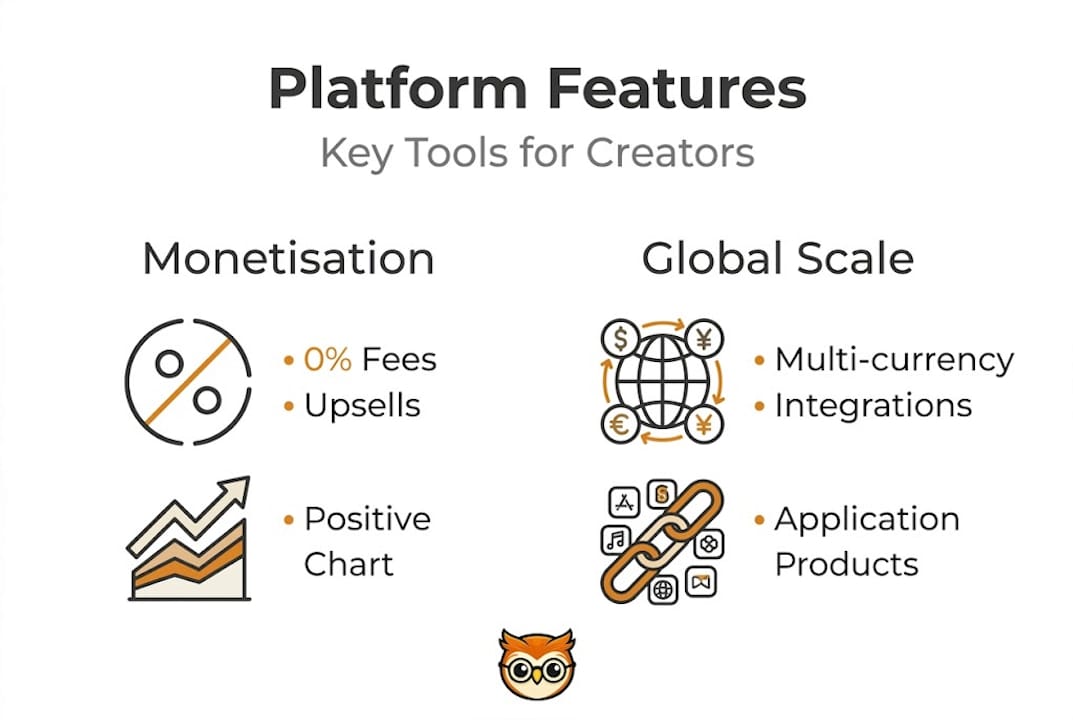
- 0% transaction fees on all plans, not just the highest tier
- Multi-currency payment processing so students see local pricing
- Custom domain support to protect your brand identity
- VAT and tax compliance tools or integrations, since international tax obligations vary significantly
- Affiliate programme capabilities to leverage word-of-mouth across new markets
- Upsell and order bump features to increase revenue per student without additional traffic
- Language support or localisation options for non-English-speaking markets
- Flexible upgrade or migration paths so you are not locked in as you grow
For global monetisation success, prioritise platforms with 0% transaction fees, multi-currency support, and upsell functionality. If budget is a constraint, begin with Thinkific or Teachable and plan a migration to Kajabi once you reach consistent monthly revenue that justifies the investment.
Pro Tip: Before migrating platforms, document every automation, email sequence, and integration you have built. Migration is far smoother when you treat it as a project rather than a spontaneous switch. Give yourself a 90-day transition window.
A common mistake when scaling internationally is assuming that platform support is sufficient. Currency conversion fees charged by your payment processor, not your platform, can quietly add 2 to 4% per transaction. Always check both layers. The combination of a 0% platform fee and a high processor fee can still erode your margins. Review strategies for global sales to understand how to structure pricing and payment flows that work across borders without surprises.
Critical lessons: why marketing and audience come before platforms
Here is the uncomfortable truth that most platform comparison guides avoid: the platform you choose matters far less than the audience you build before you launch anything.
We see this pattern repeatedly. A creator spends three months evaluating Kajabi versus Thinkific, obsessing over feature differences, then launches to an email list of 47 people and wonders why sales are slow. Another creator builds a following of 8,000 engaged readers over 18 months, launches a simple Teachable course with a basic checkout page, and generates $60,000 in the first week. The technology was never the bottleneck.
Marketing drives revenue; platforms simply handle delivery. Profit margins of 70 to 95% are genuinely achievable in this space, but those margins only materialise when someone is actually buying. Without an audience, even the most sophisticated platform is just an empty shop.
The creators who succeed long-term treat platform selection as a logistics decision, not a strategic one. They choose a platform that fits their current stage, focus their energy on content creation and audience growth, and migrate when the business demands it. They do not wait for the perfect setup before producing value.
If you are empowering educators with marketplaces and global tools, remember that the marketplace is an amplifier, not a starting point. Build something worth amplifying first. Then let the platform do its job.
Take the next step: sell digital content with BibliOWLteca
You now have a clear view of how learning platforms compare, which revenue models produce the strongest results, and what global scale actually requires. The next step is putting that knowledge into action.
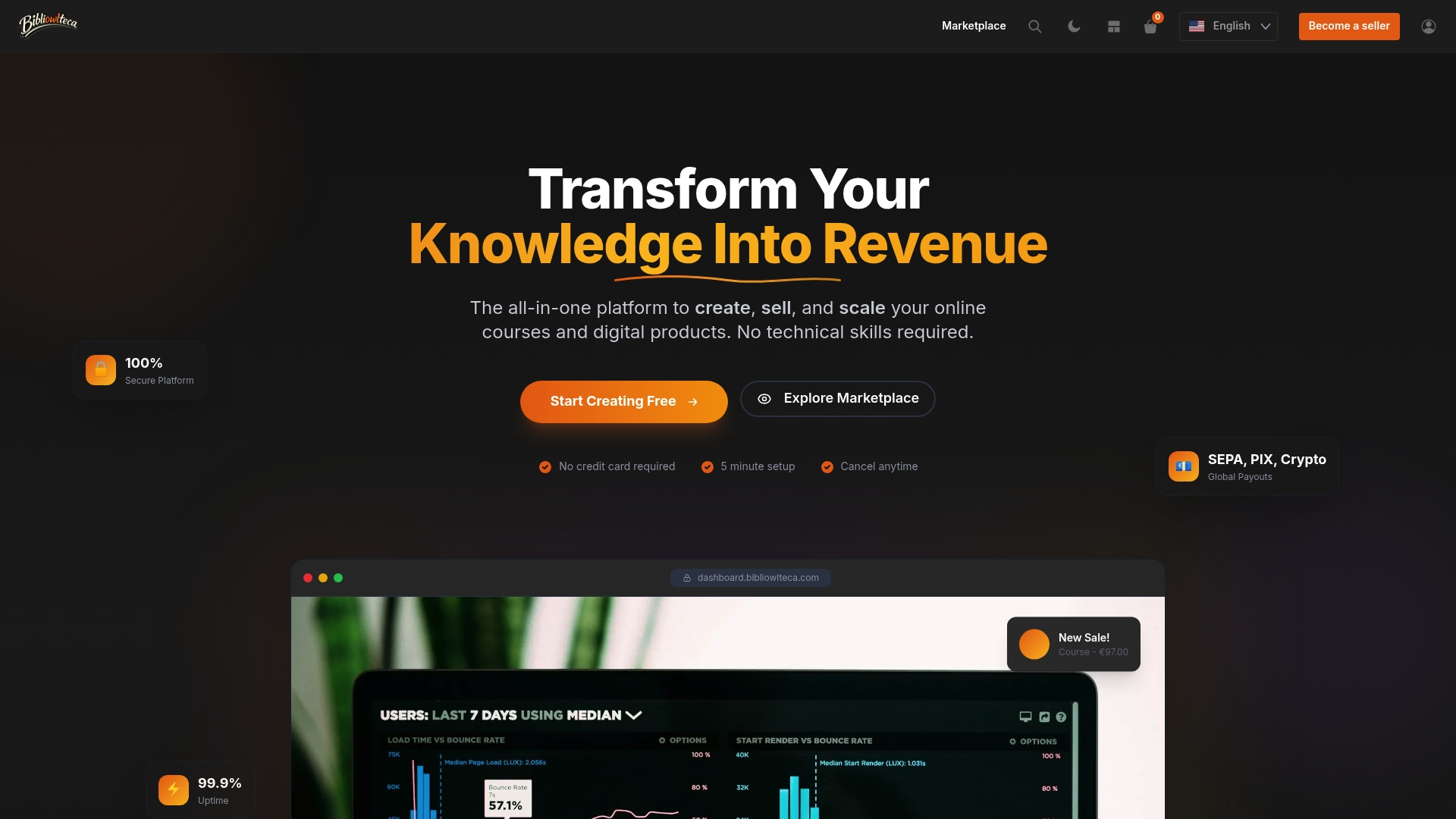
BibliOWLteca's marketplace gives creators a secure, scalable environment to sell e-books, courses, and digital products to an international audience. With built-in multi-currency payment support, tax compliance tools, and a straightforward setup process, BibliOWLteca removes the technical friction that slows most creators down at launch. There are no complex integrations to manage and no hidden fees eating into your margins. Whether you are launching your first digital product or expanding an existing catalogue to new markets, your BibliOWLteca account is ready when you are. Start selling to a global audience today.
Frequently asked questions
What is a learning platform and how does it differ from a marketplace?
A learning platform provides the tools to create, host, and deliver online courses with full branding and student management, while a marketplace connects creators with buyers but typically offers less control over platform delivery and brand identity.
How much can I realistically earn with a learning platform?
Average creators earn $37,000 per year, the top 5% earn between $1 million and $5 million annually, and the highest earners almost always combine multiple revenue streams with an active community.
What should I look for in a platform if I want to sell internationally?
Focus on 0% transaction fees, multi-currency payment support, and clear upgrade or migration paths so your platform can grow alongside your international audience without technical friction.
Does platform choice or audience size matter more for revenue?
Audience size and engagement matter significantly more. Marketing drives revenue and platforms with high margins of 70 to 95% only deliver returns when there is an engaged audience ready to purchase your products.