
TL;DR:
- Selling digital educational products globally involves complex tax compliance, platform limitations, and checkout friction.
- Proper platform evaluation and ongoing testing are essential to ensure smooth, compliant buyer experiences and protect revenue.
- Educators should shift mindset from content creation to managing a seamless digital commerce experience.
Publishing an e-book or online course feels like the exciting part. Setting up a checkout flow that handles tax-exempt schools across six different jurisdictions? That's the part nobody warns you about. Many educators pour months into developing brilliant content, only to discover that the technical and legal realities of selling digital products globally can quietly undermine all that effort. Confusing tax settings, platform limitations, and checkout friction cost real revenue every day. This guide pulls back the curtain on those complexities and gives you a clear, practical path to publishing and selling your educational products with confidence.
Table of Contents
- What are digital products and why are they ideal for educators?
- Key challenges in selling digital products globally
- How leading platforms handle pricing and tax compliance
- Choosing your platform: What matters for secure, frictionless sales
- Practical steps to publish and succeed: Your action checklist
- Why most educators underestimate digital sales complexity—and how to get ahead
- Ready to sell your digital products globally? Start here
- Frequently asked questions
Key Takeaways
| Point | Details |
|---|---|
| Understand digital product scope | Digital products for educators go beyond e-books, including courses, lesson plans, and media. |
| Watch for tax and exemption pitfalls | Automated checkout and compliance handling varies and impacts both sales and support. |
| Choose platforms with flexible tax tools | Select a marketplace that supports transparent tax display and exemption handling for global buyers. |
| Follow a sales and compliance routine | Set up, test, and regularly review pricing and tax settings to minimise admin headaches. |
| Emphasise the full buyer experience | Success means focusing on both content and the end-to-end buyer journey, not just great materials. |
What are digital products and why are they ideal for educators?
Before we explore the mechanics of global sales, it is worth getting crystal clear on what a digital product actually is and why educators are so well positioned to benefit from them.
A digital product is any item that exists in a digital format and can be delivered electronically without physical shipping. For educators and content creators, this covers a wide and growing range of formats. The most common categories include:
- E-books and PDF guides covering lesson content, study materials, or reference documents
- Online courses delivered as video modules, audio lectures, or structured written lessons
- Lesson plans and curriculum packs designed for teachers and tutors to use directly
- Webinars and recorded workshops sold as standalone access or bundled packages
- Templates, worksheets, and quizzes that complement other learning resources
- Membership content where subscribers access ongoing educational material regularly
The appeal of publishing educational materials in these formats comes from a handful of practical advantages that simply do not exist with physical products. First, there is no shipping cost, no warehousing, and no manufacturing. Once your product is created, the cost of delivering it to the ten-thousandth customer is effectively zero. Second, digital delivery is instant. A student in New Zealand who purchases your course at midnight receives access immediately, without any manual effort on your part.
Third, and perhaps most compelling for educators specifically, digital products scale in a way that one-on-one teaching never can. A single well-structured course can serve a handful of students or ten thousand, without a proportional increase in your time or energy. This creates the kind of passive income that allows educators to keep teaching whilst also building financial stability over the long term.
The market for selling e-books and courses worldwide has matured significantly. Buyers are comfortable purchasing educational content online, payment infrastructure is robust across most regions, and learners actively seek out specialist knowledge from independent creators. For educators who already have deep subject expertise, the barrier to entry has never been lower. The knowledge is already there. The challenge is in the distribution and compliance layer, which is exactly where many first-time sellers struggle.
Key challenges in selling digital products globally
Knowing why digital products are powerful is only half the picture. The other half, the part that tends to catch educators off guard, is understanding why going global creates real complexity.

Most educators enter the digital sales space thinking about content quality, course structure, and marketing. Those things matter enormously. But the mechanics of processing payments across multiple countries introduce a second layer of challenge that is rarely discussed openly.
Here are the most common pain points you will encounter when selling digital educational products to an international audience:
- Value Added Tax (VAT) and digital services tax. Many countries require sellers to collect and remit digital services tax on sales made to their residents, even if the seller is based abroad. Getting this wrong can lead to back-payments and penalties.
- Currency conversion and payout reliability. Buyers want to pay in their local currency. Sellers need payouts in their own currency. Platforms handle this with varying degrees of reliability and transparency.
- Platform limitations on tax-exempt buyers. Schools, universities, and non-profit institutions are often legally tax-exempt. On many platforms, there is simply no checkout mechanism for these buyers to declare their exemption, leading to friction, refund requests, and support overhead.
- Regional content restrictions. Some platforms cannot process payments from certain countries at all, invisibly cutting off entire markets.
- Compliance documentation. Collecting and storing the correct evidence to support your tax filings (such as buyer location data and transaction records) is the seller's responsibility, even when platforms automate parts of the process.
The most costly mistakes in digital sales are not bad products or weak marketing. They are invisible checkout problems that buyers never report, they simply leave and never return.
That last point deserves emphasis. When a tax-exempt institution hits a checkout flow that forces them to pay tax they are not legally obligated to pay, many simply abandon the purchase. You never see that as a failed sale. You see it as silence. Global digital sales strategies that account for these edge cases from the start perform materially better than those built purely around the standard buyer experience.
As a real-world example, US tax-exempt checkout gaps on platforms like Gumroad have been documented publicly. Buyers who are legally sales-tax-exempt have no way to prove that status during checkout, meaning they are charged tax and must request a refund. This is not a rare edge case. Schools, libraries, and government-funded education programmes encounter this regularly.
How leading platforms handle pricing and tax compliance
Once you understand the landscape, it helps to see how specific platforms approach these issues in practice. The differences between platforms on tax handling and pricing controls are significant and often not obvious from marketing materials alone.
Teachable is one of the more thoughtful platforms when it comes to tax-inclusive pricing. Via Settings > Taxes, tax-inclusive pricing lets you choose whether the price displayed to buyers already includes tax or whether tax is added at checkout. This seems simple but it materially affects buyer trust. When a buyer sees a price and then watches it increase at checkout, cart abandonment rises. Importantly, enabling tax-inclusive pricing on Teachable only affects new sales. Existing payment plans and active subscriptions remain on their original pricing terms, which is something sellers often miss when updating their settings.
Gumroad is widely used and generally solid for straightforward digital sales. However, as documented in its public GitHub issue tracker, the platform currently has no checkout mechanism for US customers to declare tax-exempt status. The result is that tax gets charged, then refunded manually, creating overhead for both sellers and buyers. For creators whose primary audience includes institutions, this is a meaningful limitation.
Here is a direct comparison of how three common platform types handle key tax and pricing scenarios:
| Feature | Teachable | Gumroad | Generic marketplace |
|---|---|---|---|
| Tax-inclusive pricing toggle | Yes, configurable | Limited | Varies widely |
| Tax-exempt buyer checkout | Basic support | No automated flow | Often unavailable |
| Applies to existing subscribers | No, new sales only | N/A | Varies |
| Multi-currency display | Yes | Yes | Often limited |
| Automatic VAT collection | Yes | Yes | Varies by region |
| Seller compliance documentation | Partial | Partial | Varies |
When choosing or reviewing your platform, the top e-book sales tools for educators differ most in exactly these areas. A platform that automates VAT collection but provides no support for institutional buyers may serve one segment of your audience perfectly whilst quietly losing another.
Getting your pricing digital products strategy right means accounting for how tax is presented at every stage of your checkout, not just in the final total. Buyers form strong impressions in the first few seconds of reaching your checkout. Surprise charges, even when technically correct, damage trust.
Pro Tip: Before committing to any platform for your primary product catalogue, purchase a test product from your own store using a private browser. Check the exact price display at each checkout stage, and if your audience includes schools or institutions, contact the platform's support team with a hypothetical tax-exemption scenario. Their response will tell you a great deal about how they handle edge cases.
Choosing your platform: What matters for secure, frictionless sales
With a clear picture of how platforms differ, the next practical question is: how do you actually evaluate and choose the right one for your specific situation?
The instinct for most educators is to choose whichever platform a colleague recommended or whichever one showed up first in a search. That approach works until it does not. A more rigorous evaluation process protects your revenue and your reputation long before problems surface.
Digital marketplaces for educators vary considerably across the features that matter most for compliance and buyer experience. Here is a practical evaluation framework:
- Identify your primary buyer types. Individual learners, small businesses, and institutions each have different checkout needs. If you expect institutional buyers, tax exemption handling is non-negotiable.
- Test the checkout flow end to end. Do not just look at the seller dashboard. Complete an actual purchase as a buyer and note every moment of friction or confusion.
- Review the platform's VAT and digital tax handling. Understand which regions the platform collects tax for automatically and which ones you are responsible for manually.
- Check payout currencies and schedules. Confirm that you can receive payments in your currency reliably and understand the typical payout timeline.
- Read the platform's documentation on tax-exempt buyers. If this documentation is absent or vague, treat it as a red flag.
- Evaluate customer support quality. Create a test support ticket with a complex scenario. Slow or generic responses suggest the platform is not built for sellers who need compliance-level answers.
- Look at community feedback and public issue tracking. Platforms with active public repositories or community forums often surface known limitations more transparently.
As documented in publicly reported checkout limitations, even popular platforms can have gaps that create real administrative overhead. Finding these gaps before launch is far cheaper than resolving them after you have hundreds of customers.
The distribution platforms for educators that serve this audience best tend to combine automated tax compliance with a genuinely smooth buyer experience across regions. That combination is rarer than you might expect.
Pro Tip: Ask the platform directly: "How does a US tax-exempt institution purchase my product without being charged sales tax?" If they cannot give you a clear process, you now know exactly where your support inbox will fill up.
Practical steps to publish and succeed: Your action checklist
Choosing your platform is not the end of the process. It is the beginning of an ongoing practice. Here is a structured action checklist to get your digital product business launched correctly and maintained effectively over time.
Getting started: Initial setup
- Create your seller account and complete all identity verification steps fully before publishing anything.
- Configure your tax settings immediately. Do not use default settings without reviewing them. Check whether tax-inclusive pricing is enabled, and verify which regions your platform collects tax for automatically.
- Upload your product and set your pricing in the currency most natural for your primary audience. If you sell to multiple regions, check whether buyers can see prices in their local currency.
- Write clear, specific product descriptions that set accurate expectations about format, access, and delivery. Ambiguity about what a buyer receives is a leading cause of disputes.
- Set up your payout details and confirm that your bank account or payment method is correctly connected before you make your first sale.
- Test your checkout by purchasing your own product through an incognito browser, using a real payment method. Verify the exact price display, any tax additions, and the delivery mechanism.
Compliance and institutional buyers
- Create a plain-language page or FAQ entry explaining how tax-exempt organisations should contact you to arrange a purchase. Even if your platform lacks automated exemption handling, having a clear manual process prevents lost sales.
- As noted in Teachable's tax-inclusive settings, updating pricing settings affects new sales only. Document this so you do not accidentally assume existing subscribers are affected when you make changes.
Ongoing health checks: A reference routine
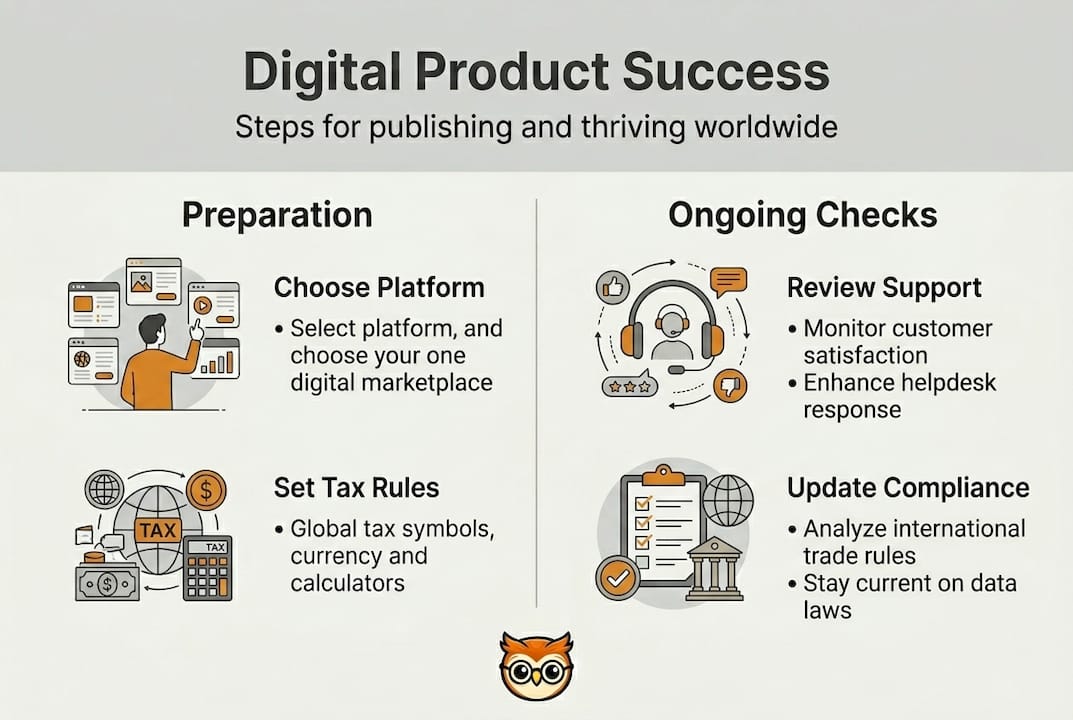
Use this schedule to keep your digital product business compliant and performing well:
| Task | Weekly | Monthly | Quarterly |
|---|---|---|---|
| Review support inbox for checkout issues | ✓ | ||
| Check sales reports for unusual drop-offs | ✓ | ||
| Review payout accuracy and currency rates | ✓ | ||
| Audit product descriptions and pricing display | ✓ | ||
| Check for platform updates affecting tax settings | ✓ | ||
| Full compliance review: tax, VAT, regional rules | ✓ | ||
| Test checkout flow from buyer's perspective | ✓ | ||
| Update institutional buyer FAQs and processes | ✓ |
Following a publishing checklist for educators like this one prevents the slow drift where settings get out of date, platform changes go unnoticed, and small compliance gaps compound into bigger problems over time.
Why most educators underestimate digital sales complexity—and how to get ahead
Here is an uncomfortable truth that most guides on this topic avoid: successful digital selling is not primarily a content problem. It is a systems and experience problem. And educators, by training and temperament, are often very good at the content part and systematically underprepared for the systems part.
This is not a criticism. It reflects the reality that educators spent years developing their expertise in a subject, not in payment infrastructure, VAT compliance, or checkout UX. When they transition to selling digital products, they naturally lead with their strength, which is knowledge. The business mechanics feel like a secondary concern until a tax-exempt school contacts you confused about a charge, or your platform changes a setting and no one receives a notification.
What separates digital sellers who grow steadily from those who plateau or burn out is a mindset shift. The shift is from thinking "I create content" to thinking "I run a digital commerce experience." These are not the same thing. The first framing puts all the attention on the product. The second framing puts equal attention on the buyer's journey from discovery through checkout through post-purchase access.
The real-world digital sales lessons that experienced sellers share almost always centre on something invisible: the checkout flow they never tested properly, the tax setting they never revisited, the institutional buyer who emailed once, got a confusing response, and never came back. These are not dramatic failures. They are quiet ones.
Invest time early in understanding what your buyers experience, not just what you intend them to experience. These two things are often quite different, especially across different countries, buyer types, and device contexts. A checkout that feels smooth on a desktop browser in the UK may display very differently for a tablet user in Brazil or an institutional procurement officer in the United States.
The creators who get ahead are the ones who test, document, iterate, and treat compliance not as a chore but as a core feature of their product. A buyer who encounters zero friction, pays the correct amount with no surprises, and receives their product instantly is a buyer who comes back and recommends you to others. That is where the real leverage in digital education lies.
Pro Tip: Set a recurring calendar reminder to review both your buyer support inbox and your full checkout flow after every major platform update. Platforms make changes to tax handling and checkout logic regularly, and these updates rarely come with prominent notifications to sellers.
Ready to sell your digital products globally? Start here
Understanding the mechanics of global digital sales puts you well ahead of most creators who skip straight to publishing. The next step is choosing an environment that supports everything you have just learnt, automatically.
BibliOWLteca is built specifically for educators and content creators who want to reach a global audience without getting buried in compliance complexity. The BibliOWLteca marketplace brings together robust tax handling, multi-currency support, and international payment processing in a single platform designed around the realities of selling educational content worldwide. Rather than piecing together workarounds for checkout gaps and exemption edge cases, you can focus on what you do best: creating knowledge worth sharing. If you are ready to publish your e-books, courses, or educational resources to a global audience with the infrastructure to back it up, BibliOWLteca is the place to start.
Frequently asked questions
How do tax-exempt buyers purchase digital products without extra admin?
On some platforms, tax-exempt checkout gaps mean buyers have no automated way to declare their status, so they are charged tax and must request a manual refund. Choosing a platform with built-in exemption handling, or providing a clear manual process for institutional buyers, reduces this overhead significantly.
Can I update tax settings for existing subscribers?
Platform changes to pricing or tax settings usually apply only to new sales. As noted in Teachable's tax settings documentation, enabling tax-inclusive pricing does not affect existing payment plans or subscriptions, meaning existing subscribers keep their original pricing terms unchanged.
Why does digital product checkout look different in each country?
Checkout flows vary by country because local tax laws, exemption rules, and platform-specific logic all differ by jurisdiction. As seen in documented checkout differences, even within a single country like the United States, edge cases such as tax-exempt buyers can produce a materially different checkout experience than the standard flow.
What's the first thing to check before selling digital content online?
Ensure your platform has transparent, configurable tax settings and a clear buyer checkout flow that handles both standard and tax-exempt purchases. Setting this up correctly before your first sale prevents the majority of compliance and refund issues.
How often should I review my digital sales settings and compliance?
Review your tax, pricing, and buyer support settings at least every quarter to keep pace with changing regulations and platform updates. Monthly checks on your sales reports and payout accuracy are also strongly recommended to catch smaller issues before they compound.