
Pay what you want pricing lets buyers choose their own price, sometimes with a suggested amount or minimum floor to guide them. It works best for digital products with near zero marginal cost, including course launches, ebooks and community resources, where the biggest risk is a crowded market rather than a loss on each unit sold.
TL;DR:
- Use ex ante pricing when buyers choose an amount before access, or ex post pricing after they try the product; post access can strengthen fairness.
- Start with an ebook, template pack, or self paced course; avoid live cohorts and custom work that require costly delivery for each buyer.
- Use your usual rate as the suggested amount, then set a minimum that admits price sensitive buyers while blocking token payments.
- Compare pay what you want pricing with your fixed price on the same traffic, tracking conversion, average payment, and revenue per visitor; test anchors and floors separately.
- Buyers often pay more than zero, but high payments may come from a loyal few; inspect payment distribution for a spike at the minimum.
Table of Contents
- How pay what you want pricing actually works
- When PWYW tends to work best for your product
- Design choices that reduce the financial risk
- How to measure whether your PWYW pilot is working
- Step by step: running a PWYW pilot safely
- How BibliOWLteca supports a PWYW pilot
- Publisher perspective: rules of thumb worth keeping
- Try a PWYW pilot on your next launch
- FAQ
- Sources
How pay what you want pricing actually works
Pay what you want splits into two main flows. In the ex ante version, buyers see the price field before they pay, often next to a suggested amount, and decide what to enter before they get the product. In the ex post version, buyers get access first (a course module, an ebook chapter, a template pack) and are asked to pay afterwards, based on what they felt it was worth. According to Wikipedia's overview of the model, both variants are common for digital products and low overhead offerings, and sellers typically soften the risk with a suggested price or a minimum floor.
The behaviour behind this is not pure economic self interest. Buyers tend to respond to fairness norms, a sense of reciprocity towards the seller, and the social signal of paying "enough". Field studies and experiments collected in a PMC review of PWYW behaviour find that many buyers pay positive amounts even with no enforcement, contrary to what a simple cost-minimising model would predict.
Three variants show up repeatedly in practice:
- A suggested price anchor displayed near the input field, which nudges buyers towards a reasonable number.
- A minimum price floor that blocks token or zero payments while keeping the rest of the range open.
- Reputation-based FairPay, where a buyer's payment history across transactions affects what they are offered next time.
When PWYW tends to work best for your product
Not every product is a good candidate. Use this checklist to judge fit before you commit to a pilot.
- Your product has near zero marginal cost to deliver, such as an ebook, a template pack or a recorded course.
- You are launching something new and want trial, feedback or word of mouth more than maximum revenue on day one.
- Your audience is a community, a mailing list or a following with some existing trust in you.
- Your fulfilment cost per unit is low enough that a handful of minimal payments will not create a loss.
- You are not selling a single expensive item (a one-to-one coaching package, custom consulting) where a bad outcome from one buyer matters a lot.
PWYW becomes risky once fulfilment cost rises or when the product requires your time per buyer. A cohort-based live course with a hard cap on seats is a weaker fit than a self-paced ebook you can sell endlessly at near zero cost.
Design choices that reduce the financial risk
The gap between "letting buyers pay anything" and "a workable pricing experiment" comes down to a few design levers.

A suggested price works as an anchor: most buyers look for a cue before typing a number, and a visible suggestion (even one they can override) pulls the average payment towards it rather than towards zero. The systematic literature review on ScienceDirect notes that economic, subjective and social predictors all shape how much people pay, and a well-placed anchor is one of the few levers sellers fully control.
A minimum price floor protects you from token payments without removing the flexibility buyers value. A £2 floor on a £15 suggested-price ebook still lets price-sensitive buyers in while cutting off £0.10 non-payments. Wikipedia's entry on the model lists floors as the standard fix for exploitative non-payment.
- Ex post flows (pay after reading or watching) tend to raise perceived fairness because buyers already know what they got.
- Phrasing matters: "pay what felt fair" performs differently from "pay what you can", since the first invokes fairness norms and the second invokes charity.
- FairPay-style reputation systems work well for repeat buyers of a course library, since past fair payments can unlock better future offers.
Pro Tip: Set your suggested price at what you would normally charge, not at a discount, since buyers anchor on that number more than they discount from it.
How to measure whether your PWYW pilot is working
Three numbers tell you most of what you need. Conversion rate is the share of visitors who complete a purchase at any price. Average paid price is the mean of what buyers actually enter. Revenue per visitor (or ARPU across a cohort) multiplies the two and is the number that tells you whether PWYW beat your usual fixed price.
- Run an A/B test of PWYW against your normal fixed price on the same traffic source to isolate the pricing effect.
- Test two suggested-price anchors (for example one higher, one lower) to see how much the anchor itself moves the average.
- Test with and without a floor to measure how many buyers would have paid near zero without one.
Field studies on PWYW show that buyers often pay a positive amount rather than defaulting to zero, with payments in some experiments exceeding the price the seller would have set, as documented in Kim, Natter and Spann's study in the Journal of Marketing. That pattern, replicated across several field settings, is the main reason PWYW is worth testing rather than dismissing on instinct.
When you look at the distribution of payments rather than just the average, watch for a spike at your floor (a sign buyers are paying the minimum rather than engaging with the price decision) and a long tail of high payments from a small group, which usually signals strong existing loyalty rather than typical buyer behaviour.
Step by step: running a PWYW pilot safely
- Pick one low-cost, repeatable product (an ebook, a short course, a template bundle) and set a clear goal: more conversions, more reach, or test data on willingness to pay.
- Write product page copy that states the suggested price plainly and explains, in one line, why you are trying this ("to make this reachable at launch").
- Set your payment flow with a floor, a default suggested amount, and your usual tax and fee settings switched on exactly as they would be for a fixed-price sale.
- Run the pilot for a fixed window (a launch week, a month), track conversion rate and average paid price daily, then adjust the anchor or floor once you have enough data to see a pattern.
Combining PWYW with a small base fee or minimum commitment, a hybrid approach recommended in Stripe's guidance on flexible pricing, keeps the behavioural upside of buyer-set prices while giving you a revenue floor you can plan around. For the payment administration itself, from recurring billing to automated reminders, tools built for structured collection such as those covered in Settleo's guide to payment types are worth a look if you plan to run PWYW alongside subscriptions or instalments.
How BibliOWLteca supports a PWYW pilot
Running a PWYW test means juggling pricing fields, currencies, tax rules and delivery all at once, and that is the part of the stack we built for.
- Flexible checkout and pricing controls that let you set a suggested price and a floor on individual listings rather than locking every product to one fixed figure.
- Multi-currency payments and built-in tax handling, so a buyer paying in a different currency still lands on a price your compliance settings already account for.
- Delivery and analytics tools that hand you conversion and average paid price data per product without a separate tracking setup.
Ebooks, short courses and templates are the product types best suited to a first PWYW test on our categories page, since each carries near zero fulfilment cost per additional buyer.
Publisher perspective: rules of thumb worth keeping
The creators who get the most out of PWYW treat it as a repeatable experiment, not a one-off stunt. Start with a cheap, digital, repeatable product, always show a suggested anchor, and resist the urge to remove your floor just because early numbers look soft. Pair it with a fixed-price option once you have a season of data, and only scale PWYW to higher-value products once the pattern holds across more than one launch.
— BibliOWLteca
Try a PWYW pilot on your next launch
Testing pay what you want pricing is far easier when your checkout, currency handling and tax settings are already built for flexible pricing rather than bolted on afterwards.
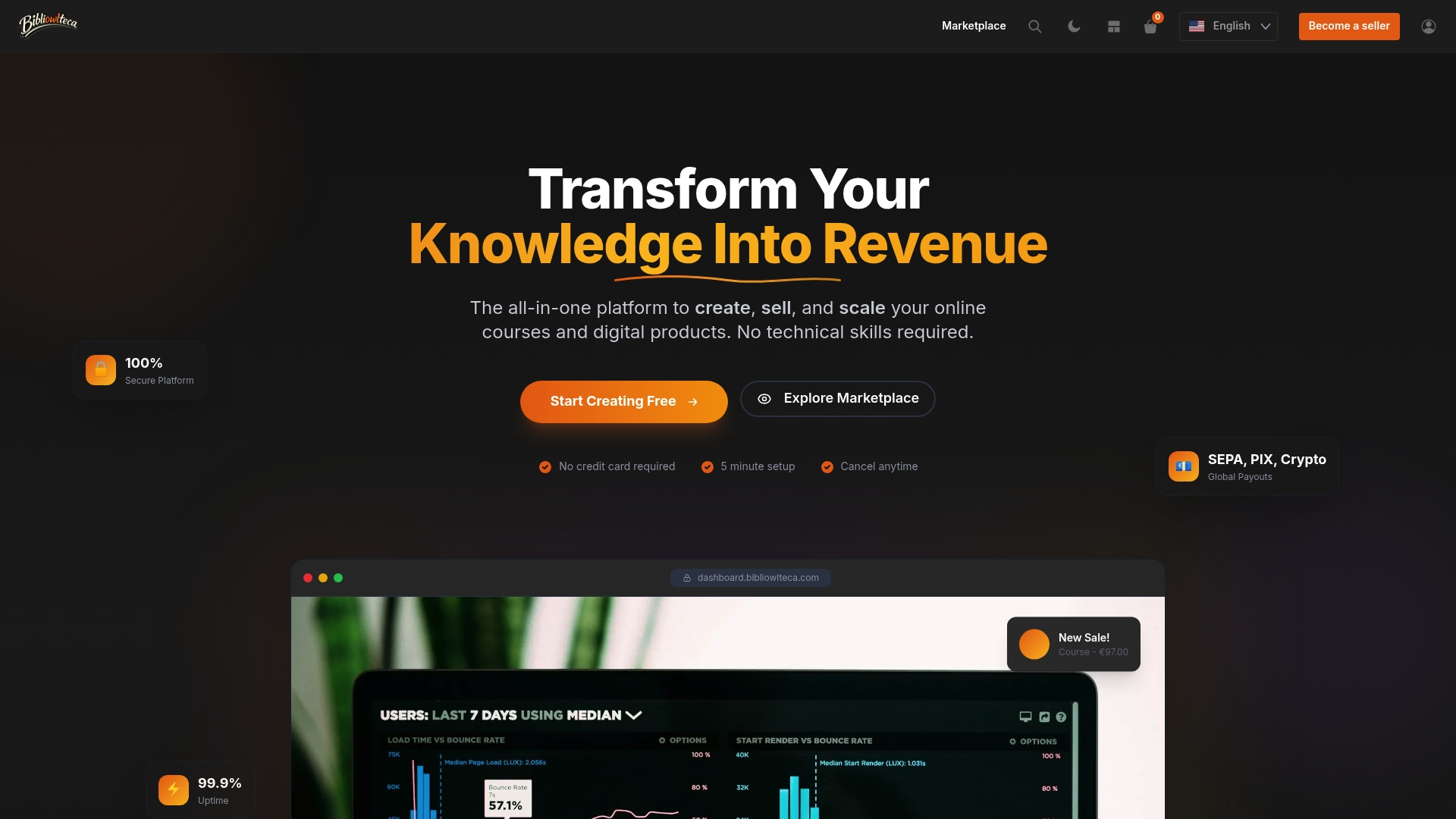
We offer pricing controls, multi-currency checkout and instant digital delivery that enable you to run a PWYW pilot on an ebook, a short course or a template pack without rebuilding your sales page. Setup takes a product listing and a suggested price field, not a new store.
- See current plan details and the transaction fee structure on our pricing page.
- Browse how a PWYW-ready listing looks on our ebook product page.
- Check category fit for finance and business titles on our digital downloads page.
Visit our Creator Plan pricing to set up your first PWYW listing.
FAQ
What does "pay what you want" mean?
Pay what you want means the buyer chooses the price, sometimes guided by a suggested amount or restricted by a minimum floor the seller sets. It differs from a fixed price model because the final amount is decided at the point of purchase by the buyer rather than listed in advance.
What is pay per use pricing?
Pay per use pricing charges customers based on how much of a product or service they actually consume, such as per API call or per unit of usage, rather than a flat subscription. It is a usage-based model, distinct from PWYW, which lets the buyer set the amount rather than tying price to consumption, as outlined in Stripe's guidance on usage-based billing.
Is there a fee to use GPay?
This article does not cover Google Pay fee structures, since that detail sits outside PWYW pricing design. For official fee information, check the payment provider's own published terms.
Is pay.gov legit?
Pay.gov is a legitimate official US government payment portal, and according to its own FAQs, there is no charge to use the service itself. Any fee a payer sees usually comes from the agency or the payment method, not from Pay.gov.
Do academic studies support pay what you want pricing?
Field studies and experiments, including research published in the Journal of Marketing, find that buyers frequently pay more than zero under PWYW, often driven by fairness and reciprocity rather than pure self interest. A systematic review of the evidence confirms the pattern while noting that long-term sustainability still needs more research.
Sources
- Pay-what-you-want — Wikipedia
- Pay What You Want: A New Participative Pricing Mechanism — Journal of Marketing (Kim, Natter, Spann)
- Systematic literature review of PWYW — ScienceDirect
- Pay-per-use pricing — Stripe
- Pay