
TL;DR:
- Subject indexing assigns standardised terms from controlled vocabularies to improve topic-based retrieval of digital educational content. It offers consistency, better precision, and hierarchical browsing, essential for large collections. Combining automated algorithms with human review ensures scalable, accurate, and trustworthy indexing practices.
Subject indexing is the process of analysing a document's content and assigning standardised subject terms from a controlled vocabulary to enable topic-based retrieval in catalogues and search systems. For content creators and educators, understanding what is subject indexing means understanding why some digital materials surface instantly in a search and others disappear into obscurity. Systems like the Library of Congress Subject Headings (LCSH), the Medical Subject Headings (MeSH) thesaurus, and databases such as PsycInfo all rely on this discipline to connect learners with relevant resources. Whether you publish e-books, courses, or research guides, subject indexing is the structural backbone that makes your content findable by topic rather than by title alone.
What does subject indexing achieve for digital educational content?
Subject indexing groups related documents under standard subject terms so that users find all relevant resources on a topic in a single search, rather than hunting by author name or guessing at titles. This is particularly significant for educators who manage large collections of digital materials across multiple subjects and levels. When a learner searches for "cognitive development in early childhood," a well-indexed repository returns every relevant course, e-book, and guide regardless of whether the creator used that exact phrase.
The benefits extend well beyond basic retrieval. Subject indexing reduces ambiguity by replacing the chaos of free-text tagging with authoritative, agreed-upon terms. It also supports two distinct modes of searching: directed searching, where a user knows what they want, and exploratory browsing, where a user is discovering a field. Cross-references between broader, narrower, and related terms guide learners through a subject area in a way that no keyword cloud can replicate.
For educators building digital repositories or course libraries, the practical advantages are considerable:
- Consistency across creators. When multiple educators contribute materials, subject headings prevent synonym drift. One creator calls it "formative assessment," another calls it "ongoing evaluation." A controlled vocabulary maps both to the same authoritative term.
- Improved precision. Controlled subject headings reduce synonym mismatch and improve retrieval precision compared to simple keyword tags, which vary with every author's word choice.
- Browsable subject trees. Hierarchical subject structures let learners move from a broad topic like "Mathematics" down to "Algebra" and further to "Quadratic equations," discovering related materials at each level.
- Cross-referencing. A record indexed under "Special educational needs" may carry a "see also" reference to "Inclusive education," guiding users to adjacent resources they would not have thought to search for.
- Richer metadata. Subject headings sit inside structured metadata fields, making your content readable not just by human users but by search engines, aggregators, and library discovery systems.
Pro Tip: When building a course library or digital repository, adopt a single subject heading list from the outset rather than retrofitting one later. Retroactive indexing is far more time-consuming than applying terms at the point of publication.
How does subject indexing work? Techniques and controlled vocabularies
The methodology behind subject indexing follows a clear sequence, though the skill lies in the judgement applied at each step. Professional indexers at institutions such as the Library of Congress select subjects using evidence drawn from a document's title, abstract, table of contents, and body text, weighing the prominence and significance of each theme before assigning terms. For visual materials such as photographs or infographics, the process is more interpretive, requiring the indexer to infer subject matter from context rather than explicit text.

The core tool in any subject indexing system is the controlled vocabulary. A controlled vocabulary is a curated list of authorised terms where each concept has one preferred label and a defined set of relationships to other terms. LCSH, used by libraries worldwide, contains hundreds of thousands of headings with scope notes, broader terms, narrower terms, and related terms. MeSH, maintained by the US National Library of Medicine, performs the same function for biomedical literature. In research databases like PsycInfo, each record receives multiple subject headings to improve search relevance well beyond what free-text keywords can achieve.
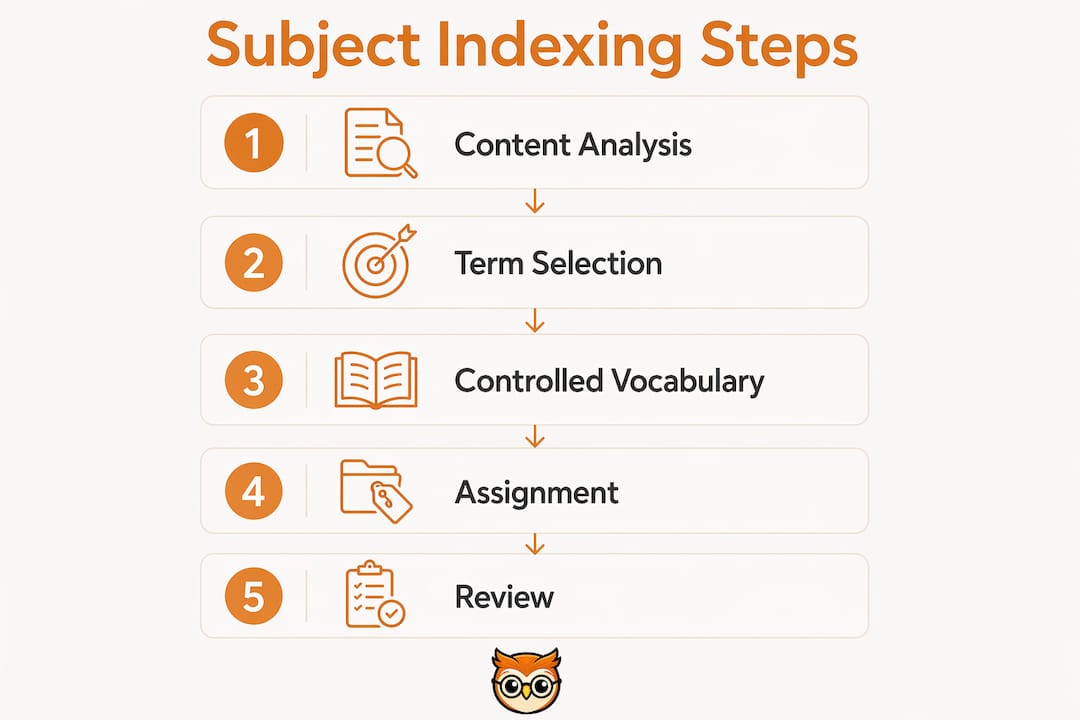
The practical process of subject indexing follows these steps:
- Read the document. Examine the title, abstract, introduction, and conclusion to identify the primary themes. Do not rely on the title alone; authors frequently use creative or ambiguous titles that obscure the actual subject matter.
- Identify the core concepts. Determine which topics are treated with depth and which are merely mentioned in passing. A document about "project-based learning in secondary schools" has two core concepts: the pedagogy and the educational level.
- Consult the controlled vocabulary. Search the relevant thesaurus or subject heading list for authorised terms that match the identified concepts. Check scope notes to confirm the term covers the intended meaning.
- Assign multiple headings. A single document typically receives several subject headings to capture its full scope. A course on "climate change communication" might be indexed under "Environmental communication," "Climate change," and "Science journalism."
- Apply subdivisions where available. Many controlled vocabularies allow geographic, chronological, or form subdivisions. LCSH permits headings like "Education, Higher, Great Britain, History, 20th century," adding precision that a flat keyword tag cannot provide.
- Record your reasoning. In professional cataloguing environments, indexers document why particular terms were chosen, especially for ambiguous materials. This supports quality review and consistency across a team.
The difference between this process and simple tagging is substantial. Subject headings from controlled vocabularies provide consistency across different content creators using varied terms for the same concepts, whereas free tags reflect only the individual creator's vocabulary at the moment of publication.
Manual vs automated subject indexing: which approach suits educators?
Manual subject indexing, as described above, produces high-quality, precise results because a trained human reads the document, exercises judgement, and selects terms with full awareness of context. The limitation is speed and scale. A professional cataloguer might index 20 to 40 items per day. For a platform hosting thousands of educational resources, manual indexing alone is not a realistic solution.
Automated subject indexing addresses the scale problem by using algorithms and, increasingly, large language models to map document text to controlled vocabularies and produce ranked subject concepts. The performance of these systems is measured using precision, recall, and F1 scores. Precision measures how many of the assigned terms are correct; recall measures how many of the correct terms were actually assigned. Automated systems tend to favour recall over precision, which means they cast a wide net but may include irrelevant or loosely related terms.
| Dimension | Manual indexing | Automated indexing |
|---|---|---|
| Speed | Slow (20 to 40 items per day) | Fast (thousands of items per hour) |
| Precision | High, with expert judgement applied | Variable; tends to favour recall |
| Consistency | Dependent on indexer training | Consistent once the model is trained |
| Cost | High (skilled labour required) | Lower at scale after initial setup |
| Contextual nuance | Excellent for complex or visual content | Weaker for ambiguous or visual materials |
| Quality control | Built into the process | Requires human review or confidence thresholds |
Automated indexing systems often require human-in-the-loop checks to maintain trustworthiness, particularly in educational contexts where an incorrectly indexed resource could mislead a learner or fail a curriculum alignment check. The most effective current approach combines both methods: automated indexing handles the bulk of a collection at speed, and human reviewers check edge cases, low-confidence assignments, and newly published materials.
For educators and content creators, the practical implication is that you do not need to choose one approach absolutely. Platforms and repositories that support semantic indexing for educational materials increasingly offer hybrid tools where AI proposes subject terms and the creator confirms or adjusts them before publication.
Pro Tip: When using automated indexing tools, set a confidence threshold below which all suggested terms require human review. A threshold of around 70 to 80 percent confidence typically balances efficiency with accuracy for educational content.
How to implement subject indexing for your digital educational materials
Applying subject indexing principles to your own content does not require a library science qualification. It does require a consistent process and the right reference tools. The steps below are designed specifically for educators and content creators working with digital materials such as e-books, online courses, and educational guides.
- Choose a controlled vocabulary suited to your subject area. LCSH is the broadest and most widely adopted, making it a sound default for general educational content. For health and life sciences, MeSH is the standard. For education-specific materials, the ERIC Thesaurus, maintained by the US Department of Education, provides terms aligned with curriculum and pedagogy. Selecting the right list from the start prevents costly rework later.
- Embed subject headings in your metadata fields. Most content management systems, learning management systems, and digital publishing platforms provide metadata fields for subject or keyword. Use these fields to enter authorised subject headings rather than informal tags. This makes your content readable by library discovery systems and educational aggregators that harvest metadata.
- Assign between three and eight subject headings per item. Too few headings leave gaps in retrieval; too many dilute precision. For a 90-minute course on "data literacy for secondary school teachers," appropriate headings might include "Data literacy," "Information literacy," "Secondary education," "Teacher training," and "Digital skills."
- Use a thesaurus to check for related and narrower terms. Subject-heading thesauri can be expanded to include related narrower terms, capturing more relevant records than keyword searching alone would retrieve. If your course covers "formative assessment," check whether the thesaurus also lists "Assessment for learning" or "Diagnostic assessment" as related terms worth including.
- Combine subject headings with keyword tags, but keep them separate. Subject headings and keywords serve different functions. Subject headings provide controlled, consistent access; keywords capture the specific language your audience uses in search engines. Maintain both in your metadata, but do not conflate them. A learner searching Google uses different language than a librarian searching WorldCat.
- Audit your indexing periodically. Controlled vocabularies evolve. LCSH updates its headings regularly to reflect changes in language and scholarship. Review your subject headings annually and update any deprecated terms to maintain retrieval accuracy. An online library search guide can help you understand how subject terms behave differently across platforms and databases.
- Monitor discoverability outcomes. Track which subject headings drive traffic to your materials through your platform's analytics. If a heading generates no searches, consider whether it is too specialised or whether learners use different terminology. Adjust accordingly, always within the constraints of your chosen controlled vocabulary.
The importance of subject indexing becomes most apparent when a collection grows beyond a few dozen items. At that scale, informal tagging systems collapse under the weight of inconsistency, and learners begin to miss relevant materials simply because no one standardised the vocabulary used to describe them. Structured subject access, applied consistently from the beginning, scales with your collection rather than against it.
Key takeaways
Subject indexing is the single most effective method for making digital educational content consistently discoverable by topic across diverse audiences and platforms.
| Point | Details |
|---|---|
| Core definition | Subject indexing assigns standardised terms from a controlled vocabulary to enable topic-based retrieval. |
| Controlled vocabularies | Tools like LCSH, MeSH, and the ERIC Thesaurus provide authorised terms that prevent synonym drift across creators. |
| Manual vs automated | Manual indexing offers precision; automated systems offer scale. A hybrid approach suits most educational platforms. |
| Practical implementation | Assign three to eight subject headings per item, embed them in metadata fields, and audit annually for deprecated terms. |
| Discoverability impact | Combining subject headings with keyword tags maximises retrieval across both library systems and general search engines. |
Subject indexing in the age of AI: a perspective from BibliOWLteca
The conversation around subject indexing has shifted considerably in the past two years. Large language models can now propose subject headings with reasonable accuracy, and several repository platforms have begun integrating AI-assisted indexing into their publishing workflows. At BibliOWLteca, we find this genuinely exciting. But we also think the enthusiasm sometimes outruns the evidence.
The uncomfortable reality is that automated indexing systems still struggle with nuance. A course titled "Bridging the gap in STEM education" might be assigned headings related to engineering infrastructure by an algorithm that reads "bridging" too literally. A human indexer catches that immediately. An AI system with no confidence threshold does not. The precision versus recall trade-off in automated indexing is not a minor technical detail. For educators, it determines whether a learner finds the right course or a loosely related one.
What we advocate for at BibliOWLteca is a position that most technology vendors are reluctant to take: controlled vocabularies are not a legacy technology waiting to be replaced by AI. They are a quality standard that AI should be trained to respect. The consistency that LCSH or MeSH provides across thousands of creators and millions of documents is precisely what makes a collection trustworthy and navigable. Abandoning that consistency in favour of algorithmically generated tags is a step backwards dressed up as progress.
Our practical advice is to treat AI-suggested subject terms as a first draft, not a final answer. Review them. Adjust them against your chosen controlled vocabulary. And build that review into your publication workflow from the start, not as an afterthought. The educators who do this now will have collections that remain discoverable and coherent as their libraries grow. Those who rely entirely on automated tagging will spend considerable time later untangling the inconsistencies.
The role of libraries in academic growth has always depended on the quality of subject access. Digital education platforms are now the libraries of the 21st century. The same standards apply.
— BibliOWLteca
How BibliOWLteca helps you organise and sell educational content
BibliOWLteca is built for educators and content creators who take the discoverability of their materials seriously. The platform supports structured metadata and subject tagging at the point of publication, so your e-books and courses are organised for both human browsing and search engine indexing from the moment they go live.

When you publish on BibliOWLteca, you manage your own store, set your own pricing in multiple currencies, and reach a global audience without the technical overhead of building your own infrastructure. Subject indexing principles are built into the platform's content management tools, meaning your materials surface in the right searches rather than getting lost in a sea of unstructured tags. If you want to see the full range of tools available for organising and selling educational content, explore BibliOWLteca's features to find what fits your publishing workflow.
FAQ
What is the definition of subject indexing?
Subject indexing is the process of analysing a document's content and assigning standardised subject terms from a controlled vocabulary to enable topic-based retrieval. It differs from keyword tagging in that terms come from an authorised list rather than the creator's own word choice.
What are examples of subject indexing systems?
The Library of Congress Subject Headings (LCSH), the Medical Subject Headings (MeSH) thesaurus, and the ERIC Thesaurus are the most widely used subject indexing systems. Research databases such as PsycInfo also apply controlled vocabulary subject headings to every record in their collection.
How does subject indexing differ from keyword indexing?
Subject indexing uses authorised terms from a controlled vocabulary, ensuring consistency regardless of how different creators describe the same concept. Keyword indexing reflects the author's or creator's own language, which varies widely and leads to synonym drift that reduces retrieval precision.
Why is subject indexing important for educational content?
Subject indexing groups all materials on a topic under a single authorised term, so learners find every relevant resource in one search rather than missing items described with different wording. For growing digital collections, this consistency is what keeps a library navigable as it scales.
Can automated tools replace manual subject indexing?
Automated subject indexing tools can process large volumes of content quickly, but they tend to favour recall over precision, meaning they may assign loosely relevant terms without human review. A hybrid approach, where AI proposes terms and a human confirms them, currently produces the most reliable results for educational materials.