TL;DR:
- A structured close reading workflow involves three distinct stages—understanding, analysing, and synthesising—to deepen comprehension and interpretation. Preparing with suitable texts and annotation tools is essential for effective engagement, focusing on deliberate features and avoiding over-annotation. Digital tools enhance this process but must be used as supports, not substitutes, for analytical thinking.
Most readers finish a text and feel they understood it, only to realise they cannot explain what the author actually did or why it worked. Surface-level reading is a habit, not a limitation. A structured close reading workflow changes that habit by giving you a repeatable process for moving from initial impression to evidence-based interpretation. Whether you are analysing a poem for an essay, studying a dense academic article, or shaping source material into content you will publish, this guide walks you through each stage with the specificity that generic reading advice never provides.
Table of Contents
- Key takeaways
- Your close reading workflow starts with preparation
- The three-read method explained
- From annotations to argument
- Adapting the workflow for digital work
- Common close reading mistakes
- My honest take on close reading workflows
- Deepen your reading practice with BibliOWLteca
- FAQ
Key takeaways
| Point | Details |
|---|---|
| Preparation shapes the outcome | Choosing the right text length and setting up annotation tools before you start prevents distraction and directs your focus. |
| Three reads build real comprehension | A three-stage reading process separates orientation, analysis, and synthesis so each stage has a clear, manageable purpose. |
| Annotations need direction | Predetermining what textual features to look for stops you collecting irrelevant notes and keeps your analysis sharp. |
| Arguments come from selected evidence | Converting annotations into a claim requires choosing one to three strong pieces of evidence and building outward from there. |
| Digital tools support but do not replace judgement | AI summarisation and digital annotation speed up orientation and organisation, but the interpretive work remains yours. |
Your close reading workflow starts with preparation
Before you read a single word analytically, two decisions shape everything that follows: what text you choose and how you set up your working environment. Get these wrong and your workflow collapses at the first obstacle.
Choosing the right text
Not every text rewards close reading in the same way. For students and educators building the skill from scratch, short, rich texts of roughly 100 to 400 words offer the best balance of complexity and manageability. A passage this length contains enough linguistic and structural detail to practise on without becoming overwhelming.
What makes a text rich? Look for writing where the author's choices feel deliberate. Poetry is the obvious starting point, but literary essays, speeches, op-eds, and even advertisement copy repay close attention. For content creators specifically, analysing a well-constructed newsletter or longform article gives you double value: you sharpen your reading skills while studying a model you can learn from structurally.
For nonfiction and academic texts, you do not need to apply close reading to the whole document. Feature hunting in selected passages with focused rereading is far more productive than trying to analyse every paragraph at the same depth.
Setting up your tools
Your annotation tools determine how much analytical work you can capture and revisit. Physical readers often do best with a pencil rather than a highlighter, since a pencil lets you write marginal questions, not just mark text. If you are working digitally, choose a PDF reader or annotation platform that supports colour-coded highlights and threaded comments.
Here is a quick checklist for preparation:
- Print or open the text in a format that allows annotation
- Decide in advance whether you are working on paper or digitally
- Set aside a focused block of time, at least 30 minutes without interruptions
- Have a separate notebook or document open for synthesis notes
- Remove notifications from your device or workspace
Pro Tip: Before your first read, write one sentence at the top of your notes page stating what you already know or expect from this text. This primes your critical attention and gives you a baseline to challenge as you read.
The three-read method explained
The most reliably effective close reading workflow follows three distinct reads, each with a separate objective. Attempting to annotate and synthesise during a first read conflates tasks that work better in sequence. The three reads method builds comprehension and analytical depth in stages: first read for gist, second read for craft analysis, third read for synthesis.
First read: understand before you judge
Read the text straight through without annotating. Your only goal here is to grasp the gist. What is the text about? What is the general tone? What is your initial emotional or intellectual response? Resist the urge to underline anything. This read is about orientation, not evaluation.

After finishing, jot down two or three sentences describing what you understood and what surprised or confused you. These notes become your compass for the second read.
Second read: analyse the author's choices
This is where the real analytical work happens. You are no longer asking what the text says. You are asking how and why the author says it in this particular way. Effective close reading analyses multiple language layers systematically, covering diction, syntax, imagery, figurative language, tone, and structure.
Here is how to structure your second read annotation:
- Read one paragraph or stanza at a time. Pause after each unit and annotate before moving on.
- Focus on specific features you predetermined. Word choice, sentence length patterns, repeated sounds or images, and grammatical structures are all productive starting points.
- Write questions, not just observations. "Why does the author choose a passive construction here?" is more generative than "passive verb."
- Mark patterns, not just individual instances. A metaphor appearing once may be coincidental. Three metaphors from the same semantic field suggest deliberate authorial intent.
- Note what is absent as well as what is present. If a character is never named, that omission is itself a choice worth examining.
- Keep your annotations brief. A two to five word marginal note is more useful than a sentence that restates the text.
Targeted annotations, focused on specific literary features, prevent you from collecting a mass of notes that have no analytical direction. Over-annotation is one of the most common traps in this stage, and it derails the third read.
Pro Tip: Assign a colour to each feature category before you start. Blue for imagery, red for syntax patterns, green for tonal shifts. Colour-coded annotations make the third read dramatically faster and reveal patterns you might otherwise miss.
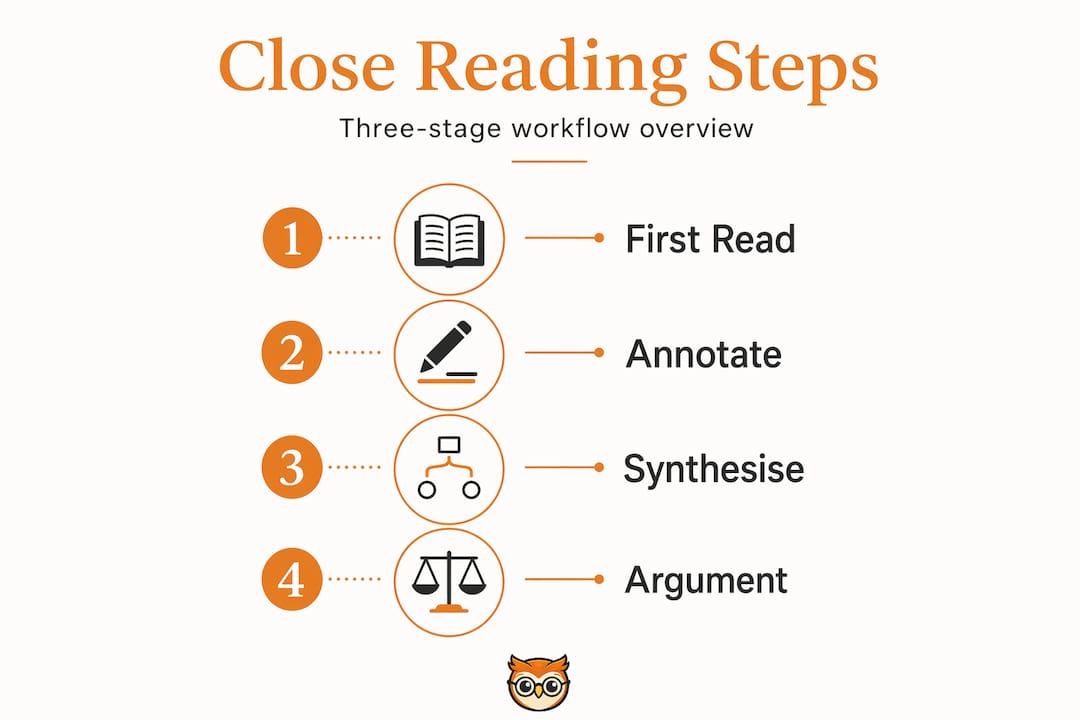
Third read: synthesise into interpretation
With your second-read annotations in place, read the text once more. This time, you are looking for connections between the features you marked. Which annotations cluster together? Which observations from different parts of the text seem to respond to each other?
Close reading reveals authorial intent through subtle patterns that only become visible once you have labelled the individual components. The third read is where those patterns become an argument.
From annotations to argument
Annotations alone are not close reading. Annotations become close reading only when organised to support a thesis with evidence. This transition from note-taking to argument construction is where many students stall, and it is genuinely a separate skill.
Building your claim
Start by reviewing your annotations and asking: what do these observations, taken together, suggest about the text's meaning or effect? A good close reading thesis is specific and debatable. "The poem uses darkness imagery" is an observation. "The poem's progressive darkening imagery maps the speaker's shift from grief to acceptance" is a claim that requires evidence and earns the reader's attention.
Converting annotation into an argument works best when you select one to three strong evidence pieces and formulate your thesis before you begin writing. Trying to use every annotation you collected results in an unfocused analysis.
Structuring your analysis
A reliable framework for organising a close reading argument uses four components:
| Component | What it does | Example |
|---|---|---|
| Claim | States the interpretive argument | "The syntax mimics the character's psychological fragmentation." |
| Evidence | Quotes or describes the specific textual moment | The sentence beginning "He stopped. Then stopped again." |
| Warrant | Explains the connection between evidence and claim | Short, repetitive syntax creates a sense of arrested motion. |
| Significance | Explains why this matters to the text's larger meaning | This reinforces the theme of paralysis in grief. |
Work through this structure for each piece of evidence you select. Then ask which order of evidence is most persuasive: chronological through the text, or building from smallest to largest scale? For academic essays, building from local detail to wider significance usually carries more conviction.
- Avoid using evidence that only restates the claim rather than supporting it
- Dismiss any annotation that cannot be connected to your thesis through a clear warrant
- Aim for precision over quantity: one sharply analysed quotation beats three vaguely referenced ones
Adapting the workflow for digital work
The three-read method was developed in a world of printed texts, but it maps surprisingly well onto digital environments. The core logic does not change. The tools do.
Digital annotation tools enable colour-coding, searchable notes, and detailed commenting, which makes the second read particularly powerful for tracking patterns across long documents. A searchable highlight lets you pull every instance of a specific image pattern in seconds, a task that takes considerably longer on paper.
For content creators, the close reading workflow doubles as a content research method. When you are drafting an article or script based on source material, a structured reading process extracts far more usable insight than a single skimming pass. Annotating a source text for argument structure, evidence quality, and rhetorical moves gives you raw material for original analysis rather than summary.
Here is how the workflow shifts in a digital context:
- Use annotation software that supports nested comments so you can build on observations across reads
- Create a separate synthesis document where you paste standout annotations alongside your emerging thesis
- For long nonfiction, annotate chapter conclusions and opening paragraphs first, then select two or three sections for deep second-read treatment
- Explore AI tools for educators and creators to support orientation and synthesis without replacing critical analysis
AI summarisation tools can consolidate your annotations and highlight central ideas, which speeds up the transition into the third read. Use them to organise, not to interpret. The moment you let an AI tool generate your claim, you have exited the close reading process entirely.
| Stage | Physical workflow | Digital workflow |
|---|---|---|
| First read | Read straight through, pencil aside | Read in browser or PDF reader, no marking |
| Second read | Pencil annotations, marginal notes | Colour-coded highlights, threaded comments |
| Third read | Review annotations, draft thesis | Search highlights by colour, synthesis document |
| Argument building | Written outline | Digital notes export to writing tool |
Common close reading mistakes
Even readers who understand the theory of close reading make predictable errors when they practise it. Knowing these traps in advance is the most efficient way to avoid them.
Summarising instead of analysing is the single most common mistake. A summary tells you what happened. An analysis tells you how the text constructed that event and why those choices matter. Whenever you catch yourself paraphrasing the text's content, stop and ask: what is the author doing with language here, and what effect does that choice create?
Over-highlighting is the annotation equivalent of the same error. When everything is marked, nothing is marked. Selective annotation, focused on evidence for a specific claim, produces a legible and usable set of notes. Over-annotation produces noise.
Other patterns worth watching for:
- Focusing on content rather than craft: analysing what a character does rather than how the author constructed that character through language
- Treating your first-read impression as your final interpretation, rather than a hypothesis to test against evidence
- Skipping the third read because the second read felt thorough enough
- Writing annotations that are too long, essentially paraphrasing rather than labelling
Pro Tip: After your second read, cover your annotations and read the text once more. If your covered notes contain mostly paraphrase, redo them with a focus on the author's technique rather than the text's content.
"Close reading is not about reading more carefully. It is about reading with a specific question in mind and following the evidence wherever it leads."
My honest take on close reading workflows
I have watched a lot of people attempt close reading and abandon it after one or two tries, convinced the problem is their intelligence or patience. It almost never is. The problem is that they are treating close reading as a single act rather than a structured process with distinct stages.
What I have found, working with educators and content creators who are serious about their craft, is that the three-read structure is not just pedagogically sound. It genuinely reduces cognitive load by giving each read a single job. When you stop trying to analyse and synthesise simultaneously during your first pass, the whole experience becomes less effortful and more productive.
The digital tools question is worth being direct about. AI summarisation is genuinely useful for orientation, particularly with dense academic texts where a quick overview of central arguments saves time. But I have seen creators rely on it too heavily and end up with a confident-sounding summary of someone else's argument rather than an original interpretation. The moment you outsource the synthesis stage, you lose the close reading benefit entirely.
One thing I would add that most guides omit: your close reading workflow will take three or four full attempts before it feels natural. The first time, you will over-annotate. The second, you will under-annotate. By the third or fourth text, you start to calibrate. Persistence at this specific stage is what separates readers who develop genuine analytical ability from those who give up and go back to surface-level reading.
Build your personal rhythm. Some readers do better with longer time gaps between reads. Others prefer to complete all three reads in a single sitting. Neither is wrong. What matters is that you keep the stages distinct even when they are close together in time.
— BibliOWLteca
Deepen your reading practice with BibliOWLteca
If this workflow has sharpened how you think about reading, there is considerably more to explore. BibliOWLteca publishes resources specifically for students, educators, and content creators who want to move beyond passive consumption into genuine textual analysis.

Start with the guide on close reading strategies for a thorough breakdown of classroom and independent reading methods. If you are an educator building this into lesson planning, the resource on critical reading for educators offers curriculum-level applications. For anyone creating and selling educational content digitally, BibliOWLteca's platform provides the infrastructure to turn your expertise into a published course, e-book, or reading resource that reaches students worldwide. Visit BibliOWLteca to explore.
FAQ
What is a close reading workflow?
A close reading workflow is a structured, multi-stage process for analysing a text in depth. It typically involves separate reads for comprehension, annotation of craft features, and synthesis into an evidence-based interpretation.
How many times should you read a text for close reading?
The standard recommendation is three reads: the first for overall gist, the second for detailed annotation of the author's choices, and the third for synthesis into a coherent argument.
What is the difference between summarising and analysing in close reading?
Summarising restates what a text says. Analysing examines how and why the author made specific language choices and what effect those choices have on meaning. Close reading focuses entirely on the latter.
Which digital tools support a close reading workflow?
PDF annotation platforms with colour-coded highlights and searchable comments work well for the second read. AI summarisation tools can assist with synthesis orientation, but the interpretive claim must remain your own.
How long should a text be for close reading practice?
For beginners, 100 to 400 words is a productive range. Short, layered texts allow full analytical attention without the overwhelm that comes with longer documents.