
TL;DR:
- Structured summaries significantly improve content retention and understanding for learners.
- Effective summarization involves clear purpose, active reading, and objective drafting.
- Combining AI tools with human review ensures accurate, nuanced, and trustworthy educational content.
Readers forget 80 to 90% of content within a month without structured summaries. For educators and content creators, that statistic is not just alarming — it is a call to action. A well-crafted book summary does more than condense pages; it anchors key ideas, makes teaching more effective, and transforms raw reading into reusable educational material. Whether you are building an e-book, designing a course module, or preparing lesson content, mastering the art of summarisation saves time and dramatically improves what your audience actually retains. This guide walks you through every stage, from preparation to final editing, with practical frameworks and honest advice about where most people go wrong.
Table of Contents
- Preparation: Setting intent and gathering tools
- Active reading and structured note-taking
- Drafting and structuring your summary
- Editing, verifying, and adapting for teaching or content creation
- Why manual review matters: Our take on trustworthy summaries
- Level up your summaries with BibliOWLteca
- Frequently asked questions
Key Takeaways
| Point | Details |
|---|---|
| Set clear intent | Clarifying your purpose before summarising improves focus and outcome quality. |
| Use active reading | Structured engagement and note-taking make your summaries more accurate and useful. |
| Draft objectively | Summarise in your own words without bias for faithful representation of the original text. |
| Edit and adapt | Carefully review and tailor summaries to suit teaching or content creation needs, using checklists. |
| Mix AI and human review | Combine AI draft and human refinement for scalable yet nuanced educational summaries. |
Preparation: Setting intent and gathering tools
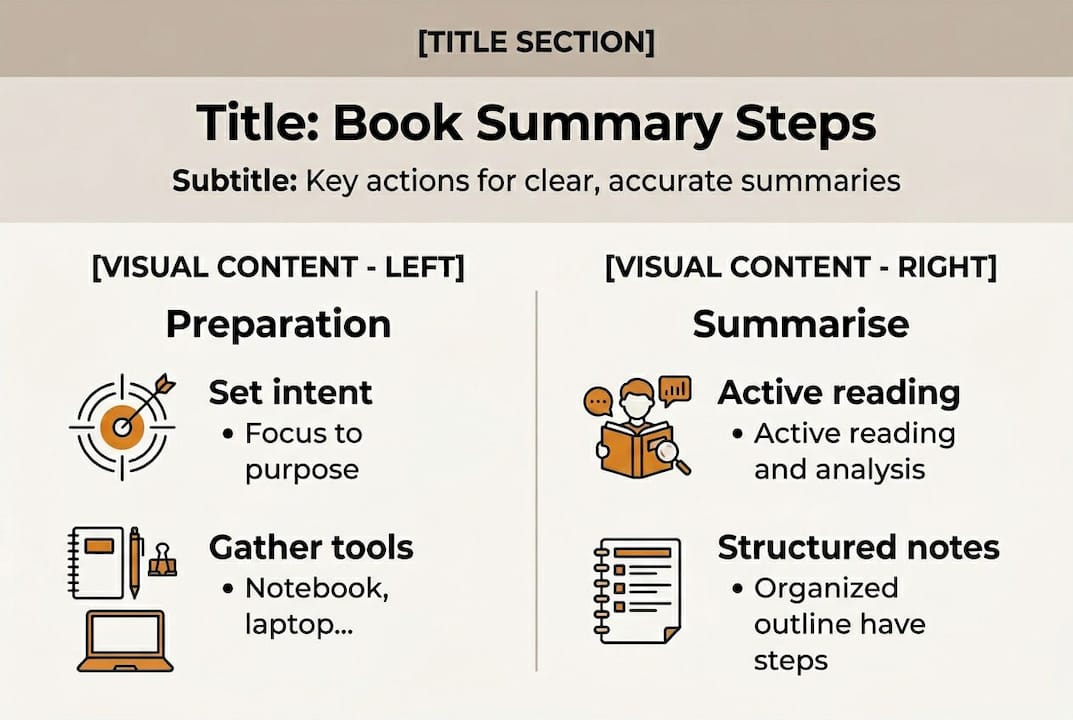
Before you open the book, you need to know why you are summarising it. This sounds obvious, but skipping this step is the single biggest reason summaries end up unfocused and hard to use. Are you building a course lesson around a key argument? Creating an e-book that distils a complex topic? Preparing a reading guide for students? Your purpose shapes everything: what you highlight, how long your summary should be, and which details matter.
Once your intent is clear, gather your tools. A reliable note-taking application such as Notion, Obsidian, or even a simple word processor works well. Physical highlighters are useful for printed books. AI writing assistants can help with initial structuring, but they work best when you have already defined your focus. An outline template prepared in advance saves significant time during reading.
Choosing a methodology before you start is equally important. Three approaches stand out for educators and content creators:
- FRAME process: Find purpose, Read/Record actively, Arrange by structure, Merge essentials, Extend/Expand for application.
- Two-Column notes: Key ideas on the left, your analysis or teaching notes on the right.
- SQ3R: Survey, Question, Read, Recite, Review. Excellent for dense academic texts.
Here is a quick comparison to help you choose:
| Method | Best for | Effort level | Output format |
|---|---|---|---|
| FRAME | Course creation, e-books | Medium | Structured outline |
| Two-Column | Lesson planning | Low | Annotated notes |
| SQ3R | Academic or dense texts | High | Layered review |
Building educational reading lists around a consistent methodology also helps your audience engage more deeply with your curated content.
Pro Tip: Write your summarisation goal in one sentence before you begin. Stick it at the top of your notes document. Every time you feel lost in the text, return to that sentence and ask: does this detail serve my goal?
Active reading and structured note-taking
With your tools and purpose ready, you can begin engaging with the book through active reading. Active reading is not the same as careful reading. It means reading with a specific question in mind, pausing to record ideas as they emerge, and constantly asking what the author is trying to prove or teach.
For non-fiction, focus on spotting the central argument, the evidence used to support it, and the conclusions drawn. For fiction, use frames like 5Ws/How (Who, What, Where, When, Why, How) or SWBST (Somebody Wanted But So Then) to capture narrative structure without getting lost in plot detail.
The core mechanics of summarising a book effectively include structured notes on themes, characters, and main ideas, organised as you read rather than reconstructed afterwards. Trying to summarise from memory after finishing a long book is one of the most common and costly mistakes.

Here is a comparison of the three most popular note-taking methods for summarisation:
| Method | Strengths | Weaknesses | Ideal use |
|---|---|---|---|
| Two-Column | Fast, flexible | Can miss connections | Lesson notes |
| SQ3R | Deep comprehension | Time-intensive | Academic summaries |
| Direct annotation | Immediate capture | Hard to reorganise | Quick reference |
A practical sequence for capturing information during active reading:
- Skim the chapter headings and subheadings before reading.
- Write one question per chapter that you expect the text to answer.
- Read actively, highlighting only sentences that directly address your question.
- After each chapter, write a two to three sentence summary in your own words.
- Note any terms, data points, or quotes you may want to include in your final summary.
Applying close reading strategies helps you spot the subtle arguments and structural choices authors use, which is especially valuable when summarising for teaching. Developing the habit of critical reading also sharpens your ability to separate the author's core message from supporting detail.
Pro Tip: Never highlight more than 10% of any chapter. If everything feels important, nothing is. Ruthless selection during reading makes drafting far easier.
Drafting and structuring your summary
Once your notes are organised, the next step is turning them into a structured summary. This is where many educators stall, either writing too much or losing the author's original intent in their own interpretation.
Think of your summary in three layers:
- Macro level: The book's central argument or thesis in one to two sentences.
- Meso level: The three to five key points or chapters that support the central argument.
- Micro level: Specific examples, data, or quotes that illustrate each key point.
To write an effective draft, identify the central message, outline key points, write a concise draft in your own words, and maintain objectivity throughout. Objectivity is harder than it sounds. It means representing what the author actually argues, not what you wish they had argued or what fits your lesson plan most conveniently.
A numbered drafting sequence that works well for educational content:
- Write the macro-level thesis statement first.
- List your meso-level key points as subheadings.
- Fill in micro-level detail under each subheading using your notes.
- Write connecting sentences between sections to maintain flow.
- Read the draft aloud and cut anything that does not serve your stated purpose.
Common pitfalls to avoid during drafting:
- Redundancy: Saying the same point twice in different words wastes your reader's time.
- Bias: Framing the author's argument through your own opinion undermines the summary's value.
- Spoilers: For narrative or case-study-driven books, revealing the conclusion too early can reduce engagement in your course or e-book.
- Vagueness: Phrases like "the author discusses many things" tell your audience nothing useful.
Using a developing educational books checklist can help you verify that your summary aligns with the standards expected in professional educational publishing.
Pro Tip: Write your draft without looking at the book. Use only your notes. This forces you to process the ideas rather than copy them, which produces a far more original and teachable summary.
Editing, verifying, and adapting for teaching or content creation
With a draft in hand, editing and adapting ensure your summary delivers genuine clarity and value. Editing a summary is different from editing an essay. You are not just checking grammar; you are verifying that every sentence faithfully represents the source material.
Start with factual verification. Go back to the book and cross-check any statistics, dates, names, or direct quotes in your summary. Errors in educational content erode trust quickly, and a single factual mistake can undermine an entire course module.
For long books, chunking is essential. Break the book into logical sections and summarise each chunk separately before combining them. This prevents the common problem of early chapters dominating the summary while later chapters are rushed.
AI tools are genuinely useful at this stage for generating initial structural drafts or identifying gaps in coverage. However, AI and human hybrid strategies improve fidelity and nuance in ways that AI alone cannot achieve. Always apply human judgement to check for tone, context, and the kind of subtle meaning that automated tools regularly miss.
"The best summaries are not the shortest ones. They are the ones that make the reader feel they understand the book's purpose without having read it."
Adapting your summary for different formats requires specific adjustments:
- For e-books: Add section headers, pull quotes, and a brief glossary of key terms. Explore how the role of e-books in education can shape your formatting decisions.
- For course modules: Break the summary into digestible units with reflection questions at the end of each section.
- For infographics: Extract only the macro and meso levels; micro detail does not translate visually.
- For lesson plans: Align each key point with a specific learning objective.
A final verification checklist before publishing or teaching:
- All facts and quotes verified against the source.
- No personal opinion presented as the author's view.
- Summary length appropriate for the intended format.
- Key terms defined for the target audience.
- Attribution and bibliography complete and accurate.
Researchers tracking summarisation benchmarks consistently find that shorter summaries score higher on factual accuracy, while longer ones tend to feel more natural but introduce more errors. Keep that trade-off in mind when deciding how detailed your summary needs to be.
Why manual review matters: Our take on trustworthy summaries
Here is something most summarisation guides will not tell you: the biggest risk in educational summarisation is not getting the facts wrong. It is getting the tone wrong. A summary that is technically accurate but strips away the author's nuance, urgency, or context can mislead students just as effectively as an outright error.
We have seen this happen repeatedly with AI-generated summaries. They are fast, scalable, and often structurally sound. But AI misses nuance in ways that matter enormously for teaching. A book about historical trauma, for instance, requires a summary that honours the weight of the subject. An AI tool will give you the facts. It will not give you the gravity.
Our view is that the hybrid approach is not just a best practice; it is an ethical responsibility for educators. Use AI to handle the heavy lifting of first drafts and structural organisation. Then sit with the summary yourself and ask: does this feel like the book? Does it prepare my students to engage with the real text, or does it replace that engagement with a shortcut?
The classic books checklist we recommend for educators is built around this principle: accuracy first, nuance second, and always with the student's learning outcome in mind.
Level up your summaries with BibliOWLteca
You now have a solid framework for summarising books at a professional level. The next step is putting those summaries to work in formats that actually reach your audience and generate income from your expertise.

BibliOWLteca gives educators and content creators the infrastructure to publish e-books, build course materials, and distribute digital products globally, all from one platform. Whether you are packaging your summaries into a downloadable guide, a structured course, or a curated reading programme, BibliOWLteca handles the delivery, payments, and tax compliance so you can focus on the content. Start turning your summarisation skills into a scalable educational business today.
Frequently asked questions
What is the most effective method for summarising a book for teaching?
Using active reading combined with the FRAME process and a clear outline ensures your summary is both accurate and engaging for students.
How can I avoid adding personal bias to my summary?
Focus on the author's stated arguments, avoid unnecessary interpretation, and review for objectivity before finalising your draft.
Are AI tools reliable for summarising educational books?
AI is fast and useful for first drafts, but always requires human review to catch nuance and ensure accuracy in teaching materials.
What are common mistakes to avoid when writing a summary?
Avoid spoilers, redundancy, and personal interpretations; also take care not to omit details that are critical for your intended educational purpose.
Why do summaries boost retention for readers?
Without structured summaries, readers forget up to 90% of content within a month, making summaries essential for lasting comprehension and recall.