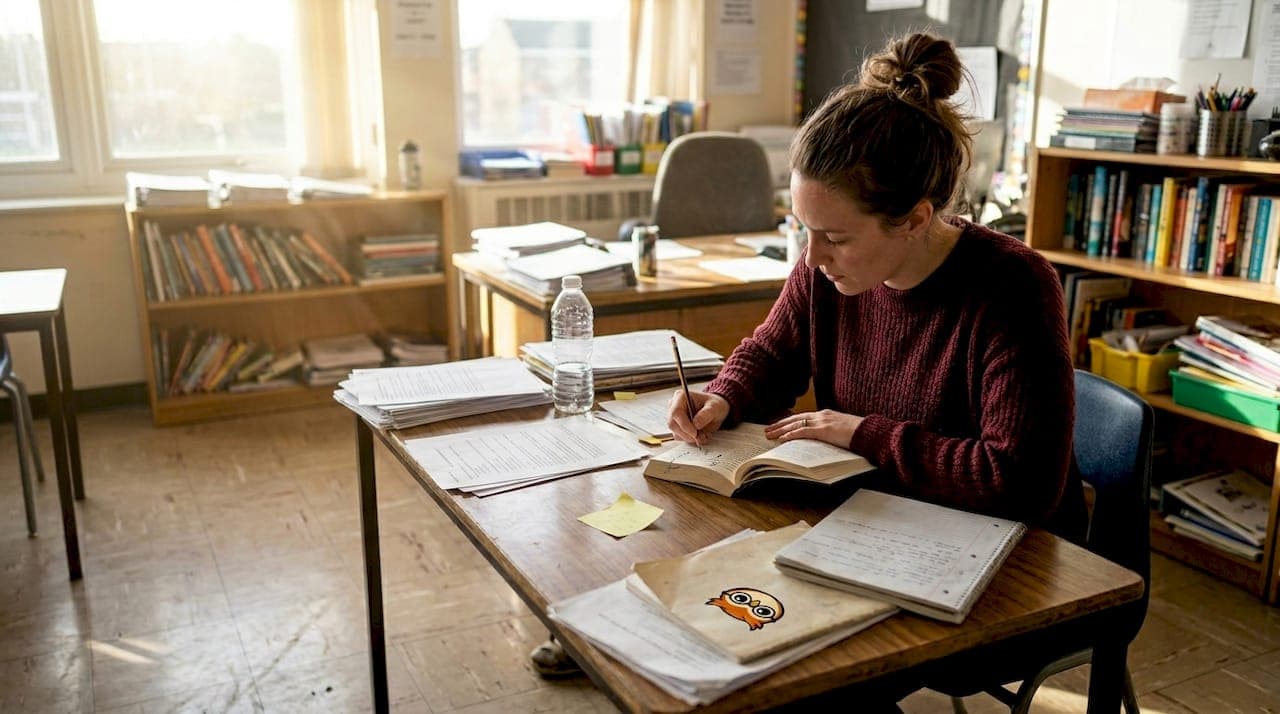
Close reading is not simply reading slowly or carefully. It is a structured, analytical process that trains you to examine a text's language, form, and structure with precision, uncovering layers of meaning that a surface-level read would miss entirely. For educators and content creators, this distinction matters enormously. When you understand what close reading actually involves, you can teach it more effectively, design better learning materials, and help students move beyond passive comprehension into genuine critical thinking. This guide walks you through the origins, mechanics, evidence, and practical application of close reading so you can use it with confidence.
Table of Contents
- Understanding close reading: origins and principles
- The core mechanics of close reading
- Close reading in education: effective strategies and adaptations
- What the research shows: impact and limitations
- Modern debates: context versus text and evolving approaches
- Applying close reading: practical tips for educators and content creators
- Start enhancing your teaching with the right resources
- Frequently asked questions
Key Takeaways
| Point | Details |
|---|---|
| Text-focused analysis | Close reading means examining exactly how meaning is constructed within the text itself. |
| Stepwise practical method | Effective close reading combines multiple readings, annotation, and asking text-dependent questions. |
| Classroom strategies | Gradual release, scaffolding, and well-chosen texts help all learners benefit from close reading. |
| Balance is essential | Avoid over-interpretation and integrate context when needed for access and engagement. |
| Empirical support | Research shows close reading improves comprehension but works best alongside vocabulary and strategy instruction. |
Understanding close reading: origins and principles
Close reading did not emerge from modern literacy movements. It comes from New Criticism, a literary movement from the early twentieth century that placed the text itself at the centre of analysis, deliberately setting aside the author's biography, historical context, and reader emotion. The text was treated as a self-contained object, and meaning was found within its words, not around them.
This foundational principle still shapes how close reading is taught today. The definition of close reading focuses on a text's language, structure, and form rather than on assumptions or background knowledge. That is what makes it such a powerful tool for building genuine comprehension.
For educators, understanding these roots helps you explain to students why evidence from the text always takes priority. For content creators, it offers a framework for analysing your own writing and the materials you curate.
The core principles of close reading include:
- Focus on the text itself: meaning is found in the words on the page, not in what you assume the author meant
- Attention to language: word choice, tone, and syntax all carry meaning worth examining
- Structural awareness: how a text is organised shapes how it communicates
- Evidence-based interpretation: every claim about a text must be supported by specific textual evidence
"The goal of close reading is not to find a single correct meaning, but to understand how a text creates meaning through its choices."
If you are working on mastering critical reading as part of your teaching practice, these principles form the bedrock of everything else.
The core mechanics of close reading
Knowing what close reading is and knowing how to do it are two different things. The process involves multiple rereadings: first for gist, then for structure, and finally for deeper meaning. Each pass through the text serves a distinct purpose.
Here is a practical three-stage approach you can use in the classroom or adapt for independent study:
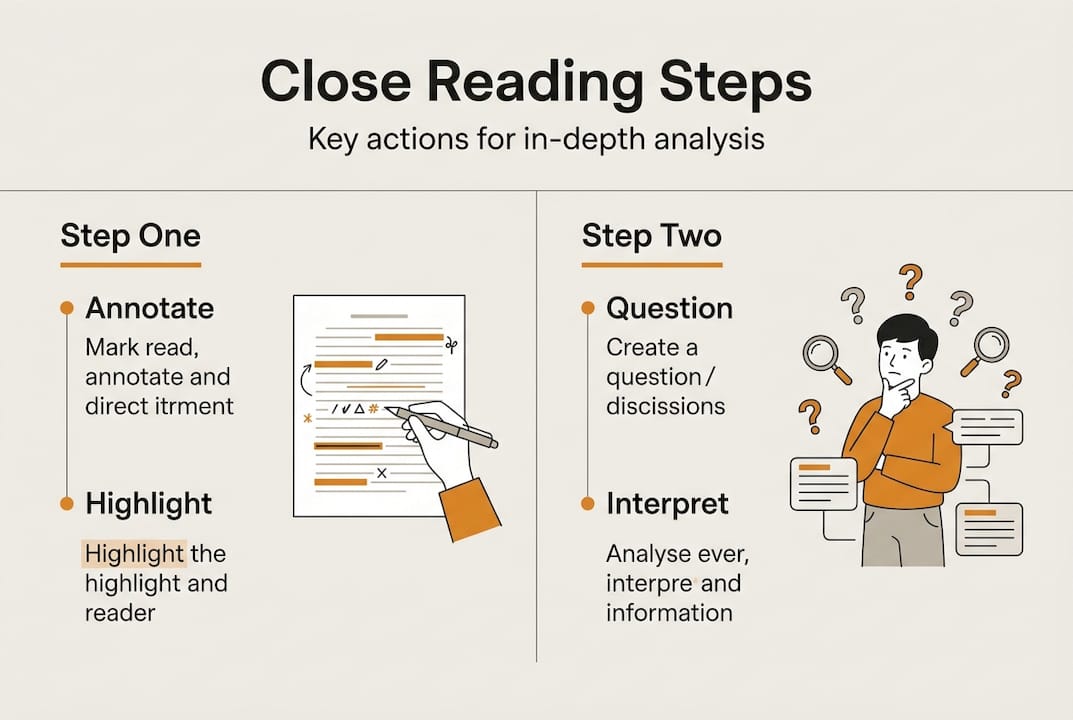
- First reading: literal comprehension Read the text once to understand what it says on the surface. What is happening? Who is speaking? What is the basic situation?
- Second reading: analytical focus Read again with a specific lens. Examine diction (word choice), syntax (sentence structure), tone, and imagery. Ask: why did the writer choose this word and not another?
- Third reading: synthesis and interpretation Bring your observations together. What patterns emerge? What argument or theme is the text building? How do the parts create the whole?
Annotation is essential throughout this process. Encourage students to mark unfamiliar words, circle repeated images, underline shifts in tone, and write questions in the margins. Text-dependent questions are equally important: questions that cannot be answered without returning to the text itself.

Think-alouds are another powerful technique. When you model your own thinking process aloud as you read, students see what analytical reading looks like in practice, not just in theory. You can find a detailed step-by-step close reading framework that works well for classroom settings.
A common pitfall is over-interpretation: reading meaning into a text that simply is not there. Remind students that every claim needs a direct quote or specific reference to support it.
Pro Tip: When students make an interpretive claim, ask them to point to the exact line or phrase that supports it. This single habit builds rigorous analytical thinking faster than almost anything else.
When building reading lists for your courses, choose texts that reward this kind of close attention. Short poems, dense paragraphs, and complex speeches all work well.
Close reading in education: effective strategies and adaptations
Close reading does not look the same across all year groups or contexts. Effective instruction requires scaffolding, and the level of support you provide should match where your students are.
The gradual release model works particularly well. You model the process first, then guide students through it together, and finally ask them to work independently. This structure, combined with chunking texts and using graphic organisers, makes close reading accessible even for younger or less confident readers.
Here is a comparison of how close reading strategies shift across different contexts:
| Context | Text type | Key strategy | Support level |
|---|---|---|---|
| Primary school | Short picture book excerpts | Interactive read-alouds, guided questions | High scaffolding |
| Secondary school | Poems, speeches, short stories | Annotation, text-dependent questions | Moderate scaffolding |
| Higher education | Essays, academic articles | Independent analysis, synthesis tasks | Low scaffolding |
| Content creators | Blog posts, scripts, digital media | Structural and tonal analysis | Self-directed |
For content creators, close reading is not just a teaching tool. It is a way to audit your own materials. Reading your content as a close reader would reveals gaps in logic, inconsistencies in tone, and missed opportunities for clarity.
Useful strategies across all levels include:
- Chunking: break longer texts into short, manageable sections before analysing
- Graphic organisers: visual tools that help students map structure, argument, and evidence
- Interactive read-alouds: particularly effective for younger students or complex texts
- Paired annotation: students annotate together before sharing observations with the class
Pro Tip: Monitor engagement closely during close reading sessions. If students go quiet in a disengaged way rather than a focused one, shorten the passage or introduce a discussion prompt to re-energise the room.
If you are exploring ebooks in education as a delivery format, close reading activities translate well to digital texts with annotation tools built in. You might also find classic books for education a useful resource when selecting texts that reward close analysis.
What the research shows: impact and limitations
The evidence for close reading is encouraging but nuanced. Repeated reading and vocabulary instruction do boost comprehension, yet only about 23% of classroom time is spent on research-aligned reading instruction. That gap represents a significant missed opportunity.
Studies show moderate gains in comprehension when close reading is taught explicitly, with stronger results on teacher-designed assessments than on standardised tests. This suggests that close reading builds the kind of deep, contextual understanding that does not always show up in multiple-choice formats.
| Outcome area | Evidence strength | Notes |
|---|---|---|
| Comprehension gains | Moderate | Stronger on teacher-designed tasks |
| Vocabulary development | Strong | Particularly with repeated exposure |
| Standardised test performance | Mixed | Less consistent across studies |
| Student engagement | Variable | Depends heavily on text choice and pacing |
"The most consistent finding is that explicit instruction in reading strategies, including close reading, produces better outcomes than unguided reading practice alone."
Limiting factors are real and worth acknowledging. Over-analysis can drain the pleasure from reading. Students who are already disengaged may find the process frustrating rather than illuminating. Poetry and prose also respond differently to close reading, and what works for a sonnet may feel forced when applied to a newspaper article.
The reading comprehension data points to one consistent recommendation: explicit instruction matters more than the specific technique. How you teach close reading is as important as whether you teach it.
For a broader perspective on why analytical engagement with texts matters, the case for studying literature benefits extends well beyond exam performance.
Modern debates: context versus text and evolving approaches
Close reading has not stood still since its New Criticism origins. Today, practitioners debate how much context should enter the process. Modern close reading sometimes integrates context for accessibility, but text-dependence remains the primary focus.
The debate breaks down along several lines:
- Traditionalists argue that introducing context too early biases interpretation and undermines the discipline of reading the text on its own terms
- Progressives contend that some historical or cultural context is necessary for students to access difficult texts, particularly those from different eras or traditions
- Pragmatists take a middle position: use context strategically, but only after students have engaged with the text itself
- Assessment specialists note that standardised tests typically reward text-dependent responses, making a strong case for keeping context minimal in exam preparation
For most educators, the pragmatist position offers the most flexibility. You can introduce context as a second layer, after students have formed their own initial responses to the text. This preserves the analytical rigour of close reading while making it more accessible.
The close reading approaches that work best in diverse classrooms tend to be those that remain flexible without abandoning the core principle: the text comes first. Understanding the role of literature in society can also help you frame these debates for students in a meaningful way.
Applying close reading: practical tips for educators and content creators
Theory is only useful when it translates into action. Short, focused sessions of 10 to 15 minutes with a clear purpose, explicit modelling, and text-dependent questions consistently produce the best results.
Here is a stepwise method you can use immediately:
- Choose your text carefully: short, complex passages work best. Poems, speeches, and dense paragraphs reward close attention. Avoid texts that are too long or too simple.
- Introduce the text: give students a brief, neutral framing. Do not over-explain before they have read it.
- Model your process: read aloud and think aloud simultaneously. Show students what you notice and why it matters.
- Scaffold the analysis: provide guiding questions that direct attention to specific features of the text.
- Independent or paired task: ask students to annotate a section independently, then share observations.
- Discussion: use close reading as a springboard for class conversation, not just silent analysis.
Some annotation techniques worth teaching explicitly:
- Circle words that feel surprising, unusual, or loaded with meaning
- Underline phrases that repeat or echo elsewhere in the text
- Write a one-word summary of each paragraph in the margin
- Mark moments where the tone shifts
- Note any questions the text raises but does not answer
Pro Tip: Use close reading to spark discussion rather than to arrive at a single correct answer. The richest learning happens when students compare their annotations and discover they noticed different things.
Avoid these common mistakes: choosing texts that are too long, skipping the modelling stage, and asking questions that can be answered without reading the text. For inspiration on text selection, classic literature and close reading pair naturally, and identifying literature gaps can help you find areas where your reading programme needs strengthening.
Start enhancing your teaching with the right resources
Close reading is one of the most transferable skills you can teach, and the right resources make all the difference. Whether you are building a reading programme from scratch, designing digital courses, or curating materials for your students, having access to quality texts and practical guides saves you significant time.

At BibliOWLteca, we support educators and content creators who want to turn their knowledge into structured, shareable learning experiences. From exploring more resources to publishing your own educational content globally, our platform gives you the infrastructure to reach learners wherever they are. If close reading has shown you the value of precise, purposeful language, imagine what a well-designed digital course could do for your audience.
Frequently asked questions
How is close reading different from regular reading?
Close reading is an analytical process that involves carefully examining a text's language, structure, and meaning, rather than reading for general understanding or plot.
What types of texts are best for close reading?
Short, dense passages are ideal, particularly poems, speeches, or excerpts from literature where word choice and structure carry significant weight.
Can close reading help with understanding non-literary texts?
Yes. Close reading techniques apply beyond literature to speeches, essays, and digital media, where analysing tone and structure reveals how an argument is constructed.
What is the best way to introduce close reading to students?
Start with explicit modelling using a short, well-chosen text, and focus on text-dependent questions that require students to return to the text for evidence.
What are common challenges with close reading?
Over-interpretation and disengagement are the most frequent issues. Scaffold with support and keep passage length short to maintain focus and motivation.