
TL;DR:
- Effective book summaries distill a book's core ideas into a concise, objective format that supports long-term retention.
- They should focus on a clear thesis and 3–7 main ideas, structured around themes rather than chapter order.
An effective book summary is a concise distillation of a book's core ideas that supports long-term learning and quick recall. Without one, 80–90% of what you read is forgotten within 30 days. That figure is not a warning to read less. It is a case for reading smarter. This guide to effective book summaries gives you a research-backed process for capturing what matters, retaining it longer, and putting it to practical use. Whether you are a student, a self-directed learner, or an avid reader, the techniques here will change how you engage with every book you pick up.
What do you need before you start summarising a book?

Preparation separates a useful summary from a forgettable one. The single most important habit to build before you write a word is active reading. Active reading means engaging with the text as a conversation, not a broadcast. You question the author's claims, mark passages that support the central argument, and note where your thinking shifts.
Think of every book as a tree. The trunk is the thesis or central message. The branches are the supporting arguments, examples, and evidence. Your job as a summariser is to describe the trunk clearly, then select only the branches that explain why the trunk stands. Branches that are interesting but peripheral stay out of the summary.
Before you open the book, set a clear purpose for your summary. Are you summarising for quick recall, for a study group, for a course you are building, or for a decision you need to make? Purpose shapes length, structure, and the level of detail you include. A summary written for a study group needs more context than one written as a personal reference note.
Choosing the right tools and length
The right tools depend on your workflow, not on what is fashionable. The table below contrasts the most common approaches.
| Method | Best for | Limitation |
|---|---|---|
| Highlighting and margin notes | First-pass reading, physical books | Hard to search or reorganise later |
| Index cards or note cards | Capturing individual ideas | Time-consuming for long books |
| Digital note-taking apps | Searchable, shareable summaries | Requires discipline to avoid over-noting |
| Voice memos | Quick capture while reading | Needs transcription before use |
On length, optimal summaries run between 150 and 800 words. A 150–400 word summary suits rapid scanning and quick recall. A 300–800 word summary suits detailed study or teaching. Anything longer risks becoming a second book rather than a distillation of the first.
The key preparation steps are:
- Identify the book's central thesis before you begin writing anything.
- Decide on your summary's purpose and target length.
- Choose one note-taking method and stick to it throughout the book.
- Read the introduction and conclusion first to understand the author's intended arc.
Pro Tip: Read the chapter headings and subheadings before you start the book. This gives you a mental map of the trunk and branches before you encounter any detail.
How do you write an effective book summary step by step?
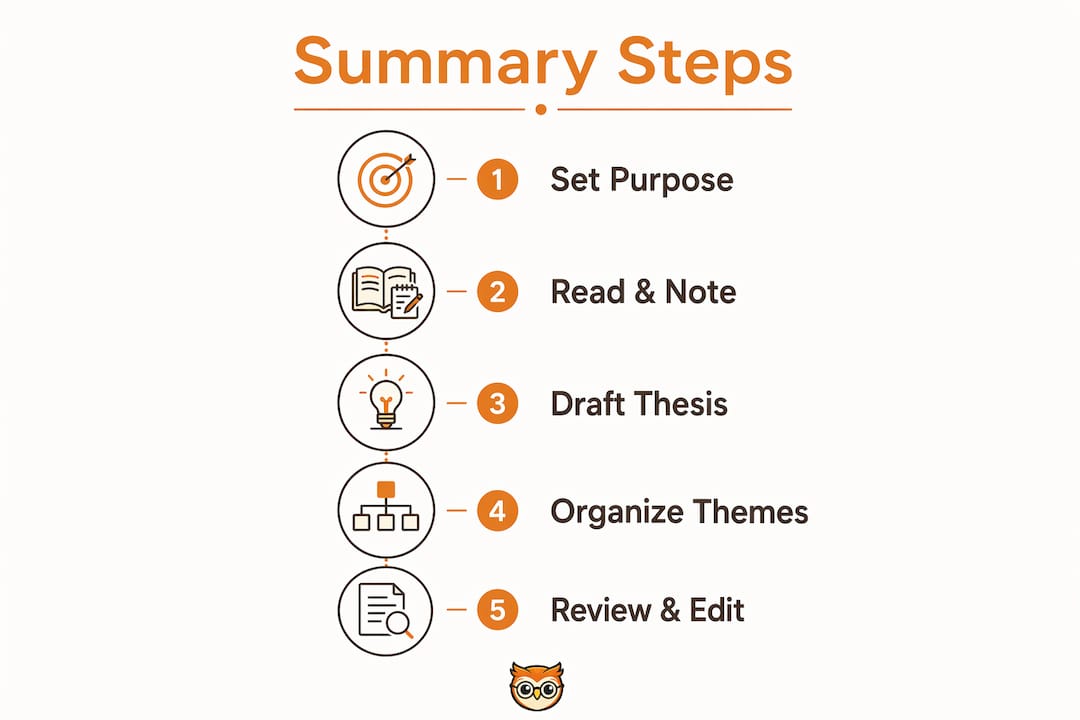
The most reliable method for creating concise book summaries is the two-pass approach. On the first pass, you note ideas as you read. On the second pass, after finishing the book, you cut everything that does not directly support the thesis. Two-pass summarisation prevents memory drift and forces you to distinguish between ideas that felt important in the moment and ideas that actually matter to the whole.
The most common failure in summary writing is the retelling trap. This happens when you summarise chapter by chapter, following the book's sequence rather than its meaning. A chapter-by-chapter summary is a table of contents with extra words. A genuine summary focuses on 3–7 major ideas that support the thesis, regardless of where in the book those ideas appear. If you cannot state the book's thesis in one sentence before you start writing, you are not ready to summarise it yet.
The summarisation process
Follow these steps in order:
- State the thesis. Write one sentence that captures the book's central argument. This is your anchor.
- List 3–7 major ideas. Identify the key points that prove or develop the thesis. Ignore everything else.
- Write in your own words. Paraphrase every idea. Do not copy sentences from the book.
- Structure by theme, not by chapter. Group related ideas together, even if they appear in different parts of the book.
- Add one or two examples. Choose the most memorable illustration from the book to make abstract ideas concrete.
- Write a first draft. Aim for your target length. Do not edit while writing.
- Polish on the second pass. Cut anything that does not directly support the thesis. Tighten every sentence.
Summary structures compared
Different purposes call for different structures. The table below shows three common formats.
| Structure type | How it works | Best use case |
|---|---|---|
| Thematic | Groups ideas by theme across the whole book | Academic study, literature analysis |
| Framework | Organises ideas around the author's own model or system | Business books, self-help |
| Action-oriented | Converts key ideas into specific steps or decisions | Professional development, skill building |
Pro Tip: Include one direct quote only if it captures an idea better than any paraphrase could. One powerful quote adds texture. Two or more quotes signal a lack of understanding of the material.
Write every sentence of your summary as if the reader has not read the book. This forces clarity. If a sentence only makes sense to someone who already knows the content, rewrite it.
What are the most common book summary mistakes?
The most damaging mistake is mixing summary with personal opinion. A summary is an objective distillation of what the author argues. A review is your assessment of whether the argument is convincing. These are different documents with different purposes. Combining them produces something that is neither useful as a reference nor credible as a critique. Keep them separate from the start.
The second most common error is over-quoting. Using ten or more direct quotes does not demonstrate thorough reading. It demonstrates an inability to paraphrase, which is the core skill of summarisation. One or two impactful quotes are enough. Every other idea should be in your own words.
The following mistakes appear most often, along with the fix for each:
- Too long. A summary exceeding 800 words usually contains padding or chapter-by-chapter retelling. Fix: apply the thesis test to every paragraph. If a paragraph does not support the thesis, cut it.
- Too short. A summary under 150 words omits the evidence that makes the thesis credible. Fix: add the two or three strongest supporting ideas.
- Retelling the plot. Listing what happens in each chapter is not summarising. Fix: ask "what does this prove?" for every idea you include.
- Copying phrases from the book. Borrowed language means you have not processed the idea. Fix: close the book before writing each sentence.
- No clear thesis. A summary without a thesis is a list of observations. Fix: write the thesis sentence first and return to it after every paragraph.
- Ignoring the summary's purpose. A summary written for quick recall needs different content than one written for teaching. Fix: state your purpose before you begin.
Pro Tip: After writing your summary, read it aloud. Sentences that sound clunky or unclear are the ones that need rewriting. Your ear catches what your eye misses.
Simplicity and brevity are not signs of shallow thinking. They are signs of genuine understanding. A summary that a stranger can read and immediately grasp is more useful than a dense document that only makes sense to you.
How can you use book summaries to improve retention?
A summary written and never revisited is a missed opportunity. Periodic review is the mechanism that converts a summary from a one-time exercise into a long-term learning tool. Review your summary one week after writing it. Note what you still recall clearly and what has already faded. The gaps tell you which ideas need reinforcing.
Summaries work best as living documents that you refine over time. When you encounter a new book, article, or experience that connects to an older summary, add a note. This progressive summarisation approach builds a personal knowledge base rather than a collection of isolated documents.
Practical ways to get more from your summaries include:
- Link ideas to decisions. After reading a business or self-help book, write one specific action you will take based on the summary. This connects abstract ideas to real behaviour.
- Use summaries as study guides. Convert bullet points into questions. "The author argues X" becomes "What does the author argue about X?" Testing yourself is more effective than re-reading.
- Build educational reading lists around themes. Group summaries by topic so you can see how different authors approach the same problem.
- Share summaries with others. Explaining an idea to someone else is one of the most reliable ways to consolidate your own understanding.
- Keep secondary details separate. Store additional notes, extended quotes, and tangential ideas in an appendix or separate document. The main summary stays short and scannable.
The goal is not to accumulate summaries. The goal is to build a system where your summaries are easy to find, easy to read, and connected to how you think and work.
Key takeaways
Effective book summaries require a clear thesis, a thematic structure, and regular review to deliver lasting knowledge retention.
| Point | Details |
|---|---|
| Start with the thesis | Write one sentence capturing the book's central argument before drafting anything else. |
| Focus on 3–7 major ideas | Summarise themes, not chapters, to avoid the retelling trap. |
| Keep summaries concise | Aim for 150–800 words and move secondary detail to a separate appendix. |
| Separate summary from opinion | An objective distillation and a personal review are different documents with different uses. |
| Review and refine over time | Revisit summaries weekly, then periodically, to reinforce retention and update connections. |
The habit that changed how I read
Most readers treat summarisation as a chore that follows reading. I used to do the same. I would finish a book, feel satisfied, and then write a summary that was really just a list of things I had underlined. It looked thorough. It was almost useless.
The shift came when I stopped thinking of a summary as a record of what I had read and started thinking of it as a test of whether I had understood it. If I could not write the thesis in one sentence, I had not understood the book. That single constraint made me a far more careful reader before I ever picked up a pen.
The other lesson I learnt the hard way is that brevity is not the enemy of depth. A 300-word summary that captures the three ideas you will actually use is worth more than a 1,200-word document you will never open again. Conciseness forces you to decide what matters. That decision is where the real learning happens.
My advice is to develop your own summarising style rather than copying a template. Some readers think thematically. Others think in frameworks or sequences. Your summary structure should reflect how you naturally process ideas, because that is the structure you will actually use. Start with the methods described here, then adapt them until the process feels like thinking, not like homework.
— BibliOWLteca
Reading and learning resources on Bibliowlteca
Bibliowlteca's marketplace brings together eBooks, courses, and educational content from creators around the world, all in one place.

Whether you are looking to deepen your understanding of a subject or find structured learning materials to complement your reading, the Bibliowlteca eBooks catalogue gives you direct access to quality content across a wide range of topics. Creators on the platform publish guides, study materials, and course content that pair naturally with the summarisation habits you are building. Visit the Bibliowlteca marketplace to find content that supports your learning goals.
FAQ
What is an effective book summary?
An effective book summary is an objective, concise distillation of a book's central thesis and 3–7 major supporting ideas, written in your own words. It is not a review, a plot retelling, or a collection of quotes.
How long should a book summary be?
Optimal summary length is 150–800 words. Use 150–400 words for quick reference and 300–800 words for detailed study or teaching purposes.
How do you avoid the retelling trap in summaries?
Write the book's thesis in one sentence before you begin. If you cannot do that, you are not ready to summarise. Structure your summary around themes, not chapters.
Should you include direct quotes in a book summary?
One or two well-chosen quotes can strengthen a summary. More than that signals over-reliance on the author's words rather than genuine comprehension of the ideas.
How often should you review a book summary?
Review your summary one week after writing it to identify what has faded from memory. After that, revisit it periodically and update it when new reading or experience connects to the ideas inside.