
TL;DR:
- Creating an annotated bibliography requires critical reading, proper source selection, and adherence to formatting rules. Proper organization, evaluation, and reflection enhance the quality and credibility of your work. Final reviews ensure technical accuracy and demonstrate your understanding of each source’s relevance.
Most students encounter an annotated bibliography assignment and immediately feel uncertain about where to start. The task looks deceptively simple: gather some sources, write a few notes, format everything correctly. But creating annotated bibliographies guide-worthy work requires more than a list of citations. It demands that you read critically, evaluate what you find, and articulate why each source matters. This guide walks you through every stage, from selecting your citation style and gathering sources to writing polished annotations and doing a final quality check, so you can submit with confidence.
Table of Contents
- Key takeaways
- Creating annotated bibliographies guide: what you need before you begin
- How to write effective annotations, step by step
- Formatting and organising your bibliography
- Common mistakes and how to avoid them
- Final review and verification
- My perspective on annotated bibliographies
- How Bibliowlteca supports your research projects
- FAQ
Key takeaways
| Point | Details |
|---|---|
| Choose your citation style first | Confirm whether APA, MLA, or Chicago is required before writing a single citation. |
| Annotations are critical, not just descriptive | Each annotation must summarise, evaluate, and reflect on the source's relevance. |
| Formatting rules differ by style | Hanging indents for citations and an additional 0.5-inch indent for annotations are non-negotiable. |
| Read in two passes | Skim first, then annotate on the second read for stronger, faster annotations. |
| Review before submission | Cross-check alphabetical order, indentation, and citation accuracy as a final step. |
Creating annotated bibliographies guide: what you need before you begin
Before you write a single word of annotation, preparation makes all the difference. Skipping this stage is the main reason students waste hours reformatting work they have already done.
Confirm your citation style. The three most common formats are APA, MLA, and Chicago. Each structures citations differently, and each has specific rules for how annotations should appear beneath them. If your instructor or publisher has not specified a style, ask directly rather than assume. Creating citations in APA, for instance, places the publication year immediately after the author name, whereas Chicago footnote style handles the same information at the bottom of the page. Using the wrong format from the start means reformatting everything later.
Gather credible, relevant sources. Academic journals, peer-reviewed books, government publications, and reputable institutional reports are your foundation. Credibility matters here because your annotations will evaluate each source. A poorly chosen source gives you little to say in the evaluation section. Use your library's database rather than a general web search wherever possible. Libraries shape academic research outcomes and information literacy in ways that general search engines simply do not.
Set up your organisational tools. You need a reliable system to track citations, notes, and draft annotations before you start reading. Consider the following options:
- Reference management software (such as Zotero or Mendeley) that auto-generates citations and lets you attach notes to each source
- A shared document or spreadsheet with one row per source, columns for author, date, key argument, and your evaluation notes
- A physical or digital notebook dedicated to marginal notes while reading
- A folder structure that mirrors your bibliography, with one file per source
Understand your assignment guidelines. Read the brief carefully before touching a source. Some instructors want purely descriptive annotations; others require full critical evaluation. Some assignments specify a word limit per annotation or a total number of sources. Knowing this upfront shapes every decision you make, from which sources you choose to how much space you dedicate to evaluation.
| Tool type | Best for | Example |
|---|---|---|
| Reference manager | Storing and auto-citing sources | Zotero, Mendeley |
| Spreadsheet | Tracking notes across many sources | Google Sheets |
| Word processor | Drafting and formatting annotations | Microsoft Word |
| Notebook | Active reading and margin notes | Physical or digital |
Pro Tip: Create a citation for each source the moment you find it, before you even read it fully. Tracking down publication details later, especially for book chapters or journal articles, wastes significant time.
How to write effective annotations, step by step
This is where most students either struggle or cut corners. A strong annotation is not a summary padded with filler sentences. Annotations must engage critically with sources rather than simply collect citations.
The three types of annotations
The three primary annotation types are descriptive, evaluative, and combination. Descriptive annotations summarise what a source says without judging its quality or relevance. Evaluative annotations assess methodology, credibility, bias, and how the source stands up to scrutiny. Combination annotations, the most common type in academic settings, do both: they describe the source and evaluate its value to your research.
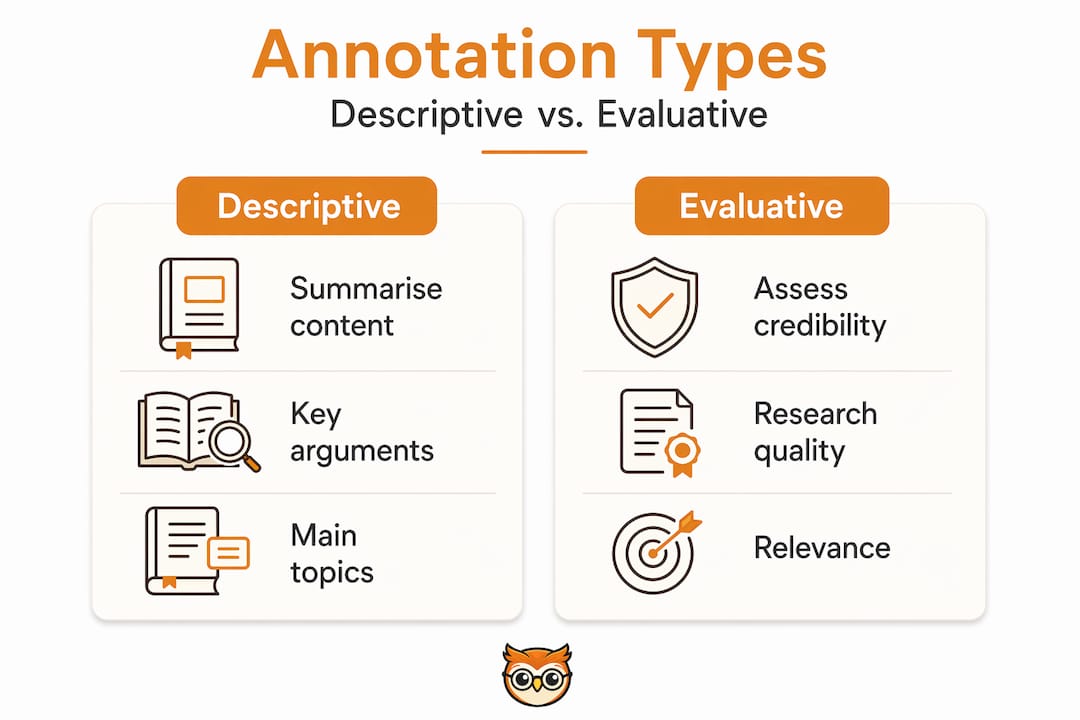
For most undergraduate and postgraduate assignments, you will be expected to write combination annotations. If you are unsure which type your instructor expects, the assignment brief should specify, and if it does not, ask before you write all your annotations in the wrong mode.
A numbered process for writing annotations
-
Skim the source first. Read the abstract, introduction, headings, and conclusion before engaging with the full text. This gives you a map of the argument and lets you spot the key claims quickly.
-
Read actively on your second pass. A two-pass reading strategy improves annotation quality significantly. On the second read, underline key claims, note the methodology, and write marginal notes in your own words. This makes drafting far easier.
-
Write a concise summary. Two to three sentences that capture the source's main argument or findings. Avoid quoting directly from the source. Paraphrase in your own words, and stay focused on what is most relevant to your research question.
-
Evaluate the source critically. Consider who wrote it and what qualifications they have. Assess the methodology: is the research peer-reviewed? Is there a clear bias? Is the data recent enough to be relevant? One to two sentences is usually sufficient for this element.
-
Reflect on relevance. One to two sentences explaining how this source connects to your specific research. Does it support your argument, provide a counterpoint, or fill a gap in the existing literature?
-
Check your length. Annotations typically range from 100 to 300 words, with 150 to 200 words being the most common expectation in academic contexts. A structure of 3 to 7 sentences covers summary, evaluation, and relevance without padding.
Here is what a strong combination annotation looks like in practice:
Smith, J. (2023). Climate literacy in secondary schools: A national survey. Journal of Environmental Education, 54(2), 112-129.
This study examines climate literacy levels among secondary school students across twelve regions in the United Kingdom, drawing on survey responses from over 4,000 pupils. Smith employs a mixed-methods approach, combining quantitative survey data with qualitative interviews from thirty educators. The sample size is substantial and the methodology transparent, lending the findings credibility. The research reveals a significant gap between students' reported concern about climate change and their actual scientific understanding of its causes. This source is directly relevant to Chapter Two of this dissertation, where curriculum design recommendations are explored, as Smith's data provides empirical grounding for the argument that environmental education needs structural reform.
Notice that this annotation describes the study, evaluates its methodology, and explains precisely why it matters to the wider research context.
Pro Tip: Write annotations immediately after reading each source, not at the end of your research phase. Active annotation while reading deepens your understanding/08%3A_The_Writing_Process/8.02%3A_Annotation) and makes the final write-up far less painful.
Formatting and organising your bibliography
Getting the content of annotations right is only half the task. Poor formatting loses marks even when the writing itself is strong. Students frequently lose marks for incorrect formatting, particularly around indentation rules.
Alphabetical ordering
Citations must be listed alphabetically by the first element of each entry, which is usually the author's surname. When an author has multiple works listed, order those entries by year of publication, with the earliest first. When a source has no author, alphabetise by the title, ignoring "A", "An", and "The" at the start.
Indentation rules that matter
This is where many bibliographies fall apart visually. The rules differ depending on whether you are looking at the citation line or the annotation block beneath it:
- The citation uses a hanging indent: the first line is flush with the left margin, and all subsequent lines of the citation are indented by 0.5 inches.
- The annotation sits below the citation and is indented an additional 0.5 inches from the left margin. So the entire annotation block is indented 0.5 inches.
- If your annotation runs to more than one paragraph, subsequent paragraphs within the annotation require indenting of their first line without adding extra spacing between them.
Citation style comparison
The table below shows how a journal article citation is formatted across the three main styles. The annotation formatting rules for indentation remain consistent, but the citation itself changes significantly.
| Style | Author format | Year placement | Title formatting |
|---|---|---|---|
| APA 7th | Surname, Initials. | Immediately after author | Italicised for journal/book |
| MLA 9th | Surname, First name. | Near end of citation | Title in quotation marks for articles |
| Chicago 17th | Surname, First name. | Near end of citation | Title in quotation marks for articles |
Building a consistent visual presentation across all entries matters as much as the content itself. Use your word processor's paragraph formatting settings to apply hanging indents rather than pressing the Tab key manually. Manual tabs shift when documents are opened on different computers, making your bibliography look unprofessional. You can find a practical walkthrough on how to build bibliographies effectively that covers visual organisation in detail.
Common mistakes and how to avoid them
Even careful researchers make predictable errors when putting an annotated bibliography together. Knowing what to watch for saves significant revision time.
Ignoring the assignment brief. This is the single most common source of lost marks. If the brief specifies 150 words per annotation and you write 300, that is not thoroughness. It is a failure to follow instructions. Read the brief before you start, and recheck it before you submit.
Annotations that are too vague or too long. A vague annotation says things like "this source discusses climate change and is relevant to my topic." A strong annotation names specific arguments, specific methods, and specific connections to your research question. Equally, an annotation that runs to 400 words is usually a sign that the writer is summarising rather than synthesising.
Insufficient critical evaluation. Many students write annotations that are purely descriptive. They summarise what the source says but never assess whether it is reliable, whether the methodology is sound, or whether there is any notable bias. Skipping evaluation is the most common reason annotations feel weak, even when the writing is clear.
Inconsistent formatting. Switching between citation styles within a single bibliography, using inconsistent capitalisation in titles, or forgetting to apply hanging indents to some entries but not others: these errors signal carelessness. Formatting consistency is something reviewers notice immediately.
- Check every citation against the style guide before moving on
- Apply indentation using your word processor's built-in paragraph settings
- Use a reference manager to reduce manual formatting errors
- Compare your draft entries against a trusted annotated bibliography example in your chosen style
Pro Tip: Write notes directly onto a source as you read it. Active annotation of texts/08%3A_The_Writing_Process/8.02%3A_Annotation) during the reading phase means your draft annotation practically writes itself. Researchers who try to reconstruct their thoughts hours after reading spend far more time at the keyboard.
Managing many sources at once is also where errors compound. If you are working with ten or more sources, a simple tracking spreadsheet with columns for author, year, annotation draft status, and formatting checked is worth the ten minutes it takes to set up.
Final review and verification
Submitting without a final review is one of the most avoidable sources of lost marks. This stage does not take long if your earlier preparation was solid.
-
Read each annotation aloud. This catches awkward phrasing, missing words, and sentences that made sense when you wrote them but read strangely on review.
-
Verify every citation against the style guide. Check the author format, year placement, title capitalisation, journal name formatting, and punctuation. Citation errors are easy to introduce and easy to miss when you are close to the work.
-
Confirm alphabetical ordering. Print or export your bibliography and check each entry manually. Software does not always sort correctly when surnames begin with "Mc" or "O'" or when there is no author.
-
Check all indentation settings. Scroll through the document and confirm that every citation uses a hanging indent and every annotation block is correctly indented beneath it.
-
Seek peer or instructor feedback. Sharing a draft with a classmate or tutor before final submission often catches errors you have become blind to after hours of working on the document. Even a five-minute review from a fresh set of eyes is worth it.
-
Use validation tools thoughtfully. Citation checking tools can flag obvious formatting errors, but they do not evaluate whether your annotation communicates genuine critical understanding. Automated tools are a useful starting point, not a substitute for careful reading.
The goal of this final pass is not just technical correctness. Engaging critically with sources is the purpose of the entire exercise. Your review should confirm that each annotation demonstrates that you have read, understood, and assessed the source rather than simply listing it.
My perspective on annotated bibliographies
I have worked with a lot of students and researchers who treat the annotated bibliography as a box-ticking exercise. They want to get it done quickly, move on, and treat the annotations as a formality before the "real" writing begins. I understand that instinct. But it is wrong, and in my experience, it shows in the quality of the papers that follow.
What I have found is that the annotation process is where genuine research thinking actually happens. When you sit down to write 150 words evaluating a source, you are forced to decide whether you actually understand it. You cannot hide vague comprehension behind a confident-sounding citation. Either you can explain what the study found and why the methodology is credible, or you cannot. That clarity is the difference between a student who has read their sources and one who has read at them.
The annotation process also reveals gaps in your research that you would otherwise miss entirely. I have seen researchers reach the annotation stage and realise they have seven sources all making the same point, with nothing to balance or challenge the argument. That is a problem. But it is a much smaller problem when you catch it during bibliography construction than when you catch it in a supervisor's feedback on your third draft.
The other misconception worth addressing is that annotations get easier with experience. They do, but not because the thinking becomes less rigorous. They get easier because you learn to read strategically and write concisely. Creating an annotated bibliography/08%3A_The_Writing_Process/8.02%3A_Annotation) prepares you for the kind of synthesis writing that literature reviews and research papers demand. Think of each annotation as a short, precise argument, and you will find the habit transfers directly into stronger academic writing.
— BibliOWLteca
How Bibliowlteca supports your research projects
If you are working through the steps in this guide and want additional support, Bibliowlteca is built for exactly that.

Bibliowlteca brings together educational resources, templates, and expert-led guides for students, researchers, and educators managing academic writing projects. Whether you need a ready-to-use bibliography template in APA or MLA format, or you are looking for structured tutorials on citation building and source evaluation, the platform gives you practical tools rather than generic advice. Educators can also publish and distribute their own bibliography guides, annotation tutorials, and research skills content to students globally. Visit Bibliowlteca to explore the full range of tools available, and check out the guide on why bibliographies matter for credible academic content to see how citation practices connect to broader research quality.
FAQ
What is an annotated bibliography?
An annotated bibliography is a list of citations, each followed by a short paragraph that summarises, evaluates, and reflects on the source's relevance to a research topic.
How long should each annotation be?
Annotations typically range from 100 to 300 words, with 150 to 200 words being the most common expectation. Always check your assignment brief for a specified word count.
What are the main types of annotations?
The three primary types are descriptive (summarising only), evaluative (assessing credibility and quality), and combination (doing both), with combination being the most frequently assigned in academic settings.
How do I format indentation correctly?
Citations use a hanging indent, meaning the first line is flush left and subsequent lines are indented 0.5 inches. The annotation block sits beneath the citation and is indented an additional 0.5 inches from the left margin.
Which citation style should I use?
Use the style your instructor or publication specifies. APA is common in social sciences, MLA in humanities, and Chicago in history and some arts disciplines. When in doubt, ask before you begin.