
TL;DR:
- Learning how to compare novels shifts readers from simple preference to deep literary understanding, revealing authors' techniques and intentions.
- A rigorous comparison relies on exploring theme, form, and content, analyzing how each element influences meaning and reader impact.
Most readers can tell you which novel they preferred. Far fewer can explain why one author's treatment of isolation cuts deeper than another's, or how two books set in entirely different eras can illuminate the same human truth. Learning how to compare novels moves you from passive preference to genuine literary understanding. It is the difference between saying "I liked this more" and being able to articulate exactly what each author achieved and how. This guide walks you through the essential frameworks, preparation steps, and analytical techniques to make your comparisons genuinely illuminating.
Table of Contents
- Key takeaways
- How to compare novels: the three-pillar framework
- Preparing a meaningful comparison
- Executing your comparison
- Common traps in novel comparisons
- Evaluating your comparative insights
- My perspective on comparing novels
- Deepen your literary exploration with BibliOWLteca
- FAQ
Key takeaways
| Point | Details |
|---|---|
| Use theme, form, and content | Ground every comparison in these three interconnected elements for depth and coherence. |
| Write a focused thesis | A strong comparative thesis names the authors, the shared theme, and identifies meaningful similarities or differences. |
| Analyse authorial choices | Discuss diction, tone, imagery, and structure rather than retelling plot events. |
| Avoid the ping-pong trap | Integrate both novels within each paragraph rather than writing separate mini-essays about each. |
| Verify your conclusions | Check that each paragraph links evidence to your thesis and synthesises insights rather than listing observations. |
How to compare novels: the three-pillar framework
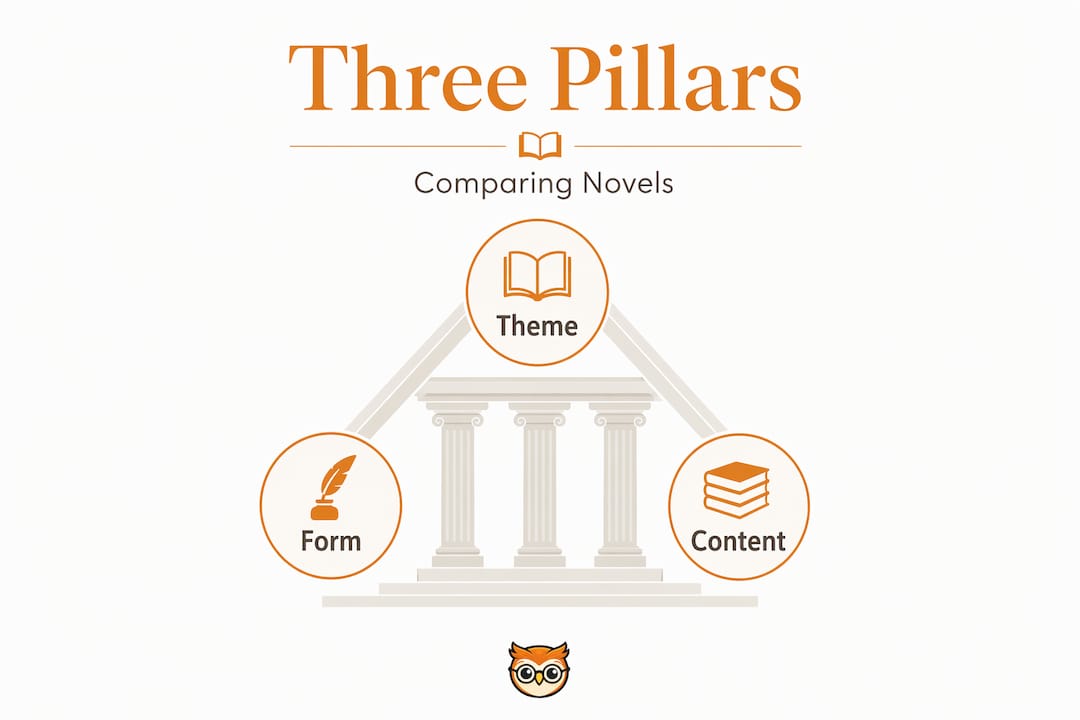
Every successful novel comparison rests on three interconnected elements. Get these right from the start and the rest of the process becomes considerably clearer.
Theme
Theme is the central idea or concern that a novel explores. It is not the plot. The Road by Cormac McCarthy and Never Let Me Go by Kazuo Ishiguro are both about survival and mortality, but their thematic treatments differ enormously. McCarthy's theme is stripped bare, urgent, and elemental. Ishiguro's is quietly suffocating, built on acceptance and loss of agency. Identifying the shared theme is just your starting point. The real comparative work lies in examining how each author shapes that theme differently.
When assessing novel themes, the most productive questions are not "what is this novel about?" but "what does this novel argue about its subject?" That shift moves you from description to analysis.
Form
Form covers genre, narrative structure, point of view, and pacing. Two novels can share a theme but deploy completely different formal choices. A first-person confessional narration creates intimacy and unreliability. A third-person omniscient narrator creates distance and authority. Contrasting plot structures, such as a linear chronology against a fractured, non-linear one, can tell you a great deal about what each author prioritises. A novel structured around a single day, like Mrs Dalloway, makes different formal claims about time and consciousness than one spanning decades.
Content
Content is the texture of the writing itself: diction, syntax, imagery, tone, symbolism, and voice. This is where close reading becomes indispensable. When literary comparison methods are applied well, patterns in language reveal authorial intention that plot summary never could. Consider how Toni Morrison's use of fragmented syntax in Beloved enacts the trauma her characters carry, while Jane Austen's perfectly balanced periodic sentences perform the social constraint her characters navigate.
The theme, form, and content framework is widely regarded as the foundation of rigorous comparative analysis. These three elements are not separate checklists. They interact constantly, and the most revealing comparisons explore those interactions.
- Theme tells you what each novel is about at its deepest level.
- Form tells you how the narrative is constructed and delivered.
- Content tells you with what the author builds meaning, word by word.
Pro Tip: Before writing a single comparison, annotate a short passage from each novel side by side. Look for three moments where the authors make similar or opposite choices in diction or structure. Those moments are often where your best comparative insights live.
Preparing a meaningful comparison
Good preparation separates a muddled comparison from a genuinely illuminating one. The decisions you make before you write determine almost everything about the quality of the analysis that follows.
Choosing your novels
Not every pair of novels makes for a productive comparison. You need sufficient points of genuine contact, whether that is shared theme, similar historical context, comparable formal structures, or contrasting treatments of the same subject. Choosing Austen and Hemingway simply because both are canonical produces a comparison too diffuse to be useful. Choosing Austen and Edith Wharton, both examining the social world's grip on women's choices, gives you a focused and generative pairing.
A curated reading list can make this selection process easier, particularly when you are building comparative pairings around specific themes or periods.
Crafting your thesis
A clear, debatable thesis is the single most important preparation step. It must identify the thematic focus, acknowledge both authors, and indicate the nature of the comparison, whether that is similarity, contrast, or a more complex relationship. A weak thesis says "Both novels explore identity." A strong one says "While both McCarthy and Ishiguro examine identity under threat, McCarthy frames selfhood as something fought for through action, whereas Ishiguro presents it as gradually surrendered through compliance." The second version gives you an actual argument to prove.
Organising your approach
There are three primary ways to organise a novel comparison:
- Point-by-point. Each paragraph addresses a single analytical point and discusses both novels within it. This approach maintains the sense of active comparison throughout.
- Block method. You discuss one novel fully, then the other. This works for shorter, tighter comparisons but risks producing two separate analyses rather than a genuine dialogue between texts.
- Thematic clusters. You group related points around key themes or techniques. This is particularly effective for longer or more complex comparisons where a strict point-by-point approach would feel mechanical.
Pro Tip: Whatever structure you choose, test it by writing your paragraph headings or topic sentences before drafting. If each topic sentence mentions both novels, your structure is genuinely comparative. If any topic sentence mentions only one, revise before you write the full paragraph.
Executing your comparison
Preparation gives you the materials. Execution is where literary comparison techniques either come to life or fall flat. This stage demands close, precise reading and disciplined analytical writing.
-
Gather specific textual evidence. Do not work from memory. Return to the texts and mark passages where the relevant technique appears clearly: a telling image, a shift in narrative voice, an unusual syntactic choice. Fiction is intentionally constructed; meaning arises from authorial craft and anticipating reader response. Your evidence must reflect that.
-
Track one or two recurring elements. Focusing on one or two recurring elements such as a central symbol or a consistent shift in narrative voice prevents vague comparisons and adds genuine analytical depth. If you try to compare everything, you end up comparing nothing with real precision.
-
Build integrated paragraphs. A point-by-point integrated structure means each paragraph moves from evidence in the first novel to evidence in the second, then draws a comparative sentence connecting both to your thesis. This keeps the comparison alive in every paragraph rather than splitting the essay into two halves.
-
Focus on technique and effect, not events. Describe what an author does and what effect that choice creates. Plot moments should only support explanation of technique and effect, not replace it. "Gatsby throws lavish parties" is plot. "Fitzgerald uses the excess of Gatsby's parties to expose the hollowness of the American Dream through imagery of waste and artifice" is analysis.
-
Write the comparative sentence explicitly. Do not leave the connection implicit and hope the reader notices it. State the comparison directly: "Where Morrison fragments syntax to enact trauma, Austen employs studied equilibrium to perform social control, both making form inseparable from meaning."
Comparisons must analyse how themes are shaped by form, style, context, and authorial technique to reveal what effect they have on the reader. The strongest comparative insights do not simply identify similarities or differences; they explain why those differences matter and what they reveal about each author's purpose.
This is the standard that separates a surface-level comparison from a genuinely analytical one. Technique without purpose is description. Purpose explained through technique is literary analysis.
Common traps in novel comparisons
Even well-prepared readers fall into predictable mistakes when comparing novels. Knowing these patterns in advance helps you catch them early.
-
Retelling plot instead of analysing technique. This is the most common weakness. If your paragraphs describe what happens rather than how the author constructs meaning, you are summarising, not analysing. Every analysis of novels gains its real value from examining authorial choices, not narrative events.
-
Writing separate mini-essays. The rhetorical ping-pong effect occurs when a comparison alternates mechanically between novels without integrating them: three paragraphs on one text, three on the other, with no real dialogue. It produces two analyses wearing the costume of a comparison.
-
Ignoring authorial context. An author's biographical context, historical moment, and stated intentions are not irrelevant. They are part of what shapes the choices you are analysing. A comparison of 1984 and Brave New World that ignores the different political contexts in which Orwell and Huxley were writing misses a significant part of what the formal and thematic differences mean.
-
Spreading too thin. Attempting to compare ten different elements across two novels rarely produces depth. Grouping related comparison points within focused paragraphs and tracking one or two key elements across both texts consistently produces more persuasive and coherent analysis than covering everything superficially.
Pro Tip: After drafting each paragraph, ask yourself: "Did I name what the author did, explain how they did it, and state the effect it creates?" If any of these three questions goes unanswered, the paragraph is incomplete.
Evaluating your comparative insights
Once you have written a draft comparison, the verification stage is where the real quality control happens. This is not simply proofreading. It is asking whether your comparative argument actually holds.
Use this checklist as your evaluative framework:
| Check | What to look for |
|---|---|
| Thesis consistency | Does every paragraph connect back to your central comparative argument? |
| Evidence quality | Are your quotations specific, and do they clearly demonstrate the technique you claim? |
| Synthesis, not listing | Does each paragraph draw a conclusion about what the comparison reveals, rather than just presenting two separate observations? |
| Significance of differences | Have you explained why the differences between the two novels matter, not just described them? |
| Conclusion strength | Does your conclusion reinforce the argument and leave the reader with a clear sense of what the comparison illuminates? |
The last point deserves particular attention. Weak conclusions simply restate what was said. Strong ones reflect on the significance of the comparison: what does it reveal about how these authors understood their subject, their form, or their readers? A conclusion that answers the question "so what?" is genuinely analytical. One that merely summarises is not.
It also helps to read your comparative paragraphs aloud. Sentences that feel natural and precise when written sometimes reveal themselves as tangled or vague when spoken. Passages where you cannot easily explain the connection between evidence and claim are passages that need reworking.
My perspective on comparing novels
I have come to believe that most readers underestimate how much comparing novels changes the reading experience itself, not just the writing that follows. When I started approaching pairs of novels as conversations rather than parallel texts, something shifted.
In my experience, the single biggest transformation comes from focusing on what authors choose rather than what they include. The moment you start asking why a novelist uses free indirect discourse instead of direct narration, or why they structure a chapter around a single image repeated three times, the novel becomes a different kind of object. It reveals its own architecture. Comparing two novels that make different choices around the same challenge makes those choices visible in a way that reading one novel alone rarely does.
What I have found genuinely difficult, and what I think most guides understate, is maintaining balance between two texts without losing analytical momentum. There is a real temptation to write more about the novel you find more interesting, or to let the stronger argument pull you away from the weaker one. Resisting that pull takes deliberate discipline. The texts deserve equal attention, not because fairness is a virtue in itself, but because the less obvious novel often contains the more surprising insights.
My strongest recommendation is this: treat the comparison as a question, not a conclusion. Begin with genuine curiosity about what the two novels reveal when placed in dialogue. The best comparative analyses I have read do not feel like arguments being won. They feel like conversations between brilliant readers who have taken two books seriously enough to let them speak to each other.
— BibliOWLteca
Deepen your literary exploration with BibliOWLteca
If this guide has sparked a desire to read more widely and compare more rigorously, BibliOWLteca is built for exactly that kind of literary ambition.

On BibliOWLteca's platform, you will find a growing collection of digital novels, literary analysis resources, and educational content created by authors and educators worldwide. Whether you are looking for classic texts to pair for a comparative study, scholarly guides to support your close reading, or curated collections organised by theme and period, the platform brings them together in one accessible, international space. You can browse, purchase, and read directly through your account, making it straightforward to build a personal comparative reading library at your own pace.
FAQ
What are the three main elements used to compare novels?
The three foundational elements for comparing novels are theme, form, and content. Theme covers the central ideas each novel explores; form addresses structural and generic choices; content examines language, tone, imagery, and voice.
How do I avoid summarising plot in a novel comparison?
Focus on what the author does rather than what happens. Describe specific techniques such as diction, syntax, or narrative structure and explain the effect they create on the reader. Plot events should only appear to illustrate a technique, not to retell the story.
What is the best structure for comparing two novels?
A point-by-point integrated structure is generally the most effective. Each paragraph addresses a single analytical point and includes evidence from both novels, followed by a comparative sentence that links both back to your central thesis.
How do I write a strong comparative thesis?
A strong thesis names both authors, identifies the shared theme or focus, and indicates the nature of the comparison, whether similarity, contrast, or a nuanced combination of both. It must be arguable, not simply observational.
How many comparison points should I cover?
Depth beats breadth every time. Tracking one or two recurring elements such as a central symbol or shifts in narrative voice across both novels produces far more persuasive analysis than attempting to cover many points superficially.