TL;DR:
- Postmodernist literature confounds readers and scholars by disrupting traditional storytelling techniques and emphasizing self-reference and ambiguity. It emerged after WWII as a reaction to modernist ideals, questioning grand narratives and universal truths through techniques like metafiction, intertextuality, and fragmentation. Its themes highlight the fluidity of identity, the instability of reality, and critique consumer culture, requiring active, critical reader engagement.
Postmodernism literature has confused students and scholars alike for decades, and that confusion is largely earned. Unlike most literary movements, postmodernism does not arrive with a clean manifesto or a set of polite rules. It arrives with a wrecking ball. If you have ever read a novel that suddenly addressed you directly, shattered its own plot mid-chapter, or questioned whether its narrator was telling the truth at all, you have encountered postmodern literature firsthand. This guide cuts through the noise to explain what postmodernism literature actually is, where it came from, why its characteristics matter, and how you can read and analyse postmodern texts with genuine confidence.
Table of Contents
- Key takeaways
- Historical context of postmodern literature
- Core characteristics and techniques
- Notable postmodern literary themes
- Postmodernism vs modernism: key differences
- My perspective on studying postmodern literature
- Explore further with Bibliowlteca
- FAQ
Key takeaways
| Point | Details |
|---|---|
| Postmodernism rejected grand narratives | The movement grew from a philosophical distrust of universal truths and singular, authoritative interpretations. |
| Metafiction is a defining device | Postmodern texts draw attention to themselves as constructed fictions, breaking the illusion of transparent storytelling. |
| Intertextuality and pastiche are central | Postmodern writers borrow, parody, and blend genres deliberately, treating all culture as material. |
| Themes centre on multiplicity and instability | Identity, history, and reality are presented as fluid, contested, and open to plural readings. |
| Critical reading is required | Postmodern literature actively disrupts passive consumption, asking readers to participate in constructing meaning. |
Historical context of postmodern literature
To understand what is postmodernism literature, you need to understand why it appeared when it did. It did not simply evolve as a stylistic upgrade from modernism. It was a rupture, driven by historical trauma and philosophical disillusionment.
The key catalyst was the aftermath of the Second World War. The optimism that had sustained both Enlightenment rationalism and modernist experimentation crumbled under the weight of the Holocaust, Hiroshima, and the Cold War's existential dread. If human reason and progress had led there, postmodernism emerged as a reaction to modernism and to the failures of those grand promises.
The philosophical underpinning came largely from Jean-François Lyotard, who in The Postmodern Condition (1979) argued that postmodernism could be defined by incredulity toward metanarratives. These metanarratives were the big, overarching stories cultures told themselves to explain and justify progress, science, religion, and history. Postmodernism simply stopped believing them.
Jacques Derrida and Michel Foucault deepened this scepticism considerably. Derrida's deconstruction argued that language is fundamentally unstable, that texts undermine their own meanings. Foucault demonstrated that what counts as knowledge or truth is always shaped by structures of power, not by objective reality. These ideas gave postmodern literature both its theoretical skeleton and its subversive attitude.
The broader cultural context matters too. The rise of consumer culture in the 1950s and 1960s, the proliferation of mass media, television, and advertising created a world saturated with signs and simulations. Jean Baudrillard would later call this the age of the simulacrum. Literature had no choice but to respond.
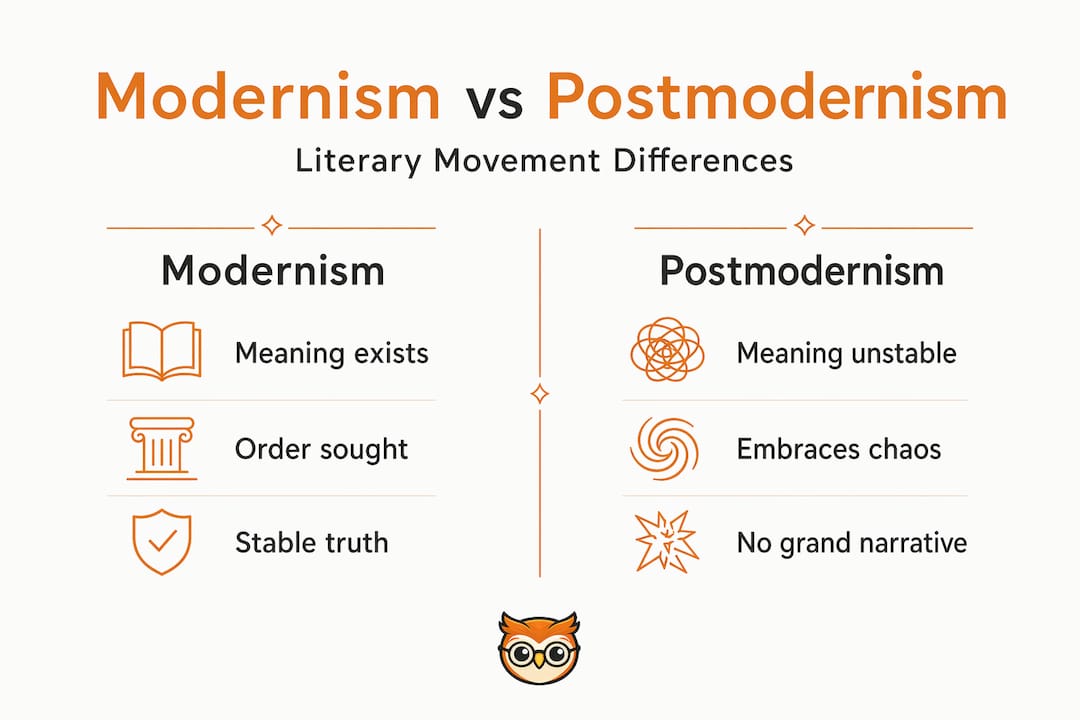
The contrasts with modernism are worth laying out clearly:
- Modernism sought order beneath chaos. It believed in the possibility of deeper meaning, psychological truth, and unified consciousness, even if that consciousness was fragmented.
- Postmodernism abandoned the search for underlying order altogether. Chaos was not a problem to be solved; it was the condition of existence.
- Modernism was serious about its experiments. Think of Virginia Woolf's stream of consciousness or James Joyce's Ulysses reaching for transcendence through form.
- Postmodernism often met seriousness with irony, parody, and play. It questioned whether transcendence was even possible or desirable.
- Modernism was still invested in the individual self and its interior life.
- Postmodernism argued the self was not a stable, fixed thing but a construction, shifting with context, culture, and discourse.
Understanding this contrast is foundational to any serious engagement with postmodern texts.
Core characteristics and techniques
Defining postmodern literature means identifying a cluster of techniques that, taken together, create its distinctive texture. No single device defines the movement, but the combination creates something unmistakable. Postmodern literature is defined by metafiction, intertextuality, pastiche, fragmentation, irony, and scepticism of grand narratives, and each of these serves a specific intellectual purpose.
Here is a breakdown of the core literary techniques in postmodernism:
- Metafiction. The text draws explicit attention to its own fictional nature. The narrator might address the reader directly, comment on the act of writing, or acknowledge that the story you are reading is a constructed artefact. John Barth's Lost in the Funhouse is a masterclass in this. The effect is to prevent passive immersion and push the reader into critical reflection.
- Intertextuality. Postmodern texts are dense with references to other texts, genres, historical events, and cultural products. They treat the entire archive of human culture as a quarry. Thomas Pynchon weaves together detective fiction, science, pop culture, and paranoid conspiracy into novels that feel like the entire twentieth century has been pressed between two covers.
- Pastiche and parody. Rather than creating something from scratch, postmodern writers recombine existing styles and forms. Pastiche blends styles without mockery; parody exaggerates for comic or critical effect. Both techniques highlight the artificiality of any single, authoritative literary style.
- Fragmentation and non-linear narrative. Postmodern fragmentation and non-linear narratives are deliberate responses to the instability of truth, not arbitrary stylistic experiments. A fractured narrative mirrors a fractured world. Kurt Vonnegut's Slaughterhouse-Five moves backwards, forwards, and sideways in time because that is precisely how trauma, memory, and the absurdity of war actually feel.
- Unreliable narrators. Postmodern texts use narrators who are confused, deceptive, or openly inconsistent. The reader cannot trust the text to deliver a reliable account of events, which raises larger questions about how we trust any account of reality.
- Irony. Postmodern irony is not just tone; it is a structural feature. It keeps the text from committing fully to any single position, allowing it to hold contradictions simultaneously.
Postmodern texts use fragmentation, self-reference, irony, and multiple perspectives to reflect cultural complexity and invite critical engagement.
Pro Tip: When analysing a postmodern text, do not try to resolve its contradictions. The contradictions are the point. Ask instead what the text reveals by refusing to settle.

One subtlety worth understanding at this stage is the difference between metafiction and metanarrative. Students frequently conflate the two, which leads to muddled analysis. Metafiction refers to textual self-reference within a specific work; metanarrative refers to the grand cultural stories that postmodernism distrusts. A novel that talks about itself is metafiction. The idea that science will save humanity is a metanarrative. The distinction sounds small, but it changes your entire interpretation.
For guidance on applying these techniques to real texts, the close reading strategies at Bibliowlteca offer a practical framework that pairs well with postmodern analysis.
Notable postmodern literary themes
The characteristics above generate a distinctive set of thematic concerns. Understanding these postmodern literary themes is where your reading of individual texts will deepen considerably.
-
Questioning history and reality. One of the most powerful postmodern themes is the challenge to accepted historical accounts. Historiographic metafiction blends history and fiction, forcing readers to question how history is constructed. E.L. Doctorow's Ragtime places fictional characters alongside historical figures like Harry Houdini and Emma Goldman without distinguishing clearly between them. The message is pointed: history is always someone's narrative, shaped by power and perspective, not an objective record.
-
Multiplicity of identity. Postmodernism rejects singular truths, favouring multiplicity, contradiction, and the collapse of fixed identities. Characters in postmodern fiction frequently resist being pinned down. They may shift in gender, nationality, or psychology. They embody contradictions that would feel unresolved in a realist novel but feel entirely authentic here. Salman Rushdie's Midnight's Children is built on exactly this principle, with identity always fluid, always contested.
-
The blurring of fiction and reality. This is not merely about blending genres. It is a philosophical provocation. If fiction and reality use the same tools (language, narrative, representation) and if those tools are inherently unstable, then the boundary between a news report and a novel is less solid than we like to think. Don DeLillo makes this explicit in White Noise, where the "most photographed barn in America" has no identity beyond its own reproduction.
-
Playfulness, irony, and contradiction as serious tools. Students sometimes mistake postmodern irony for nihilism or dismissiveness. It is neither. Playfulness in postmodern literature is a way of holding multiple truths simultaneously without pretending any one of them is final. Vladimir Nabokov's Pale Fire is simultaneously a poem, a commentary on that poem, and a study in obsession and self-delusion. The humour does not undercut the seriousness; it is the vehicle for it.
-
Critique of consumerism and mass media. The role of literature in society has always included social critique, and postmodernism takes this further by making consumer culture itself a subject. Television, advertising, brand names, and spectacle become literary material. DeLillo and Pynchon both treat consumer capitalism not as backdrop but as the very medium through which contemporary experience is filtered and distorted.
These themes connect to a broader shift in literary consciousness, one that treats chaos and complexity not as problems to be solved but as the accurate shape of contemporary experience.
Postmodernism vs modernism: key differences
Understanding how does postmodernism affect literature requires seeing how sharply it departs from what came before. The table below distils the core contrasts:
| Aspect | Modernism | Postmodernism |
|---|---|---|
| Attitude toward meaning | Meaning exists; it must be uncovered | Meaning is unstable, constructed, contested |
| Narrative structure | Experimental but ultimately coherent | Deliberately fragmented, non-linear, contradictory |
| View of the self | Complex but real; worthy of deep exploration | Fluid, constructed, and socially contingent |
| Relationship to history | History as context for individual experience | History as narrative to be deconstructed |
| Tone | Serious, often tragic | Ironic, playful, often self-mocking |
| Truth | Subjective but reachable through art | Plural, provisional, and always mediated |
The practical implication for scholars is significant. When you apply a realist or modernist interpretive framework to a postmodern text, you will keep looking for the "real" meaning beneath the surface. Postmodernism argues there is no such bedrock. The text performs its instability rather than hiding it.
This does not mean postmodern texts are meaningless. It means they generate meaning differently. Postmodern literature purposefully disrupts narrative immersion to involve readers actively in constructing meaning. You are not a passive receiver; you are a co-author of the text's significance.
Some notable writers and works to explore as you build your understanding include:
- Thomas Pynchon (Gravity's Rainbow, The Crying of Lot 49)
- Kurt Vonnegut (Slaughterhouse-Five, Breakfast of Champions)
- Don DeLillo (White Noise, Underworld)
- Salman Rushdie (Midnight's Children, The Satanic Verses)
- Angela Carter (The Bloody Chamber)
- Italo Calvino (If on a winter's night a traveller)
Pro Tip: Reading a brief critical introduction to a postmodern text before you begin it dramatically changes how you track its devices. Margaret Rose's work on parody or Linda Hutcheon on historiographic metafiction are excellent starting points.
A useful counterpoint to postmodernism is the reading habits built through classic literature. Bibliowlteca's article on classic literature and thinking explores how earlier literary traditions train the analytical instincts that postmodern texts then productively unsettle.
My perspective on studying postmodern literature
I have worked with readers and students engaging with postmodern texts for long enough to notice a consistent pattern. The initial reaction is often frustration. The text will not settle. The narrator cannot be trusted. The plot refuses to resolve. And the temptation is to conclude that the author is being deliberately obscure or self-indulgent.
That frustration, in my experience, is actually the beginning of a genuine literary education. It is the moment when you realise that your expectation of coherence was itself an assumption. Postmodern literature does not withhold clarity because the author is playing games. It withholds clarity because it is telling the truth about how reality actually functions.
What I find most underappreciated is how morally serious postmodernism is, beneath its playfulness. Historiographic metafiction, for example, is not just a clever trick. It is a sustained argument that history is written by winners, that narratives encode power, and that every reader has a responsibility to interrogate the stories they are given. That is a profoundly ethical position.
The misconception I encounter most often is the belief that postmodernism is nihilistic. Because it rejects grand narratives and universal truths, students assume it rejects meaning altogether. It does not. It influences readers to question assumptions and accept multiple, provisional interpretations. That is not nihilism. That is intellectual humility.
My genuine advice: resist the urge to master postmodern texts. You will learn more by sitting with their contradictions than by resolving them prematurely.
— BibliOWLteca
Explore further with Bibliowlteca
If this guide has sharpened your appetite for postmodern literary theory, Bibliowlteca has a growing library of resources to take your study further.

Whether you are a student working through your first Pynchon novel or a scholar building a course on contemporary literary movements, Bibliowlteca brings together educational content that matches your depth of curiosity. From theory-focused articles on why we study literature to creator-led e-books and courses on literary analysis, the platform connects you with knowledge that goes well beyond the surface. Visit Bibliowlteca to discover educational content built for serious readers and the creators who serve them.
FAQ
What is postmodernism in literature?
Postmodernism in literature is a movement that rejects fixed meanings, grand narratives, and objective truth, using techniques like metafiction, fragmentation, irony, and intertextuality to reflect the instability of language and reality.
How does postmodernism differ from modernism?
Modernism sought deeper meaning beneath chaos; postmodernism abandoned the search for any stable meaning altogether, treating all narratives as constructed and all truths as provisional.
What are the main characteristics of postmodern literature?
The defining characteristics include metafiction, intertextuality, pastiche, non-linear narrative structures, unreliable narrators, irony, and a rejection of universal or singular truths.
What are well-known examples of postmodern literature?
Key examples include Kurt Vonnegut's Slaughterhouse-Five, Thomas Pynchon's The Crying of Lot 49, Salman Rushdie's Midnight's Children, Don DeLillo's White Noise, and Italo Calvino's If on a winter's night a traveller.
What is historiographic metafiction?
Historiographic metafiction is a postmodern technique that blends historical events with fiction, deliberately questioning how history is narrated and challenging the idea that historical accounts are objective or neutral.