

Estonia charges 24% VAT on digital products sold to consumers, whether the seller is Estonian or an e-resident trading through Estonia. Sell to a VAT-registered business elsewhere in the EU, and the reverse charge shifts the liability to the buyer once you validate their VAT number. The first three moves for any seller: confirm whether each buyer is a consumer or a business, check any EU business VAT number through VIES, and register for the OSS scheme if you sell digital content to consumers across several EU countries.
TL;DR:
- Validating VAT numbers through VIES before each sale is crucial to applying the reverse charge correctly and avoiding retroactive tax liabilities.
- OSS registration is recommended once consumer sales in more than one EU country become regular, simplifying VAT obligations with quarterly digital returns.
- Keep detailed records of all VIES checks, invoices, and proof of buyer location to withstand audits and correct mistakes promptly.
- Selling to non-EU buyers or physical products outside the EU VAT scope requires understanding local obligations and may escape Estonia's VAT rules.
- Platforms that automate VAT calculation, multi-currency payments, and exportable records significantly reduce compliance errors for digital content sellers.
Table of Contents
- Quick compliance checklist for Estonian creators and digital sellers
- What counts as a digital product or service under Estonia's VAT rules
- Place of supply, VAT rates and who pays: B2C vs B2B rules for Estonia
- OSS and IOSS explained for Estonian sellers: registration and returns
- VAT registration, invoicing and recordkeeping: what Estonian sellers must keep
- Common mistakes, audits and penalties: practical fixes
- How platforms and marketplaces help with VAT work
- Author perspective: top priorities for Estonian creators
- Sell digital products through Bibliowlteca without building VAT logic from scratch
- Sources
Quick compliance checklist for Estonian creators and digital sellers
Run through this before you process each sale, and again at the end of every reporting period.
Per sale:
- Confirm the buyer's country. VAT for digital products depends on where the customer sits, not where you do.
- Confirm buyer status. Business buyers with a valid VAT number get the reverse charge; consumers pay VAT baked into the price.
- Keep proof. Store the VAT number check or, for consumers, two pieces of location evidence (billing address, IP country, card issuing country).
Registration decisions:
- Register for KMKR in Estonia if your turnover crosses the domestic threshold or you're already trading as an Estonian entity.
- Register for OSS instead of registering separately in every EU country where you have consumer sales.
Operational habits:
- Show consumers VAT-inclusive prices in their own currency where the platform allows it.
- Log every VIES check with a timestamp. This one habit prevents most of the disputes tax auditors raise later.
Pro Tip: Screenshot or export your VIES validation result the moment you check it. A VAT number can become invalid weeks later, and auditors judge you on what was true at the time of sale, not what shows up if they check today.
What counts as a digital product or service under Estonia's VAT rules
Estonian VAT law treats an "electronically supplied service" as one delivered automatically over the internet with minimal human involvement. That single test decides whether you're taxing a digital product the normal way or the special way.
Examples that clearly qualify, based on EMTA's own service taxation guidance and the Value Added Tax Act:
- E-books and downloadable PDFs delivered through an automated system
- Pre-recorded video courses, including those with automated quizzes
- Software licences, SaaS subscriptions and plugin downloads
- Stock templates, design files and audio tracks sold as instant downloads
Mixed supplies complicate things. A course bundled with a printed workbook, or a subscription that includes a physical box each quarter, splits into two supplies with potentially different VAT treatment. Live one-to-one coaching delivered over video call, where a real person is doing the teaching in real time, generally falls outside the "electronically supplied" category altogether, because it needs substantial human input to happen.
The Estonian Tax and Customs Board's guidance on taxation of services and Value Added Tax Act §§ 9, 10 and 15 are the reference points EMTA itself points sellers to when a product doesn't fit neatly into one category. When in doubt, classify conservatively and keep a note of your reasoning.
Place of supply, VAT rates and who pays: B2C vs B2B rules for Estonia
The rule of thumb is simple even when the paperwork isn't: for consumers, VAT follows the buyer's country; for businesses, VAT follows the recipient's country too, but liability usually shifts to them.
Sell an e-book to a private customer, Estonian or otherwise inside the EU, and you charge VAT at that customer's local rate. Sell the same file to an Estonian consumer directly, and that rate is the standard 24%. Sell to an EU business with a valid VAT number, and you apply the reverse charge: no VAT on your invoice, the buyer accounts for it themselves under their own domestic rules.
That reverse charge only holds up if you validate the number. Run it through VIES at the point of sale and keep the result. Skip that step, and if the number turns out to be invalid or fake, tax authorities can treat the sale as B2C retroactively, leaving you owing the VAT you never charged.
A few worked cases make the pattern concrete:
- Estonian consumer buys your course: charge 24% Estonian VAT.
- German business with a valid VAT number buys a licence: zero-rate the invoice, apply reverse charge, note the VAT number on the invoice.
- Customer in Canada buys a template pack: outside EU VAT scope entirely, though check your obligations under the buyer's own local tax rules.
OSS and IOSS explained for Estonian sellers: registration and returns
The One Stop Shop exists for exactly this problem: selling digital content to consumers scattered across the EU without registering for VAT in twenty-seven countries separately.
- Check if OSS applies to you. If you sell electronically supplied services, e-books, courses, downloads, to consumers in other EU member states, OSS is almost certainly the simpler path.
- Register through e-MTA. Estonian businesses use the Union OSS scheme via the e-MTA portal; non-EU sellers use the non-union scheme instead.
- File quarterly returns. OSS returns are digital-only and due by the last day of the month following each quarter, covering VAT collected across every EU country where you had consumer sales.
- Pay in one go. One payment through e-MTA settles VAT owed to every member state involved, rather than separate payments to separate tax offices.
EMTA itself frames the OSS special scheme as the practical alternative to multi-country VAT registration, and it's the option most Estonian creators end up using once EU consumer sales pick up.
Pro Tip: Map every sale to its destination country as you go, not at quarter end. Sellers who scale quickly often discover their bookkeeping wasn't built to sort transactions by country, and reconstructing three months of sales by destination the week before an OSS deadline is a miserable way to spend a Sunday.
VAT registration, invoicing and recordkeeping: what Estonian sellers must keep
Registering for KMKR in Estonia becomes necessary once your taxable turnover passes the domestic threshold, or the moment you start trading as an Estonian-registered entity selling taxable supplies. Non-resident sellers with no Estonian establishment generally look to OSS first rather than a full KMKR registration, since OSS covers the EU consumer side without a local registration.
Whichever route applies, your invoices need to hold up under scrutiny:
- B2C invoices: buyer's country, VAT rate applied, VAT amount shown separately from the net price.
- B2B invoices: buyer's VAT number, a note that reverse charge applies, and no VAT amount charged.
- Every reverse-charge invoice needs a record of the VIES check that justified it, stored alongside the invoice itself.
Keep these records for the statutory retention period, and store VIES results as evidence rather than trusting memory. A crosswalk report mapping each sale to its OSS line, built as you go, saves real time if EMTA ever asks questions.
Common mistakes, audits and penalties: practical fixes
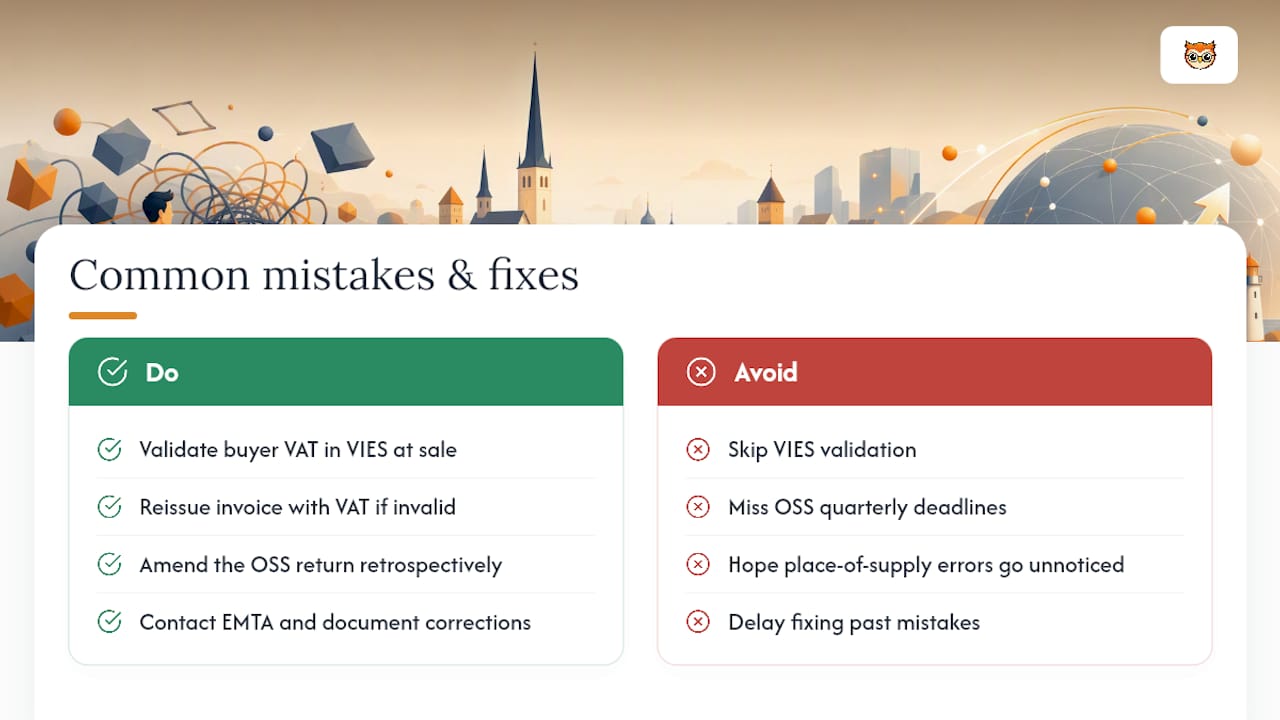
The mistake that comes up most often: sellers skip VIES validation, then discover months later that a "business" buyer's VAT number was invalid all along. The fix is retrospective correction, reissuing the invoice with VAT applied and amending the relevant OSS return, but it's far easier to validate once at the point of sale.
Missed OSS deadlines are the second recurring problem. Late quarterly payments attract interest and penalties, and repeated lateness draws closer EMTA attention. If you've misapplied place-of-supply rules on past sales, contact EMTA directly, document your correction, and fix it going forward rather than hoping it goes unnoticed.
How platforms and marketplaces help with VAT work
A platform that handles country-based VAT collection removes most of the manual sorting that trips up growing sellers. The practical features worth checking for:
- Automatic VAT calculation based on buyer country and status
- Multi-currency settlement so you're not converting figures by hand
- Exportable sales records that map cleanly to OSS reporting lines
- Secure digital delivery that satisfies the "automated supply" test for electronically supplied services
Bibliowlteca's own feature set covers global payments and digital delivery for creators selling ebooks and courses, which is worth weighing against handling VAT logic entirely in-house once your EU consumer sales start multiplying.
Author perspective: top priorities for Estonian creators
If you sell one product to a handful of local buyers, VAT compliance is straightforward. The moment you sell across the EU, priorities shift fast. Validate every business VAT number before trusting a reverse charge. Register for OSS the moment consumer sales in more than one or two EU countries become a regular pattern, not after you've missed a filing.
The habit that saves the most trouble isn't clever tax planning. It's boring, consistent evidence storage: every VIES check, every invoice, mapped to its country from day one.
— BibliOWLteca
Sell digital products through Bibliowlteca without building VAT logic from scratch
Handling VAT correctly across dozens of EU countries by hand is where most solo creators lose an afternoon a month, and where the mistakes above tend to creep in. Some platforms are built for creators who prefer focusing on content creation by handling multi-currency checkout, secure digital delivery and exportable sales records suitable for country-by-country OSS reporting demands.
Whether you're selling e-books, full courses, or template packs, the underlying VAT mechanics stay the same, and having delivery, payments, and record export in one place means less reconciling spreadsheets at quarter end. Creators selling ebooks and downloads can start with the ebook product page, while anyone building a broader course or mentorship business should look at the full Bibliowlteca features overview to see what fits their catalogue. Set up your store, connect your payment settings, and let the platform's records do the heavy lifting when your next OSS return is due.
Sources
- E‑commerce and services special schemes | Estonian Tax and Customs Board
- Estonia VAT rules - One Stop Shop - European Commission
- Taxation of services | Estonian Tax and Customs Board
- A guide to VAT for e‑residents